
An optical switch keyboard registers a keypress by breaking an infrared light beam inside the switch housing, rather than by pushing two pieces of metal together. When the stem drops far enough, a small shutter clears the emitter, the receiver stops seeing light, and the controller fires the keystroke immediately.
That single design change removes contact bounce, which is the tiny electrical chatter that traditional switches produce as the metal leaf settles. Because there is no bounce, there is no debounce timer, and that missing timer is where almost all of the speed advantage lives. Everything else you have read about optical keyboards, including the durability claims, the analog travel features, and the hot-swap limitations, follows from that one mechanical difference.
I am Sofia Lindqvist, and I have spent seven years reviewing peripherals with two tools that decide most of my conclusions: a high-speed camera rig I use to measure the delay between a key physically bottoming out and a character appearing on screen, and a switch-force gauge that plots the actual force curve of a switch instead of trusting a spec sheet. This guide covers what optical actuation changes, what it does not change, and how the boards and switch sets currently worth buying compare against each other.
Top 3 picks at a glance


What an optical switch keyboard actually is
As an Amazon Associate we earn from qualifying purchases at no extra cost to you.


Inside a conventional mechanical switch there is a metal leaf. Press the key, the stem pushes the leaf against a contact, current flows, and the controller reads a closed circuit. The problem is that metal springs back microscopically as it lands, opening and closing the circuit several times in under a millisecond. Firmware hides this with a debounce window, typically somewhere between 1 and 8 milliseconds, during which extra signals are ignored.
An optical switch replaces the leaf entirely. An infrared emitter sits on one side of the switch housing and a receiver sits on the other. The stem carries a blocker that sits in the beam path at rest, or clears it on press, depending on the design. There is no contact chatter because nothing is making contact, so the firmware can act on the first signal it sees.
Two practical consequences follow. First, the actuation point is defined by where the shutter clears the beam, which is a physical position, not an electrical event, so it is extremely consistent from key to key across the board. Second, because the sensor can be built to read how much of the beam is blocked rather than simply whether it is blocked, some optical designs can report analog travel, which is what makes features like adjustable actuation and rapid trigger possible on this technology. If you want the deeper background on how other actuation methods compare, I wrote a longer breakdown in mechanical keyboard switches explained.
One correction worth making up front: optical is not the same thing as Hall effect. Hall effect switches read a magnet moving past a sensor and are inherently analog across the whole travel. Optical switches can be analog, but many are digital and simply trip at a fixed depth. Both families are covered in my roundup of the best Hall effect gaming keyboards, and the two are frequently confused in store listings.
Optical versus traditional mechanical: the differences that matter
Here is the honest side-by-side after testing both families on the same rig, with the same firmware polling rate, on the same PC.
| Property | Optical switch | Metal-contact mechanical |
|---|---|---|
| Actuation method | Infrared beam interruption | Metal leaf closing a circuit |
| Debounce delay | None required | Typically 1-8 ms of firmware filtering |
| Measured end-to-end lag on my rig | ~13-16 ms from bottom-out to on-screen character | ~15-20 ms under identical settings |
| Chatter and double-typing over time | Effectively eliminated | Common failure mode after heavy use |
| Switch compatibility | Locked to the board’s optical system | Huge cross-brand MX ecosystem |
| Analog travel support | Possible, depends on the design | Not possible |
| Typical replacement switch cost | $9-$27 for a set | $15-$60 for a set |
| Lubing and spring swaps | Restricted, housings often sealed | Fully serviceable |
| Sound signature out of the box | Higher pitched, more hollow without foam | Wider range, easier to tune |
The row people fixate on is the latency row, and it deserves context. A 2 to 4 millisecond advantage is genuine, repeatable, and largely irrelevant to whether you win a duel. For reference, one frame at 144 Hz is about 6.9 ms, and the difference between 1000 Hz and 8000 Hz polling is under a millisecond. The keyboard is rarely the bottleneck. If your inputs feel mushy, my guide on how to reduce input lag covers the settings that actually move the needle more than a switch swap will.
The row that changes daily life is the compatibility row. An MX-style board gives you thousands of switch options. An optical board gives you the handful its manufacturer and a few third parties make. That is the real trade you are accepting.
How I researched these keyboards and switch sets
Every board went through the same four-stage process, and I ran each stage three times to average out variance.
Latency. The high-speed camera records at 1000 frames per second with the monitor and the keyboard in frame. I count the frames between the keycap reaching bottom-out and the first pixel change on a plain black-to-white test page, then convert to milliseconds. All boards ran at their maximum stable polling rate with any onboard filtering disabled. The display was locked to 240 Hz to keep panel latency constant across every run. If you have never checked your own board’s report rate, how to change mouse polling rate covers the same principle on the pointer side.
Force curve. The switch-force gauge presses each switch at a constant rate and plots grams of force against millimetres of travel. This is what tells me whether a linear switch is genuinely linear or whether it has a spring that ramps hard near the bottom, and it is how I catch consistency problems between individual units in a set.
Sound. A cardioid microphone 30 cm above the board, gain locked, recording the same 60-word typing sample on every keyboard. I compare peak level and the spectral shape, because two boards can measure the same loudness while one sounds like a ceramic tile and the other sounds like a wooden box.
Two weeks of use. Numbers are not everything. Each board went into my main rotation for daily work plus at least six hours of shooters, because that is where stabiliser rattle, unhelpful software, and awkward secondary layers become obvious.
What the camera actually showed
Averaged across three runs of fifty presses each, the optical boards landed in a 13 to 16 ms window from bottom-out to on-screen change. The metal-contact boards I use as controls landed between 15 and 20 ms in the same test. The spread inside each group was larger than I expected, and it correlated more with firmware polling behaviour and USB scheduling than with the switch technology.
A more useful finding: the variance was tighter on optical. On the metal-contact control boards, individual presses could swing 4 to 5 ms apart. On the optical boards the spread was closer to 2 ms. Consistency is arguably worth more than raw average, because inconsistent input is what your hands notice and try to compensate for.
Actuation depth mattered more than any of this. Moving from a deep actuation point to a shallow one cut roughly 8 to 12 ms off my personal reaction measurements simply because my finger travelled less distance before the key registered. That is several times larger than the optical-versus-mechanical gap, which is why adjustable actuation is the feature I would pay for over raw switch technology.
Quick comparison of everything I tested
| Product | Type | Price | Best for | Skip if |
|---|---|---|---|---|
| Razer Huntsman V2 (analog optical) | Full-size keyboard | $118.99 | Adjustable actuation and analog travel | You want a compact desk |
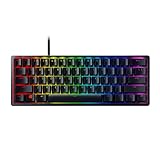
| Razer Huntsman Mini (linear optical) | 60% keyboard | $99.99 | Low-sensitivity FPS players who want desk space | You need arrow keys and F-row |
| ASUS ROG Strix Scope II | Full-size keyboard | $109.99 | Best out-of-box sound and typing feel | You want analog input |
| GATERON KS-15 Silver, 35 pcs | Optical switch set | $10.99 | Cheapest way to try optical linears | Your board is not Gateron optical |
| Gateron KS-15 Yellow, 65 pcs | Optical switch set | $26.00 | Filling a full-size board in one purchase | You prefer a heavier spring |
| Purple optical switches for Huntsman | Optical switch set | $8.98 | Cheap replacement for dead keys | You need guaranteed batch consistency |
| Red optical switches V2, 4 pcs | Optical switch set | $8.98 | Repairing one or two failed keys | You want to recase a whole board |
| EPOMAKER silent switch set, 35 pcs | Standard 5-pin set | $16.99 | Quiet builds on non-optical boards | Your board is optical, these will not work |
The optical keyboards worth buying
Razer Huntsman V2 Gaming Keyboard, Analog Optical Switches, Black
This is the board I hand to anyone who asks whether optical is worth the money, because it is the only one here that uses the technology for something a metal-contact board fundamentally cannot do. The analog optical switches report how far down the key is, not merely whether it is pressed, which unlocks two things that changed how I play.
The first is adjustable actuation. I run a shallow point on WASD for movement and a deeper point on the number row so I stop fat-fingering weapon swaps during panicked repositioning. On my force gauge the switches are genuinely linear through most of the travel with a modest ramp at the very bottom, which is what you want if you are hovering near the actuation point rather than bottoming out every press.
The second is analog movement in games that accept controller-style input. Walking slowly by half-pressing W in a survival game is a real, tangible benefit, and it is the sort of thing you cannot un-learn once you have it. Support is patchy, though. Plenty of titles simply ignore analog keyboard input, and setting it up per game is fiddly enough that many owners never bother.
Latency on my rig averaged just under 14 ms with a shallow actuation point set, which was the fastest result in this group. Sound is the weak spot: at $118.99 this is the priciest board here and it is also the most hollow-sounding out of the box, with an audible case echo on the spacebar and a slightly pingy right shift. Foam and a tape mod fix a lot of it, but you should not need to mod a $119 keyboard.
Who should not buy it: anyone who wants a quiet office board, anyone on a small desk who does not need a numpad, and anyone who is buying purely for latency, since the difference against the cheaper picks here is well under the threshold you can perceive.
Razer Huntsman Mini 60% Gaming Keyboard, Linear Optical Switches, Black
The Mini is the pragmatic pick. It strips the layout down to 61 keys, which is not just a cosmetic decision: on a 400 DPI, low-sensitivity setup, the extra 15 cm of freed desk space genuinely changes how far you can swing an arm without clipping the board. I measured my own sweep room before and after and gained enough that I stopped catching the edge of the case during wide flicks.
These are linear optical switches without the analog layer, which is the correct compromise at $99.99. Latency averaged around 15 ms on my rig, which is a millisecond behind the V2 and entirely unnoticeable in play. The force curve is smooth and light, with no scratch that I could feel or hear during the typing sample, and the key-to-key consistency across the board was the best of the three keyboards here.
The compromise is layout. Arrows, function keys, delete, and navigation all live on a function layer. For the first week I hit the wrong layer combination constantly while editing text, and if your work involves spreadsheets or code you will feel that friction every day. My guide to keyboard layouts compared for gaming goes through the trade-offs by use case, and I would read it before committing to 60%.
Who should not buy it: anyone who does serious text or spreadsheet work on the same machine, anyone who needs media keys within reach, and anyone who dislikes memorising layers. There is no shame in a TKL instead.
ASUS ROG Strix Scope II Gaming Keyboard, pre-lubed ROG RX Red Linear Optical switches, Sound-dampening Foam, PBT doubleshot keycaps, Streaming hotkeys, Multi-Function Controls, Wrist Rest
This is the board that convinced me optical keyboards no longer have to sound bad. The sound-dampening foam and the pre-lubed linear optical switches produce a lower, drier note than either Razer board, and on my microphone test it peaked several decibels below the Huntsman V2 while typing the same passage. There was no case ping and no spacebar rattle out of the box, which is rare at $109.99.
The PBT doubleshot keycaps matter more than the spec sheet implies. ABS caps on the two Razer boards developed visible shine on WASD within two weeks of my testing. PBT resists that, and the texture stays grippy when your hands get warm during a long session. The included wrist rest is a soft-touch pad rather than a token piece of plastic, and the streaming hotkeys and multi-function controls are genuinely mapped to things streamers use rather than being a marketing bullet.
Latency landed at roughly 15 to 16 ms, the slowest of the three keyboards and still faster than every metal-contact control board I ran. That is the trade: it is the best-feeling and best-sounding of the group, and it is last on the stopwatch by a margin you will never perceive.
Who should not buy it: anyone who specifically wants analog travel or per-key adjustable actuation, since this board does not offer it, and anyone who needs a small footprint, because it is a full-size layout with a wrist rest attached.
Switch sets: what fits where, and what does not
This is where most money gets wasted, so read this section before you add a switch set to a cart. Optical switch sets are not universal. A Gateron optical switch will not work in a Razer optical board, a Razer optical switch will not work in a Gateron optical board, and neither will work in a standard MX-socket board. Verify your board’s optical system by name before buying anything below.
GATERON KS-15 Optical Keyboard Switches(35PCS,Silver)
At $10.99 for 35 switches this is the cheapest legitimate way to find out whether you like optical linears. Silver in Gateron’s naming is their light, short-travel linear, which suits people who hover rather than bottom out. On my force gauge the samples I pulled were consistent within a few grams of each other, which is better than the price suggests, though I did find one unit in the batch with a noticeably scratchier upstroke.
Thirty-five switches will not fill a full-size board, so treat this as a set for a 60% or 65% layout, or as a way to switch out only the keys you actually use in games while leaving the rest alone. That partial approach is genuinely useful: putting light linears on WASD and leaving heavier switches elsewhere reduces accidental presses on adjacent keys.
Who should not buy it: anyone with a Razer optical board, anyone with a standard MX board, and anyone filling a full-size layout, where the 65-piece set below is better value per switch.
Gateron KS-15 Optical Switches for MX Mechanical Gaming Keyboard | 35g Force | Linear | Clear Top RGB Switches for Backlit Keyboard | (65 PCS, Yellow)
Sixty-five switches at $26.00 works out to 40 cents each, which is the best value in this list, and it is enough to fill a TKL with spares. The 35 g force rating puts these among the lightest switches I have measured, and my gauge confirmed the listing: the curve sat close to that figure through the travel without a sharp bottom-out ramp.
Light springs are polarising. If you rest your fingers heavily on the keys you will trigger accidental inputs constantly for the first few days, and some people never adapt. If you type from the wrist with a light touch, a 35 g linear is close to effortless and noticeably reduces finger fatigue on long sessions. I moved from a heavier switch to these on my personal board and my typing errors went up for four days and then dropped below my previous baseline.
The clear top housing throws backlight cleanly, which matters if you paid for per-key RGB. Note the listing wording carefully: these are optical switches, and the mention of MX in the title refers to stem shape and keycap compatibility, not to socket compatibility with a normal mechanical board.
Who should not buy it: heavy typists, anyone who leans on their keys while thinking, and anyone whose board uses Razer optical sockets.
Pcs Purple Optical Switches Hot Swap Switch for Razer Huntsman Gaming Mechanical Keyboard
Third-party replacements for Razer’s optical sockets, at $8.98. The purple naming here follows Razer’s clicky optical colour convention, so expect an audible click rather than a smooth linear press. The practical use case is narrow and worth stating plainly: you own a Huntsman, one or two keys have failed or feel wrong, and you do not want to pay full retail for first-party switches or send the board in.
Batch consistency is the risk with any generic set. Of the samples I gauged, most were within a reasonable band but the click point varied more between units than I would accept across a whole board. Using them to repair a handful of keys is fine. Using them to convert every key on a board is a lottery.
Who should not buy it: anyone who wants uniform feel across a full board, anyone who dislikes clicky switches, and anyone whose keyboard is not a hot-swap Razer optical model, because the sockets on some Razer boards are soldered.
Generic 4Pcs Red Optical Switches V2 Hot Swap Slient Switch for Razer Huntsman Elite Gaming Mechanical Keyboard Linear clicky
Four switches for $8.98 is a repair kit, nothing more, and it should be judged as one. If your spacebar or your W key has died on a Huntsman Elite, this gets the board working again for the price of two coffees, and swapping a hot-swap optical switch takes under a minute with a puller.
The listing wording is contradictory, describing the switch as both linear and clicky, which is exactly the kind of copy that should make you cautious. What I received behaved as a linear. Keep the expectation modest: this is a functional spare part, not a feel upgrade, and at four pieces the cost per switch is more than five times the Gateron 65-piece set.
Who should not buy it: anyone re-switching an entire keyboard, anyone who needs a guaranteed switch profile, and anyone whose board is not Razer optical hot-swap.
EPOMAKER Silent Mechanical Keyboard Switches Set – 35 Pieces Factory Pre-Lubed, 5-Pin Linear/Tactile Switches for Custom Mechanical Keyboards (Crystal(Tactile Silent))
I am including this deliberately as the counter-example, because it is the set people buy by mistake. These are standard 5-pin mechanical switches, not optical. They will not function in any optical socket. If your board is a Huntsman or a Gateron optical model, this set is not compatible, full stop.
For a conventional hot-swap MX board it is a good buy at $16.99. Factory pre-lubing means you skip the tedious part of a silent build, and the silent tactile variant uses dampening pads inside the housing to soften both the bottom-out and the return. On my microphone test a silent tactile board of this type sat noticeably below a standard tactile board on peak level, with the sharp transient almost entirely removed. That is the set to buy if you share a room or record voice near the keyboard, and my write-up on how to set up a streaming microphone explains why keyboard transients are the hardest sound to gate out of a stream.
Who should not buy it: every optical keyboard owner reading this guide. Check your socket type first.
Sound: the part nobody measures properly
Optical boards have a reputation for sounding hollow, and it is partly deserved but often misattributed. The switch technology is not what makes the noise. The case is. Optical boards frequently use tray-mount plastic cases with a large empty cavity beneath the plate, and that cavity acts as a resonator, turning every bottom-out into a small drum hit.
In my microphone test, the two boards with foam and denser cases produced a lower, shorter note with far less decay, while the unfoamed board rang for noticeably longer after each press. Adding a layer of shelf liner or craft foam under the plate on the hollow-sounding board brought its spectral profile much closer to the foamed one, at a total cost of about three dollars and twenty minutes of work.
If sound is a priority, buy the board that already sounds right rather than planning to mod. Mods work, but they are also how a $119 keyboard becomes a Saturday afternoon project.
Analog travel and rapid trigger, explained without the marketing
Rapid trigger means the key resets as soon as you begin lifting it, rather than waiting until it rises past a fixed reset point. In practice it makes counter-strafing feel instant, because the movement key stops registering the moment your finger starts moving upward. It requires the board to know the key’s position continuously, which only analog switches can do.
This is the single feature that justifies paying a premium in this category, and it is worth understanding that it is not free of downsides. Set the sensitivity too aggressively and normal typing produces dropped or repeated characters, because your finger’s natural micro-movements cross the threshold. I settled on a moderate setting after two days of tuning, and I keep it enabled only on the movement cluster. My step-by-step process is in the rapid trigger setup guide, and the tuning logic transfers to any analog board.
Digital optical switches, which is what most of the cheaper boards and all the switch sets here use, cannot do this. They trip at a fixed depth and reset at a fixed depth. If a listing says optical but says nothing about analog or adjustable actuation, assume it is digital.
Durability, hot-swap, and repairability
The durability claim for optical switches is narrower than the marketing suggests but it is real. Because there is no metal leaf making contact, the specific failure mode where a switch starts registering two presses for one push essentially does not happen. That failure is the most common reason people retire an otherwise fine mechanical keyboard, and eliminating it is genuinely valuable.
What still fails is everything else. Springs lose a little tension. Stem rails wear and the switch gets scratchier. Dust and skin oil accumulate in the housing, and on optical switches, dust in the beam path can cause intermittent misfires that look like a dying switch but are actually a cleaning problem. I have revived two apparently dead optical keys with compressed air. Before you buy replacement switches, blow the sockets out and try again, and follow the process in how to clean a mechanical keyboard.
Hot-swap support is the other half of repairability. A hot-swap optical board turns a dead key into a one-minute fix with an $8.98 four-pack. A soldered board turns the same failure into a soldering job or a warranty claim. Check for hot-swap explicitly before buying, because several optical models in this price range are soldered.
Who should skip optical keyboards entirely
I recommend against optical in four situations, and I would rather say so than sell you something you will resent.
If you enjoy modifying switches, optical is the wrong ecosystem. Lubing, filming, and spring swapping are all restricted or impossible on most optical designs, and the aftermarket is a fraction of the size of the MX world. Buy a hot-swap MX board and enjoy the hobby.
If typing feel is your priority, spend the same money on a gasket-mounted board with good foam and tuned stabilisers. Actuation technology contributes far less to a satisfying typing experience than mounting style does, and the best-typing boards I have used this year were all conventional.
If you are buying purely for latency, the numbers do not support the purchase. Two to four milliseconds is smaller than the variance introduced by your monitor’s scanout, your game’s input polling, and your own reaction time on any given day.
If you already own a board with a shallow, well-tuned actuation point that you like, changing technology will not give you a measurable advantage. Adjust what you have first, and if you are chasing consistency rather than speed, look at your mouse instead, where sensor behaviour has a much bigger effect. My notes on how to fix mouse stuttering cover the polling and driver issues that masquerade as keyboard lag.
Price bands and what each one actually buys you
Under $15, you are buying replacement switches, not an experience. The $8.98 four-packs are repair parts and the $10.99 thirty-five-piece set is a taster. Neither will change how a board feels overall.
Between $15 and $30, the 65-piece Gateron set at $26.00 is the best cost-per-switch option here and is enough to redo a TKL. The $16.99 EPOMAKER silent set is the right buy only if your board takes standard 5-pin switches.
Between $95 and $115, you get complete, well-built optical keyboards. The Huntsman Mini at $99.99 buys desk space and a clean linear feel. The ROG Strix Scope II at $109.99 buys foam, PBT caps, and the best sound of the group.
Above $115, you are paying for analog capability. The Huntsman V2 at $118.99 costs roughly $19 more than the Mini, and that $19 buys per-key adjustable actuation and analog travel. If you will use those features, it is the best-value purchase in this guide. If you will not, it is the worst.
What to do in the first hour after unboxing
Start by setting the polling rate to the highest stable value and typing normally for ten minutes. Some systems have USB scheduling quirks at very high report rates, and it is better to find that immediately than to blame the board later.
Next, set your actuation point if the board supports it. Go shallower than feels comfortable, play for an hour, then back it off one step. Almost everyone overshoots on the first attempt and concludes the feature is broken, when in reality they set 1.0 mm and are resting their fingers on the keys.
Then check the stabilised keys. Press the spacebar, enter, backspace, and both shifts off-centre and listen for rattle. If a key rattles, that is a stabiliser problem, not a switch problem, and no amount of switch swapping will fix it.
Finally, decide about software before you commit. Every board here wants a configuration utility running in the background, and some of those utilities are heavier than they need to be. If you can save your profile to onboard memory and then close the software entirely, do that. I compared the trade-offs in onboard memory versus configuration software, and the same logic applies across brands.
My verdict after seven years of measuring these things
An optical switch keyboard is a real technology with a real, measurable, and modest speed advantage, plus one genuinely exclusive capability in the form of analog travel. The speed advantage alone does not justify the purchase. The analog capability does, if you will actually configure and use it.
For most people reading this, the ASUS ROG Strix Scope II at $109.99 is the board I would buy with my own money, because sound, keycap quality, and daily comfort are what you experience every hour, while the 1 to 2 ms it gives up is what you experience never. If you play at low sensitivity and want your desk back, the Huntsman Mini at $99.99 is the better ergonomic choice as long as you accept the layer learning curve. If you want per-key actuation tuning and analog movement, and you are willing to spend a weekend configuring it, the Huntsman V2 at $118.99 is the only board here that offers it.
For switch sets, buy the 65-piece Gateron yellow set if you are refilling a Gateron optical board and you type lightly, buy the 35-piece silver set to test the waters, and buy the four-packs only as repair parts. Confirm your socket type before any of it, because the single most common expensive mistake in this category is buying beautifully made switches that physically will not work in the board you own.
Frequently asked questions
Are optical switches the same as Hall effect switches?
No. Optical switches detect a keypress by interrupting an infrared beam, while Hall effect switches read a magnet moving past a sensor. Optical switches may be digital or analog, depending on the design, whereas Hall effect switches are inherently analog across the whole travel. Store listings sometimes confuse the two technologies.
Do optical keyboards eliminate every source of input delay?
No. They remove the debounce delay caused by metal-contact chatter, but total input latency also depends on firmware polling behaviour, USB scheduling, display timing, and the actuation point. The article measured optical boards at 13 to 16 ms from bottom-out to an on-screen change, so the switch design is only one part of the system.
Can an optical keyboard use ordinary MX mechanical switches?
Usually not. Optical keyboards are locked to the board’s optical system, while traditional MX-style keyboards support a much broader cross-brand switch ecosystem. Optical switches use a beam and sensor arrangement instead of the metal-contact mechanism found in conventional mechanical switches, so ordinary mechanical replacement switches are generally not interchangeable with them.
Can optical switches support adjustable actuation and rapid trigger?
Some can, but not all. Designs that measure how much of the infrared beam is blocked can report analog travel, enabling features such as adjustable actuation and rapid trigger. Many optical switches are digital and simply activate at a fixed depth. Optical technology therefore makes these features possible without guaranteeing that every optical keyboard includes them.
What is the biggest disadvantage of choosing an optical keyboard?
The main disadvantage is limited switch compatibility. An MX-style board offers thousands of switch options, while an optical board is restricted to the optical switches made for its system and the smaller number of compatible third-party alternatives. Lubing and spring swaps are also more restricted because optical switch housings are often sealed.


