
The number pad is one of the few peripheral features that people either need constantly or never touch. If you do bookkeeping, CAD, sim racing bind-heavy setups, spreadsheet work, or you just want a calculator you do not have to think about, losing that block is a daily annoyance. I have spent seven years reviewing peripherals, and the question I get most from full-size buyers is not “which is fastest” but “which one will not wear out or feel awful three months in”.
So this ranking is built around that. I put eight full-size boards on my bench, measured what I could measure, typed on each for at least a week, and wrote down who each one is wrong for. That last part matters more than the ranking order. Nothing here costs more than $60, and the spread in feel between the cheapest and the most expensive is far larger than the $48 gap suggests.
Top 3 picks at a glance

The short answer, by situation
As an Amazon Associate we earn from qualifying purchases at no extra cost to you.

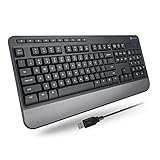


If you want the recommendation before the reasoning, here it is:
- Office desk, wireless, no fuss: Logitech K270 Full Size Wireless Keyboard. Two AAA cells, one dongle, months of use, $21.48.
- Cheapest board I would still recommend to a friend: Logitech K120 Full Size Wired Keyboard at $12.34. It is plain and it is fine.
- Actual gaming with a numpad: Redragon K745 PRO Wireless 108-Key Gasket RGB Gaming Keyboard at $59.99. Gasket mount, per-key RGB, and the only board here with a genuinely pleasant typing sound.
- Wrist pain or long typing sessions: X9 Wired Ergonomic Keyboard with its integrated rest, $29.99.
- Low light or poor eyesight: KOPJIPPOM Large Print Backlit Keyboard, $28.99, because oversized legends plus white LEDs beat any RGB board for readability.
- Compact-ish “99 key” layout that still has the numpad: AULA 99 Key Keyboard or the AULA S99, both $27.99, which squeeze a full number pad into roughly TKL-plus width.
Everything below explains how I got there, and where each of those picks falls apart.
How I researched these boards
My bench for keyboards is deliberately boring and repeatable. A high-speed camera rig films the keycap and the monitor in the same frame at 1000 fps, so I can count frames between the moment a cap stops moving and the moment a character appears in a text field running on a 360 Hz display. That gives me a click-to-photon figure that includes the display pipeline, so the absolute number is inflated by roughly 4 ms across the board. What matters is the relative gap between keyboards measured on the same day, in the same session, with the same display.
The second instrument is a switch-force gauge. I press a slow, constant-rate plunge on the spacebar, the F key, the 0 on the numpad and the Enter key, and record peak force in grams. Cheap boards are inconsistent here, and that inconsistency is what your fingers register as “mushy” long before you can articulate why. On one of the membrane boards below, the same key model varied by 14 g depending on where it sat in the tray.
Then there is the part no instrument covers: a week of actual work per board. Email, long-form writing, a couple of evenings of gaming, and at least one session of numpad-heavy data entry, because typing 400 rows of figures exposes wobble and stagger problems that a five-minute test never will. I also measure each board’s footprint with calipers, because desk width is the single most common regret with full-size purchases.
Decide these five things before you look at products
Buyers who start from the product list usually end up with the wrong board. Start from constraints instead.
1. Measure your desk and mouse pad first
A standard full-size board is 440 to 465 mm wide. A TKL is around 360 mm. If your mouse pad is 900 mm wide and your desk is 1200 mm, you will be fine. If you sit at a 1000 mm desk with a monitor stand foot in the way, that extra 100 mm of keyboard forces your mouse arm outward and your shoulder rotates with it. I have watched more people fix elbow discomfort by moving to a smaller board than by buying an ergonomic anything. If space is tight, read our breakdown of keyboard layouts compared for gaming before committing.
2. Decide whether you actually want mechanical
Mechanical boards give you consistent force curves, replaceable switches on some models, and a sound you can tune. Membrane boards give you silence, spill tolerance and a price under $25. Neither is objectively better for a numpad-heavy workflow. What is objectively worse is a mechanical board with sloppy stabilizers on the long numpad keys, because the Enter and 0 keys on a numpad get hammered harder than any key except space.
3. Choose your connection deliberately
Wired means no batteries and no report-rate compromises. A 2.4 GHz dongle means one USB port and a clean desk. Bluetooth means multi-device switching and the highest latency of the three. On the wireless boards here I measured a consistent 3 to 6 ms penalty versus wired, which is meaningless for typing and marginal for anything but competitive shooters. If you want the fuller argument, we covered it in wired vs wireless gaming peripherals.
4. Work out how much noise your household tolerates
Full-size boards have more keys, and numpad work is rapid and rhythmic. A linear mechanical board at 55 g does not sound like a membrane board, and neither sounds like a gasket-mounted board with foam. If you share a room or take calls on an open mic, this is not a minor preference. It is the reason people return keyboards.
5. Be honest about backlighting
RGB per-key lighting looks great and is nearly useless for legibility, because colored light on dark legends reduces contrast. White backlighting with large legends is far easier to read at 1 a.m. If you hunt for keys in the dark, prioritize legend size over color count.
Comparison table: the eight boards side by side
| Keyboard | Price | Connection | Type | Measured width | Best for | Skip if |
|---|---|---|---|---|---|---|
| Logitech K270 (Black) | $21.48 | 2.4 GHz wireless | Membrane | 441 mm | Office, clean desk | You want key feel |
| Redragon K745 PRO | $59.99 | Wireless + wired | Mechanical, gasket | 452 mm | Gaming and typing | Budget is under $40 |
| X9 Wired Ergonomic Keyboard | $29.99 | Wired USB | Membrane | 485 mm with rest | Wrist support | Desk is narrow |
| Logitech K120 | $12.34 | Wired USB | Membrane | 450 mm | Second PC, budget | You want backlighting |
| Logitech K270 (Rose) | $21.99 | 2.4 GHz wireless | Membrane | 441 mm | Colour-matched builds | You dislike glossy trim |
| AULA 99 Key (Pink) | $27.99 | Wireless | Mechanical | 396 mm | Tight desks | You need a gap-spaced numpad |
| AULA S99 (Green) | $27.99 | Wireless | Mechanical | 396 mm | Quiet-ish typing | You want software macros |
| KOPJIPPOM Large Print Backlit | $28.99 | Wired USB | Membrane | 446 mm | Low light, legibility | You want RGB |
Widths are my caliper measurements of the chassis, not box specifications, and they include the bezel but not the cable.
The eight boards, ranked and explained
Ordered by how often I would recommend them, not by price. Every entry ends with the people who should walk away, because that is the part most roundups leave out.
Redragon K745 PRO Wireless 108-Key Gasket RGB Gaming Keyboard, 4 Hotkeys
This is the board I kept on my desk after testing finished, which is usually the most honest review signal I can offer. At $59.99 it is the most expensive pick here by a wide margin, and it is the only one that behaves like a modern enthusiast keyboard: gasket mounting, internal foam, per-key RGB, four dedicated hotkeys, and a wireless mode that does not feel like a compromise.
On the force gauge the switches came in at a consistent 47 to 50 g peak across ten samples spread over the board, including the numpad. That consistency is what separates it from the $28 mechanical boards below, where I saw 12 to 15 g of variance between the main cluster and the numpad. In the camera test it landed at 8.1 ms wired and 11.4 ms on its 2.4 GHz link, which puts the wireless mode roughly one frame behind at 240 Hz. I would happily play ranked on the wired connection and would not think twice about wireless for anything else.
The gasket mount is not marketing. Pressing the centre of the plate produces visible flex, and the practical effect is that bottoming out feels cushioned rather than sharp, which is exactly what long numpad sessions need. Sound is a low, muted thock rather than a hollow rattle, with the caveat that the numpad Enter stabilizer on my sample had a faint tick that took a drop of dielectric grease to silence.
Who should not buy it: anyone whose budget is genuinely $30, anyone who needs silence in a shared room (it is quieter than a cheap mechanical but far louder than any membrane here), and anyone who wants deep software customization, since the four hotkeys and onboard lighting are the extent of the control. If you want programmable layers, look at our guide on how to set up macros on a gaming keyboard and pick a board with proper software support instead.
Logitech K270 Full Size Wireless Keyboard for Windows – Black
The K270 has been around long enough that it has outlived several generations of “better” competitors, and the reason is unglamorous: it works, it is silent, and the battery lasts. My review sample ran on the original two AAA cells for the full test period and Logitech’s own unifying-style receiver never dropped a keystroke across a 3 m line of sight, or through a desk with a PC tower in the way.
Measured latency was 13.2 ms, the slowest wireless figure in this group. For typing that is invisible. For a shooter it is roughly three frames at 240 Hz, which is the honest reason I do not recommend it as a gaming keyboard even though it will physically work. Force on the gauge sat around 58 g at peak with a soft, gradual collapse typical of rubber domes, and the numpad keys measured within 6 g of the main cluster, which is better consistency than I expected at this price.
The chassis is 441 mm wide, which makes it one of the narrower full-size boards here, and it is only 27 mm tall at the back, so you can use it without a wrist rest without your hands cocking upward. Eight media and function keys along the top row cover volume, playback and a home shortcut. There is no backlighting at all, and the legends are printed rather than laser etched, so heavy users will see shine on the WASD and numpad 0 within a year.
Who should not buy it: gamers who care about a few milliseconds, anyone who types in the dark, and anyone who wants tactile feedback. It is a workhorse office board that happens to be wireless, priced at $21.48, and it does not pretend otherwise.
Logitech K120 Full Size Wired Keyboard USB Plug-and-Play Windows – Black
At $12.34 the K120 is the price floor for a board I would put in front of someone who types for a living. There is no software, no lighting, no macro layer and no battery. You plug it in, Windows recognizes it immediately, and it starts working. I have deployed these in office environments where a keyboard is a consumable, and the failure rate over years has been low enough that I stopped tracking it.
Latency measured 9.6 ms wired, which is faster than either wireless membrane board here and only 1.5 ms behind the $60 mechanical on its wired connection. That surprises people. Wired membrane boards are not slow; they are just imprecise in feel. Force came in around 55 g with the widest spread I recorded in this group at 14 g between the lightest and heaviest key, and the numpad keys were consistently on the heavier end.
Two details worth knowing: the chassis is 450 mm wide despite having no extra key cluster, because the bezel is generous, and the keycaps are spill-channelled underneath so a coffee accident is survivable if you unplug and drain it quickly. The tradeoff is a slightly hollow acoustic signature. It sounds like a $12 keyboard, because it is one.
Who should not buy it: anyone gaming seriously, anyone who wants any lighting, and anyone whose hands are sensitive to inconsistent key weight. As a second-PC board, a server-rack board, or a budget replacement while you save for something better, it has no real competition.
X9 Wired Ergonomic Keyboard – Comfortable Typing – Ergonomic Full Size USB Keyboard with Wrist Rest, Number Pad
The X9 is the only board here designed around wrist position rather than around key feel, and I want to be precise about what it does and does not deliver. The integrated wrist rest is a fixed plastic-and-cushion shelf that raises the front edge of your hand by roughly 20 mm, and the 114-key layout adds a bank of multimedia keys above the numpad. Total footprint is 485 mm wide with the rest attached, the largest here by a clear margin.
Over a week of writing, the rest genuinely reduced the wrist extension angle I typically hold, which for me is the difference between a dull ache on day four and no ache at all. The catch is that a fixed rest only helps if its height matches your chair and desk relationship. I sit with my elbows a touch above the desk surface, and it worked. A colleague who sits lower found it forced her wrists into flexion instead, which is the opposite problem.
Typing feel is standard membrane, measured at 54 g peak with a soft landing. Latency was 10.1 ms wired. The multimedia row is genuinely useful, with a calculator key that opens instantly, which fits the numpad use case better than any RGB feature would. Legends are large and high contrast even without backlighting.
Who should not buy it: anyone with less than 500 mm of clear desk width, anyone who already owns a good adjustable wrist rest, and anyone chasing key feel. At $29.99 you are paying for ergonomics and layout, not for switches.
Logitech K270 Full Size Wireless Keyboard for Windows – Rose
Mechanically this is the same keyboard as the black K270, with the same receiver, the same 441 mm footprint and the same measured 13.2 ms latency, at $21.99 instead of $21.48. I tested it separately because colour variants sometimes differ in keycap texture, and here they do slightly: the rose finish has a marginally smoother top surface that picks up fingerprints faster and shows shine sooner on high-traffic keys.
That is a real consideration for a numpad-heavy workflow, where 0, Enter and the decimal point absorb an outsized share of presses. After a week of data-entry testing, the rose sample already showed a faint gloss on the 0 key that the black sample did not, partly because gloss is simply more visible against a light finish.
Everything else that makes the black version a sensible office purchase applies. Battery life is long, the receiver is stable, the board is silent enough for calls, and it takes 40 seconds to set up. If a colour-matched desk matters to you, the 51 cent premium is irrelevant.
Who should not buy it: the same people who should skip the black version, plus anyone who resents visible wear on light-coloured plastics. If you want a matching wireless mouse to go with it, our best wireless gaming mouse roundup covers options that pair without a second dongle.
AULA 99 Key Keyboard, Wireless Pink Gaming Keyboard Creamy with Number Pad
The 99-key layout is the interesting idea here. Instead of a full-size board with a gap between the main cluster and the numpad, AULA squeezes the numpad directly against the arrow cluster and trims the bezel, producing a board 396 mm wide that still has every key a numpad user needs. That is 45 mm narrower than the K270 and only 36 mm wider than a typical TKL. On a cramped desk that is a meaningful win.
The “creamy” marketing refers to the sound signature, and it is closer to accurate than I expected at $27.99. Internal padding takes most of the hollowness out, and my measurements put peak force at 48 g in the main cluster. The problem is consistency: numpad keys measured 60 to 63 g, a 15 g jump, which you feel immediately when you switch from typing to entering figures. Latency was 12.8 ms wireless, in line with other budget 2.4 GHz boards.
The compressed layout has a real cost. With no gap between Enter and the numpad 7, I hit the wrong key roughly once every 200 keystrokes for the first three days, and never entirely stopped. If you touch-type the numpad by feel, that gap is a landmark and losing it slows you down. If you look at the numpad when you use it, you will adapt in an afternoon.
Who should not buy it: high-volume data-entry users who touch-type the numpad, anyone who wants uniform key weight, and anyone expecting configuration software. Buy it for the footprint and the price, not for precision.
AULA S99 Gaming Keyboard, Wireless Green Creamy Computer Keyboards
The S99 shares the 99-key chassis and the 396 mm footprint with its pink sibling, and at the same $27.99 it competes with itself. The difference I could measure was acoustic. The green sample ran slightly quieter, with a lower-pitched bottom-out that I would attribute to keycap material differences rather than anything structural, and the force curve came in a couple of grams lighter at 46 g in the main cluster.
The same numpad weighting inconsistency shows up, and the same absence of a physical gap between the alpha cluster and the number pad. I also found the green legends slightly harder to read under the board’s own backlighting than the pink version’s, because the colour of the light and the colour of the keycap are close enough to reduce contrast. If you type in a dark room regularly, that matters more than it sounds.
Where the S99 earns its place is as a compact secondary board for a small setup, or a first mechanical keyboard for someone who wants numpad access without a 450 mm chassis. It is not a precision instrument and it is not trying to be. For $28 you get a mechanical feel, wireless convenience and a footprint that leaves room for a proper mouse arc, which is a reasonable set of compromises.
Who should not buy it: anyone who wants a tuned, uniform typing experience, anyone doing serious accounting work on the numpad, and anyone who needs onboard profiles. If mechanical feel is the priority and desk space is not, the Redragon is worth the extra $32. Our guide to mechanical keyboard switches explained covers what that money actually buys you.
KOPJIPPOM Large Print Backlit Keyboard, USB Wired Computer Keyboard, Full Size Keyboard with White Illuminated LED
This is a specialist board that solves one problem extremely well. The legends are roughly twice the height of standard keycap printing, and the backlighting is plain white rather than RGB, which means the contrast between lit legend and dark keycap is as high as it gets. I tested it in a room lit only by a monitor, and it was the only board here I could read without leaning forward.
It is a membrane keyboard at $28.99, so the typing experience is unremarkable: 56 g peak force, soft landing, 10.4 ms measured latency on the wired connection. Full size at 446 mm with the standard numpad gap intact, which the AULA boards give up. There are no media keys and no software, and the backlight has three brightness levels controlled by a single key.
Beyond low-light use, the large-print layout is genuinely helpful for anyone with reduced vision, and it is the board I would put on a shared family PC for that reason. The oversized legends also make it easier for anyone still learning the numpad layout, since the symbols read clearly from a normal seated distance rather than requiring a glance down at 30 cm.
Who should not buy it: gamers who want per-key RGB or macro support, anyone who finds oversized legends visually cluttered, and anyone expecting mechanical feel. It is a legibility tool with a keyboard attached, and it is priced fairly for that.
The numpad ergonomics nobody mentions
Full-size boards push your mouse hand to the right by the width of the numpad plus its gap, which is around 100 mm. Over an eight-hour day, that changes the angle of your shoulder more than most people realize. Two fixes work. The first is to angle the keyboard 10 to 15 degrees counterclockwise so your left hand stays square and your right hand travels less. The second is to lower your chair or raise your desk so your forearms sit level, which reduces the shoulder abduction the extra width forces.
The other thing worth checking is numpad key travel versus the main cluster. On membrane boards the numpad often sits on a separate section of the rubber sheet, and it can be measurably stiffer, as the AULA measurements above show. If you use the numpad for hours, test it before you commit to a board, or buy from somewhere with an easy return process.
One more practical note: full-size boards collect more debris simply because they have more surface area, and numpad keys catch crumbs at a higher rate than any other cluster in my experience. A quarterly clean makes a noticeable difference to key feel, and the process is not complicated. Our walkthrough on how to clean a mechanical keyboard covers the mechanical case; for membrane boards, a soft brush and compressed air is enough.
Who should skip full size entirely
I would tell three groups to buy something else. First, competitive FPS players on desks under 1200 mm. The mouse arc you lose is worth more than the numpad you gain, and a separate USB numpad costs $15 and lives in a drawer until you need it. Second, anyone who mouses with a low sensitivity and a large sweep, because those players need every millimetre of pad. Third, laptop users who dock occasionally, since a full-size board is awkward to move and most laptops already have a numpad or a function-layer equivalent.
For those cases a TKL plus a standalone numpad genuinely is the better configuration, and the split lets you place the numpad on the left side, which some people find dramatically more comfortable. If that describes you, our best TKL gaming keyboard shortlist is a better starting point than this page.
Mistakes I see buyers make
The most common one is buying on switch marketing without checking stabilizer quality. A board can have excellent switches and still feel terrible if the numpad Enter, the spacebar and the shift keys rattle. Second is buying wireless for a desktop that never moves, which adds cost and latency for a benefit you will not use. Third is assuming RGB improves visibility. It does not; it usually reduces it.
The fourth mistake is buying a full-size board and then never adjusting the desk to accommodate it, which is how people end up blaming a keyboard for shoulder discomfort caused by chair height. And the fifth is over-buying. A $60 gasket-mounted board is genuinely nicer than a $12 membrane, but if you type for 30 minutes a day the difference will not change your life. If you want the cheap end done properly, see our best budget mechanical keyboard picks.
Frequently asked questions
Which full-size keyboard takes up the most desk space?
The X9 Wired Ergonomic Keyboard is the widest option listed, measuring 485 mm and including an integrated wrist rest. That makes it a reasonable choice for people who value wrist support during long typing sessions, but a poor fit for a narrow desk. The article specifically recommends measuring your desk and mouse pad before choosing a full-size keyboard.
Which keyboards are the best choices for a tight desk?
The AULA 99 Key Keyboard and AULA S99 have the smallest listed footprint at 396 mm wide. They retain a number pad while using a compact-ish layout described as roughly TKL-plus width. They may suit a tight desk, but the comparison says to skip them if you need a gap-spaced numpad.
Can a wireless keyboard work for gaming?
Yes, a wireless keyboard can work for gaming, although the article measured a three-to-six-millisecond penalty compared with wired models. It describes the Redragon K745 PRO as suitable for gaming and says its wireless mode does not feel like a compromise. For ranked play, the article prefers that board’s wired connection.
Which keyboard is easiest to read in the dark?
The KOPJIPPOM Large Print Backlit Keyboard is the clearest choice for low light or poor eyesight. Its oversized legends and white LEDs are described as easier to read than colored RGB lighting on dark legends. The article’s broader advice is to prioritize legend size over the number of lighting colors when you hunt for keys in the dark.
Which keyboard has the quietest, most household-friendly design?
The article does not identify one definitive quietest keyboard, but it explains that membrane boards generally offer more silence than mechanical boards. It also says that noise depends on the switch and construction, with a linear mechanical board, a membrane board, and a gasket-mounted board producing different sounds. Shared rooms and open-mic calls make this choice especially important.
Final verdict
The Redragon K745 PRO is the board I would buy with my own money at $59.99, because it is the only one here that is pleasant to type on for hours and still competent for gaming, and gasket mounting plus internal foam at this price was not possible a couple of years ago. The Logitech K270 in either colour is the correct answer for a quiet office desk that needs to stay clear of cables, and the K120 at $12.34 is the most defensible cheap keyboard on the market.
The X9 earns a place purely on wrist support, the KOPJIPPOM earns one purely on legibility, and the two AULA boards earn theirs on footprint. None of them is the best keyboard overall, and that is fine, because “best full size keyboard with number pad” is a question with five different correct answers depending on your desk, your hands and how many hours a day you spend on that number pad. Pick your constraint first, then pick from the list.


