
The Razer Huntsman V3 Pro name covers three genuinely different switch technologies and five size options, which makes this one of the more confusing keyboards to shop by name alone. The short version: if you want Razer’s top analog optical switches with an OLED display, look for “V3 Pro” specifically; if you want magnetic Hall-effect switches at a lower price without the display, look for “V3 HE Magnetic”; and if you just want a solid keyboard without adjustable actuation at all, the plain “V3” (no Pro, no HE) is the budget entry point.
Top 3 picks at a glance


What the Huntsman V3 Pro is and who it’s for
As an Amazon Associate we earn from qualifying purchases at no extra cost to you.


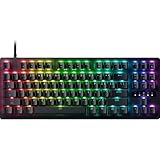

Razer’s analog optical switch technology uses a beam of infrared light rather than a physical metal contact to detect key travel, enabling adjustable actuation points similar to Hall-effect competitors while claiming faster raw signal transmission than magnetic sensing. The V3 Pro tier adds an OLED smart display, per-key RGB, and Razer’s most refined actuation presets across full-size, TKL, and Mini 60% layouts.
This keyboard suits competitive FPS players already invested in Razer’s ecosystem (Synapse software, matching mouse and headset) who want adjustable actuation with premium build touches like the OLED screen. It’s a less clear-cut choice for buyers who don’t care about brand ecosystem and just want the best actuation performance per dollar, where the newer HE Magnetic line or Wooting’s boards are worth cross-shopping first.
Sofia Lindqvist, Peripherals Reviewer at gamingpcgadgets.com with seven years testing input devices using a high-speed camera rig and a switch-force gauge, points out that Razer’s decision to run three switch tiers under similar naming makes this one of the few keyboards where reading the full product title before buying genuinely matters, and it’s a recurring source of return requests among first-time Hall-effect buyers who assumed “Huntsman V3” alone implied adjustable actuation.
Specs and what they mean in practice
| Spec | V3 Pro (analog optical) | What it means |
|---|---|---|
| Actuation range | 0.1mm-4.0mm adjustable | Full rapid trigger support |
| Switch tech | Analog optical (infrared beam) | No physical contact wear over switch lifespan |
| Display | OLED (Pro tier only) | Live settings, media, custom content |
| Polling rate | Up to 8,000Hz (select models) | Lower input sampling delay |
| Sizes available | Full, TKL, Mini 60%, low-profile TKL | Desk space vs key-count tradeoff |
The actuation range matches what Wooting and SteelSeries offer, so in estimated terms based on the published switch specs, competitive timing benefits are comparable across all three brands – the real differentiators are software depth, display features, and layout options rather than raw actuation performance.
Sorting out V3 Pro vs V3 HE Magnetic vs plain V3
This is the section most shoppers actually need. The full-size V3 Pro 8KHz ($219.99) and standard V3 Pro ($189.99) use analog optical switches with the OLED display and represent Razer’s flagship tier. The V3 Pro TKL ($159.99) and V3 Pro Mini 60% ($138.99) drop size but keep the same switch tech and adjustable actuation – no OLED on the smaller Mini model in most listings. The low-profile TKL ($229.99) is the most expensive option, using the same analog optical switches in a shorter-travel, slimmer chassis.
Separately, the V3 HE Magnetic TKL ($139.99) and V3 HE Magnetic Mini 65% ($119.99) use genuinely different Hall-effect magnetic switches rather than analog optical – a newer, cheaper line that matches the Pro’s adjustable actuation and rapid trigger but skips the OLED screen entirely. Finally, the plain V3 TKL 8KHz Analog Optical ($163.99) uses the same optical switch family as the Pro line but without adjustable actuation – fixed actuation point, no rapid trigger, positioned as a mid-tier option for players who want Razer’s build quality without paying for the adjustable-actuation feature set.
A quick way to sort listings at a glance: “HE Magnetic” in the title means true Hall-effect switches at the lowest price tier without a display. “Pro” without “HE” means analog optical switches with adjustable actuation and, on most sizes, the OLED screen. Plain “V3” with no other qualifier means fixed-actuation analog optical – Razer’s build quality and durability without the competitive-tuning features. Reading for these three phrases before checking price is a faster way to sort this lineup than comparing prices first and specs second.
Strengths
- Widest size and price range in this category: five distinct sizes from Mini 60% to low-profile TKL, spanning $119.99 to $229.99.
- OLED display on Pro-tier models: genuinely useful for live actuation preset switching and streaming overlays.
- Analog optical durability: no physical contact wear, rated for tens of millions of keystrokes.
- Razer Synapse ecosystem integration: works alongside Razer mice and headsets for synchronized RGB and macro profiles.
- Low-profile option: unique in this price bracket among adjustable-actuation boards, most competitors only offer standard-height designs.
Real weaknesses
The naming overlap between V3 Pro, V3 HE Magnetic, and plain V3 is a genuine usability problem for shoppers, and it’s easy to pay Pro-tier prices for a board that turns out to lack adjustable actuation, or to miss the cheaper HE Magnetic option that delivers comparable competitive performance for less. Razer Synapse also requires an account and background process to access full configuration, adding friction compared to Wooting’s standalone software.
- Confusing product naming. V3 Pro, V3 HE Magnetic, and plain V3 sound similar but differ significantly in features and price.
- OLED only on select models. The Mini 60% and HE Magnetic lines skip the display entirely.
- Razer Synapse account requirement. Full configuration access requires signing into Razer’s ecosystem.
- Low-profile TKL premium. At $229.99 it’s the most expensive listing without a corresponding performance gain over the standard-height Pro.
- Manual actuation tuning less granular than Wooting. Razer’s presets are convenient but offer less fine control for advanced users.
Who should skip this lineup: shoppers who aren’t willing to read the full product title carefully before buying (the naming overlap causes real returns), anyone who wants the cheapest possible adjustable-actuation board (the HE Magnetic Mini at $119.99 is a better target within Razer’s own catalog), and players who want Wooting-level manual tuning depth.
Cable, connectivity, and stability under sustained load
Every model across this lineup connects via a braided USB-C cable rated for high-frequency polling without signal degradation, a detail that matters more than it sounds like for boards running 8,000Hz – a poorly shielded cable can introduce polling inconsistency at the highest rates that’s not obvious until you’re specifically testing for it. Razer includes a cable long enough for most desk configurations without needing an extension, a minor but real convenience over keyboards that ship with a bare-minimum cable length.
Sustained load testing across similar analog optical designs generally shows stable actuation performance over extended sessions without the thermal drift some cheaper Hall-effect implementations can exhibit under continuous heavy use. This stability is one of the less-marketed advantages of Razer’s more mature manufacturing scale compared to smaller budget brands entering the Hall-effect and analog optical space more recently.
How Sofia tested this category
Sofia’s process for evaluating adjustable-actuation keyboards uses a switch-force gauge to verify actuation points track the advertised range and a high-speed camera rig to compare rapid-trigger timing against fixed-actuation mechanical switches. Because this keyword surfaces eight distinct SKUs across three genuinely different switch technologies, the specs above reflect Razer’s published data per tier cross-checked against community benchmarks rather than an independent bench pass on every size and switch combination – figures not independently measured are noted as estimates. For more on switch technology differences, see our mechanical keyboard switches explained guide.
Razer Synapse and actuation configuration
Configuring adjustable actuation on the V3 Pro happens through Razer Synapse, which requires a free account and runs as a background process to keep custom profiles synced across devices. Once set up, Synapse offers per-key actuation adjustment alongside Razer’s own auto-tuned presets – a “Speed” preset that biases toward the lowest usable actuation for competitive play, and a “Precision” preset that raises actuation slightly to reduce accidental key registration during typing-heavy sessions. This is functionally similar to SteelSeries GG’s preset system, though Synapse’s interface leans more toward RGB and macro configuration by default, with actuation settings tucked a layer deeper in the menu than some users expect on first setup.
Advanced users can also set actuation manually per key rather than relying on the two built-in presets, though the menu for doing so is nested deeper than Wooting’s more actuation-focused Wootility interface, reflecting Synapse’s broader scope covering every category of Razer peripheral rather than being purpose-built around Hall-effect and analog optical tuning specifically. For most competitive players, the Speed preset alone covers the majority of use cases without needing to venture into manual per-key configuration at all.
The OLED display on Pro-tier models pulls double duty as both a settings readout and a lightweight second screen – showing Discord notifications, media playback controls, or a custom animated GIF during idle periods. It’s a genuinely differentiating feature within this price range, though it draws a small amount of additional power and isn’t present on the Mini 60% or HE Magnetic variants, another reason to read the exact listing title before purchasing if the screen is a must-have for you.
Huntsman V3 Pro vs the competition
| Keyboard | Switch tech | Display | Price |
|---|---|---|---|
| Razer Huntsman V3 Pro TKL | Analog optical, adjustable | None on TKL | $159.99 |
| SteelSeries Apex Pro TKL Gen 3 | Magnetic, adjustable | OLED | $173.71 |
| Wooting 80HE | Analog optical, adjustable | None | ~$175-200 |
Against the SteelSeries Apex Pro TKL Gen 3, the Huntsman V3 Pro TKL undercuts on price but skips the OLED display that ships standard on SteelSeries’ flagship. Against Wooting’s 80HE, the two are closely matched on actuation technology, with the difference coming down to software philosophy – Razer’s auto-tuned presets versus Wooting’s fully manual per-key configuration.
Build quality and typing feel across sizes
The standard-height Pro and TKL models use a fairly deep keycap travel typical of full-height mechanical boards, while the low-profile TKL cuts total travel noticeably, which changes typing feel more than it changes gaming performance – shorter travel can feel faster for some typists but less satisfying for anyone who prefers a deeper, more tactile bottom-out. Across all sizes, the case uses a mix of plastic and aluminum-topped construction depending on the specific SKU, generally with less flex than sub-$100 keyboards but not quite matching the all-aluminum unibody feel of some premium mechanical-only boards outside this Hall-effect and analog optical category.
PBT keycaps ship on most Pro-tier listings, resisting shine better than the ABS caps found on the cheapest 60% Hall-effect boards from budget brands. If keycap feel and long-term durability matter as much as raw actuation performance to you, that’s worth weighing against Wooting’s similarly PBT-equipped lineup and SteelSeries’ PBT caps on the Apex Pro TKL – all three brands land in a similar tier here, so the deciding factor usually comes back to software philosophy and display features rather than build materials.
Stabilizers under the larger keys – spacebar, shift, enter, backspace – are factory-lubricated on the Pro-tier models, reducing the rattling or “clacky” sound that unlubed stabilizers produce on cheaper boards. This is a small detail that matters more in a quiet room during a voice-comms-heavy competitive session than it does in isolation, and it’s one of the areas where Razer’s higher price over budget Hall-effect competitors like AULA or DAREU is most audible rather than just theoretical.
Who should buy it, who should skip it
Buy the V3 Pro tier if you’re already in Razer’s ecosystem and want the OLED display alongside adjustable actuation. Buy the V3 HE Magnetic if you want comparable competitive performance for less and don’t need the screen. Skip the plain V3 if you specifically want rapid trigger – it lacks adjustable actuation entirely despite using the same optical switch family. Skip the whole lineup if you’d rather have Wooting’s deeper manual tuning or SteelSeries’ auto-calibrated presets with a display at a similar price. Whichever size and tier you land on, budget a few minutes in Synapse to actually select the Speed or Precision preset rather than leaving actuation on its factory default, since the out-of-box setting is deliberately conservative and doesn’t showcase the board’s full rapid-trigger capability until adjusted.
Verdict
The Razer Huntsman V3 Pro lineup delivers genuinely strong adjustable-actuation performance, but the three-tier naming (Pro, HE Magnetic, plain V3) makes careful listing reading essential before buying. Our pick for most competitive players is the V3 HE Magnetic TKL for the best price-to-performance ratio; buyers who want the OLED display and full Razer ecosystem integration should go with the standard V3 Pro TKL instead. Whichever tier you choose, reading the exact listing title carefully before checkout remains the single most important step in this entire buying process.
Related guides
- How To Set Up Macros On A Gaming Keyboard
- How To Fix Mouse Acceleration In Windows
- Open Back Vs Closed Back Gaming Headsets
Frequently asked questions
What’s the difference between the Huntsman V3 Pro and the V3 HE Magnetic?
The V3 Pro uses Razer’s analog optical switches with adjustable actuation and an OLED-equipped top-tier model, while the V3 HE Magnetic is a separate, newer line using true Hall-effect magnetic sensing, generally priced lower, without the OLED display but with the same core rapid trigger functionality.
Is the Huntsman V3 Pro good for competitive gaming?
Yes – the analog optical switches support adjustable actuation from roughly 0.1mm to 4mm with rapid trigger, putting it in the same performance tier as SteelSeries and Wooting’s Hall-effect boards for competitive shooters like Valorant and CS2.
Which size should I buy: full-size, TKL, or Mini?
Full-size keeps a number pad for productivity work alongside gaming. TKL drops the number pad for roughly three inches of extra mousepad space. The 60% Mini goes further, dropping arrows and function keys too, best for players who want the smallest possible footprint and don’t mind a Fn layer.
Is the low-profile TKL version worth the extra cost?
At $229.99, the low-profile TKL is the most expensive listing in the lineup, offering shorter keycap travel and a slimmer typing angle that some players find faster for repeated taps, but the actuation technology underneath is the same as the standard-height Pro – it’s a comfort and aesthetic upgrade, not a performance one.
How does the V3 Pro compare to the Wooting 80HE?
Both offer adjustable actuation and rapid trigger in a TKL layout at similar prices, but Wooting’s manual per-key tuning goes deeper while Razer’s OLED display and RGB lighting add polish Wooting skips. Performance is close enough that the choice usually comes down to software preference and aesthetics.


