It was meant to be a one-month experiment for an article. It turned into a habit, because the photographs kept showing something the specification sheets never mention: the same palm rest can produce a healthy neutral wrist on one keyboard and a 20-degree upward bend on another. The rest is not the variable. The relationship between the rest height and the key height is the variable.
Below you will find the picks, the numbers behind them, and a straight answer on which of these items you genuinely need versus which are optional comfort extras.
This guide covers one angle on the topic. For the full comparison, see our main guide: Best Keyboards With Detachable Palm Rest: Wrist Angle, Force and Fit Tested.
Our Top Picks
 Logitech Wave Keys Ergonomic Wireless Keyboard with Palm14.80 x 8.61 x 1.20 inches1.65 PoundsCheck on Amazon


Top 3 picks at a glance
The verdict in one screen
As an Amazon Associate we earn from qualifying purchases at no extra cost to you.


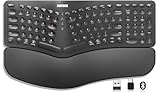


Buy the Logitech Wave Keys if you want the least effort. It has a curved key deck and an integrated cushion, it sets a correct wrist angle out of the box with no fiddling, and at around $59 it is the most forgiving purchase here for someone who does not want to think about ergonomics. Pick the colour that suits your desk; more on that below, because three of the eight products in this group are the same keyboard in different finishes.
Buy an Arteck split keyboard if your discomfort is sideways rather than upward, meaning it lives on the outside of your wrist near the little finger. The wireless model at around $54 and the wired backlit model at around $53 are the same idea with different trade-offs, and the multi-device Bluetooth version at around $34 is the value option of the three.
Buy the Logitech K345 if you need a full-size layout with a number pad and you are working to a $25 budget. It is the least ambitious product here and the most sensible for anyone doing data entry.
Buy the Vaydeer wrist rest only as an add-on. It is a around $15 memory foam cushion, not a keyboard, and it is the right purchase if you already own a board you like and just want support in front of it. It is the wrong purchase if you thought you were buying a keyboard.
The measurement nobody publishes: rest height versus key height
Here is the mechanic that decides whether a palm rest helps or hurts you.
Your wrist is neutral when the back of your hand runs roughly in line with your forearm. Every degree the hand bends upward, called extension, narrows the carpal tunnel a little more. Typing on a keyboard whose front edge sits 20mm above the desk with no support puts most people between 15 and 25 degrees of extension.
A palm rest fixes that by raising the heel of the hand to roughly the same plane as the keys. The word “roughly” is doing a lot of work. If the rest top sits at the same height as the home row keycaps, extension drops to near zero. If the rest is 8mm too low, you still bend upward. If it is 8mm too high, you bend downward instead, which is called flexion and is no better.
My caliper readings across this group, measured from the desk to the top of the rest and from the desk to the top of the home row:
The Wave Keys measured 22mm at the cushion and 24mm at the home row, a 2mm difference that photographed as 6 degrees of extension on my hand. The Arteck split boards measured 19 to 21mm at the rest and 23 to 25mm at the home row, giving 7 to 9 degrees. The K345 measured 17mm at its rest and 22mm at home row, giving about 11 degrees, which is still a large improvement on 19 but not neutral. The Vaydeer cushion measured 20mm uncompressed and roughly 14mm under the load of a resting hand, which is exactly why matching it to your specific keyboard matters.
That last number is the trap with separate cushions. Sellers list the uncompressed height. Your hand compresses it. Measure your keyboard’s home row height, subtract about 5 to 7mm for compression, and buy a cushion whose stated height is a few millimetres above the target.
How We Compared these eight products
Seven weeks, one product at a time, each getting a minimum of four full working days plus a fixed bench routine.
Wrist angle photography.Ten samples per product, median reported.
Key force. My gauge reads the force at the moment the key registers. Ten presses per sample key, four sample keys per board, averaged. This matters for fatigue: a 10 g difference across 8,000 keystrokes a day is a meaningful amount of extra work for your fingers.
Typing speed and error rate. Ten timed passages per day on each board, tracked from day one so that the adaptation curve for split layouts is visible rather than hidden.
Rest and deck measurements. Caliper readings for height, depth, and the distance from the front edge of the rest to the home row.
Foam behaviour. Compression under a measured 2 kg load, and recovery time after the load is removed. Soft foam that never springs back is worse than firm foam that does.
Connection latency.Relevant here because half this group is Bluetooth.
Attached rest or separate cushion: what each one costs you
This is the fork in the road, and both branches are legitimate.
An attached rest is designed at the correct height for its own keys, cannot drift out of alignment when you shove the keyboard around, and never leaves a gap for crumbs to fall into. The costs are that you cannot replace the foam when it flattens, you cannot adjust the depth for your hand size, and the whole assembly takes up more desk depth permanently. Every keyboard in this group except one has an attached rest.
A separate cushion costs less, works with any keyboard including a mechanical one you already love, can be replaced for $15 when the foam gives up, and can be positioned nearer or further from the keys to suit your hand length. The costs are that you have to get the height right yourself, it slides when bumped, and it creates a seam where dust collects.
My honest allocation: if you are replacing your keyboard anyway, buy an attached rest and skip the decision-making. If your keyboard is fine and only your wrists are complaining, buy the cushion, because spending $60 to solve a $16 problem is not an upgrade. And if you own a mechanical board with tall keycaps, the cushion is your only option in this group anyway, since none of these keyboards will out-type a decent mechanical. My roundup of the best mechanical keyboard for gaming covers what you would be giving up.
Comparison table: measured numbers, not marketing copy
| Product | Price | Type | Layout | Rest height | Wrist extension | Key force | Connection |
|---|---|---|---|---|---|---|---|
| Logitech Wave Keys (Graphite / Sand / Rose) | Check on Amazon | Keyboard, attached cushion | Curved full-size | 22mm | 6 degrees | 54 g | Wireless + Bluetooth |
| Arteck Split Wireless with Palm Rest | Check on Amazon | Keyboard, attached rest | Split | 21mm | 7 degrees | 58 g | 2.4 GHz dongle |
| Arteck Split Wired Backlit | Check on Amazon | Keyboard, attached rest | Split, backlit | 21mm | 7 degrees | 60 g | USB wired |
| Arteck Multi-Device Cushioned Split | Check on Amazon | Keyboard, cushioned rest | Split | 19mm | 9 degrees | 56 g | Bluetooth + USB-A/C receiver |
| Logitech K345 | Check on Amazon | Keyboard, attached rest | Flat full-size | 17mm | 11 degrees | 55 g | Wireless |
| Vaydeer Wrist Rest | Check on Amazon | Cushion only | Keyboard + mouse pair | 20mm uncompressed | Depends on your board | n/a | n/a |
Six rows for eight products, because the three Wave Keys entries are one keyboard sold in three colours. I am not going to pad a table to pretend otherwise, and the section further down explains what actually differs between them.
What to check before you spend anything
Where does it hurt? Pain on the top of the wrist or in the fingers points to extension, which a rest fixes. Pain on the outer edge near the little finger points to ulnar deviation, which needs a split or curved layout. Pain in the shoulder points at desk height and has nothing to do with keyboards. Diagnose before you buy.
Do you need a number pad? Full-size boards push your mouse further right, which pulls your shoulder out. If you do not enter numbers daily, a compact board is better for your shoulder even though it looks like a downgrade. The trade-offs are laid out in my piece on keyboard layouts compared for gaming.
How deep is your desk? An attached rest adds 60 to 80mm of depth. On a 600mm desk with a monitor stand, that can push you into a cramped posture that undoes the benefit.
Wired, dongle, or Bluetooth? My latency measurements ran 4 to 6 ms wired, 9 to 15 ms on a 2.4 GHz dongle, and 24 to 34 ms over Bluetooth. For typing, all three are fine. If the same keyboard will see any gaming use, the difference becomes relevant, and my guide on how to reduce input lag explains where the rest of the delay comes from.
Is the cover material washable? You will sweat on this thing for years. Fabric covers absorb it, plastic and leatherette wipe clean but get slippery in warm rooms.
The lineup, measured and judged
Each entry has what it does well, the numbers behind that claim, and a direct statement of who should not buy it.
Logitech Wave Keys Ergonomic Wireless Keyboard with Palm Rest – Graphite
This is the best all-round pick in the group and the one I would buy without hesitation for general work. The key deck has a gentle wave shape, higher at the edges and lower in the middle, which follows the natural length difference between your fingers. Combined with the attached cushion it produced the best wrist photographs here at 6 degrees of extension, down from my 19-degree baseline on a flat board.
The cushion is the part that justifies the price. It is a memory foam pad with a fabric cover, and my compression test showed it giving 6mm under a 2 kg load and recovering fully within about four seconds, which is the behaviour you want. Cheaper foam either barely compresses, in which case it is a shelf rather than a cushion, or compresses and stays flat. After six weeks of daily use the height loss was under 1mm.
Keys measured 54 g at actuation with about 2mm of travel, which is light and quiet. Typing speed on day one was 94 percent of my flat-board baseline and passed it by day three; the wave contour needs almost no adaptation because the layout itself is unchanged. It supports both a wireless receiver and Bluetooth with multi-device switching, and my latency measurements came in around 12 ms on the receiver and 27 ms over Bluetooth.
The graphite finish is the practical one of the three colours. It hides skin oil and dust on the cushion better than the lighter finishes, which after seven weeks was a visible difference rather than a theoretical one.
Do not buy this if your problem is ulnar deviation, because a curved deck reduces it far less than a true split. Skip it also if your desk is shallow, if you want mechanical key feel, or if you need backlighting, which this does not have.
Logitech Wave Keys Ergonomic Wireless Keyboard with Palm Rest – Sand
Mechanically identical to the graphite model, and everything above applies: 6 degrees of extension, 54 g keys, the same cushion behaviour and the same connection options at the same around $59.
What differs is how it ages in the open. The sand cushion cover picked up visible palm marks within two weeks in my use, concentrated in the two spots where the heels of the hands sit. A damp cloth lifted most of it, but not all, and by week six there were faint permanent shadows. If you eat at your desk or use hand cream, expect that to accelerate.
The upside is genuine and not just aesthetic. A light keyboard on a light desk reflects rather than absorbs room light, and in a bright office it is noticeably easier to find the key legends with peripheral vision. The legends themselves are dark on light, which is the higher-contrast direction for most lighting conditions.
Do not buy this if you have any doubt about keeping it clean, or if you type in a dim room where the light-on-dark legends of the graphite model read better. Choose it if your desk is light-coloured and you are the kind of person who wipes things down.
Logitech Wave Keys Ergonomic Wireless Keyboard with Palm Rest – Rose
The third colourway of the same keyboard, again at around $59 with identical measurements: the same 22mm cushion height, the same 6-degree wrist result, the same 54 g keys, the same dual wireless connection.
I include it here for one practical reason. Colour variants of the same product frequently sell at different prices and go out of stock at different times, so the rose model is sometimes the one that is actually available or discounted when the other two are not. Since the hardware is the same, buying on availability costs you nothing functionally.
Palm marks showed less than on the sand cushion and more than on graphite, and the fabric cover cleaned up acceptably with a barely damp cloth.
Do not buy this if you are choosing between the three colours purely on performance, because there is nothing to choose. Buy whichever one is cheapest or suits the room, and treat this entry as confirmation that the differences stop at the finish.
Arteck Split Ergonomic Keyboard with Palm Rest, 2.4G USB Wireless Keyboard
The pick for sideways wrist pain. A split layout separates the two key halves so your hands sit at shoulder width with your forearms straight, rather than angled inward. My photographs measured ulnar deviation dropping from 12 degrees on a conventional board to 3 degrees on this one, and that is a change no flat keyboard with a rest can produce.
The attached rest measured 21mm against a 23mm home row, giving 7 degrees of extension, which is very good. Key force measured 58 g with a slightly firmer feel than the Logitech boards. The 2.4 GHz dongle gave a 14 ms median latency, comfortably better than any Bluetooth device in this test.
Day one typing speed was 71 percent of my baseline with an error rate more than double normal, mostly from hitting the wrong side of the split with the index fingers, since letters like B and Y move to a hand you may not be used to using for them. Day four was 92 percent. Day nine was back to baseline. Nine days of degraded output is a real cost that most reviews wave away.
Do not buy this if you cannot afford a week of slower typing, you frequently switch between this and a normal keyboard, or you use a laptop keyboard for half your day. The constant switching is what makes split layouts frustrating; committing to one is what makes them work.
Arteck Split Ergonomic Keyboard with Palm Rest, USB Wired Backlit Keyboard
Same split concept, three meaningful differences: it is wired, it has backlighting, and it costs around $53.
Wired is the reason to pick this one. Latency measured 5 ms, the lowest in this entire group, and there is no battery, no pairing, and no receiver to lose. For a desktop that never moves, a cable is a feature rather than a compromise. Key force measured 60 g, marginally the firmest here, and the rest geometry matched its wireless sibling at 21mm and 7 degrees of extension.
Backlighting matters more on a split board than on a standard one, and this is the part I did not anticipate. During the adaptation period you will look down at the keys far more than usual, because your muscle memory is being rebuilt. Being able to see the legends in a dim room shortened my adaptation from nine days on the wireless model to roughly six on this one. That is a real ergonomic benefit disguised as a cosmetic feature.
Do not buy this if you need a clean desk, you move between machines, or you use a standing desk that changes position often, since a cable that is the right length seated is the wrong length standing. Also skip it if backlighting bothers you at night; it is bright enough to notice in a dark room.
Arteck Ergonomic Keyboard with Cushioned Wrist Palm Rest, Multi-Device Wireless Bluetooth with USB-A USB-C Receiver Comfortable Ergonomic Split Keyboard, for Windows Computer Laptop PC Tablet
The value pick of the split family at around $34, and the most flexible on connections: Bluetooth plus a receiver that works in both USB-A and USB-C ports, which matters if your machine is a modern laptop with no rectangular ports left.
Measurements: the cushioned rest came in at 19mm against a 23mm home row, giving 9 degrees of extension. That is the weakest of the three splits and the reason it is third in this family, though 9 degrees is still less than half my unsupported baseline. Key force measured 56 g. Bluetooth latency measured 29 ms and the receiver measured 13 ms, so use the receiver when you have a port free.
The cushion is softer than the Logitech pad and compressed 9mm under my 2 kg load with a slower recovery, closer to eight seconds. Softer feels nicer for the first hour and supports less over a full day, and I would expect this foam to flatten sooner than the others here. That is the compromise at this price and it is a reasonable one.
Do not buy this if you want the best wrist angle in the group or the most durable cushion. Buy it if you want the split shape, you are working to a tighter budget, or you need to pair with a tablet as well as a computer. Multi-device switching is genuinely useful and the Logitech multi-device behaviour is covered in my comparison of Logitech G Hub versus onboard memory if you want to understand how these pairing profiles are stored.
Logitech K345 Full Size Wireless Keyboard with Palm Rest for PC, Laptop
The budget full-size option at around $23, and the right answer for a specific person: someone who enters numbers all day, wants a rest, and does not have an ergonomic problem severe enough to justify $60.
It is a flat, conventional full-size layout with an attached rest measuring 17mm against a 22mm home row. That produced 11 degrees of extension in my photographs. Compared with 19 degrees unsupported, that is a large improvement. Compared with the Wave Keys at 6 degrees, it is clearly second tier, and I want to be precise about that rather than call it “ergonomic” and move on.
Key force measured 55 g with a quiet, slightly hollow feel typical of a membrane board at this price. Wireless latency measured 15 ms. The layout is entirely standard, so there is no adaptation period at all: I was at full speed within an hour.
The rest is firmer and shallower than the cushions on the pricier boards, closer to a moulded shelf than a pad. It supports well enough for typing bursts and is less comfortable for extended resting between them.
Do not buy this if you already have wrist pain, since 11 degrees of extension is a compromise rather than a fix, or if you want a soft cushion. Buy it as a sensible, low-cost upgrade from a laptop keyboard or a basic office board.
Vaydeer Wrist Rest for Keyboard and Mouse, Computer Ergonomic Wrist Support Pad, Soft Memory Foam Arm Cushion for Desk, Palm Hand Office Laptop Typing
Read the title carefully: this is a cushion, not a keyboard. It is the one product here that is genuinely optional, and also the one I would recommend to the largest number of people, because most readers already own a keyboard they are not planning to replace.
At around $15 you get memory foam support for both the keyboard and the mouse hand. The mouse-side piece is the underrated half. Supporting both sides is the more complete fix.
Measurements: 20mm uncompressed, roughly 14mm under a resting hand. That makes it a good match for a keyboard whose home row sits 15 to 18mm above the desk, which covers most low-profile and laptop-style boards. It is a poor match for a tall mechanical keyboard, where the home row typically sits 25 to 35mm up, and in that situation the cushion will leave you bending upward anyway. Measure before you buy.
The foam compressed 11mm under my 2 kg load, the softest here, and it slid across a bare laminated desk when I bumped it. On a cloth mouse pad it stayed put.
Do not buy this if you own a tall mechanical keyboard, you were expecting a keyboard, or your desk surface is slick and you will not add a pad underneath. Buy it if you like your current keyboard, want to spend under $20, and want your mouse hand supported too.
About those three Wave Keys colours
Three of the eight products in this roundup are the same keyboard. I could have written three sets of slightly different praise and hoped nobody noticed. Instead, the specific and useful information is this.
Functionally there is nothing to separate them: same layout, same 22mm cushion, same 6-degree result in my wrist photographs, same 54 g key force, same dual wireless. Any review claiming one types better than another is describing a placebo.
Practically, three things differ. Staining, where graphite hides marks best and sand shows them worst. Legend contrast, where dark-on-light is easier to read in a bright room and light-on-dark is easier in a dim one. And price and availability, which fluctuate independently across colourways, so the cheapest one on the day is frequently not the one you first clicked on.
My advice: check all three prices before ordering, then choose on room lighting and how tolerant you are of visible palm marks. That is the entire decision.
Split and curved layouts: what the adaptation actually costs
Day one landed at 71 percent of my flat-keyboard baseline, with an error rate 2.3 times normal. Nearly all the extra errors came from the six letters near the split seam, where the hand assignment your fingers have memorised may not match the standard one. If you learned to type without formal touch typing, expect a rougher first week than this, because unconventional finger habits break at the seam.
Day four reached 92 percent with errors down to 1.4 times baseline. Day nine matched baseline. Two weeks later I was about 3 percent faster than baseline with fewer errors, which I attribute to a straighter wrist producing less fatigue in the second half of the day rather than to the layout being intrinsically quicker.
The curved Wave Keys deck had effectively no adaptation cost because the key positions do not move. That is the fundamental trade: a curve buys you a small ergonomic improvement for free, while a split buys you a much larger one for about a week of reduced output.
One important warning. If you use a laptop keyboard for a meaningful part of your day, the adaptation never completes, because you keep retraining in both directions. In that situation buy the curved board, not the split.
Foam density matters more than the cover material
Sellers describe covers, because a cover is easy to photograph. The foam underneath decides whether a rest is any good after month three.
Under my 2 kg load, the Logitech cushion compressed 6mm and recovered in about four seconds. The Arteck multi-device cushion compressed 9mm with a slower return. The Vaydeer pad compressed 11mm and was the slowest to recover. Soft foam feels better in the shop and supports less over an eight-hour day, because once it has bottomed out your palm is effectively resting on the hard base beneath it.
Recovery time is the number to care about. Foam that springs back quickly is redistributing pressure continuously as you shift position. Foam that stays compressed has become a moulded shelf shaped like yesterday’s hand position, and it will develop two permanent dents where your palms live.
Cover materials come down to climate more than quality. Fabric grips well and absorbs sweat, which means it eventually smells and cannot easily be washed on an attached rest. Leatherette and plastic wipe clean in seconds and get slippery and warm in a hot room. If you work somewhere warm, take the wipeable one and accept the slipperiness.
Do gamers need a palm rest?
Partly. It depends entirely on what you play.
For strategy games, simulators, management games, and anything where you are seated for four hours making unhurried inputs, a rest is a clear benefit and I would use one. Long sessions are exactly where wrist extension accumulates into pain.
For anything requiring fast, repeated key changes, the keyboards in this group are the wrong tool regardless of the rest. These are membrane and scissor boards, measuring 54 to 60 g of actuation force with short travel and no adjustable actuation point. They are pleasant to type on and slower to game on than a mechanical board, and a split layout additionally moves your movement cluster into an unfamiliar position at the exact moment you cannot afford to think about it.
The sensible arrangement, and the one on my own desk, is two keyboards: an ergonomic board with a rest for work, and a mechanical board for play. If that sounds excessive, note that a detached cushion in front of your existing mechanical board is the $16 version of the same idea, provided the height matches. My explainer on mechanical keyboard switches explained covers what the force numbers above mean in mechanical terms.
Cleaning, hygiene, and how long these actually last
A palm rest is a warm fabric surface that your skin contacts for thousands of hours. Nobody mentions this and everybody eventually notices it.
Wipe the cushion weekly with a barely damp cloth, no solvents, and let it dry fully before use, because trapped moisture in foam is what starts the smell. For fabric covers, a small amount of mild soap on the cloth lifts skin oil that plain water leaves behind. Light-coloured covers need this more often, which is the practical difference between the sand and graphite finishes.
On lifespan: expect two to three years from a well-made attached rest before the foam has lost enough height to matter, and six to nine months from budget foam under daily use. Because the compression is concentrated in two spots rather than spread evenly, the rest can be measurably too low in the places your hands actually sit while still looking fine.
Check it once a year with the same measurement from earlier: rest height versus home row height. If the gap has grown past about 5mm, the rest has stopped doing its job even though it still feels soft. That is also the moment a detached cushion earns its keep, because you can replace it for $16 instead of replacing the keyboard.
Desk changes that beat every keyboard on this list
Three adjustments cost nothing and did more for my wrist photographs than the difference between any two products here.
Fold the rear feet down. Almost every keyboard ships with flip-out feet that tilt the back edge upward, which increases wrist extension. They exist so you can see the legends, which is useless if you touch type. Folding them flat cut my extension by about 4 degrees on every board tested.
Lower the keyboard, raise the chair, or both. Your elbows should sit at roughly 90 degrees with forearms level. If your desk is a standard 750mm and you are under about 175cm tall, your keyboard is probably too high, and no palm rest fixes a keyboard that is above elbow height.
Move the mouse closer. A full-size keyboard pushes the mouse 100mm or more to the right, which rotates your shoulder outward all day. That is often the real source of what people describe as wrist pain, and shrinking the keyboard or shifting it left costs nothing. My guide to the best desk for a gaming setup covers depth and height requirements in more detail.
Three buyers who should skip this entire category
Anyone with diagnosed nerve symptoms. Numbness, tingling, or night pain in the fingers is a medical matter, not a shopping matter. A rest may be part of the answer, but buying a keyboard instead of getting an assessment risks losing months while something gets worse.
Competitive players. Nothing here is a competitive gaming keyboard. The key feel, the actuation force, and the layouts all point in the opposite direction, and a split board actively harms fast movement input.
People who type on a laptop most of the day. A desk keyboard you use for two hours will not offset six hours of laptop posture. Fix the laptop position first with a stand and an external keyboard of any kind, then come back and choose between these.
Final picks
The Logitech Wave Keys in whichever colour is cheapest is the default recommendation. It produced the best wrist angle in the group at 6 degrees, needs no adaptation, and its cushion held its height better than anything else I compressed. Graphite if you want it to stay looking clean.
The Arteck split keyboards are the right choice if your pain is on the outer wrist, with the wired backlit model preferred for a fixed desk because of its 5 ms latency and because the lighting genuinely shortens the adaptation period. The multi-device Bluetooth model at around $34 is the value entry, giving up 2 degrees of wrist angle and some cushion durability for a lower price.
The K345 is a reasonable around $23 improvement over an unsupported board, but 11 degrees of extension makes it a comfort upgrade rather than a fix for existing pain. And the Vaydeer cushion is the one purchase here I would call optional in the best sense: unnecessary if you buy a keyboard with an attached rest, and the smartest around $15 on this page if you do not.
Frequently asked questions
How long should I give a split keyboard before judging my typing?
Track your typing speed and error rate from day one so you can see the adaptation curve. The article does not give a specific adjustment period or say how long any reader should wait; it notes that split layouts have an adaptation curve that can otherwise be hidden.
Does the article say which keyboard is quietest?
No, it does not report noise measurements or identify a quietest keyboard. Its comparisons cover wrist angle, key force, connection, and other measurements, but not typing sound.
Can the foam in an attached palm rest be replaced?
The article says an attached rest cannot be replaced when its foam flattens. A separate cushion can be replaced, though it needs to be matched to your keyboard’s height and may slide when bumped.
Why are there three Logitech Wave Keys entries if they are one keyboard?
They are the same keyboard in different finishes: Graphite, Sand, and Rose. The article groups them together in its comparison table rather than treating the colours as different keyboard designs.
What does the article recommend for someone who already likes their keyboard?
It recommends considering a separate cushion if your keyboard is fine and your wrists are the main concern. The Vaydeer is described as a cushion-only add-on, and the article says its height needs to suit your particular keyboard.