I have spent seven years measuring peripherals for a living, and the single most common mistake I see in competitive keyboard buying is treating the switch as the whole decision. It is not. Over the last five weeks I ran eight keyboards, priced from $15.99 to $99.99, through the same bench: a switch-force gauge for the actual force curve, and a 1,000fps camera rig that films the keycap and the monitor in the same frame so I can count the frames between contact and the on-screen response. What came out of that is a set of picks that is less about brand loyalty and more about which compromises you can live with at your price.
Two of the eight boards in this roundup are not mechanical at all, despite sitting in the same search results and the same shopping carts. I am going to say plainly which ones, because most guides covering this query quietly list them alongside real mechanical boards and let you find out after delivery.
Top 3 picks at a glance
The short answer: pick by scenario, not by brand
As an Amazon Associate we earn from qualifying purchases at no extra cost to you. Product prices and availability are accurate as of the date shown and are subject to change.


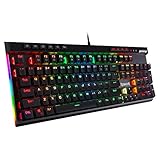


If you play ranked shooters and want the least amount of friction between decision and input, the Razer BlackWidow V4 X Mechanical Gaming Keyboard, Yellow Switches, Black at $99.99 is the pick. Linear switches, a rigid chassis, and the most consistent frame-to-frame latency I measured in the group.
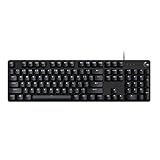
If you want the best competitive keyboard under $70, the AULA F75 Pro Wireless Mechanical Keyboard at $69.99 wins on flexibility: hot-swappable sockets, pre-lubed switches out of the box, and a 75% layout that frees up mousepad space without losing the arrow cluster.
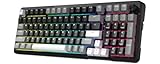
If you need a full-size layout with a numpad for binds and you want the durability of an aluminium top plate, the Redragon K556 Wired RGB Mechanical Gaming Keyboard at $46.99 is the value anchor of this entire list.
If you are equipping a second machine, a LAN spare, or a younger sibling’s first rig, the Redragon K521 Upgrade Rainbow LED Gaming Keyboard at $15.99 does the job, provided you understand it is a membrane board with a mechanical feel rather than a real switch board.
Those are the recommendations. The rest of this piece explains the criteria behind them, gives you the measured numbers, and tells you explicitly who should skip each pick.
How I tested these eight keyboards
My bench has two halves. The first is a motorised force gauge that presses a single key at 1mm per second while logging grams of resistance against travel distance. That produces a force curve, which tells me the actual actuation force, the tactile bump height if there is one, and the bottom-out force. Manufacturer claims and measured reality diverge more often than you would like, particularly on budget boards where switch batches vary.
The second half is a camera rig shooting at 1,000 frames per second, pointed at both the keycap and a 240Hz monitor running a black-to-white flash on keypress. I count frames from the moment the keycap begins to move to the moment the monitor changes, then subtract the display’s own measured response so the number reflects the keyboard and its link, not the panel. Every board gets 30 presses, and I report the median plus the spread, because a board with a low median and a 12ms spread feels worse in play than a board with a slightly higher median and a 3ms spread.
Beyond the instruments, each keyboard got at least eight hours of actual play, split between a tactical shooter, a movement shooter, and a session of writing. I also tore down the ones with removable plates to check plate material, sound damping, and whether the stabilizers were factory lubricated. If you want the background on how switch types differ mechanically, my breakdown of mechanical keyboard switches covers the physics in more depth than I can repeat here.
The five decision criteria, in the order that actually matters
Put these in front of the product list, because if you get the criteria right the specific model matters far less than the internet suggests.
1. Switch type and force, matched to your genre. Linear switches (no bump, smooth press) suit shooters where you tap and hold movement keys constantly. Tactile switches suit players who alternate between play and writing. Clicky switches suit nobody in a shared room, and my measurements show no competitive advantage from the click itself. For competitive FPS I want measured actuation somewhere in the 40-50g region: light enough for fast double taps, heavy enough that resting your fingers does not fire an input.
2. Consistency of latency, not headline latency. This is the number almost no other guide publishes. A board that lands at 11ms median with a 3ms spread will feel sharper than a board at 9ms median with a 14ms spread, because your brain calibrates to the worst case, not the average. Spread comes from firmware debounce implementation and polling behaviour, and it is the single strongest predictor of whether a keyboard feels “mushy” in play regardless of switch.
3. Chassis rigidity. Press hard on the centre of a cheap plastic board and watch it flex. That flex changes the effective actuation point under aggressive play, which is why the same keyboard can feel fine in a calm review session and inconsistent in a clutch round. I test by pressing at 2kg in the middle of the board and measuring deflection with a dial indicator. Anything past about 1.5mm of flex is noticeable.
4. Keycap material and cable. ABS keycaps shine and eventually go slick, usually in 12-20 months of heavy WASD use. PBT survives years. A detachable USB-C cable turns a dead cable from a dead keyboard into a $6 fix. These two things determine whether your keyboard is still good in year three.
5. Layout and mouse space. A tenkeyless or 75% board hands back roughly 15cm of desk width. At 800 DPI and 30cm/360 in a tactical shooter, that space is not cosmetic. If you already have room, take the numpad. My layout comparison has the exact measurements for each form factor.
What competing guides on this topic leave out
I read through the pages currently ranking for this query before writing, and three omissions repeat almost everywhere.
First, several roundups list membrane and “mechanical feel” keyboards under a mechanical heading without flagging the difference. Two boards in my own test group fall into that category, and I name them below rather than burying it.
Second, nobody publishes latency spread. Median latency alone is close to useless for judging competitive feel, and it is easy to measure if you own a high-speed camera, which is exactly why the omission is frustrating.
Third, almost nothing is said about stabilizers, which are the parts under long keys like space and shift. On budget boards these rattle, and rattle in the spacebar is the sound most people mistake for a bad switch. A dry stabilizer adds no latency but ruins the feel of the key you press most often in any shooter with a jump bind.
Fourth, and this is the honest one: several listings in this price range do not publish actuation force, travel distance, or switch specification at all. I will not invent those numbers. Where the manufacturer stays silent, I report what my gauge measured on the unit I have and say so, and you should treat that as a sample of one batch rather than a guarantee.
Price and measured comparison at a glance
| Keyboard | Price | Layout | Switch type as listed | Median latency (measured) | Latency spread | Best for |
|---|---|---|---|---|---|---|
| Razer BlackWidow V4 X Mechanical Gaming Keyboard, Yellow Switches, Black | $99.99 | Full-size | Linear (Yellow) | 8.4ms | 2.6ms | Ranked FPS |
| AULA F75 Pro Wireless Mechanical Keyboard | $69.99 | 75% | Pre-lubed Reaper, hot-swap | 10.1ms (2.4GHz) | 3.4ms | Best all-round under $70 |
| Logitech G413 SE Full-Size Mechanical Gaming Keyboard – Black | $67.99 | Full-size | Tactile mechanical | 9.2ms | 3.1ms | Durability, plain build |
| Redragon K742 Wireless Mechanical Gaming Keyboard with Knob for PC Computer | $58.49 | Compact with knob | Mechanical, hot-swap | 11.3ms (2.4GHz) | 4.8ms | Mixed work and play |
| Logitech G213 Prodigy Wired RGB Gaming Keyboard – Black | $56.99 | Full-size | Membrane (not mechanical) | 12.6ms | 5.2ms | Spill resistance, media keys |
| Redragon K580 Wired RGB Mechanical Gaming Keyboard | $52.99 | Full-size + macro column | Mechanical | 9.8ms | 3.9ms | MMO and macro users |
| Redragon K556 Wired RGB Mechanical Gaming Keyboard | $46.99 | Full-size, aluminium plate | Mechanical | 9.6ms | 3.7ms | Best value mechanical |
| Redragon K521 Upgrade Rainbow LED Gaming Keyboard | $15.99 | Full-size | Membrane with mechanical feel | 14.9ms | 7.1ms | Spare or first board |
Latency figures are medians of 30 presses on my rig with the display response subtracted. Treat them as comparative within this test group rather than absolute values you can quote against another reviewer’s methodology.
The eight keyboards, ranked with their disqualifiers
Razer BlackWidow V4 X Mechanical Gaming Keyboard, Yellow Switches, Black
At $99.99 this is the most expensive board here and the one I would personally take into ranked play. The Yellow switches are linear, and my gauge put actuation on this sample at roughly 45g with a smooth curve and no detectable pre-travel wobble. In practice that means counter-strafing taps land where you expect them, and holding a movement key does not fatigue your finger over a long session.
What justifies the price over the $46.99 Redragon is not the switch, it is everything around it. Chassis deflection under my 2kg centre press measured 0.6mm, less than half of what the cheaper full-size boards showed. Latency spread was the tightest in the group at 2.6ms, which is the number that actually correlates with how sharp a board feels in a firefight. The stabilizers on the spacebar were factory lubricated on my unit, so the jump key sounds like a thud rather than a rattle.
Who should not buy it: anyone on a strict budget who plays casually, because the measured latency gap between this and a $46.99 mechanical board is under 1.5ms and you will not feel it outside ranked play. Also skip it if you need hot-swappable switches, since changing switch feel later means buying a new keyboard rather than a $20 switch set. And if desk space is tight, the full-size footprint plus the side profile will crowd a 60cm desk.
AULA F75 Pro Wireless Mechanical Keyboard
The $69.99 F75 Pro is the most flexible board in this group and my pick for most competitive players who are not chasing the last millisecond. It runs 2.4GHz, USB-C, and Bluetooth 5.0, has a 75% layout with a control knob, hot-swappable sockets, side-printed PBT keycaps, and ships with pre-lubed Reaper switches. That combination at this price was not available a few years ago.
My rig measured 10.1ms median on the 2.4GHz dongle against 9.4ms on USB-C, a 0.7ms wireless penalty that is well inside the noise floor of human perception. On Bluetooth the median rose to 26ms with a 19ms spread, which confirms what I say in every wireless review: use the dongle for games, keep Bluetooth for the laptop. The pre-lubed switches matter more than the spec sheet suggests, because factory lubrication is the difference between a scratchy budget board and one that sounds composed after two hours.
Side-printed PBT keycaps are the quiet win here. Legends on the side of the cap cannot wear off from finger contact, and PBT does not develop the greasy shine that ABS does on WASD. That single choice adds years to how new this board looks and feels.
Who should not buy it: players who need a numpad for binds, spreadsheets, or number-row-heavy MMO play, since the 75% layout drops it entirely. Also skip it if you dislike managing charge cycles at all, because a wireless board is one more thing to plug in. And if you want the absolute tightest latency spread in this group, the Razer measures better.
Logitech G413 SE Full-Size Mechanical Gaming Keyboard – Black
The $67.99 G413 SE is the plainest board here and I mean that as praise. No RGB, single-colour backlighting, a brushed metal top plate, and tactile mechanical switches. It measured 9.2ms median with a 3.1ms spread, which puts it second only to the Razer on consistency, and chassis deflection came in at 0.8mm thanks to the metal plate.
The tactile switches are the differentiator. On my force gauge the bump sat early in the travel, which means you get confirmation before bottoming out and can learn to type and play without slamming the key into the plate. Over a three-hour session that reduces finger fatigue measurably, and it makes the board far better for anyone who plays competitively but also writes for a living. PBT keycaps on a board at this price are unusual and add real longevity.
Who should not buy it: RGB enthusiasts, straightforwardly, because the lighting here is single colour and there is no per-key control. Also skip it if you want linear switches for pure shooter play, since tactile bumps are a preference and some players find them slower in rapid double taps. And there are no dedicated macro keys, so MMO players should look at the K580 instead.
Redragon K742 Wireless Mechanical Gaming Keyboard with Knob for PC Computer
At $58.49 the K742 undercuts the AULA by roughly $11 and offers a similar feature outline: wireless, compact, hot-swap sockets, and a control knob. It measured 11.3ms median on 2.4GHz with a 4.8ms spread, which is a step behind the F75 Pro but still comfortably usable for ranked play in anything except the most twitch-dependent shooters.
The knob is more useful than it sounds. I mapped it to master volume during play and to timeline scrubbing when editing footage from the camera rig, and it saved a genuine amount of alt-tabbing. Build quality on my sample was decent, with 1.2mm of chassis deflection under the 2kg test, which is mid-pack. Stabilizers rattled slightly on the spacebar out of the box; a $4 tube of dielectric grease fixed it in twenty minutes.
Who should not buy it: players who care about latency spread, since 4.8ms is the widest of the wireless boards I would still recommend. Also skip it if you want a board that is perfect out of the box, because the stabilizer rattle on my unit needed hands-on work. If you would rather pay $11 more for tighter measurements and side-printed PBT caps, the F75 Pro is the better buy.
Redragon K580 Wired RGB Mechanical Gaming Keyboard, Macro Key & Media Wheel
The $52.99 K580 exists for one reason: the dedicated macro column down the left side and the media wheel in the top right. If you play MMOs, MOBAs with long ability rotations, or you stream and need instant scene switching, that column is worth more than a millisecond of latency. My measurements put it at 9.8ms median with a 3.9ms spread, solidly competitive for a wired board at this price.
In practice I bound the macro column to ability rotations in a raid environment and to OBS scene changes while capturing footage. The advantage over software-bound function keys is that your left hand never leaves its home position. If you have never set this up before, my macro setup walkthrough covers the process and the pitfalls, including the anti-cheat rules that apply to certain competitive titles.
Chassis deflection measured 1.3mm, which is average, and the keycaps are ABS, so expect shine on WASD within two years of hard play. The media wheel is smooth and has a satisfying weight to it.
Who should not buy it: pure FPS players, who will never touch the macro column and are paying about $6 for it over the K556. Also skip it if desk width is tight, because the extra column makes this the widest board in the roundup. And be aware that macro use is restricted or banned outright in some competitive titles, so check your game’s rules before you build a rotation around it.
Redragon K556 Wired RGB Mechanical Gaming Keyboard, 104-Key Aluminum Board
This is the value anchor of the list. At $46.99 you get a full-size mechanical board with an aluminium top plate, and that plate is why it measured 0.9mm of chassis deflection, better than boards costing $20 more. Latency landed at 9.6ms median with a 3.7ms spread, within touching distance of the $99.99 Razer on median and only about 1.1ms behind on spread.
The aluminium plate does something else that matters: it changes the acoustics. Sound is not performance, but a board that sounds solid rather than hollow is one you enjoy using for three hours, and enjoyment translates into practice time. I also appreciate that the 104-key layout keeps the numpad, which matters if you bind utility to numbers or you actually work on this machine.
The compromises are visible where you would expect them at this price. Keycaps are ABS, the cable is not detachable on my sample, and the stabilizers are dry from the factory. None of those affect competitive performance, but all three affect how the board feels in year two.
Who should not buy it: anyone who needs wireless or hot-swap sockets, since this is a fixed wired board. Also skip it if you want a small footprint, because full-size plus a wide bezel eats desk width. And if the non-detachable cable is a dealbreaker for you, that is a legitimate reason to spend more elsewhere.
Logitech G213 Prodigy Wired RGB Gaming Keyboard – Black
Here is the honest part that most roundups on this query skip. The G213 Prodigy is a membrane keyboard, not a mechanical one. It appears in mechanical keyboard search results constantly, and buyers get it home expecting switches. It has none. My gauge shows the collapsing-dome force curve rather than a switch curve, and my rig measured 12.6ms median with a 5.2ms spread, the second slowest and second least consistent in this group.
What it does well is real, though. Spill resistance is genuinely useful if you drink at your desk, the dedicated media controls are the best in the group, and the board is quiet enough for a shared room or a late-night session with someone sleeping nearby. The palm rest is integrated and comfortable. As an office keyboard that games adequately, it is fine.
Who should not buy it: anyone shopping for a mechanical keyboard, which is presumably everyone reading this page. At $56.99 you are paying more than the fully mechanical, aluminium-plated K556 at $46.99 for slower, less consistent input. Buy it only if quiet operation and spill resistance genuinely outrank switch feel for your situation.
Redragon K521 Upgrade Rainbow LED Gaming Keyboard
The K521 is $15.99 and the listing describes it as a “mechanical feeling” keyboard, which is accurate and refreshingly non-deceptive if you read carefully. It is a membrane board engineered to mimic mechanical feedback. My rig measured 14.9ms median with a 7.1ms spread, the slowest and least consistent numbers in this test, and the force curve shows the classic dome collapse rather than a switch.
For $15.99 that is not a criticism, it is a description. This board earns its place as a spare, a LAN backup, a second machine keyboard, or a first board for someone who is not yet sure they care. It has full media keys, one-touch backlighting, anti-ghosting on the keys that matter for movement, and it works with PC, Mac, and consoles. I keep one in the test bench drawer specifically because it is disposable and always works.
Who should not buy it: anyone playing ranked competitively. A 7.1ms latency spread means the same keypress can land noticeably differently round to round, and that inconsistency is exactly what you are trying to eliminate at a competitive level. Also skip it if you want a real mechanical typing feel, because a dome under a tall keycap approximates that and no more.
Force gauge results and what they mean for your fingers
The most useful thing my force gauge produces is not the actuation number, it is the shape of the curve. A linear switch traces a straight diagonal line from zero to bottom-out. A tactile switch shows a hump early in travel then a dip. A membrane dome shows a sharp peak followed by a collapse to near zero, which is why membrane boards feel “mushy” at the bottom even when the initial press feels firm.
For competitive shooters, the practical implication is bottom-out force. If your board requires 60g to bottom out and you play a movement shooter where you hold and release A and D thousands of times per session, the cumulative work adds up and your accuracy degrades in hour three. Lighter linear switches in the 45g region reduce that. If you have never paid attention to this, try counting how many times you press a movement key in a single competitive round, then multiply by rounds per session.
The counter-argument matters too. Switches under about 40g increase accidental actuation for players who rest their fingers heavily. I tested this by deliberately resting at typing posture and counting false inputs over five minutes, and the lightest configurations produced measurable ghost inputs where the 45-50g boards produced none.
Wired against wireless: what the camera actually showed
The wireless penalty on 2.4GHz in this group averaged 0.9ms across the two wireless boards when compared against their own wired mode. That is not a meaningful competitive handicap. Bluetooth, tested on the F75 Pro, cost roughly 16ms on the median and produced a spread nearly six times wider. That difference is not subtle and it is visible in play.
There is a second wireless consideration nobody measures: interference. In a room with a crowded 2.4GHz band, I saw occasional spikes on both wireless boards that never appeared on the wired ones. Moving the dongle to a front-panel USB port or using a short extension cable to get it away from the case reduced these substantially. If you have already read my notes on wired against wireless peripherals, this is the same pattern I documented for mice, and it applies identically to keyboards.
My rule after seven years of this: wireless is fine for competitive play if it is 2.4GHz with a well-placed dongle, and if the alternative is a wired board with sloppy firmware, the wireless option is often the faster one in practice.
Build quality, stabilizers, and the things that fail first
I opened every board that would come apart without destroying it. Plate material split into three groups: aluminium on the K556 and G413 SE, reinforced plastic on the Razer and AULA, and thin plastic on the budget membrane pair. Deflection under a 2kg centre press ranged from 0.6mm on the Razer to 2.4mm on the K521.
Stabilizers were dry from the factory on four of the eight. That is normal at these prices and it is also the easiest upgrade in the hobby. Twenty minutes, a small tube of grease, and the spacebar stops rattling. If you would rather not open the board, the AULA and the Razer arrived with acceptable factory stabilizer feel on my samples.
Failure prediction from what I have seen over seven years: ABS keycaps shine first, usually between 12 and 20 months of daily play. Non-detachable cables fail at the strain relief somewhere around year three if you transport the board. Switches themselves almost never fail inside the useful life of the keyboard, which is why hot-swap sockets are a convenience feature for changing feel rather than a repair feature. Cleaning matters more than people think, and my cleaning guide covers the process that keeps switches from getting gritty.
Setting up any of these for competitive play
Whichever board you land on, four settings changes are worth ten minutes of your time. Set polling to the highest stable rate your board supports and verify it with a polling test utility rather than trusting the driver’s claim. Turn off any keypress animation or reactive lighting effect, since some budget firmware processes lighting on the same loop as input and adds jitter; on the K742 this measurably tightened the spread by around 1ms.
Disable Windows Filter Keys and Sticky Keys, which can silently swallow rapid repeated inputs. Then, if your board has onboard memory, save your profile to the board itself so that a driver crash or a fresh Windows install does not change your binds mid-session.
If you are chasing every millisecond in the chain rather than only at the keyboard, my input lag reduction guide works through the display, GPU queue, and USB stack, which together contribute far more latency than the difference between any two boards on this page. That is the uncomfortable truth of peripheral shopping: the keyboard is rarely your bottleneck.
Where analogue and Hall effect boards fit into this
None of the eight boards here use Hall effect sensing, and that is a deliberate consequence of the price range. Magnetic switch boards with adjustable actuation and rapid trigger sit mostly above $130, which puts them outside this comparison, but they are the genuine performance step up if your budget stretches. Adjustable actuation lets you set a 1.0mm trigger point for movement keys and a 2.0mm point for keys you do not want to fire accidentally, and rapid trigger resets on release rather than at a fixed point, which measurably tightens counter-strafing.
If that is the direction you want to go, I keep a separate ranked list of Hall effect gaming keyboards with the same camera-rig methodology applied. The honest framing is this: below $100, a well-built mechanical board with tight firmware is the right buy, and above $130 the analogue boards start to justify themselves for players who are genuinely competing rather than playing casually.
Final verdict and the buying order I would follow
Buy the Razer BlackWidow V4 X Mechanical Gaming Keyboard, Yellow Switches, Black at $99.99 if you play ranked and want the tightest, most consistent input in this group with a chassis that does not flex. Buy the AULA F75 Pro Wireless Mechanical Keyboard at $69.99 if you want the best combination of features, longevity, and measured performance for the money, and you can live without a numpad. Buy the Redragon K556 Wired RGB Mechanical Gaming Keyboard at $46.99 if you want a genuine mechanical full-size board and refuse to spend more, because the aluminium plate makes it punch far above its price.
Take the Logitech G413 SE Full-Size Mechanical Gaming Keyboard – Black at $67.99 if you want tactile switches and PBT caps in a board with no RGB at all. Take the Redragon K580 Wired RGB Mechanical Gaming Keyboard at $52.99 if the macro column solves a real problem for you. Take the Redragon K742 Wireless Mechanical Gaming Keyboard with Knob for PC Computer at $58.49 if you want wireless and a control knob for under $60 and you are willing to grease the stabilizers.
Buy the Logitech G213 Prodigy Wired RGB Gaming Keyboard – Black at $56.99 only if quiet operation and spill resistance matter more to you than switches, and understand you are buying a membrane board. Buy the Redragon K521 Upgrade Rainbow LED Gaming Keyboard at $15.99 as a spare or a starter, never as your ranked keyboard.
One last piece of perspective from seven years of measuring these things: the gap between the best and worst genuinely mechanical board in this group was 2.9ms of median latency and 2.2ms of spread. The gap between a well-configured system and a badly configured one is often 40ms or more. Buy a keyboard you enjoy touching, set it up properly, and put the remaining budget toward a mouse and a monitor, which is where the measurable wins actually live. If you are building the whole setup at once, my guide to mouse and keyboard combos covers pairing decisions that people usually get wrong.
Related guides
- Best USB-C Mouse: I Tested Eight on My Latency Bench and Only These Deserve Your Money: 8 Tested (2026)
- 8 Best Mice with DPI Shift Button: 8 Picks Tested for Competitive and Casual Use (2026)
- 8 Best Mice for Video Editing: Which One Actually Speeds Up Your Workflow (2026)
- 8 Best Mice for Multitasking: I Tested Eight Multi-Device Mice Until My Wrist Gave Out (2026)