Most people buy a USB C hub for dual monitors the same way they buy phone chargers: they look at the price, glance at the port count, and hit checkout. Then the hub arrives, they plug in two monitors, and only one display works — or both work at a stuttering 30Hz — or the hub runs so hot they’re worried about leaving it plugged in. The problem isn’t that USB C hubs are bad. It’s that the marketing on these products is genuinely misleading. A listing that says “dual monitor” often means “dual monitor only if your laptop supports DisplayPort Alternate Mode in the right configuration,” and a hub advertised at “4K” frequently means 4K at 30Hz on one port and 1080p on the other.
The second most common mistake is buying too many ports. A 13-in-1 hub sounds like better value than a 7-in-1 hub, but every additional port shares the same limited bandwidth coming through that single USB C cable. Stack two 4K monitors, an external SSD, and a webcam on one hub and you’ll feel it. The third mistake is ignoring power delivery entirely, then discovering your laptop slowly drains while plugged into the hub.
As an Amazon Associate we earn from qualifying purchases at no extra cost to you.



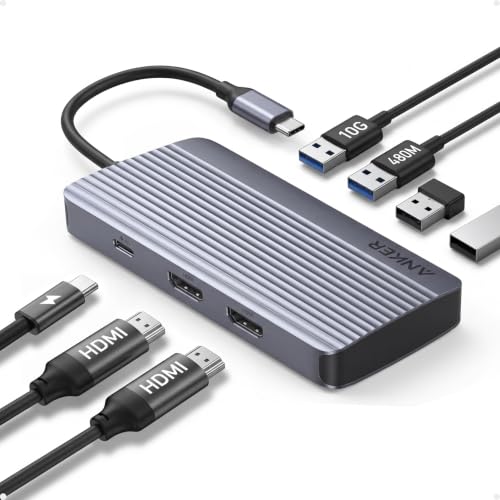
This guide walks through what actually determines whether a dual-monitor hub will work with your setup and your laptop, with real numbers at every step. The example products referenced below — including the Selore dual HDMI adapter at around $29 and the Anker 8-in-1 at around $53 — are typical of what the market looks like at each tier.
Our Top Picks
 Docking Station Dual Monitor 4K HDMI 13-in-1 USB13-in-1 Docking Station (USB C)13 x 0.5 x 5 inches0.3 PoundsCheck on Amazon


Top 3 picks at a glance
Decide These 3 Things First
Before comparing any products, answer these three questions. They eliminate roughly half the market immediately.
1. What video output does your laptop’s USB C port actually support? This is the single biggest determinant. If your laptop is a MacBook Air M1 or M2, or any laptop with an Apple M1/M2 base chip, a plain USB C hub will only drive one external display — full stop. You need a hub with DisplayLink technology (a compression chip that sends video over USB data) instead of native DisplayPort Alt Mode. On Windows, most modern laptops with Thunderbolt 3, Thunderbolt 4, or USB4 ports can drive two displays natively. If your port is plain USB 3.2 with “DP Alt Mode,” check whether it supports MST (Multi-Stream Transport); macOS does not support MST, so Macs need the two outputs to be independent Alt Mode streams or DisplayLink.
2. What resolution and refresh rate do your monitors need? Two 4K 60Hz monitors require around 25.9 Gbps of video bandwidth — more than a standard USB 3.2 Gen 2 hub’s data lane can always guarantee alongside other traffic. Two 1440p 60Hz monitors need about 14.2 Gbps, which is far more comfortable. If you’re running two 1080p monitors, almost any hub labeled “dual monitor” will do, and you shouldn’t pay more than about $35.
3. How much charging power does your laptop need? Hub power delivery passthrough ranges from 60W to 100W on compact hubs and up to 85–100W on fuller docks. A 13-inch ultrabook typically needs 45–65W; a 16-inch performance laptop often wants 90W or more. If the hub only passes 60W and your gaming laptop draws 100W+, you’ll lose charge under load.
Video Output: Resolution, Refresh Rate, and the 30Hz Trap
Read spec sheets carefully, because “4K dual monitor” almost never means 4K60 on both ports. Common configurations you’ll actually see:
- Budget adapters ($25–35), like the Selore USB C to Dual HDMI adapter: typically 4K at 30Hz on one HDMI port and 1080p at 60Hz on the other, or dual 1080p 60Hz. The 30Hz output is fine for documents and browsing, but mouse movement looks visibly laggy.
- Mid-range hubs ($30–55), like the Anker 7-in-1 dual monitor hub at around $28: commonly dual 4K at 30Hz or one 4K 60Hz plus one 1080p 60Hz.
- Fuller docks ($45–70), like the 13-in-1 units around $44: often dual 4K 60Hz when paired with a Thunderbolt or USB4 host, dropping to lower modes on lesser ports.
One clarification that saves returns: “4K 30Hz” is not the same as “4K.” At 30Hz, scrolling and cursor movement stutter noticeably. If you work in documents all day it’s tolerable; if you do anything visual, hold out for 60Hz on at least your primary monitor. Never trust a listing that doesn’t state the refresh rate — that omission is deliberate.
Size and Portability: Stick vs. Hub vs. Dock
Physical format matters more than people expect, and the tradeoff is heat and cable strain.
- Plug-in sticks (the adapter type, roughly 3.5–4.5 inches long, 1.5–2 inches wide, 1.5–2.5 oz) plug directly into the laptop. They’re cheapest, but the cantilevered weight stresses the USB C port, and they block adjacent ports on many laptops. Fine for occasional use; poor for a permanent desk setup.
- Compact hubs with a tethered cable (roughly 4–5.5 inches long, 1.2–1.6 inches wide, 2–4 oz, with a 6–12 inch captive cable) sit on the desk and are the sweet spot for most people. The Anker 8-in-1 at around $53 fits this category.
- Full docks (6–9 inches wide, 8–16 oz, often with a separate power brick) handle more ports and higher sustained loads without throttling, but they need their own outlet space and add desk clutter.
If your setup is permanent, favor a hub or dock with a captive cable of at least 8 inches — anything shorter forces the hub to dangle off the desk edge.
Build Quality, Materials, and Heat
A dual-monitor hub pushing two video streams is doing real work, and heat is the failure mode that kills them. Look for an aluminum or aluminum-and-PC shell rather than all-plastic; aluminum acts as a passive heatsink and typically keeps internal components 10–15°F cooler under load. Shell temperature up to about 105–115°F (40–46°C) during sustained video output is normal; if a hub is too hot to rest your palm on, that’s a red flag.
Check the cable, too. Captive cables should be braided nylon rather than bare PVC, and the strain relief where the cable meets the housing is where cheap hubs fail first — usually within 8–14 months of daily plugging and unplugging. Weight is a rough proxy here: a hub that feels like a solid 3–4 oz of metal generally outlasts a 1.5 oz plastic shell.
Performance Under Load: Power Delivery and Data Speed
Three numbers define real-world performance:
- Passthrough charging: 60W is the budget baseline, 85W is comfortable for most laptops, and 100W (now often labeled 140W on newer units) covers 16-inch performance machines. Verify your laptop’s included charger wattage and don’t go below it.
- USB data speed: USB 3.2 Gen 1 (5 Gbps) is standard and fine for peripherals; Gen 2 (10 Gbps) matters if you offload photos or video to external drives through the hub. Note that on many non-Thunderbolt hubs, plugging in a fast SSD can cause brief frame drops on the monitors — a downside of shared bandwidth.
- SD card speed: if you use card readers, look for UHS-I at minimum; most budget hubs top out around 80–100 MB/s real-world even if the card is faster.
Price Tiers: What Each Dollar Actually Buys
- $25–35 (budget): Dual 1080p 60Hz or mixed 4K30/1080p output, 5–8 ports, 60–85W passthrough, plastic or thin aluminum shell. Examples: the Selore dual HDMI adapter (around $29) and the Anker 7-in-1 (around $28). This tier is genuinely sufficient for two 1080p monitors in a home office.
- $35–60 (mid-range): Better video configurations (4K60 on the primary port), 85–100W charging, aluminum shells, longer braided cables. The Anker 8-in-1 at around $53 and the 13-in-1 units around $44 sit here.
- $60–150+ (premium/DisplayLink): Dual 4K 60Hz on nearly any laptop including M-series Macs (DisplayLink models), 90–100W charging, Ethernet, and driver-supported stability. Necessary if you own an M1/M2 MacBook Air or a laptop without MST support.
The honest takeaway: for two 1080p or 1440p monitors on a Windows laptop, spending over $60 buys convenience, not capability. For dual 4K 60Hz, budget realistically $45–100.
Warranty and Brand Support
USB C hubs are a category where the warranty genuinely differs by brand. Anker backs its hubs with 18-month to 2-year warranties and a reputation for honoring them; many generic Amazon brands offer 12 months and make you pay return shipping. Since a hub failure can take a laptop port’s usability down with it in rare overload cases, favor established brands for anything permanently tethered to an expensive laptop. Also check whether firmware or driver downloads exist for your model — DisplayLink hubs always require a driver, which is a maintenance cost worth knowing upfront.
Spec Checklist
| Spec | Budget ($25–35) | Mid ($35–60) | Premium ($60–150) |
|---|---|---|---|
| Dual monitor output | 4K30 + 1080p60, or dual 1080p60 | 4K60 primary + 1080p60/4K30 secondary | Dual 4K60 (incl. DisplayLink for Macs) |
| Passthrough charging | 60–85W | 85–100W | 90–100W+ |
| Data ports | 2–3 × USB-A 5 Gbps | 3–4 × USB-A, 1 × USB-C 5–10 Gbps | USB-A + USB-C, 10 Gbps, often Ethernet |
| Shell material | Plastic or thin aluminum | Aluminum | Machined aluminum, braided cable |
| Cable | 6 in. captive, PVC | 8–12 in. braided | 12+ in. braided or detachable |
| Warranty | 12 months | 18–24 months | 24 months + driver support |
Red Flags
- “Supports dual 4K monitors” with no refresh rate listed. Assume 30Hz until proven otherwise.
- No mention of laptop compatibility for dual displays. If the listing doesn’t state that M1/M2 Macs are unsupported (many aren’t), the marketing is overselling.
- “100W charging” that’s actually 85W passthrough. Some hubs list the charger’s input, not what reaches the laptop. Look for the phrase “passthrough” or “host charging” wattage specifically.
- Port count inflation. A 13-in-1 hub sharing one 10 Gbps uplink isn’t 13 times anything — bandwidth is finite.
- Reviews mentioning overheating, one display dropping out, or flickering after a few months. These are the category’s actual failure modes; a handful of reviews citing the same issue is a pattern.
- Prices that look too good. A “dual 4K 60Hz” hub for under $20 almost certainly isn’t. (Prices in this guide reflect typical online listings as of 2026 and fluctuate by retailer.)
FAQ
Why does only one of my monitors work with my USB C hub?
Almost always a host limitation, not a broken hub. Apple M1/M2 base-chip laptops natively support only one external display, and some Windows laptops lack MST support. Either upgrade to a machine with Thunderbolt 4/USB4, or buy a DisplayLink-based hub, which drives two displays on nearly any laptop via a driver.
Can a USB C hub charge my laptop while running two monitors?
Yes, if it has power delivery passthrough and you connect a charger. Match or exceed your laptop’s original charger wattage — 65W for most ultrabooks, 90–100W for larger machines. Note that hubs draw roughly 5–10W for their own operation, so effective charging is slightly below the stated number.
Is a $30 hub good enough, or do I need to spend more?
For two 1080p or 1440p 60Hz monitors on a compatible Windows laptop, a $29–35 hub like the Selore adapter or the Anker 7-in-1 is genuinely enough. Step up to $45–60 if you need dual 4K 60Hz, faster charging, or an aluminum shell for a permanent desk.
Will a USB C hub work with both a MacBook and a Windows laptop?
The hub itself will connect to both, but dual-display behavior differs: Windows machines with MST can run two mirrored-extending displays through one port, while Macs require DisplayLink support or independent DP Alt Mode streams. If you switch between both platforms, buy a DisplayLink hub — it’s the only configuration that behaves identically on both.