The desktop surface you choose shapes everything that sits on it: how your mouse tracks, how cables route, whether a monitor arm can clamp on, and how the whole setup sounds when you slam a keyboard. Tempered glass looks futuristic and wipes clean; solid wood feels warm and takes a clamp without complaint. They behave very differently in daily gaming use, and the right pick depends on how you build your setup.
As an Amazon Associate we earn from qualifying purchases at no extra cost to you.


Top 3 picks at a glance
How each surface performs
| Factor | Tempered glass | Solid wood |
|---|---|---|
| Monitor arm clamp | Needs rubber pads, risk of cracking | Excellent, grips firmly |
| Cable grommets | Hard to drill, use edge clips | Easy to drill or route |
| Mouse tracking | Poor without a mat | Fair, better with a mat |
| Fingerprints / smudges | Very visible | Hides marks |
| Noise | Clacky, resonant | Damped, warmer |
| Weight capacity | Limited, watch point loads | High, spreads load |
Where glass wins
Glass suits a minimalist, show-off build. It cleans in seconds, resists moisture and heat, and pairs beautifully with RGB because light reflects off the surface. If your setup is light, one monitor, keyboard, mouse, glass looks stunning. The catches are real, though: optical mice can struggle to track on clear or glossy glass, so you will need a full desk mat, and clamp-on monitor arms need protective pads and a careful torque setting because over-tightening can crack tempered glass at the edge.
Where wood wins
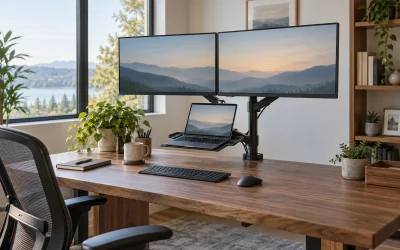
Solid wood (or a thick wood-veneer board) is the practical choice for a heavy, cable-managed battlestation. You can clamp a dual-monitor arm without fear, screw in under-desk trays, drill grommet holes, and stick adhesive cable channels that actually hold. Wood also damps keyboard and mouse noise, so a loud mechanical board sounds less harsh. The trade-off is maintenance: real wood can mark from spills and heat, and benefits from an occasional wipe with the right cleaner rather than harsh chemicals.
Practical build considerations
Think about weight first. A triple-monitor, speaker-laden setup puts serious point loads on the surface; wood handles that comfortably, while glass concentrates stress and can fail if the panel is thin or the clamp is over-torqued. Next consider cable management: if you want a clean under-desk raceway and grommets, wood is far easier to modify. Finally, consider your room; glass shows every crumb and fingerprint, so it demands more frequent cleaning to keep that premium look.
FAQ
Can you mount a monitor arm on a glass desk?
Yes, but carefully. Use a clamp with wide rubber pads, tighten only until snug, and prefer a grommet-style mount if the glass has a pre-cut hole. Thin or unsupported glass can crack under a clamp’s point pressure, so check the desk’s rated capacity and the arm’s clamp requirements first.
Does a mouse work on a glass desk?
Optical mice often track poorly on clear or glossy glass because the sensor cannot find a texture to read. A full-surface desk mat fixes this instantly and also protects the glass from scratches. Do not rely on a bare glass surface for precise aiming.
Bottom line
Pick glass for a light, minimalist, easy-to-clean showpiece and accept that you will need a mouse mat and gentle clamp handling. Pick solid wood for a heavy, cable-managed, arm-clamped battlestation that shrugs off modification and quiets your peripherals. Match the surface to how many devices you will hang on it and how much you plan to drill and clamp.