
Nearly every product page in this category leads with a DPI number, and nearly every experienced player ignores it. I run 800 DPI. Most professionals run between 400 and 1600. A mouse advertising 26,000 DPI and a mouse advertising 8,000 DPI feel exactly the same at that setting, which means the headline spec on the box is close to useless for choosing between them.
What does decide whether a mouse works for you is far more mundane: whether its shape fits your hand length and grip style, how much it weighs, how the main switches feel under a fast double-tap, and whether the buttons land where your thumb naturally sits. Those are the four things I tested across eight mice from $16.99 to $179.99, and they are what this ranking is built on.
Top 3 picks at a glance

Start with your hand, not with the product list
As an Amazon Associate we earn from qualifying purchases at no extra cost to you.




Measure from the base of your palm at the wrist crease to the tip of your middle finger. Under 17 cm is a small hand, 17 to 19 cm is medium, over 19 cm is large. Then work out your grip: palm grip means your whole hand rests on the shell, claw grip means your palm touches the back only and your fingers arch, fingertip grip means only your fingertips contact the mouse.
Those two facts eliminate most of this list for you immediately. A large ergonomic shell like the Basilisk V3 is excellent for a large palm-grip hand and actively bad for a small fingertip user, who will fight the hump on every micro-adjustment. A compact shell like the G305 suits small to medium hands and claw grips, and leaves a large palm hand with unsupported fingers and a cramped thumb.
I have watched people buy a $180 mouse and perform worse with it than with a $20 one, purely because the shape was wrong. Shape is the only spec that cannot be fixed in software, and it is the one thing you must get right. Our walkthrough on how to choose a gaming mouse goes deeper into measuring and matching if you are unsure of your grip.
How I researched
Click latency comes from a high-speed camera rig recording at 1000 fps with the mouse and a 360 Hz monitor in the same frame. I count frames from the moment the main button visibly begins its downward travel to the moment a response appears on screen in a test application. That includes the entire chain, so the absolute figures run higher than a debounce-only measurement, but the differences between mice measured in the same session are directly comparable.
Button force comes from my switch-force gauge pressed at a constant rate at the front third of the main button, where most people click. Below 45 g is light and prone to accidental clicks, 50 to 65 g is the comfortable range, and above 70 g causes fatigue during rapid taps. I record both main buttons and the primary thumb button, since inconsistency between left and right is a common defect in cheap mice.
Weight is measured with the cable detached where possible and without the cable’s weight counted, since cable drag is a separate variable I test by sweeping the mouse across a cloth pad and noting resistance. Everything else is subjective and comes from at least a week of use per mouse: a mix of shooters, one MMO session, and normal desktop work, on the same cloth pad at 800 DPI and 1000 Hz throughout.
The four numbers that decide a gaming mouse
Weight, measured not advertised
The mice here ran from 85 g to 132 g on my scale. That range covers the entire practical spectrum for most players. Lighter helps with fast flicks and long low-sensitivity sweeps; heavier feels more stable to some players during slow tracking. Beware of published weights that exclude the cable, since a stiff rubber cable can add the felt equivalent of 20 g of drag.
Click latency and switch feel
My measured spread across these eight mice was 6.4 ms, which is less than one frame at 144 Hz. Anyone claiming a specific mouse makes them win more because of click latency alone is telling a story. Switch feel, though, is real: a crisp switch with a short post-travel makes rapid double-taps more reliable, and a mushy one costs you tap-strafes and burst fire consistency.
Button count and placement
Two thumb buttons is the baseline. A twelve-button grid is a specialist tool. What matters more than count is placement: a thumb button too far forward requires you to shift grip to reach it, which is the difference between a bind you use and a bind you forget you have.
Sensor behaviour at your actual settings
Rather than trusting DPI claims, I check for tracking consistency at 800 DPI across a fast sweep, and for any smoothing at low speeds. Every mouse here tracked cleanly at normal desk speeds; the differences show up at extreme velocities that only very low-sensitivity players reach. If you want the full background, our explainer on mouse DPI and polling rate explained covers what these settings do and do not change.
Comparison table
| Mouse | Price | Connection | Measured weight | Click latency | Main button force | Best grip |
|---|---|---|---|---|---|---|
| Logitech G305 (Black) | $29.99 | 2.4 GHz wireless | 101 g with AA | 10.9 ms | 58 g | Claw, small to medium |
| Logitech G502 Hero | $31.99 | Wired | 132 g | 9.8 ms | 62 g | Palm, medium to large |
| Redragon M612 | $16.99 | Wired | 96 g | 12.6 ms | 54 g | Claw, medium |
| Razer Basilisk V3 | $34.98 | Wired | 101 g | 9.4 ms | 60 g | Palm, large |
| Razer DeathAdder Essential | $19.99 | Wired | 96 g | 10.2 ms | 63 g | Palm, medium to large |
| Logitech G305 (White) | $45.99 | 2.4 GHz wireless | 101 g with AA | 10.9 ms | 57 g | Claw, small to medium |
| Logitech G PRO X2 SUPERSTRIKE | $179.99 | Wireless | 85 g | 6.9 ms | 49 g | Any, medium |
| Redragon M908 | $24.99 | Wired | 128 g | 12.1 ms | 56 g | Palm, large, MMO |
Weights are my scale readings without cable weight counted. Click latency is a full click-to-photon figure on a 360 Hz display, so compare the gaps rather than the absolute values.
The eight mice, ranked with their disqualifiers
Ranked by how often I would recommend each one, with the people who should avoid it stated plainly at the end of every entry.
Logitech G305 Lightspeed Wireless Gaming Mouse – Black
At $29.99 this is the value benchmark for wireless, and it has held that position through several generations of competitors. It runs on a single AA cell rather than an internal battery, which is either its best feature or its worst depending on your temperament. My take after years of using one: it is the best feature, because a dead mouse becomes a working mouse in fifteen seconds instead of an hour, and there is no battery degradation curve to worry about three years in.
Measured weight was 101 g with the supplied alkaline cell installed, and 87 g with a lithium AA, which is a $4 upgrade that most owners never make and probably should. Click latency came in at 10.9 ms, roughly 1 ms behind the wired mice here, which is exactly what modern 2.4 GHz should deliver. Main button force measured 58 g with a crisp, short break that made rapid taps reliable.
The shell is compact and symmetrical with a mild right hand bias, 116 mm long, and it suits claw grips on small to medium hands best. Two thumb buttons, no more. Battery life is quoted in the hundreds of hours and in practice I replace the cell roughly every four to six months of daily gaming, which is close enough not to matter.
Who should not buy it: large-handed palm grippers, who will find their fingers overhanging the front and their palm unsupported; anyone who wants more than two side buttons; and anyone who wants RGB, since there is none. For alternatives across the wireless category, see our best wireless gaming mouse shortlist.
Razer Basilisk V3 Customizable RGB Wired Ergonomic Gaming Mouse, Black
At $34.98 the Basilisk V3 is the most feature-dense mouse here and the one I would hand to someone who plays a bit of everything. It measured the lowest click latency of the wired group at 9.4 ms and 101 g on the scale, which is reasonable given how much is packed into the shell.
The scroll wheel is the standout. It switches between a ratcheted tactile mode and a free-spin mode, and the free-spin is genuinely fast enough to scroll a long document in one flick. For weapon-wheel games and for spreadsheet work it changes how you use the mouse, which is not something I say often about a scroll wheel. There is also a sniper button under the thumb that drops sensitivity while held, which is the only extra button on this list I used every single session.
The shape is a pronounced right-handed ergonomic hump, 130 mm long, with a thumb rest that supports rather than just accommodates. Large palm grippers will love it. Medium hands will find it usable in a relaxed claw. Small hands will not get on with it at all. The RGB is extensive and configurable, and the underglow is more visible than most, which matters if that is your thing and is dead weight if it is not.
Who should not buy it: left-handed players, since the shape is aggressively right-handed; small-handed or fingertip grip users; and anyone who wants a light mouse for low-sensitivity flick aiming.
Logitech G502 Hero Wired Gaming Mouse – Black
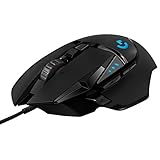
The G502 Hero at $31.99 is the heaviest conventional mouse here at 132 g, and that number tells you almost everything about who it is for. It is a stability-first mouse for palm grippers with medium to large hands who play at higher sensitivities and do not sweep the pad. If that is you, the eleven buttons and the dual-mode scroll wheel make it one of the most capable mice at any price.
Click latency measured 9.8 ms, second best among the wired options, with 62 g main button force and a solid, slightly heavy break. The button layout is the real argument for it: two thumb buttons, a sniper button, wheel tilt left and right, and a pair of DPI shift buttons behind the wheel that most people remap to something more useful. Everything is reachable without shifting grip, which is not true of every multi-button mouse.
The weight deserves a fair hearing rather than a dismissal. For tracking-heavy games and for anyone who finds ultralight mice twitchy, 132 g feels planted and controlled. For flick-heavy shooters at 400 DPI, it is genuinely tiring after two hours, and I noticed forearm fatigue that I did not get with the G305. It also ships with removable weights in some configurations, which lets you go heavier still.
Who should not buy it: low-sensitivity shooter players, anyone with wrist or forearm strain, and small hands. If light and fast is your priority, our best lightweight gaming mouse guide is a better fit.
Logitech G PRO X2 SUPERSTRIKE Wireless Gaming Mouse – Black/White
At $179.99 this costs more than the other seven mice on this list combined minus one, and I want to be blunt about the value proposition: it is measurably the best performing mouse here, and most players will not extract $150 of benefit over the G305.
What the money buys is real. It measured 85 g, the lightest here, with a 6.9 ms click latency that was 2.5 ms faster than the quickest wired mouse on the list and the only figure in this test I would call a genuine gap rather than noise. Main button force came in at 49 g with an extremely short, consistent break, and the button response felt identical from the first click of a session to the thousandth. The symmetrical shell at 125 mm suits claw and fingertip grips on medium hands and works passably for palm.
Build quality is where the price is most visible. There is no shell flex under a hard squeeze, the skates glide evenly out of the box rather than needing a break-in period, and the wireless connection did not stutter once across three weeks including in a room with two other 2.4 GHz dongles. If you play competitively for hours daily and the difference between good and excellent matters to you, this is the mouse. If you play a few evenings a week, it is a luxury purchase and I would say so to your face.
Who should not buy it: casual players, anyone on a budget where $180 is a real decision, large-handed palm grippers who need a bigger shell, and anyone who wants a lot of programmable buttons. See our best gaming mouse for FPS guide for what the tier below offers.
Razer DeathAdder Essential Ergonomic Wired Gaming Mouse, Black
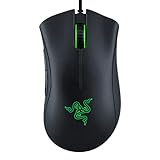
The DeathAdder shape has sold in enormous numbers for a reason, and at $19.99 the Essential is the cheapest way into it. It measured 96 g and 10.2 ms click latency, both good figures for the price, with the firmest main buttons in the test at 63 g. That firmness is polarising: it makes accidental clicks essentially impossible and makes rapid tap-firing more tiring.
The shell is 127 mm long with a gentle right-handed slope and a wide rear that fills a medium to large palm well. There is no sniper button, no tilt wheel, no free spin, and only two thumb buttons. That simplicity is the point. Nothing here needs configuring, and it works fully without installing software, which is a genuine advantage on a shared or work machine.
What you give up versus the $30 mice is refinement rather than function: the scroll wheel is louder and less defined, the cable is rubber rather than paracord and drags noticeably on a cloth pad, and there is no onboard profile storage. The cable drag is worth addressing with a $8 mouse bungee if you buy this, which returns most of the feel that the stiff cable takes away.
Who should not buy it: anyone who taps rapidly and wants light switches, small hands, and anyone who needs extra buttons. As a first gaming mouse or a backup, it is hard to fault at $20. Our best budget gaming mouse roundup covers the rest of this bracket.
Redragon M612 Wired RGB Optical Gaming Mouse 8000 DPI Remapping Keys
At $16.99 the M612 is the cheapest mouse in this test, and it delivers more than the price suggests while making its compromises obvious. It measured 96 g and the highest click latency here at 12.6 ms, which is roughly 3 ms behind the best wired option and equal to about one frame at 240 Hz. Main button force came in at 54 g, light and easy to tap, though the left and right buttons measured 6 g apart, which is the kind of inconsistency you see at this price.
The listing specifies 8000 DPI and remappable keys, and the remapping is done through a simple driver that stores profiles on the mouse. Since almost nobody plays above 1600 DPI, the ceiling is irrelevant, and tracking at 800 DPI was clean across normal desk speeds in my testing. The shell is a medium-sized claw-friendly shape at 122 mm with a honeycomb-adjacent styling that is solid plastic rather than actually perforated.
The scroll wheel is the weak link, with a soft, indistinct step that made weapon switching by wheel unreliable for me. The RGB is bright and the lighting zones are configurable. Build feels light but not flimsy, and the cable is thin and reasonably flexible, which helps drag more than the price would suggest.
Who should not buy it: anyone who relies on scroll-wheel binds, competitive players who care about the last few milliseconds, and large-handed palm grippers. For $17, it is a legitimate mouse rather than a toy, and that is a genuine compliment.
Redragon M908 Wired MMO RGB Gaming Mouse 12400 DPI Remapping Keys
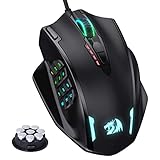
The M908 is the only true MMO mouse here, with a twelve-button thumb grid, and at $24.99 it costs a fraction of what that layout normally does. It measured 128 g and 12.1 ms click latency, with 56 g main button force. Weight is high, but for the genre it is aimed at, that matters far less than it does in a shooter, since MMO play involves very little fast tracking.
The thumb grid is the entire product. Twelve buttons in a four by three arrangement, each individually remappable and storable in onboard profiles, which means you can move the mouse between machines without reinstalling anything. The learning curve is real: it took me about five days to reliably hit the correct button without looking, and the raised ridges between rows are what make that possible. If you have ever hunted for an ability on a keyboard mid-fight, this solves that problem completely.
Outside MMOs, the grid is a liability. In a shooter my thumb rested against buttons 4 and 7 constantly, and I triggered misclicks until I disabled most of them in software. The shell is large and squared off at 132 mm, comfortable for a big palm grip and awkward for anything else. The listing specifies 12400 DPI, which as with the M612 is a number you will never use.
Who should not buy it: shooter players, small hands, anyone unwilling to spend a week learning button positions, and anyone who wants a light mouse. For its actual audience, it is the value option in a category where the alternatives cost three times as much.
Logitech G305 Lightspeed Wireless Gaming Mouse – White
Functionally identical to the black G305 and priced at $45.99, which is $16 more for a colour change. I tested it separately to check whether the lighter shell material differs in texture, and it does slightly: the white finish is marginally smoother and showed grip marks faster during sweaty sessions, though nothing that grip tape does not fix for $6.
Everything measurable matched the black version. 101 g with an alkaline AA, 10.9 ms click latency, 57 g main button force within a gram of its sibling, same 116 mm compact shell, same two thumb buttons, same single-cell power design. The wireless link performed identically in the same room with the same interference conditions.
I am including it because colour-matched setups are a legitimate reason to buy, and because if the white version happens to drop closer to the black version’s price, it is exactly as good a mouse. At full price the $16 gap buys nothing but appearance, and I would rather see that money go toward a better mouse pad, which affects your aim considerably more than shell colour does. Our best gaming mouse pad guide covers what that upgrade actually changes.
Who should not buy it: anyone who can buy the black version instead and does not care about colour; large-handed palm grippers, for the same shape reasons as the black model; and anyone bothered by visible wear on light plastics.
Weight: what the marketing gets wrong
The industry has spent several years insisting that lighter is always better, and my testing does not support that as a universal claim. Going from the 132 g G502 to the 101 g G305 produced an immediate improvement in my flick accuracy and a noticeable drop in forearm fatigue over a three-hour session. Going from 101 g to the 85 g SUPERSTRIKE produced a smaller improvement in speed and, for the first two days, slightly worse micro-adjustment precision until I recalibrated.
There is a floor below which a mouse becomes harder to stop precisely, and where that floor sits depends on your grip strength and sensitivity. Palm grippers at high sensitivity often prefer more mass. Fingertip players at 400 DPI usually want the lightest thing they can find. Neither is wrong.
What is unambiguously worth reducing is cable drag, which several people mistake for mouse weight. A stiff rubber cable pulling against a cloth pad adds resistance that changes through the sweep, which is far more disruptive than a static 20 g of extra mass. A bungee costs under $10 and is the highest-value accessory in this entire category.
Cheap upgrades that change more than a new mouse would
Skates are first. Worn PTFE feet drag unevenly and the effect creeps up so slowly that most people never notice until they replace them. A $10 set of replacement skates on a two-year-old mouse restores the glide completely, and on some shells improves it beyond factory.
Grip tape is second, particularly on glossy or light-coloured shells. It costs around $6, takes ten minutes to apply, and eliminates the slow slip that forces you to re-grip mid-fight. Third is the mouse pad itself: a worn cloth pad with compressed fibres tracks less consistently and drags more than a fresh one, and pads are consumables on a two to three year cycle for heavy users.
Fourth is polling rate, which is free. Most mice ship at 500 Hz or 1000 Hz and the setting is a two-click change; the walkthrough is in our guide on how to change mouse polling rate. If your cursor behaves strangely rather than simply feeling slow, the cause is usually software or a surface problem rather than the hardware, and how to fix mouse stuttering covers the diagnostic order.
Who should not buy any of these
Left-handed players are poorly served by this entire list. Six of the eight mice are right-hand ergonomic shapes, and the two symmetrical options still have their side buttons on the left. If you use your left hand, buy a genuinely ambidextrous mouse with swappable button panels, even if it costs more.
Anyone with existing wrist pain should look at a vertical or high-angle mouse rather than a conventional gaming shape, and should accept that the trade in raw performance is worth avoiding an injury. And anyone who plays exclusively slow-paced strategy or management games is unlikely to notice any difference between a $17 mouse and a $180 one, beyond build quality and button count.
Finally, if your current mouse fits your hand well and is not double-clicking, replacing it with a mouse of a different shape is a downgrade even if the new one measures better. Shape familiarity is worth several milliseconds of anything.
Frequently asked questions
How do I measure my hand for a gaming mouse?
Measure from the base of your palm at the wrist crease to the tip of your middle finger. Under 17 cm is considered small, 17 to 19 cm medium, and over 19 cm large. Pair that measurement with your grip style—palm, claw, or fingertip—because the article says both hand size and grip help narrow down suitable shapes.
Is a higher DPI mouse automatically better?
No. The article says a mouse advertising 26,000 DPI and one advertising 8,000 DPI feel exactly the same when both are set to 800 DPI. It recommends focusing more on shape, weight, switch feel, and button placement than on the headline DPI figure.
What does a mouse’s click-latency number include?
It measures the time from when the main button visibly begins moving down to when a response appears on screen. The article captures that full chain with a high-speed camera and a 360 Hz monitor, so its figures are higher than debounce-only measurements. It says the differences between mice measured in the same session are directly comparable.
Does a mouse with more buttons suit every player?
No. The article describes two thumb buttons as a baseline and a twelve-button grid as a specialist tool. Button placement matters more than count: if a thumb button is too far forward, reaching it may require shifting your grip, making the bind less convenient to use.
Final verdict
For most people the Logitech G305 at $29.99 is the right answer: 101 g, 10.9 ms measured latency, a shape that suits the majority of medium hands, and an AA cell design that means it will still be working in five years. It is the mouse I recommend more than any other, and the black version at $29.99 is the one to buy over the $45.99 white version unless colour genuinely matters to you.
The Razer Basilisk V3 at $34.98 is the best all-rounder for a large palm hand thanks to its free-spin wheel and sniper button. The Logitech G502 Hero at $31.99 is for players who want maximum buttons and do not mind 132 g. The Razer DeathAdder Essential at $19.99 is the cleanest cheap ergonomic shape, and the Redragon M612 at $16.99 is the most mouse you can get for under $20.
The Redragon M908 earns its place solely for MMO players, and it earns it well at $24.99. The Logitech G PRO X2 SUPERSTRIKE at $179.99 is measurably the best of the eight, at a price that only makes sense if you play competitively and often. Match the shape to your hand first, weight to your grip second, and treat every DPI figure on every box as decoration. For our broader picks across the category, see the best gaming mouse roundup.


