
Top 3 picks at a glance

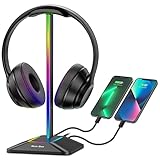
Best PC Gaming Headset Stands for Clean Desks
The best PC gaming headset stands are the ones that keep your headset upright without stealing valuable mouse space, tipping under cable tension, or adding USB features you do not actually need.
For most gaming desks, a weighted single-headset stand with a footprint under 5 inches (13 cm) is the safest choice. Choose a USB-equipped model only if its ports are positioned conveniently and the stand connects directly to the PC rather than relying on an overloaded hub. On very crowded desks, an under-desk hanger is often a better solution than any freestanding stand.
As an Amazon Associate we earn from qualifying purchases at no extra cost to you.

What matters more than the RGB lighting
1. Stability under real cable movement
Headset stands are easy to tip when the headset cable is pulled sideways. A stable design needs both a low center of gravity and enough base width to resist twisting. A heavy metal base is useful, but weight alone is not everything: a tall, narrow stand can still rotate or topple if the cable catches on it.
As a practical target, look for a base at least 10–15 cm wide or deep, a non-slip underside, and a support column that does not flex when you lift the headset. Wireless headsets are less demanding because they do not drag a cable across the desk. Wired headsets benefit from a wider base or a cable channel that guides the lead toward the rear.
2. Headset clearance and contact points
The hook should support the headband without pressing hard into its padding. A narrow metal hook can leave a permanent ridge in soft leatherette, while an extremely short hook may let large ear cups touch the desk.
Measure your headset before buying. The useful dimensions are:
- Headband width: the hook should be wider than the narrowest reinforced section of the band.
- Hook height: allow enough space for the lowest ear cup to remain above the base.
- Ear-cup swing: angled or rotating cups need clearance so they do not strike the column.
- Headband adjustment: leave the headset at its normal size; repeatedly compressing it around a short hook can stress the band.
For especially large studio or aviation-style headsets, a broad, curved cradle is safer than a thin hook. For compact gaming headsets, most standard stands provide adequate clearance.
3. Base footprint on a crowded gaming desk
A stand that occupies 15 square inches may sound compact, but that area often overlaps the mouse, keyboard cable, monitor base, or a desk mat. Place a sheet of paper under the proposed stand and mark its footprint before buying. This simple check reveals whether the stand will fit without forcing your keyboard or mouse into an uncomfortable position.
Height matters too. A tall stand may interfere with a monitor’s lower edge or block a speaker. A shorter stand can fit beneath a shelf, but it needs enough height to keep the headset’s ear cups off the desk.
Head-to-head: which stand type fits your desk?
| Stand type | Typical footprint | Typical height | Best use | Main compromise |
|---|---|---|---|---|
| Weighted single headset stand | 10–15 cm wide | 22–30 cm | Stable everyday storage | Uses permanent desk space |
| USB headset stand | 12–16 cm wide | 22–30 cm | Charging, peripherals, or lighting | Needs a cable and may add hub clutter |
| Under-desk hanger | 4–8 cm mounting width | Usually 5–10 cm below desk | Very crowded desks | Requires adhesive or screws and has less visibility |
| Dual-headset stand | 18–28 cm wide | 22–30 cm | Two headsets or headset plus controller | Consumes the most surface area |
| Monitor-mounted hook | Minimal desk footprint | Depends on mount | Small desks with spare monitor space | Can add load or obstruct monitor controls |
Best PC gaming headset stands by buying situation
Best for a conventional gaming desk: a weighted metal stand
A basic weighted stand is the best default for a single wired or wireless headset. Prioritize a rubberized base, a broad hook, and a cable exit facing away from your mouse hand. Models such as the Corsair ST100 RGB add USB ports, lighting, and a substantial base, making them suitable when the extra functions justify the desk space. Its design is better suited to a permanent setup than to a minimalist desk that is frequently rearranged.
Best for USB convenience: a powered feature stand
A USB stand makes sense when you regularly connect a wireless-headset receiver, controller, mouse, or phone cable in the same place. The Razer Base Station V2 Chroma is an example of this category, combining headset storage with USB connectivity and lighting.
Do not treat every USB port as a high-power charging outlet. A typical USB 2.0 port supplies up to 2.5 W at its nominal limit, while a USB 3.x downstream port may provide up to 4.5 W. A wireless headset might draw roughly 0.5–2.5 W while charging, but a phone or controller can compete for the same budget. If a stand has two ports sharing one upstream connection, check whether both remain fast and stable when used together.
A quick power-budget example: if a stand’s shared connection can provide 4.5 W and your headset charger draws 2 W, only about 2.5 W remains for another device before overhead and safety limits. That is enough for a low-power receiver or slow accessory charging, but not a reason to replace a dedicated powered hub.
Best for a tiny desk: an under-desk hanger
An under-desk hanger wins when every square inch matters. It removes the base entirely and keeps the headset below the keyboard or beside the computer. Adhesive versions are convenient for lighter headsets, while screw-mounted hangers are safer for heavy models or desks with textured surfaces.
Before mounting, check knee clearance, desk thickness, and the direction in which the headset cable will fall. Position the hanger far enough from the desk edge that the ear cups do not hit your legs, but close enough that you can reach it without twisting.
Best for two headsets: a dual-hook stand
A dual stand is useful for a work-and-gaming setup, two users, or a wired and wireless headset kept ready at the same time. Measure the width against your keyboard and mouse area. Two hooks can also create cable crossings, so choose one with separated channels or place the wired headset on the side nearest the PC.
USB features and cable management
A clean stand should route the upstream cable toward the rear of the desk and keep charging leads from crossing the mouse surface. A rear-facing port is usually preferable to a front-facing port for permanent wiring; front ports are more convenient for temporary connections but leave visible cables.
- Use a short right-angle USB cable when the PC is close to the stand.
- Leave a small service loop so moving the stand does not pull the PC port.
- Keep wireless receivers away from USB 3.x cables and metal obstructions when possible.
- Use a separate powered hub if the stand’s ports disconnect under simultaneous load.
- Disable stand lighting if it reflects in the monitor or adds visual clutter.
Decision matrix for a cleaner purchase
| Your situation | Recommended choice | What to prioritize |
|---|---|---|
| Wired headset and large mouse movements | Wide weighted stand | Rear cable routing, rubber base, low center of gravity |
| Wireless headset with a charging lead | Weighted stand with one convenient USB port | Port location and charging stability |
| Desk less than 100 cm wide | Under-desk hanger or monitor-side hook | Minimal footprint and knee clearance |
| Two headsets | Dual-hook stand | Width, separated cable paths, non-slip base |
| Headset with thick leatherette padding | Broad curved cradle | Wide contact surface and generous clearance |
| Frequent desk rearrangement | Simple lightweight stand | No permanent adhesive, manageable cable length |
Final buying checklist
Choose the smallest stand that safely clears the desk and does not force the headset cable across your input area. Confirm the base dimensions, hook width, total height, and the headset’s weight before ordering. If you want USB ports, verify whether they are data-capable, charging-capable, or merely pass-through extensions, and whether their power is shared.
For most people, a stable weighted stand without unnecessary electronics is the cleanest and most reliable choice. A USB model is worthwhile when it replaces a separate accessory, while an under-desk hanger is the better answer when desk space—not lighting, charging, or extra ports—is the limiting factor.


