
Top 3 picks at a glance

Best TV Headphones for Clear Wireless Audio
The best TV headphones for most people are the Sennheiser RS 195-U if clear speech and hearing adjustment matter most; choose the RS 175 for a simpler, more affordable RF system, or an Avantree HT5009-class kit when you want broad TV compatibility at a lower price.
TV headphones are not simply ordinary Bluetooth headphones with a longer battery. The transmitter, connection type, dialogue processing, charging method, and ability to keep the television speakers active can matter more than headline sound quality. The right choice depends on whether you prioritize speech, cinema sound, low delay, multiple listeners, or easy setup.
As an Amazon Associate we earn from qualifying purchases at no extra cost to you.


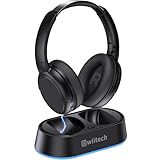
Quick comparison
| Model or class | Best for | Wireless link | TV inputs | Typical battery claim | Usual market range |
|---|---|---|---|---|---|
| Sennheiser RS 195-U | Dialogue clarity and hearing adjustment | Digital RF, dedicated dock | Optical, analog | Up to about 18 hours | Usually $250–$350 |
| Sennheiser RS 175-U | Movies, music, and simple private listening | Digital RF, dedicated dock | Optical, analog | Up to about 18 hours | Usually $180–$280 |
| Avantree HT5009 | Budget users needing optical and Bluetooth flexibility | Bluetooth, low-latency transmitter included | Optical, AUX, RCA through adapter | Up to about 40 hours, depending on use | Usually $80–$130 |
| Bluetooth headphones plus a low-latency transmitter | Using headphones you already own | Bluetooth, often aptX Adaptive or aptX Low Latency | Optical, AUX, sometimes HDMI ARC | Depends on headphones | Usually $60–$300 total |
Battery figures are manufacturer claims and vary with volume, temperature, wireless mode, and battery age. A dedicated RF kit generally provides more predictable TV performance than Bluetooth, while Bluetooth offers more flexibility with phones, tablets, and other devices.
Best for dialogue: Sennheiser RS 195-U
The RS 195-U is the strongest choice when understanding speech is more important than maximum bass or surround effect. It includes selectable listening profiles intended to improve speech intelligibility, and its independent left-right volume adjustment can help when one ear hears differently from the other.
Its dedicated RF transmitter avoids the pairing problems common with televisions and usually delivers a stable connection throughout a room or nearby home. The charging station also gives the headphones a clear storage location, reducing the chance of discovering a flat battery just as a program starts.
Choose the RS 195-U when you want:
- Speech-focused listening modes rather than generic equalization.
- Independent left and right volume controls.
- A dedicated optical connection and charging dock.
- Low perceived delay for dialogue and video.
- Private listening without depending on the television’s Bluetooth implementation.
Its limitations are equally important. This is a specialized TV system, not the best travel headset, and it is less convenient if you regularly switch between a television and a phone. The transmitter is primarily designed for optical and analog TV outputs, so an HDMI ARC or eARC port alone is not enough.
Best simpler RF option: Sennheiser RS 175-U
The RS 175-U is a better fit for viewers who want a straightforward wireless TV headset without the RS 195-U’s hearing-oriented controls. It supports selectable sound modes, including a surround-style option and bass adjustment, but it is aimed more at general film and television enjoyment than precise speech compensation.
Its digital RF connection is the main advantage over ordinary Bluetooth headphones. Audio delay is generally low enough that mouths and voices remain synchronized, and the included dock charges the headset whenever it is stored correctly.
The RS 175-U makes sense for a single listener who wants reliable private audio and does not need to use the headphones as a general-purpose mobile headset. If dialogue is consistently difficult to understand, the RS 195-U’s speech profiles are worth the extra cost instead of simply increasing volume.
Best lower-cost flexible kit: Avantree HT5009
The Avantree HT5009 is a practical choice when price and compatibility matter more than advanced hearing adjustment. The kit includes a Bluetooth transmitter and over-ear headphones, with optical and analog connection options. Its low-latency design is intended to reduce the lip-sync delay that can occur with basic Bluetooth audio.
This type of system is especially useful for older televisions that have optical output but no Bluetooth. It can also be more convenient than a dedicated RF headset if you want the transmitter to work with another Bluetooth headphone later.
Check the exact television and transmitter settings carefully. “Low latency” is not a guarantee that every Bluetooth combination will be delay-free: both the transmitter and receiving headphones must support compatible codecs, and some televisions add their own audio-processing delay.
RF versus Bluetooth: which link is better for television?
| Requirement | Dedicated RF headphones | Bluetooth headphones |
|---|---|---|
| Typical TV delay | Usually very low and consistent | Can be low with a matched low-latency codec; otherwise variable |
| Setup | Usually connect the dock once and use it | Requires pairing and codec compatibility |
| Range | Often covers a room and nearby areas | Commonly around 10 metres in practical indoor use, but walls and interference reduce it |
| Phone compatibility | Usually limited or absent | Strong advantage |
| Multiple listeners | Possible on systems supporting additional compatible receivers | Requires dual-link or a separate transmitter designed for two devices |
For television, prioritize stable synchronization over maximum Bluetooth codec bandwidth. TV speech is normally delivered as stereo or compressed surround downmixed to stereo, so a higher-resolution Bluetooth codec does not automatically make dialogue clearer.
Optical, HDMI ARC, and analog compatibility
Optical output
Optical is usually the safest connection for dedicated TV headphones. In the television’s sound menu, set the digital audio output to PCM or stereo PCM if the transmitter produces silence. Many headphone transmitters cannot decode Dolby Digital, DTS, or multichannel bitstreams through their optical input.
HDMI ARC and eARC
HDMI ARC and eARC are excellent for soundbars and AV receivers, but many TV headphone docks do not have HDMI inputs. If your television offers only HDMI audio for the desired setup, use an HDMI ARC audio extractor that explicitly supports ARC or eARC, stereo output, and the required HDCP behavior. A basic HDMI-to-optical adapter designed for an input source may not work in the reverse ARC direction.
Headphone and RCA outputs
A 3.5-mm headphone socket is simple, but some televisions mute their speakers when it is used. RCA line output usually keeps the speakers active, though volume may be fixed and controlled on the headphones instead. If the TV has only a 3.5-mm output, a 3.5-mm-to-RCA cable can connect it to a transmitter with analog inputs.
Multi-listener setups
For two listeners, do not assume that any two Bluetooth headphones can connect to one television. The TV may support only one Bluetooth device, and even televisions advertising dual audio can introduce additional delay or restrict volume control.
There are three more dependable approaches:
- Use a dedicated RF transmitter that explicitly supports additional compatible headphones.
- Use a Bluetooth transmitter with documented dual-link support and two compatible low-latency headphones.
- Connect separate headphone systems through an optical splitter or suitable analog distribution adapter.
Before buying, confirm whether the second headset receives independent volume control. Some multi-listener systems share one transmitter but require each listener to use their own headphone controls.
Settings that improve dialogue immediately
- Set the TV’s digital audio format to PCM. This removes unsupported Dolby or DTS bitstreams that can cause silence or distortion.
- Disable artificial surround processing first. Virtual surround can spread effects but make voices less centered. Re-enable it only if dialogue remains clear.
- Begin with a moderate volume and raise speech enhancement before bass. Boosting overall volume also boosts music and effects, while a speech profile targets the frequencies that make consonants easier to recognize.
- Turn off volume normalization if it pumps or dulls speech. Try the TV’s night, clear voice, or dialogue mode instead, one setting at a time.
- Test lip synchronization with a news presenter. If the delay is visible, disable extra TV audio processing and use a matched low-latency transmitter and headset.
How to choose the best TV headphones for your room
| Your situation | Best direction | Reason |
|---|---|---|
| Speech is difficult to understand | Sennheiser RS 195-U | Speech profiles and independent channel adjustment |
| You mainly watch films alone | Sennheiser RS 175-U | Low-delay RF, sound modes, and docked charging |
| You need optical compatibility on a budget | Avantree HT5009-class kit | Transmitter, optical input, and lower purchase cost |
| You already own good Bluetooth headphones | Matched low-latency Bluetooth transmitter | Avoids buying another headset, provided codec support matches |
| Two people need private audio | RF multi-headset system or documented dual-link transmitter | More reliable than assuming the TV supports two headphones |
| You need headphones for travel as well | Bluetooth noise-cancelling headphones with a transmitter | More versatile away from the television |
Final verdict
The Sennheiser RS 195-U is the best TV headphone choice when clear dialogue, hearing adjustment, and dependable everyday operation come first. The RS 175-U is the better general-purpose RF option for a single viewer, while the Avantree HT5009 offers strong value when optical, analog, Bluetooth, and long battery life are more important than advanced speech controls.
Whichever model you choose, check the television’s actual audio outputs before buying. Optical-to-PCM compatibility, a low-delay wireless match, and a charging dock will usually improve the viewing experience more than a larger list of sound modes or a higher Bluetooth codec number.


