
Transitioning from a single desktop screen to a dual-display setup is one of the most effective ways to boost productivity, but it immediately poses a spatial puzzle. Once you buy two monitors, you face a fundamental layout choice: place them side-by-side using a standard horizontal mount, or position one directly over the other in a vertical stack. Deciding between a dual monitor arm vs stacked monitor arm setup isn’t just an aesthetic decision for your home office—it fundamentally alters your neck posture, light distribution, and desktop footprint.
As remote work and creative workflows settle into refined home setups for 2026, desk space has become premium real estate. A side-by-side arm broadens your field of view horizontally, making it natural for data entry, video editing, and multi-tab browsing. Conversely, a stacked monitor arm setup reclaims horizontal desk width by building upward, making it ideal for compact nooks, narrow writing desks, or streaming control hubs. Understanding how each mount handles dynamic movement, installation load, and daily ergonomic stress will help you choose the ideal system for your home.
As an Amazon Associate we earn from qualifying purchases at no extra cost to you. Product prices and availability are accurate as of the date shown and are subject to change.
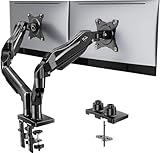


Top 3 picks at a glance
Quick Verdict
If you have a desk that is at least 48 inches wide and spend your workday jumping between active windows, spreadsheet columns, or timeline editing suites, a standard side-by-side dual monitor arm is the superior choice. Sweeping your eyes horizontally aligns with natural human visual mechanics and minimizes neck strain.
Choose a stacked monitor arm setup if your desk is under 44 inches wide, if your desk depth is shallow (18 to 24 inches), or if your secondary screen serves as a passive reference monitor (such as monitoring chat windows, code outputs, or system stats). Vertical stacking preserves valuable lateral desk space and keeps your displays contained within the footprint of a compact workspace.
Side by Side
| Feature | Dual Monitor Arm (Side-by-Side) | Stacked Monitor Arm (Vertical) |
|---|---|---|
| Primary Ergonomic Axis | Horizontal eye pan (side-to-side) | Vertical tilt / neck extension (up-and-down) |
| Desk Width Needed | 48 to 72 inches minimum | 24 to 48 inches |
| Desk Depth Needed | 24 to 30+ inches for proper focal length | 18 to 24+ inches |
| Neck Comfort | High for side-by-side multi-tasking | Moderate; top screen requires slight chin tilt |
| Desk Footprint & Look | Wide horizontal profile; commands wall space | Compact, tall tower profile; opens up sides |
| Durability & Stability | Balanced weight spread across dual articulated arms | High center of gravity; requires tall, rigid pole mount |
| Maintenance & Adjustment | Frequent dynamic adjustments via gas spring arms | Set-and-forget vertical positioning on tall pole |
| Price Range | $30.00 – $150.00 | $35.00 – $140.00 |
| Resale & Versatility | Very high demand; fits almost all work setups | Niche appeal; popular with programmers and streamers |
| Best For | Video editing, research, dual active app usage | Narrow desks, primary gaming display + chat/stream screen |
Where Dual Monitor Arm Wins
The traditional horizontal dual monitor arm remains the benchmark for home office ergonomics because human eyes are naturally oriented to scan from left to right. When two displays sit side-by-side at equal eye height, your neck pivots smoothly across a horizontal plane, utilizing dominant neck muscles built for wide panning motion rather than vertical tilting.
Side-by-side setups offer maximum dynamic flexibility. Dynamic gas-spring arms let you pull one monitor forward for focus work while pushing the secondary display back, or pivot one screen into portrait mode while keeping the other in landscape. Budget-friendly mechanical models like the WALI Adjustable Dual Monitor Arm ($32.99, holding up to 22 lbs per arm for 13–32 inch screens) offer robust post-mounted swivel adjustments for stationary setups. If you need effortless, fluid adjustability, dynamic gas-spring mounts like the HUANUO FlowLift™ Dual Monitor Stand ($59.99, supporting 4.4 to 19.8 lbs per arm with full motion motion control) allow you to move each screen independently with a light touch.
For heavy, high-end, or wider displays, a heavy-duty side-by-side system like the STANDOPIA Dual Monitor Mount ($63.99, engineered for 17–40 inch screens weighing up to 26.4 lbs per arm) keeps large panels stable without drooping. This lateral weight distribution keeps the center of gravity closer to the desk surface, reducing wobble when typing on standing desks or flexible furniture.
Where Stacked Monitor Arm Setup Wins
While horizontal setups reign in wide offices, the stacked monitor arm setup is the ultimate problem solver for space-constrained home workspaces. When your home office desk is crammed into a bedroom corner or built into a 36-inch alcove, side-by-side monitors often overhang the desktop edges, creating visual clutter and collision risks with walls or doors.
A vertical stacked mount utilizes a tall central pole—often 28 to 35 inches high—to mount one screen directly above the other. Specialized hardware like the HUANUO 17-32 Inch Dual Monitor Stand Stacked Mount ($59.99, weight capacity up to 19.8 lbs per screen) consolidates two full-sized screens into the horizontal footprint of a single display. This frees up the left and right sides of your desk for desktop speakers, audio interfaces, desk lamps, or notepad space.
Stacked setups also shine for specific workflow hierarchies. If you have a primary monitor where you focus 80% of your time (such as a 27-inch color-accurate screen or high-refresh gaming display), placing it directly at eye level keeps your main task central. The top screen acts as an auxiliary dashboard for music, system monitors, Slack threads, or reference documents that you only look at occasionally, preventing horizontal head turning away from your primary work zone.
Cost Over 5 Years
When evaluating the total cost of ownership for monitor mounts, the price difference between horizontal and vertical configurations is relatively minor upfront, but structural wear and desk durability impact long-term value.
- Initial Hardware Purchase: Standard entry-level side-by-side mechanical arms start around $30.00 to $35.00, while gas-spring horizontal mounts and tall vertical pole mounts range between $50.00 and $70.00. Heavy-duty options for screens over 32 inches cost between $60.00 and $140.00.
- Desk Wear & Repair: A stacked setup concentrates the weight of two monitors—often totaling 25 to 40 lbs including arms—onto a single tall pole. This acts as a lever, multiplying downward clamp torque on the back edge of your desk. On cheap hollow-core particleboard desks, this concentrated force can puncture or crack the surface over 2 to 3 years unless paired with a heavy-duty steel reinforcement plate ($15.00–$25.00). Horizontal mounts spread weight across two separate arm pivot joints, dispersing force more evenly across the clamp base.
- Hardware Longevity: Mechanical post mounts (common in stacked setups) have almost no moving gas struts, meaning they easily last 10+ years without mechanical decay. Gas-spring arms in dynamic side-by-side mounts slowly lose nitrogen pressure over 5 to 7 years of heavy daily repositioning, requiring occasional tension adjustment.
Expect a total 5-year hardware investment of roughly $35.00 to $85.00 for either category, making ergonomics one of the lowest daily cost investments ($0.02 to $0.05 per day) in a home office upgrade.
Which One for Your Home
Small Apartment
In a tight apartment living room or studio nook where your desk measures 40 inches wide or less, choose a stacked monitor arm setup. A side-by-side setup on a small desk will extend screens past the frame of the table, creating a hazard in high-traffic apartment walkways. Stacking the screens keeps all hardware neatly within the desk’s perimeter.
Family with Kids or Pets
In a busy household where children or pets frequently run past the desk, choose a dual monitor arm (side-by-side) with low-profile rear clearance. Stacked monitor mounts have a elevated center of gravity; if a toddler bumps the desk hard, the top screen experiences amplified sway. A horizontal setup seated lower to the desktop surface offers superior structural stability and lowers tip hazards.
Rental Home
If you live in a rental and use an inexpensive, lightweight modular desk (like hollow-core engineered wood), opt for a side-by-side dual monitor arm with C-clamp reinforcement plates or convert it to a grommet mount through an existing cable hole. The extreme rear tilt pressure created by tall vertical stacked poles can damage fragile rental furniture or leave noticeable deep compression dents in thin wood tops.
Long-Term Home Office
If you have a dedicated home office outfitted with a solid wood or thick butcher-block standing desk (55 inches wide or larger), a dynamic gas-spring dual monitor arm is the gold standard. It allows you to align screens seamlessly edge-to-edge for wide-screen immersion, pull individual panels close for detailed design work, or rotate a display into portrait orientation whenever required.
FAQ
Is a stacked monitor setup bad for your neck?
A stacked setup can cause neck strain if the top screen is positioned too high, forcing you to tilt your head back repeatedly. To prevent strain, set the primary screen lower than normal so your direct line of sight hits the upper third of the bottom monitor. Tilt the top monitor downward toward your eyes so you can view it with a simple upward eye shift rather than bending your neck upward.
Can any dual monitor arm be converted into a stacked monitor arm?
Not always. Standard horizontal dual monitor arms feature articulating side arms that cannot reach high enough above one another on a short center post. To stack two monitors vertically, you must purchase a mount specifically designed with a tall vertical pole (typically 28 inches or higher) or buy an extension pole engineered for vertical mounting.
How deep should a desk be for a dual monitor arm vs stacked setup?
For a side-by-side dual monitor setup, a desk depth of 24 to 30 inches is recommended to maintain a comfortable focal distance of 20 to 30 inches from your eyes. For a stacked setup, a desk depth of 18 to 24 inches works well because vertical stacking brings the displays closer to the back edge of the desk without requiring side clearance.
Do I need a grommet mount or C-clamp mount for heavy dual screens?
Both mounting styles work well, but C-clamps are preferred for easy installation without drilling holes in your desktop. However, if your desk sits flush against a wall with no rear overhang, or if you are installing a high-rise stacked setup on a thin desktop, a grommet mount (which bolts directly through a hole in the desk) provides superior stability and eliminates desk edge strain.
Related guides
- 8 Best Wooden Laptop Stands for Vertical Desk Setup: Tested and Ranked (2026)
- 8 Best Vertical Laptop Stands for Dual Macbook Setup: Tested and Ranked (2026)
- Usb C Hub vs Thunderbolt Dock for Desk Setup: Which Is Right for Your Home
- 8 Best Cable Raceway Kits for Glass Desk Setup: Tested and Ranked (2026)


