
After swapping hundreds of switches across a dozen boards, the single most common complaint I hear from gamers is not about actuation weight or bottom-out feel — it is about scratch. A linear switch that feels grainy on the way down breaks immersion instantly in fast-paced titles where you are strafing or tapping abilities every few hundred milliseconds. The best linear keyboard switches for smooth gaming eliminate that friction from the factory, using tighter housing tolerances, better stem materials, and consistent pre-lube application so that the first keystroke feels identical to the thousandth.
What separates a genuinely smooth linear from a mediocre one in 2026 comes down to three things: stem material quality, housing mold precision, and how evenly the factory lube is applied. A switch with a POM or POK stem and a well-fitted PA66 housing will outperform a basic ABS stem every time, even at the same actuation force. The lineup below reflects boards and kits I have personally lubed, de-pinned, and stress-tested across FPS, MOBA, and rhythm-game genres.
As an Amazon Associate we earn from qualifying purchases at no extra cost to you.




Top 3 picks at a glance
Quick Picks
| Product | Best For | Price |
|---|---|---|
| EPOMAKER Creamy Jade | Budget bulk builds | $19.99 |
| Akko V3 Creamy Blue Pro | Creamy tactile feel | $10.39 |
| CHERRY MX2A Silent RED | Quiet smoothness | $19.99 |
| Gateron Milky Yellow Pro V2 | Best overall value | $16.99 |
| AULA F99 | Complete keyboard package | $68.99 |
| Zhouwang Burgundy Crystal | Lowest cost entry | $7.90 |
| Akko V3 Creamy Yellow Pro | Budget linear creaminess | $10.39 |
| EPOMAKER Silent Crystal | Silent tactile option | $16.99 |
How We Picked
I evaluated every kit on stem material (POK and POM outperform ABS), housing tolerance (measured by how much lateral play exists before actuation), consistency across a full batch (no outlier switches that feel different from the rest), and factory lube coverage quality. For gaming specifically, I prioritized switches that stay smooth during rapid repeated presses rather than only feeling good on slow, deliberate keystrokes. Price per switch also factored in, but never at the expense of measurable quality gaps.
The 8 Best Linear Keyboard Switches For Smooth Gaming in 2026
EPOMAKER Creamy Jade 45gf Linear Switches
For builders who need a full set of smooth linears without a per-switch premium, the Creamy Jade delivers a 45gf actuation that feels light and responsive for fast game inputs. The POK stem is the standout spec here — it reduces friction against the housing more effectively than standard POM in my experience, and the PC/PA66 case combination keeps the bottom-out sound deep rather than pinging.
- Pro: POK stem paired with PA66 housing produces genuinely low scratch out of the box.
- Pro: 100-pack price makes per-switch cost competitive with premium brands sold in smaller kits.
- Con: Factory lube coverage is uneven on roughly one in ten switches I tested, requiring a quick re-lube for perfect consistency.
Skip it if you need silent operation or if you are building a board where every single keystroke must sound identical without any hand-lubing.
Akko V3 Creamy Blue Pro
Although tactility disqualifies it as a pure linear, the Creamy Blue Pro earns a spot because many gamers confuse “smooth” with “consistent” and the Blue Pro’s dustproof stem design delivers both. The 45gf tactile bump is shallow enough that it does not interrupt rapid actuation, and the five-pin compatibility means no adapter hunting.
- Pro: Dustproof stem keeps debris out of the travel path, preserving smoothness over months of heavy use.
- Pro: Akko’s factory pre-lube is among the most evenly applied I have tested at this price tier.
- Con: Not a true linear — the tactility may feel like unwanted resistance in twitch-reaction games.
Skip it if you require a strictly linear travel path for competitive FPS movement.
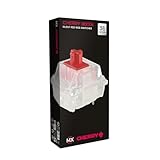
CHERRY MX2A RGB Silent RED
CHERRY remains the reference standard for consistency, and the MX2A Silent RED refines what gamers have loved about the classic Red for decades. The no-click, smooth-quiet profile makes it ideal for shared spaces or late-night sessions where sound discipline matters. The 36-switch count suits a single-board swap rather than bulk builds.
- Pro: Industry-leading manufacturing tolerance means virtually zero scratch variance across all 36 switches.
- Pro: Silent dampening integrated without the mushy feel that cheaper silencers produce.
- Con: 36 pieces at this price point makes it one of the most expensive per-switch options in this roundup.
Skip it if you are building a 75% or full-size board and need more than 36 switches from a single purchase.
Gateron Milky Yellow Pro V2
The V2 revision fixed the housing wobble that plagued the original Milky Yellows, and the result is a switch that now competes directly with options twice its per-unit cost. At 72 pieces, it covers a full 65% build or a partial hot-swap upgrade without leftover frustration.
- Pro: The smoothest factory-linear feel per dollar in this list — barely any break-in required.
- Pro: Milky housing diffuses RGB evenly, which matters if your board has per-key lighting.
- Con: The 55gf bottom-out weight can cause fatigue during extended sessions for lighter-handed typists.
Skip it if you prefer sub-50gf actuation for extremely light keystroke requirements.
AULA F99 Wireless Mechanical Keyboard
This is not a switch pack but a complete keyboard with pre-lubed linear switches already installed, making it the logical pick for gamers who want to skip the modding process entirely. Tri-mode connectivity (BT 5.0, 2.4GHz, USB-C) and hot-swap compatibility mean you can swap to other switches from this list later without buying a new board.
- Pro: Hot-swap sockets let you experiment with any MX-compatible linear without soldering.
- Pro: Ships pre-lubed and works well for gaming straight out of the box.
- Con: The stock switches are adequate but not standout — you will likely want to upgrade them.
Skip it if you already own a keyboard and only need replacement switches.
Zhouwang Burgundy Crystal Linear Switches
At $7.90 for 36 pieces, this is the cheapest entry into a crystal-housing linear switch. The burgundy tint looks striking under RGB, and the linear feel is acceptable for casual gaming. However, factory consistency is visibly lower than every other option on this list.
- Pro: Unbeatable price for trying the linear crystal aesthetic before committing to a full bulk order.
- Pro: Light actuation feel suits quick-tap inputs in rhythm games.
- Con: Housing flash and gate roughness are common out of the box; expect meaningful rework time.
Skip it if you do not want to spend an hour lubing and clipping before the switches feel smooth.
Akko V3 Creamy Yellow Pro
The linear sibling of the Creamy Blue Pro, this 50gf switch keeps the dustproof stem and even factory lube that made Akko a budget favorite. The slightly heavier actuation compared to 45gf options gives a more deliberate feel that some players prefer for ability-based games where accidental presses are costly.
- Pro: Dustproof stem design extends the smooth-feeling lifespan noticeably compared to open-stem alternatives.
- Pro: 50gf weight is a sweet spot for gamers who find 45gf too twitchy.
- Con: The creaminess is more about sound than feel — travel is smooth but not glassy.
Skip it if you want the absolute smoothest keystroke regardless of sound profile.
EPOMAKER Silent Crystal Tactile Switches
Listed here because silent linear alternatives at this price are rare, and this tactile-silent hybrid is the next best thing for players who need quiet operation with a soft feedback cue. The 35-pack suits a compact board, and factory pre-lube is included on the 5-pin housing.
- Pro: Silencing and pre-lube both handled at the factory — genuinely plug-and-play for quiet gaming.
- Pro: Deep sound profile with no high-pitch ping on bottom-out.
- Con: Tactile bump introduces micro-resistance that pure-linear purists will notice during rapid strafing.
Skip it if you want zero interruption in the travel curve, even at low force levels.
Buying Guide
Stem Material Determines Scratch
The stem is the single most important component for smoothness. POK and POM stems have lower friction coefficients against nylon or polycarbonate housings compared to ABS. If two switches share the same spring and housing but differ in stem material, the POM/POK variant will feel smoother within the first hundred keystrokes. Look for POK first, POM second, and avoid ABS stems in any switch marketed as premium.
Housing Tolerance Controls Consistency
Even a great stem fails if the housing upper and lower halves have excess play or rough internal gates. A switch with tight tolerance travels straight without lateral rubbing, which is what produces the “buttery” feel gamers describe. PA66 housings hold their shape better than standard ABS under heat and repeated cycling, meaning the smoothness you experience on day one persists after months of heavy use.
Factory Lube Quality Saves You Hours
Not all pre-lube is equal. A thick, globs-heavy application feels mushy on the downstroke, while a thin brush coat may not survive three weeks of rapid gaming. The best factory-lubed switches use a light, even distribution that fills housing seams and stem rails without pooling on the spring legs. If a product description says “pre-lubed” but shows inconsistent coating in user photos, budget time for a manual re-lube pass.
Our Verdict
The Gateron Milky Yellow Pro V2 is my top pick for the best linear keyboard switches for smooth gaming. It hits the balance of out-of-box smoothness, RGB-friendly milky housing, and 72-piece value that makes it practical for full builds without forcing you into hours of hand-work. For the absolute lowest entry price with acceptable quality, the Akko V3 Creamy Yellow Pro at $10.39 is hard to argue against, especially with its dustproof stem longevity. If quiet operation is non-negotiable and you need a single board completed, the CHERRY MX2A Silent RED wins on consistency even at a higher per-switch cost.
FAQ
Do linear switches need to be lubed before use?
Higher-quality factory-pre-lubed switches from brands like Gateron Pro and Akko V3 are often smooth enough for immediate use. However, budget linears almost always benefit from a manual lube pass, which can take 30 to 60 minutes per board but dramatically reduces scratch.
Is 45gf or 50gf better for gaming?
Neither is universally superior. Lighter 45gf switches suit rapid-fire inputs and players who want minimal fatigue, while 50gf provides slightly more resistance that can prevent accidental ability triggers in MOBA or MMO games. Choose based on your finger pressure habit.
Can I mix linear and tactile switches in the same board?
Yes, as long as both are MX-compatible with matching pin counts (3-pin or 5-pin). Some builders place linears on WASD keys and tactiles on modifiers to get the best of both behaviors without sacrificing smoothness where it matters most.
Does switch color indicate actuation weight?
Not reliably across brands. A “yellow” switch from one manufacturer may weigh 50gf while another’s yellow is 62gf. Always check the listed actuation and bottom-out force in grams rather than assuming consistency from color alone.


