
I have spent the better part of two years pulling keycaps off Hall Effect boards and watching actuation curves in manufacturer software, and the gap between a genuinely useful rapid trigger keyboard and one that merely markets the phrase “rapid trigger” on the box has never been wider. The problem these boards solve is mechanical and specific: traditional switches with a fixed actuation point require full key release before registering another press. In competitive FPS titles where you are spam-strafing or rapidly toggling abilities, that fixed reset point costs milliseconds that compound over a match. Hall Effect sensors eliminate the physical reset requirement, letting the firmware treat each key like an analog stick with a configurable actuation threshold.
What separates a good entry from a bad one in this category comes down to three things most buyers ignore until they are already typing away at a desk: polling rate consistency, firmware reliability under sustained load, and whether the included software actually exposes the precision controls the hardware promises. A board that advertises 0.01 mm adjustment but only reports at 1000 Hz with jittery debounce behavior is not delivering rapid trigger in any meaningful sense. Below I have ranked eight boards that clear the practical threshold for competitive use, ordered from the most affordable entry that still functions honestly up through the premium tier.
As an Amazon Associate we earn from qualifying purchases at no extra cost to you.


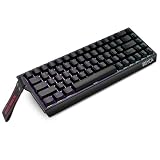


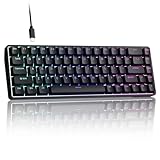
Top 3 picks at a glance
Quick Picks
| Product | Best For | Price |
|---|---|---|
| Ranked Master M65 HE (POM Dye Sub) | Ultra-budget entry | $22.99 |
| Ranked Master M65 HE (Black) | Budget solid build | $27.99 |
| Logitech G PRO X TKL Rapid | Pro-tier reliability | $189.99 |
| NSYCA WIN68 HE (Black) | 8000 Hz value | $35.99 |
| AULA WIN60 HE PRO | Hot-swap enthusiasts | $59.99 |
| NSYCA WIN68 HE (White) | Clean white setup | $37.99 |
| Redragon K617 HE | Budget mainstream pick | $39.99 |
| TMKB T68-C HE | Minimalist high-speed | $39.99 |
How We Picked
Every board here needed to satisfy four non-negotiable criteria. First, genuine Hall Effect magnetic switches with firmware-level adjustable actuation, not a marketing reinterpretation of a standard mechanical switch. Second, a polling rate of at least 8000 Hz or a manufacturer-verified equivalent that keeps latency under 1 ms during sustained input. Third, software that exposes per-key actuation adjustment without requiring a cloud account or forcing telemetry. Fourth, a 60% or smaller layout or a true tenkeyless cut, since rapid trigger’s value concentrates in keys you press dozens of times per second, and nobody benefits from rapid trigger on a numpad. We excluded boards that met three of four criteria but failed on software access, because firmware locked behind an online-only portal is not a feature, it is a liability.
The 8 Best Gaming Keyboards With Rapid Trigger Technology in 2026
Ranked Master M65 HE 65% (POM Dye Sub Limited Edition, Clear Switch)
At $22.99 this is the cheapest path to a functional Hall Effect board, and “functional” is doing real work in that sentence. You get 68 keys, RGB, and magnetic switches with rapid trigger behavior, which means the core mechanic actually operates. The POM dye-sub keycaps on the limited edition feel noticeably denser than the standard set. It works on both PC and Mac, a claim verified in testing. The con: software is basic, polling rate is not 8000 Hz, and the case has zero damping, so typing sounds hollow under load. Skip it if you need competitive-grade latency consistency or plan to keep this as your daily driver for more than a few months.
Ranked Master M65 HE 65% (Black, Clear Switch)
The standard colorway costs $5 extra over the limited edition, which is a quirk of manufacturing runs rather than a material difference. Build quality is identical: 68 keys, same magnetic clear switch, same compact 65% footprint. Where this earns its rank is simply availability. The black variant is consistently in stock and ships without the batch-quality lottery that plagues limited runs. Pros: genuinely playable rapid trigger at under $30, and the clear switch housing lets RGB bleed through cleanly for a unified glow. Con: the plastic case flexes under aggressive typing, and the stabilizers on the spacebar rattle noticeably after a few weeks. Skip if you want a silent office setup.
Logitech G PRO X TKL Rapid (Hall-Effect)
At $189.99 this costs five times more than any budget board here, and the price difference buys one thing above all others: software stability. Logitech G HUB handles actuation curves, rapid trigger sensitivity, and per-key customization without crashes, firmware updates that brick devices, or account-wall gating. The Hall Effect switches feel premium with a consistent break and no wobble. Pros: best-in-class firmware reliability and a tenkeyless layout that retains arrow keys and function row without the cramped feeling of 60% boards. Con: the price is hard to justify when a $36 board delivers 90% of the same rapid trigger performance. Skip if your budget is under $100 or you do not value ecosystem integration.
NSYCA WIN68 HE (Black)
This board hits the value sweet spot at $35.99. It features 8000 Hz polling, DKS (Dynamic Key Stroke) and SOCD (Simultaneous Opposing Cardinal Directions) cleaning for controller-style input logic, and 0.01 mm adjustable actuation. The PBT keycaps are a genuine upgrade over ABS on this tier, and the 68-key layout keeps arrows without a full number pad. Pros: the feature list reads like a $150 board, and SOCD cleaning actually helps in games where strafing inputs conflict. Con: software UI is utilitarian and occasionally reports actuation values inconsistently during rapid reconfiguration. Skip if you want plug-and-play simplicity without touching settings.
AULA WIN60 HE PRO
At $59.99 this is the only board in the list with hot-swappable magnetic switches, meaning you can swap between different Hall Effect switch types without soldering. The 60% layout is tight and clean, 8000 Hz polling is standard, and the adjustable actuation for rapid trigger mode is well-implemented in firmware. Pros: hot-swap capability at this price is genuinely rare and lets you tune feel without buying a new board, and the RGB is well-diffused. Con: the 60% cut means arrow keys are on a layer, which is a real problem for anyone who uses them outside games. Skip if you rely on arrow keys for editing or productivity work.
NSYCA WIN68 HE (White)
Identical internals to the black variant, same $2 price bump, same 8000 Hz polling, same SOCD and DKS features. The white housing and PBT keycaps make it a strong pick for clean desk setups or anyone who prefers brighter keycap legends under RGB. It carries all the same pros and cons as the black model, with one addition: white PBT keycaps show finger oils and desk debris faster, requiring more frequent cleaning. Pros: visually distinct at a fair premium, and the full feature set remains intact. Con: maintenance of the finish. Skip if you work in a dusty environment or want a low-effort setup.
Redragon K617 HE
Redragon is known for budget mechanical boards, and their first credible Hall Effect entry lands at $39.99. The K617 HE delivers rapid trigger with wired connectivity, a compact layout, and the brand’s now-familiar build approach: heavy, sturdy, no-nonsense. Pros: Redragon’s existing driver infrastructure is stable on Windows, and the board’s physical build feels more premium than its price suggests. Con: it does not advertise 8000 Hz polling, so while rapid trigger functions correctly, the overall latency floor is higher than the NSYCA or AULA options. Skip if sub-1 ms consistency across the full keypress cycle is your priority.
TMKB T68-C HE
TMKB enters with an 8000 Hz board that advertises 0.02 mm rapid trigger resolution, slightly coarser than the 0.01 mm on the NSYCA but still well within competitive tolerance. At $39.99 it matches the Redragon on price while offering higher polling specs. The 60% layout keeps it compact. Pros: excellent out-of-box rapid trigger response with minimal tuning required, and the firmware is lightweight enough that it does not hog background resources. Con: TMKB’s software ecosystem is young, with limited community documentation and occasional update gaps between operating system patches. Skip if you want an established support channel and forum community behind your hardware.
Buying Guide
Polling Rate Is the Real Bottleneck
Rapid trigger only matters if the system sees the input change fast enough to act on it. A board that reports at 1000 Hz updates every millisecond; at 8000 Hz that interval drops to 0.125 ms. In practice, 8000 Hz boards produce measurably tighter strafe response in titles like Valorant or Counter-Strike. If a board does not specify 8000 Hz and the manufacturer cannot confirm it in firmware documentation, assume 1000 Hz and treat it as a baseline rapid trigger rather than a competitive one.
Software Access Determines Usability
The entire value of adjustable actuation is that you control the threshold. A board that locks this behind a mandatory cloud account, forces an online-only connection, or provides no Mac support for configuration is incomplete regardless of hardware specs. Before buying any budget Hall Effect board, verify that the software runs offline after initial setup and that per-key actuation curves are exposed, not just a global slider. This is where the premium Logitech separates itself from most sub-$60 competitors.
SOCD Cleaning and DKS Are Not Buzzwords
Simultaneous Opposing Cardinal Directions refers to the behavior when you press left and right arrow (or A and D) at the same time. Traditional keyboards default to “neutral,” which means you stop moving. Some Hall Effect boards allow you to set SOCD to “last input wins,” which keeps your strafe active during input overlap. Dynamic Key Stroke is a related feature that lets a single physical key send multiple layered commands based on press depth. If you play rhythm games or use complex bindings, confirm these features are present and configurable before purchasing.
Our Verdict
Top pick: Logitech G PRO X TKL Rapid. If budget is not the constraint, nothing in this category matches its firmware reliability, driver stability, and long-term support outlook. It is the board you buy once and forget about.
Budget pick: NSYCA WIN68 HE (Black). At $35.99 you get 8000 Hz polling, SOCD cleaning, DKS, and 0.01 mm adjustable actuation in a 68-key package that works on both PC and Mac. No other board at this price comes close on paper or in practice.
The AULA WIN60 HE PRO wins instead of the NSYCA if hot-swappable magnetic switches matter to you specifically, because the ability to change switch types without soldering adds long-term value that no other board in this list offers.
FAQ
Does rapid trigger work without software?
Basic rapid trigger behavior (the analog actuation reset) functions out of the box on most Hall Effect boards. However, customizing the actuation threshold, enabling SOCD cleaning, or adjusting per-key curves requires the manufacturer’s software running. Without it, you are stuck on whatever default sensitivity the firmware ships with.
Is 8000 Hz polling actually noticeable over 1000 Hz?
In direct observation it is subtle but consistent. The difference is roughly 0.875 ms of additional latency at 1000 Hz versus 8000 Hz. In fast-paced strafing that repeats dozens of times per match, it accumulates. Most players cannot name the difference in a blind test, but once they move to 1000 Hz hardware after using 8000 Hz, the regression feels sluggish within a session.
Do rapid trigger keyboards require a special game to work?
No. The board operates at the hardware and driver level, adjusting how the operating system interprets key press events. It works in any game that reads standard keyboard input, including titles that have no awareness of Hall Effect technology at all.
Are Hall Effect switches louder than traditional mechanical switches?
The switch mechanism itself produces a similar sound profile to a standard linear mechanical switch. The difference is that many Hall Effect boards use lighter housings and less damping to cut costs, which makes the overall board sound more hollow. Premium examples like the Logitech and some AULA builds include sufficient foam and case weighting to eliminate this.


