When you play stage piano in a live band, the monitor in front of you does two jobs at once. It has to let you hear your own piano clearly, and it has to hand a clean signal to the house system. The best powered keyboard stage monitors with balanced line outputs for stage piano amplification do both, because a balanced XLR output carries your piano over a long cable run without picking up hum and buzz from stage lighting and power cables.
That second job is the one players learn about too late. An amp that sounds fine on its own can still leave the front-of-house engineer with a noisy feed, and then the audience hears a thinner piano than the one you play. The five options below were chosen for their balanced line outputs first.
Top 3 picks at a glance


What to Look For in a Stage Piano Monitor
Before comparing models, settle the details that decide whether a monitor works on your stage. Piano is a wide-range instrument, so a box that suits a synth lead can still sound thin on a grand piano patch.
-
Balanced line output: look for an XLR main out, mix out, or loop-through. A balanced connection rejects interference over long cable runs, which is exactly what a stage piano feed needs.
-
Full-range driver: a 10-inch or 12-inch woofer with a dedicated tweeter reproduces the low left hand and the bright right hand.
-
Enough clean headroom: the wattage figure matters less than clean output at stage volume.
-
Channel count: if you run a stage piano plus a second keyboard, a built-in mixer with at least two channels saves a separate mixer.
-
Monitor angle: a cabinet that angles back as a floor wedge aims the sound at your ears instead of at your knees.
-
Weight and size: you carry this box to every gig, so a lighter cabinet that still covers the room is worth more.
The Picks
Roland KC-400 Stereo Mixing Keyboard Amplifier
The KC-400 is the most piano-specific box here, built around keyboards rather than general PA use.
The Roland KC-400 is a 150-watt stereo mixing keyboard amplifier with a 12-inch woofer and a horn tweeter in a compact cabinet. It has four channels, so a stage piano, a second keyboard, and an additional line source can share one box, and each channel has its own level control. A three-band equalizer and a Shape switch help the piano sit clearly in a live mix without extra outboard gear.
Connectivity is where it earns its place here. Channel 1 accepts a balanced XLR microphone or line input, and the rear panel provides a line out, a sub out, and a stereo link for pairing a second KC-400. The line out sends the piano to a house system while the amp works as your on-stage monitor.
Best for: stage piano players who want a keyboard amp with a balanced XLR input and a line out to the house system.
Keep in mind: at 150 watts it suits small and mid-size stages, and large rooms will still need house reinforcement.
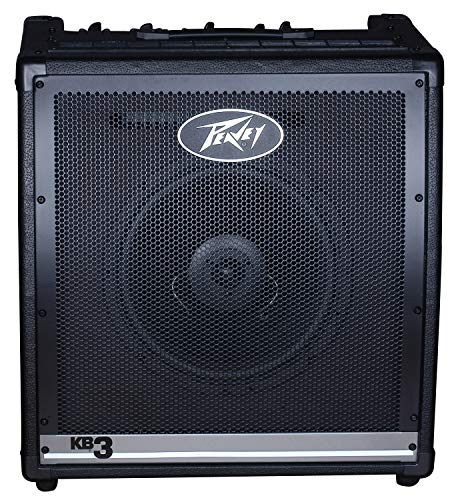
Peavey KB 3 60-Watt 1×12 Keyboard Amp
The KB 3 is the compact pick, and its balanced XLR main out is why it belongs in this guide.
The Peavey KB 3 is a compact keyboard amplifier with 60 watts of clean power, extendable to 80 watts with an extension cabinet, driving a 12-inch speaker with a tweeter. It is built as a self-contained sound system for voice, keyboards, acoustic and electric guitar, drum machines, and backing tracks, which makes it a practical single box for small stages and rehearsal rooms.
The layout is straightforward: three channels, each with two-band EQ, a microphone input on channel 1, a monitor input, a headphone out, and an effects send and return. The balanced XLR main out is the key feature for this guide, because it sends a clean, low-noise signal to a house system or mixer over a long cable run.
Best for: piano players who need a compact amp with a balanced XLR main out.
Keep in mind: 60 watts is modest for loud stages, so it works best as a personal monitor with house support.
QSC K8.2 Active 8-inch Powered Loudspeaker
The K8.2 is the loudest compact option here, working as a floor wedge, a pole speaker, or a house feed.
The QSC K8.2 is an 8-inch powered loudspeaker with a 2000-watt Class-D amplifier section, split between 1800 watts for the low-frequency driver and 225 watts for the high-frequency driver, and a peak output of 128 dB. The 8-inch woofer and 1.4-inch titanium compression driver deliver a full-range sound from a cabinet that is easy to carry and to angle as a floor monitor.
Its input section accepts microphone and line sources over XLR, with factory presets and a mix output that passes the signal to another speaker or a house system. The XLR mix output carries a balanced line-level signal, which keeps long cable runs quiet on stage.
Best for: piano players who want a loud, compact powered speaker that doubles as a floor monitor.
Keep in mind: the 8-inch woofer gives less low-end weight than a 12-inch box, so deep piano registers benefit from a subwoofer on large stages.
Yamaha DBR10 700-Watt Powered Speaker

The DBR10 is the portable pick, with a built-in mixer and easy load-in.
The Yamaha DBR10 is a 10-inch powered speaker with 700 watts of dynamic power, split between 500 watts for the low-frequency driver and 200 watts for the high-frequency driver, and a peak output of 129 dB. A 10-inch woofer and a 1-inch compression driver sit in a cabinet that weighs about 23 pounds, so it is easy to move between rehearsal and stage.
A built-in two-channel mixer accepts XLR and TRS combo inputs plus stereo RCA, and an XLR output passes the mixed signal on to another speaker or to the house system. The cabinet works upright, on a pole, or angled as a floor monitor.
Best for: piano players who want a light powered speaker with a built-in mixer and an XLR output.
Keep in mind: the two-channel mixer is basic, so players with several keyboards will want a small external mixer in front of it.
JBL Professional EON612 Powered Speaker

The EON612 is the full-range pick, with a 12-inch driver and a monitor EQ preset.
The JBL Professional EON612 is a 12-inch self-powered speaker with 1000 watts of peak power and 500 watts continuous, and a peak output of 126 dB. JBL Waveguide technology shapes the coverage pattern, and the cabinet includes Bluetooth integration for wireless audio alongside its wired inputs.
Two combo input channels accept XLR and TRS sources, with gain controls, a master volume, and EQ presets for main, monitor, sub, and speech use. An XLR loop-through output sends the signal to another speaker or a house system over a balanced connection.
Best for: stage piano players who want a 12-inch powered speaker with a balanced XLR loop-through.
Keep in mind: it is a larger and heavier box than the 8-inch and 10-inch options here, so transport needs a little more room.
Comparison Table
| Product | Key features | Best for |
|---|---|---|
| Roland KC-400 Stereo Mixing Keyboard Amplifier | 150 watts, 4 channels, balanced XLR input, line out | Stage piano with a house feed |
| Peavey KB 3 60-Watt 1×12 Keyboard Amp | 60 watts, 12-inch speaker, balanced XLR main out | Compact personal monitor with a balanced main out |
| QSC K8.2 Active 8-inch Powered Loudspeaker | 2000-watt Class-D, 8-inch, XLR mix output, 128 dB peak | Loud, compact floor monitor and house feed |
| Yamaha DBR10 700-Watt Powered Speaker | 700 watts dynamic, 10-inch, 2-channel mixer, XLR output | Portable piano monitor with a built-in mixer |
| JBL Professional EON612 Powered Speaker | 1000 watts peak, 12-inch, XLR loop-through, monitor preset | Full-range stage monitor with a loop-through |
Frequently Asked Questions
What does a balanced line output do for a stage piano?
A balanced line output sends the signal over three conductors, so interference picked up along the cable cancels itself out at the receiving end. On a stage with lighting rigs and long runs to the house mixer, that keeps the piano signal quiet and clear.
Do I still need a direct box if the monitor has a balanced XLR output?
In most cases, no. A balanced XLR main out or mix out already provides the noise-resistant signal a direct box is meant to create. A direct box is still useful if you need to split the signal or lift a ground.
How much power do I need for stage piano monitoring?
It depends on the band and the room. A 60-watt amp works as a personal monitor when the house system carries the room, while a 150-watt amp or a powered speaker in the 700-watt class covers small and mid-size stages on its own.
Can one powered speaker replace a keyboard amplifier?
Yes, for many players. A powered speaker with a built-in mixer, an XLR output, and a monitor angle covers the same jobs as a keyboard amp, and it is often louder for its size. A dedicated keyboard amp still wins on channel count, so players with several keyboards may prefer the amp.
Should the monitor sit on the floor or on a stand?
As a floor wedge angled toward your ears, a monitor gives you the clearest picture of your own playing. On a pole behind you, the same speaker covers more of the stage but reaches your ears less directly.
Conclusion
Choose by the output first and the volume second. If your gigs always have a house system, the Peavey KB 3 or the Roland KC-400 gives you a balanced feed and a clear personal monitor. If you often play rooms with no house support, the QSC K8.2 or the Yamaha DBR10 carries the room as well as your ears. For the widest piano sound on a larger stage, the JBL EON612 is the most complete single box.
Disclosure: As an Amazon Associate, we may earn from qualifying purchases.
Related guides
More from Amazon
Programs that pair well with the guide above. Offers and eligibility are set by Amazon and may change.
Free shipping on eligible items, Prime Video and more. Eligible new members can start with a free trial.
Start a Prime free trialAd-free music streaming. Eligible new subscribers can start with a free trial.
Try Music Unlimited freeA Prime membership for ages 18-24 with a trial period. Eligibility is set by Amazon.
See Prime for Young AdultsAudiobooks and podcasts to listen to on the go. Eligible new members can start with a free trial.
Try Audible freeAs an Amazon Associate we earn from qualifying purchases.