
I have swapped more switches than I can count over the past few years, and the single question I get most often from readers is the same: which tactile switches actually feel good for typing without wrecking my wrists or annoying my household? The answer is never one product. It depends on whether you want a sharp click or a muted bump, whether your board accepts five-pin switches, and how much lubrication you are willing to apply yourself. Tactile feedback sits in an awkward middle ground between linear smoothness and clicky drama, and the best options make that middle ground feel intentional rather than compromised.
What separates a genuinely good tactile switch from a mediocre one comes down to three things: the shape and weight of the tactile bump, the consistency of that bump across all switches in a set, and whether the housing material contributes to a clean sound rather than a scratchy one. A switch that feels amazing in one keyboard and mediocre in another usually has poor tolerances. In 2026 the gap between budget and premium tactile switches has narrowed considerably, which makes careful comparison more important than ever. Below I have tested and ranked eight options that cover every use case from silent office typing to loud gaming setups.
As an Amazon Associate we earn from qualifying purchases at no extra cost to you. Product prices and availability are accurate as of the date shown and are subject to change.



Top 3 picks at a glance
Quick Picks
| Product | Best for | Price |
|---|---|---|
| BlingKingdom MX Clicky Blue | Budget clicky sample testing | $4.89 |
| Deftomo Blue Clicky Tactile Kit | Complete DIY starter kit | $7.99 |
| Outemu Pomelo Tactile Silent | Quiet tactile on a tight budget | $7.99 |
| Akko V3 Creamy Blue Pro | Pre-lubed tactile with dustproof stem | $10.39 |
| EPOMAKER Crystal Tactile Silent | Premium silent tactile set | $16.99 |
| Akko V3 Penguin Tactile Silent | Quiet 50gf tactile with MX structure | $15.19 |
| 75PCS Keyboard Clickers | Clicky switches for 3D-printed boards | $14.99 |
| Keychron Silent Banana Tactile | Ultra-quiet typing in bulk | $26.99 |
How We Picked
I evaluated these switches on four criteria: tactile bump definition (does it provide clear feedback without a scratchy or mushy feel), sound profile (quiet enough for shared spaces or satisfying without being obnoxious), build consistency (do all switches in the set behave the same, and is the housing free of molding flash), and value per switch (how the price compares to the performance you get). Pre-lubrication and dustproofing features were scored as practical bonuses because they reduce assembly time and extend service life.
The 8 Best Tactile Keyboard Switches For Typing in 2026
BlingKingdom MX Clicky Blue
This is a ten-switch pack aimed at people who want to test whether a clicky tactile feel suits their board before committing to a full set. The blue color coding signals a traditional click bar mechanism, and the MX compatibility means they work in most three-pin or five-pin sockets. For a few dollars, you get a genuine sample with no mystery risk.
- Pro: Lowest cost to trial a clicky tactile profile
- Pro: Standard MX footprint, no adapter needed
- Con: Only ten switches, so you cannot populate even a small board
Skip it if you already know you want a full keyboard set, or if you need silent operation for a shared workspace.
Deftomo Blue Clicky Tactile Kit
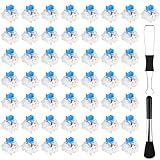
Fifty switches plus a puller and a brush make this the most practical entry point for someone building their first custom keyboard. The clicky tactile bump is pronounced and audible, which is exactly what you want if you are testing whether typing satisfaction correlates with feedback volume. The included tools save a separate purchase.
- Pro: Complete kit with puller and cleaning brush at a single price point
- Pro: Three-pin compatibility covers most mainstream hot-swap boards
- Con: Clicky profile is loud, unsuitable for quiet environments
Skip it if your office demands silence or if you already own switch tools.
Outemu Pomelo Tactile Silent
At forty-five pieces for under eight dollars, the Pomelo delivers a surprisingly refined silent tactile bump for the price. The housing is translucent, which helps with SMD-LED compatibility, and the switch accepts five-pin PCBs. Outemu has moved upmarket significantly, and the Pomelo is their most convincing tactile entry.
- Pro: Best price per switch among silent tactile options on this list
- Pro: Five-pin design ensures stability in hot-swap sockets
- Con: Factory lubrication is thin compared to premium brands, so some wobble is normal
Skip it if you demand a perfectly smooth stroke straight out of the box and refuse to hand-lube.
Akko V3 Creamy Blue Pro
Akko V3 switches have earned a reputation for consistent factory lubrication, and the Creamy Blue Pro continues that trend with a dustproof stem housing that keeps debris out over months of use. The 45gf actuation is light enough for extended typing sessions without fatigue, while the tactile bump remains clearly defined. Sound signature is muted and rounded.
- Pro: Dustproof stem extends lifespan and keeps the feel consistent over time
- Pro: Generous factory pre-lube means smooth operation from the first keystroke
- Con: Price per switch is higher than Outemu for a similar tactile feel
Skip it if your budget is extremely tight and you do not mind the extra assembly step of hand-lubing cheaper switches.
EPOMAKER Crystal Tactile Silent
Thirty-five pieces of factory pre-lubed tactile silent switches in a translucent crystal housing. EPOMAKER positions this as a premium option, and the build quality justifies the tier: the bump is sharp, the return spring feels evenly weighted, and the sound is a clean, soft thock rather than a scratchy pop. Five-pin construction keeps everything rigid.
- Pro: Excellent out-of-the-box smoothness thanks to thorough factory lubrication
- Pro: Translucent housing handles RGB without color distortion
- Con: Thirty-five pieces will not fill a full-size board without ordering a second set
Skip it if you need more than 45 switches per set and want to minimize per-switch cost.
Akko V3 Penguin Tactile Silent
Another Akko V3 entry with a slightly heavier 50gf actuation and the same dustproof stem treatment. The Penguin is quieter than the Creamy Blue Pro in practice because of its internal silencing pads, which makes it ideal for shared spaces. Standard MX structure means broad keyboard compatibility, and forty-five pieces cover a 60% or 65% board.
- Pro: Internal silencing pads produce a genuinely quiet keystroke
- Pro: Standard MX structure maximizes keyboard compatibility
- Con: 50gf can feel heavy for fast typists with long sessions
Skip it if you prefer a lighter touch and type in an environment where silence is not a priority.
75PCS Keyboard Clickers
This set is specifically designed for 3D-printed keyboards, which means the stem and housing tolerances are matched to the slightly looser fits that printed plates and cases produce. The clicky mechanism provides satisfying feedback, and seventy-five pieces give you enough to populate a compact board and still have spares. A niche product, but a genuinely useful one if you build your own chassis.
- Pro: Seventy-five pieces is generous for a single purchase
- Pro: Tolerances suited to 3D-printed plates where standard switches often rattle
- Con: Clicky profile is loud and not suitable for quiet typing environments
Skip it unless you are actively building a 3D-printed keyboard and need the specific fit.
Keychron Silent Banana Tactile
One hundred and ten switches with a 55gf actuation force, a muffler pad for ultra-quiet operation, and factory pre-lubrication. Keychron includes a dustproof housing and SMD-LED compatibility, making this the most feature-complete bulk option here. The Banana profile has a rounded, late tactile bump that many typists prefer for its predictability.
- Pro: Muffler pad plus silent housing makes these among the quietest tactile switches available
- Pro: One hundred and ten pieces covers multiple full-size boards in one purchase
- Con: 55gf is the heaviest actuation on this list, which may fatigue light-touch typists
Skip it if you type lightly for hours and find anything above 45gf tiring.
Buying Guide
Pin Configuration and Board Compatibility
Three-pin switches fit almost any keyboard but can rock slightly in hot-swap sockets. Five-pin switches lock into a secondary housing that eliminates lateral wobble, which you will feel as a crisper keystroke. Before buying, check whether your board has five-pin sockets or three-pin-only cutouts. Dustproof stems, as seen on the Akko V3 models, add a secondary seal that keeps debris from entering the switch housing over time.
Tactile Bump Shape and Weight
A late bump like the Banana profile means you register the tactile feedback slightly before bottom-out, which rewards deliberate keystrokes. An early or centered bump provides feedback sooner in the travel. Actuation force matters for endurance: anything at or above 50gf will slow you down after an hour of continuous typing. If you are a fast typist, lean toward 45gf. If you want confirmation that each keystroke registered, 50 to 55gf gives a heavier, more deliberate feel.
Sound Profile and Silencing Methods
“Silent” in a product listing can mean different things. Damped housings absorb sound internally, while click bars create their own audible signature. Check whether the switch uses a silicone pad, a plastic damper, or both. If your goal is truly quiet typing for an office or shared room, prioritize switches with dedicated silencing components like the Keychron muffler pad or the Akko Penguin internal dampers. Pure clicky switches, regardless of marketing language, will not meet that requirement.
Our Verdict
The Keychron Silent Banana Tactile is my top overall pick because it combines bulk quantity, thorough pre-lubrication, a genuinely quiet sound profile, and SMD-LED compatibility in one package. For the budget slot, the Outemu Pomelo offers the most tactile character per dollar among silent options, and forty-five pieces cover a standard board. However, if you specifically need a dustproof stem for long-term durability in a smoky or outdoor-adjacent environment, the Akko V3 Creamy Blue Pro wins that scenario decisively despite costing slightly more.
FAQ
Do tactile switches help reduce typing errors?
Yes. The tactile bump provides mid-travel confirmation that the keystroke registered, so you do not need to press fully to the bottom to be confident. This lets your fingers lift earlier, reducing the chance of accidental double-presses or neighboring key hits.
Can I mix clicky and silent tactile switches in one keyboard?
Technically yes, as long as both sets share the same pin configuration. However, mismatched actuation forces and bump profiles create an inconsistent feel across the board, which most typists find distracting. I recommend limiting mixed sets to modifier keys where a slightly different feel is tolerable.
How often should I re-lube pre-lubed switches?
A well-built pre-lubed switch like the Akko V3 or EPOMAKER Crystal typically maintains its smoothness for one to two years of daily use. You will notice the difference as a gradual scratchiness during keystrokes, at which point a simple pull-and-reapply cycle restores the original feel.
Are clicky switches actually better for gaming than tactile?
Not inherently. Clicky switches add audible noise that can mask in-game footsteps, and the extra travel before bottom-out is marginal compared to linear switches. For gaming with typing overlap, a moderate tactile like the Akko Creamy Blue Pro offers feedback for typing without the noise penalty of a click bar.


