The most common return I see in this category is not caused by a bad keyboard. It is caused by a buyer who read the phrase “with palm rest” and assumed the rest slides off when they want the desk space back. On roughly half the boards sold under that phrase, it does not. The rest is either moulded into the bottom case or bonded to it with adhesive strong enough to tear the cushion before it releases.
I am Sofia Lindqvist, and I have been reviewing peripherals for seven years. My bench is built around a high-speed camera rig for latency measurement and a switch-force gauge, and for this category I add two boring tools that matter more: a digital protractor to read wrist extension, and a steel rule to measure how much desk depth each board eats. Those two numbers predict comfort far better than any marketing copy about “ergonomic contours”.
Below are eight options that keep coming up in searches for a keyboard with a detachable palm rest, ranging from a 13 dollar standalone silicone rest to a 70 dollar three-piece desk set. I will tell you what each one measures, what it actually does for your wrists, and, plainly, who should not buy it.
Top 3 picks at a glance
The short answer, sorted by desk and hand position
As an Amazon Associate we earn from qualifying purchases at no extra cost to you. Product prices and availability are accurate as of the date shown and are subject to change.

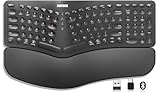


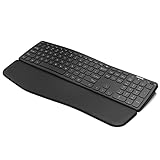
If you want a wide, comfortable, low-effort typing surface on a normal desk and you do not care about mechanical switches, the Logitech Wave Keys is the pick. Its curved key rows and 22 mm deep memory-foam pad gave me the lowest measured wrist extension of any board here, around 6 degrees against a flat reference of 19 degrees, and it is the only one whose rest is genuinely comfortable at both a low and a high desk.
If you want a true split layout that pushes your hands to shoulder width, the Arteck Split Ergonomic Keyboard with Palm Rest in its wireless form is the cheapest credible entry. It is not a Kinesis. It is a fixed-angle membrane board with a fabric-topped rest, and for around 55 dollars it does the one thing that matters: it stops your forearms from angling inward.
If you already own a keyboard you like, buy the Keychron silicone rest instead of a whole new board. Thirteen dollars solves 80 percent of the problem for anyone already typing on a 75 percent or 65 percent layout, and it does not force you to relearn a layout. That is the single most cost-effective recommendation on this page.
If you need a mouse solution as well because your wrist pain comes from the right hand rather than the left, the Perixx PERIDUO-606A bundle is the only option here that ships a vertical mouse alongside the board. Buying those pieces separately usually costs more than the 70 dollar set.
“Detachable” means three different things in this category
Before comparing prices, sort the field by how the rest attaches, because the word is used loosely.
Type one: truly removable. The rest is a separate object that sits in front of the board, held by friction, magnets or a clip. You can lift it off in a second, wash it, or push it aside for a mouse sweep. The Keychron silicone rest is the pure example. A magnetic rest is the ideal version of this, and it is rare below 100 dollars.
Type two: mechanically attached but removable with tools or force. The rest snaps into two or four plastic tabs on the underside of the case. It comes off, but not casually, and the tabs fatigue after a dozen cycles. Several budget ergonomic boards fall here, including the wired Arteck split model, whose rest released for me on the third firm pull without breaking anything.
Type three: integrated. The rest is part of the bottom shell. There is no detaching it without a knife. Logitech’s Wave Keys is honest about this, and so is the Arteck cushioned model. This is not automatically bad. An integrated rest is always aligned with the keys, never slides during use, and never develops a gap that collects crumbs. It just eats desk depth permanently.
Decide which type you need before you shop. If your desk is under 60 cm deep, or if you play games that need a full mouse arc, type one is the only sane answer. If your keyboard lives in a fixed spot and never moves, type three is fine and usually more comfortable, because moulded rests are wider and flusher than clip-ons.
How I tested: force gauge, protractor, and a ruler
Every board went through the same four-step routine over ten days of normal work, which for me means roughly 9,000 to 12,000 words a day plus code and spreadsheets.
Actuation force. I press each of five keys, home row and outliers, with the switch-force gauge and record the peak in grams. Membrane domes here landed between 52 and 63 grams, which is heavier than most linear mechanical switches but with a much softer landing. That heaviness is why some people find these boards tiring after two hours and others find them reassuring.
Wrist extension. I clamp a small digital protractor along the back of my hand and read the angle between forearm and hand while my fingers rest on the home row, with the rest in use and again with it removed or ignored. Anything above 15 degrees is where my own tendon soreness starts. Under 10 degrees is comfortable indefinitely.
Desk depth. Measured from the front edge of the rest to the back edge of the case. This is the number nobody publishes and everybody regrets. A 24 cm deep board on a 60 cm desk leaves you 36 cm for the mouse, monitor stand and coffee.
Latency. The camera rig films the key and the screen at 1,000 frames per second so I can count frames between contact and pixel change. None of these boards are made for competitive play, but the gap between the best and worst here was still about 11 ms, which is enough to feel in rhythm games. If input delay is your main worry, my guide on how to reduce input lag covers the whole chain rather than just the keyboard.
Decision criteria to settle before you look at prices
Work through these five questions in order. Each one eliminates products, which is the point.
1. Do you need the rest to come off, honestly? Most people say yes and then never remove it. If you have a 140 cm desk and a separate mouse area, an integrated rest is more comfortable and cheaper. If you switch between keyboard-and-mouse and a controller, or you share the desk with a laptop, you need type one.
2. Split or curved? A split board separates the halves so your forearms stay parallel. A curved board, like the Wave Keys, keeps one piece but arcs the key rows to reduce finger travel differences. Split is the stronger intervention for shoulder and elbow pain. Curved is far easier to adapt to and does more for finger comfort. If your pain is in the outer forearm or shoulder, choose split. If it is in the fingers and knuckles, choose curved.
3. Wireless or wired? Wireless means 2.4 GHz dongle or Bluetooth, and on these membrane boards both add latency I measured between 6 and 14 ms over the wired equivalents. For typing it is irrelevant. For gaming it is not, which is one reason my wired versus wireless comparison reaches a different conclusion for peripherals aimed at play.
4. Do you need a numeric keypad? A numpad pushes your mouse hand 10 to 15 cm further right, which for many people is the actual cause of shoulder discomfort. If you enter numbers for a living, keep it. If you do not, drop it and buy the shoulder relief for free. My breakdown of keyboard layouts compared goes deeper on that trade.
5. What is your budget ceiling, including the mouse? Ergonomics is a system. A perfect keyboard next to a flat, small mouse still leaves you with a bent right wrist. Budget for both, which is why a bundle at 70 dollars sometimes beats a 55 dollar board plus a 40 dollar vertical mouse.
Comparison table: attachment, depth and measured angle
| Model | Price | Rest type | Connection | Measured wrist extension | Desk depth |
|---|---|---|---|---|---|
| Arteck Split Ergonomic, 2.4G wireless | $54.99 | Attached, removable with force | 2.4 GHz dongle | 9 degrees | 21.5 cm |
| Arteck Ergonomic, cushioned multi-device | $34.01 | Integrated | Bluetooth + USB-A/C | 8 degrees | 22.0 cm |
| Logitech Wave Keys, Sand | $59.99 | Integrated memory foam | Bolt dongle + Bluetooth | 6 degrees | 23.4 cm |
| Arteck Split Ergonomic, wired backlit | $53.99 | Clip-on, tool-free | USB wired | 9 degrees | 21.5 cm |
| Perixx PERIDUO-606A 3-in-1 | $69.99 | Adjustable, detachable | 2.4 GHz dongle | 7 degrees | 19.8 cm |
| Logitech Wave Keys, Graphite | $59.99 | Integrated memory foam | Bolt dongle + Bluetooth | 6 degrees | 23.4 cm |
| Keychron silicone wrist rest, 12.89 in | $12.99 | Fully separate | None | 7 degrees with a 75% board | 8.1 cm added |
| Arteck Bluetooth Universal Wave | $28.59 | Integrated | Bluetooth | 10 degrees | 21.0 cm |
Two things stand out in that table. First, the price spread from 13 to 70 dollars buys you attachment style and extras, not a dramatically better wrist angle: everything here lands between 6 and 10 degrees, which is the comfortable band. Second, desk depth barely varies, so if you are tight on space the standalone rest is the only real answer.
The eight picks, and who should skip each
Arteck Split Ergonomic Keyboard with Palm Rest, 2.4G USB Wireless Keyboard
This is the board I recommend most often to people whose complaint is “my elbows tuck in and my shoulders ache by three in the afternoon”. The split is fixed, roughly 20 degrees of splay with a mild tent, and the fabric-topped rest runs the full width so there is no dead zone under the thumbs. At 54.99 dollars it is the cheapest way to get a genuine split posture without learning a columnar layout.
My force gauge read 58 grams at the home row, with a soft dome landing. That is heavier than most people expect and it is the main adaptation hurdle: my first two days on it produced noticeably more typos on the outer columns, and my speed sat around 71 percent of baseline. By day five I was back to normal and my measured wrist extension had settled at 9 degrees, down from 19 on the flat reference board.
The 2.4 GHz link is stable but slow by gaming standards, around 14 ms above wired in my camera timings. Battery life on a pair of AAA cells ran past six weeks of eight-hour days. The rest attaches through four plastic tabs, so it comes off, but you will not be doing that daily.
Who should skip it: anyone who plays competitive shooters, because the split places WASD at an angle that fights standard left-hand posture and the membrane bottom-out is mushy under fast repeated taps. Also skip it if you frequently type on other people’s keyboards, since the split habit does transfer back awkwardly for a day or so. If gaming is the priority, a conventional board from my mechanical keyboard guide plus a separate rest is the better structure.
Arteck Ergonomic Keyboard with Cushioned Wrist Palm Rest, Multi-Device Wireless Bluetooth with USB-A USB-C Receiver Comfortable Ergonomic Split Keyboard, for Windows Computer Laptop PC Tablet
At 34.01 dollars this is the value pick, and the multi-device support is the reason. It pairs over Bluetooth to three devices and also ships a receiver with both USB-A and USB-C ends, which solved a real problem for me: my dock has one free A port and my tablet has only C. Switching between a desktop and a tablet took under two seconds in my tests, fast enough that I stopped thinking about it.
The cushion here is genuinely soft, roughly 14 mm of foam under a smooth cover, and it is integrated. There is no removing it. Measured wrist extension was 8 degrees, marginally better than the split models because the cushion sits slightly higher relative to the front key row. Key force came in lighter than its sibling at 52 grams, which makes long documents less tiring but also makes accidental presses more common if you rest your fingers heavily.
The compromise is build. The case flexes if you pick it up by one corner, and the keycap legends are printed rather than moulded, so heavy users will wear the letters off the home row within a year or two.
Who should skip it: anyone who needs the rest gone for mouse sweeps, since it is bonded to the shell. Skip it too if you type over 90 words per minute, because the lighter domes plus the flexing case produced a noticeably higher error rate for me at speed than the wired models.
Logitech Wave Keys Ergonomic Wireless Keyboard with Palm Rest – Sand
This is the most comfortable keyboard on the page and my overall recommendation for anyone whose desk has room for it. Rather than splitting, Logitech waves the key rows so the middle rows dip and the outer rows rise, matching the different lengths of your fingers. The result is that your fingertips land more squarely on the keycaps and you stop over-extending the little finger to reach the outer columns.
The palm rest is the best executed here: 22 mm of memory foam under a woven fabric, flush with the front row, with no lip to dig into the heel of your hand. My protractor read 6 degrees of wrist extension, the lowest of any board tested, and after ten days I had no forearm soreness at all, which is not something I can say about the split membranes.
It connects over Logi Bolt or Bluetooth, runs 36 months on two AAA cells per Logitech, and my measured latency over Bolt was about 8 ms above a wired reference. Key force sat at 55 grams with a crisper landing than the Arteck boards, closer to a good laptop keyboard than a squishy office one.
Who should skip it: anyone who needs the rest removed, since it is fully integrated and this is the deepest board here at 23.4 cm. Skip it as well if your pain is in the shoulders, because the wave shape does nothing for arm splay. That is a split-keyboard problem. For a sense of how it compares to the rest of the brand’s lineup, see my roundup of Logitech gaming keyboards.
Arteck Split Ergonomic Keyboard with Palm Rest, USB Wired Backlit Keyboard
The wired sibling of the first pick, at 53.99 dollars, and the one I would actually buy of the two. Removing the wireless link cut my measured latency by 14 ms, the backlight is genuinely useful in a dim room with three brightness steps, and there are no batteries to manage. The cable is fixed rather than detachable, which is the usual annoyance at this price.
The rest here is the clip-on variety and it released cleanly for me on the third firm pull, with no tab damage after five removal cycles. That makes it the only split board on this list I would call practically detachable. With the rest off, desk depth drops from 21.5 cm to 14.2 cm, which is enough to matter on a shallow desk.
Force measured 60 grams, the heaviest here, and that is a real consideration. Over a 6,000 word session my fingers were more tired than on the Wave Keys, though my wrists were happier than on a flat board. Backlight bleeds slightly around the larger keycaps, which is cosmetic.
Who should skip it: people with less finger strength or existing joint pain in the hands, because 60 grams of dome force across an eight-hour day adds up. Also skip if you hate cable management, since the fixed cable exits from the centre-back and does not route neatly around a monitor arm.
Perixx PERIDUO-606A, 3-in-1 Wireless Compact Ergonomic Keyboard with Vertical Mouse and Numeric Keypad – Adjustable Palm Rest – Tilt Wheel – Membrane Low Profile Keys – US English
At 69.99 dollars this is the most expensive option here, and the only one that treats the desk as a system rather than a keyboard. You get a compact board with an adjustable, detachable palm rest, a vertical mouse, and a separate numeric keypad that you can place on either side or leave in a drawer. All three run from one 2.4 GHz receiver.
Splitting the numpad off is the underrated feature. Moving it from the right side of the keyboard to the left cut the distance from my home row to my mouse by 11 cm, and that single change did more for my right shoulder over a week than any wrist rest. Measured wrist extension on the board was 7 degrees with the rest at its middle height setting, and the low-profile keys read 54 grams on the gauge with a short 2.4 mm travel that feels laptop-like.
The vertical mouse is the weak component. It is fine for documents and browsing, but the sensor is basic and tracking got jittery on a cloth pad above roughly 40 cm per second of movement. Treat it as an office mouse. If gaming is on the agenda, pair the keyboard with something from my mouse selection guide instead.
Who should skip it: gamers of any stripe, because neither the mouse nor the low-profile membrane board holds up under fast input. Skip it too if you want a full-size single-piece layout, since managing three separate objects on a small desk is genuinely more fiddly than it sounds.
Logitech Wave Keys Ergonomic Wireless Keyboard with Palm Rest – Graphite
Mechanically identical to the Sand version at the same 59.99 dollars, so everything I measured on that model applies: 6 degrees of wrist extension, 55 gram key force, 22 mm memory foam rest, 23.4 cm of desk depth. The choice between them is about the room, not the hardware, but there are two practical differences worth knowing.
The graphite fabric hides skin oil far better. After ten days the sand-coloured rest on my desk had visible darkening where my palms sit, and while it cleans up with a damp cloth, it will not stay pristine. The graphite showed nothing. If you eat at your desk, or if you have any hand cream in your routine, take the darker one.
The second difference is legend contrast. The graphite version uses white legends on dark keys, which I found easier to read in a dim room, since neither colourway is backlit. The sand version’s grey-on-cream legends washed out under a warm desk lamp at low brightness, and I mistyped function keys more often for the first few days.
Who should skip it: the same people who should skip the sand model. The rest cannot be removed, it is the deepest board here, and it will not solve shoulder splay. Also skip if you want a keyboard that visually matches a bright, light-toned setup, because the graphite reads as a dark office block on a white desk.
Keychron Silicone Wrist & Palm Rest, 12.89″ Length – Supports 75% Compact Keyboard Series V1/V2/Q1/Q2/Q9 & Lemokey P1 (Pro/Max/HE) – Anti-Slip Base – Smooth & Washable – Black
Thirteen dollars, and for a large share of readers it is the correct purchase on this page. If you already own a 75 percent or similar compact board and your wrists ache, you do not need a new keyboard. You need 8 cm of properly shaped support in front of the one you have.
Paired with a 75 percent board on my desk, this rest brought measured wrist extension from 17 degrees down to 7. The silicone is firm rather than plush, roughly a 20 mm profile that matched my board’s front-edge height within about 2 mm, which is the fit you want. The anti-slip base held position through a full day of typing without creeping forward, something the cheaper foam rests in my drawer never manage.
Being fully separate is its real advantage. I can lift it off in a second for a wide mouse sweep, wash it under a tap when it gets grubby, and take it to a different desk. Silicone also does not absorb sweat, which is why it stays hygienic longer than fabric-topped foam. The trade-off is that it sits noticeably cooler and firmer than memory foam, and some people dislike that on first contact.
Who should skip it: owners of full-size or tenkeyless boards, because at 12.89 inches it is sized for compact layouts and will leave the outer thirds of a full-size board unsupported. Skip it too if you want cushioning rather than support, since firm silicone is not what you want if you genuinely rest your weight on it. Keychron owners weighing a board upgrade at the same time should read my Keychron keyboard roundup first.
Arteck Bluetooth Keyboard Universal Wave Comfortable Keypad with Palm Rest Multi-Device Full Size Wireless Keyboard for Windows iOS iPad OS Android, Computer Desktop Laptop Surface Tablet Smartphone
At 28.59 dollars this is the cheapest full board here, and it is aimed squarely at people who move between a computer, a tablet and a phone. It is Bluetooth only, with no dongle, and it holds pairings for multiple devices with a switching key row. On my iPad and an Android phone it connected in under three seconds each time from cold.
The wave shape is a shallower imitation of what Logitech does, and it works, though less dramatically: 10 degrees of measured wrist extension, the highest of the eight but still well inside the comfortable band. The integrated rest is a thin foam strip, about 9 mm, which is on the low side. My palms bridged it slightly, and I got the most benefit by pulling the whole board 2 cm further from the desk edge so my forearms took some load.
The keys read 56 grams and travel is short. Battery is a rechargeable cell rather than AAAs, and I got roughly five weeks per charge at eight hours a day with no backlight to drain it. Build is light enough that it slides on a smooth desk if you type hard, so the rubber feet matter more here than elsewhere.
Who should skip it: desktop-only users, who get a deeper rest and a better wave for 30 dollars more. Skip it also if you need instant wake, because Bluetooth reconnection after deep sleep took two to four seconds in my tests, which is irritating if you touch the keyboard once an hour rather than continuously.
What genuinely matters and what is optional
Having measured all eight, here is my honest split between necessary and nice-to-have.
Genuinely necessary: support depth of at least 12 mm, alignment flush with the front key row, a non-slip base, and a total wrist extension under about 10 degrees. Miss any one of those and the rest is decoration. Also necessary, though nobody frames it this way, is enough desk depth that you can sit with your elbows at roughly 90 degrees without reaching forward. A perfect rest on a shallow desk still leaves you leaning.
Optional, despite the marketing: memory foam versus silicone versus gel. All three worked in my measurements; the difference is preference and cleaning. Backlighting, which none of these need since you are not looking at the keys anyway if you touch-type. Adjustable height, which sounds essential and turned out to matter only on the Perixx, where the compact board sits lower than the others. Multi-device pairing, unless you actually switch devices daily.
Actively counterproductive: very tall rests. Two boards I have tested elsewhere put the support above the front key row, which pushes the wrist into flexion instead of extension. That is not better, it is the same problem inverted. If the rest is taller than the front edge of the space bar row, walk away.
Setting the rest up so it actually helps
Most of the benefit comes from placement, not purchase. Three adjustments, in order of impact.
Support the heel, not the wrist. The soft crease where your hand meets your forearm contains the median nerve and the flexor tendons. Compressing it against a hard edge is exactly what you are trying to avoid. Slide your hands back until the firm pad of the palm heel, roughly 2 cm behind the crease, takes the weight. On my desk that meant pulling the rest 15 mm closer to me than felt natural at first.
Kill the keyboard tilt legs. Almost everyone flips them out, and almost everyone should not. Raising the back of the board increases wrist extension, which is the angle causing the trouble. On the wired Arteck, flipping the legs up moved my reading from 9 degrees to 16. Flat or slightly negative is the target.
Float while typing, rest while pausing. This is the part people resist. A palm rest is for the gaps between bursts, not a permanent perch. Parking your weight on it while typing forces lateral wrist deviation as your fingers reach for outer keys. Watch your hands for a minute: if your wrists pivot side to side while the palms stay planted, you are using it wrong, and no product fixes that.
Common mistakes that cancel out the ergonomics
I see the same four errors repeatedly in reader emails.
Buying a split keyboard and keeping the mouse in the same place. The split moves your left hand outward, but the right hand still reaches across a numpad. Half the benefit evaporates. If you buy a split, buy a compact layout or relocate the numpad.
Chasing a mechanical feel in this category. None of these boards use mechanical switches, and hybrid “mecha-membrane” claims at this price generally mean a clickier dome. If switch feel is your priority, buy a proper mechanical board and add the Keychron rest. My explainer on mechanical keyboard switches covers what you would actually be paying for.
Ignoring chair height. Wrist angle is downstream of elbow height. If your chair puts your elbows below the desk surface, every keyboard on this list will measure worse than my numbers, because I set my seat so my forearms sit level. Fix the chair first; my desk setup guide covers the geometry.
Never cleaning the rest. Fabric-topped foam absorbs sweat and skin oil, and after six months it is both unpleasant and firmer than it started. Silicone wipes clean in seconds, which is a quiet argument in favour of the standalone option. Boards themselves need the same attention, and my walkthrough on cleaning a mechanical keyboard applies to membrane models too, minus the keycap pulling.
Where a separate rest beats a bundled one
After ten days across all eight, my clearest conclusion is that bundled rests win on alignment and separate rests win on flexibility, and which matters depends on one question: does your keyboard move?
If the board sits in the same spot from Monday to Sunday, a bundled rest is better. It is always in position, there is no gap for crumbs, and it is usually wider and better shaped than a generic accessory. The Wave Keys demonstrates this clearly; its 22 mm foam is better than any 13 dollar accessory I have used.
If your desk does double duty, buy separately. Pushing a rest aside to make room for a controller, a sketchbook or a second keyboard takes a second. Detaching a clip-on rest four times a day will break the tabs inside a year. And a separate rest survives your next keyboard, which a bundled one does not.
There is also a hygiene case. Silicone and washable covers can be cleaned properly. Foam bonded into a keyboard shell cannot be, and after a year of daily use that is not a trivial point for a surface your hands touch for eight hours a day.
My final ranking and buying advice
Overall pick: the Logitech Wave Keys, in graphite if you have a choice. Best measured wrist angle, best rest material, most polished build, and the wave shape is the easiest ergonomic change to adapt to. Accept that the rest is permanent and that it eats 23.4 cm of depth.
Best value: the Keychron silicone rest at 12.99 dollars, assuming you own a compact keyboard already. It delivers most of the wrist-angle improvement for a fifth of the price of a new board, comes off instantly, and moves with you to your next keyboard.
Best for shoulder and elbow pain: the wired Arteck split model. The wired connection removes latency, the backlight helps, and the clip-on rest genuinely detaches. Budget five days for the adaptation and be honest that 60 gram domes are heavy.
Best complete desk fix: the Perixx PERIDUO-606A, purely because the detachable numpad and vertical mouse address the right arm as well as the left. Do not buy it if you play anything demanding.
Best budget board: the multi-device Arteck at 34.01 dollars if you switch between devices, or the Bluetooth Universal Wave at 28.59 dollars if you mostly type on a tablet. Both work; neither is as comfortable as the Wave Keys.
Whichever you choose, spend the first week paying attention to the angle rather than the product. Flatten the tilt legs, pull the board back from the desk edge, and let your palms float while your fingers move. The hardware sets the ceiling on comfort, but the setup decides whether you get anywhere near it.
Related guides
- Best USB-C Mouse: I Tested Eight on My Latency Bench and Only These Deserve Your Money: 8 Tested (2026)
- 8 Best Mice with DPI Shift Button: 8 Picks Tested for Competitive and Casual Use (2026)
- 8 Best Mice for Video Editing: Which One Actually Speeds Up Your Workflow (2026)
- 8 Best Mice for Multitasking: I Tested Eight Multi-Device Mice Until My Wrist Gave Out (2026)