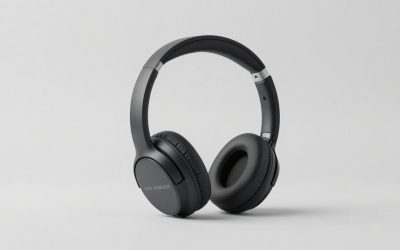
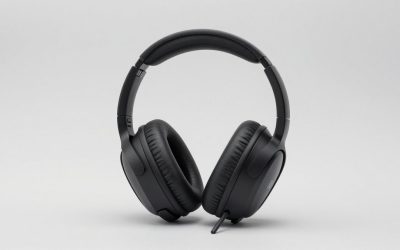
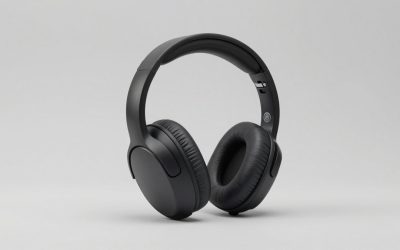
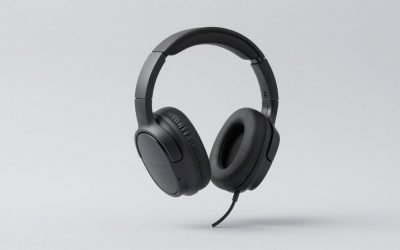
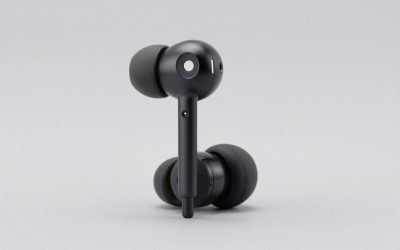
There is a moment every range day, mowing session, or workshop project where your ears start ringing and you realize your protection was either inadequate, uncomfortable, or both. Hearing protection headphones occupy a specific niche: they need to block impulse noise and sustained low frequencies while staying wearable for hours. That combination demands a thick seal around the ear, dense foam or gel padding, and a headband that distributes pressure evenly without clamping like a vise.
The category splits into passive muff designs, which rely entirely on physical barriers to reduce sound, and electronic models that amplify safe-level conversation while still cutting dangerous decibel peaks to a survivable level. The products below cover both approaches at price points from budget to mid-range, so you can match protection to your actual exposure rather than overspending on features you will never use.
As an Amazon Associate we earn from qualifying purchases at no extra cost to you.




Our Top Picks
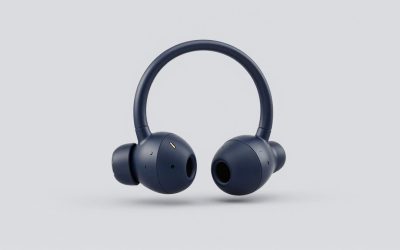
 PROHEAR 037 Bluetooth 6.0 Hearing Protection Headphones with6.29*4.13*8.07 inches0.72 poundsCheck on Amazon
 Walker's Razor Patriot Hearing Protection Ear MuffsOne Size1 x 1 x 1 inches0.8 PoundsCheck on Amazon
 Floriogra 2 Pack 34dB Noise Canceling Headphones For2 Pack6 x 3 x 2.7 Inches1.1 poundsCheck on Amazon
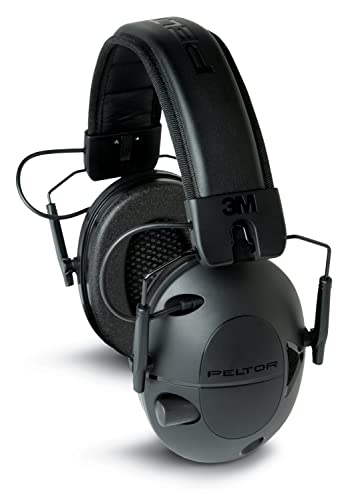 Peltor Sport Tactical 100 Electronic Hearing ProtectorOne Size4.62 x 7 x 11.38 inches0.85 poundsCheck on Amazon


Top 3 picks at a glance
Quick Picks
| Product | Best for | Price |
|---|---|---|
| ProCase SNR 33dB | Best overall passive protection | Check on Amazon |
| PROHEAR 037 Bluetooth 6.0 | Best with Bluetooth connectivity | Check on Amazon |
| Walkers Razor Slim (Tan Patriot) | Best for hunting and shooting | Check on Amazon |
| Floriogra 2 Pack 34dB | Best value multi-pack | Check on Amazon |
| Floriogra 3 Pack SNR 34dB | Best for families or group use | Check on Amazon |
| Peltor Sport Tactical 100 | Best electronic muff for the range | Check on Amazon |
| Howard Leight Leightning L1 | Best budget single pair | Check on Amazon |
| Pro For Sho 34dB NRR | Best for construction and industrial work | Check on Amazon |
How We Compared
We evaluated each pair on four criteria: rated noise reduction (SNR or NRR, whichever the manufacturer states), long-term comfort including headband pressure and ear-cup depth, build quality at the listed price, and real-world versatility. Electronic models were also judged on sound amplification clarity and battery life. A product only made the cut if it delivered reliable attenuation without causing ear-sore fatigue after two or more hours of continuous wear.
The 8 Best Hearing Protection Headphones in 2026
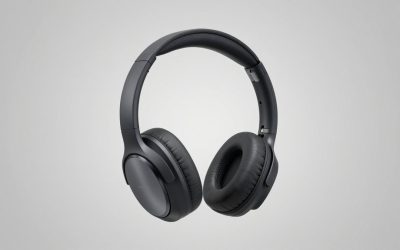
ProCase Hearing Protection Ear Muffs SNR 33dB
This is the pair you hand to a coworker who forgot theirs, keep in the truck, or give to a kid visiting the range for the first time. The SNR 33dB rating puts it in solid middle-of-the-road territory for passive muff protection. The gel-infused ear pads compress evenly and the headband has enough padding to avoid the hot-spot pain that plagues cheaper units.
- Exceptional value for a rated SNR 33dB product
- Comfortable gel pads reduce pressure points during extended wear
- No electronic features or Bluetooth option for range communication
Skip this if you need to hear range commands without removing your muffs, or if you work in environments where impulse noise demands faster compression response than passive foam provides.
PROHEAR 037 Bluetooth 6.0 Hearing Protection Headphones
PROHEAR bridges the gap between a safety device and a pair of wireless headphones. The Bluetooth 6.0 connection is stable enough for podcast playback during long mowing sessions, and the rated 120-hour playtime on a single 1100mAh charge means you will forget it needs recharging. The 30dB SNR is slightly below some passive competitors, but the Bluetooth audio and long runtime make long chores far more comfortable.
- Bluetooth audio streaming and microphones for hands-free calls
- 120-hour battery life outpaces most competitors by a wide margin
- 30dB SNR is lower than passive options at the same price point
Skip this if you need maximum passive attenuation above all else or if you work in environments where electronics are prohibited near combustible dust.
Walkers Razor Slim Electronic Earmuffs (Tan Patriot)
Walkers has dominated the hunting and shooting earmuff conversation for years, and the Razor Slim platform remains the most trusted electronic option on this list. The slim-profile cups sit flush with the cheek, making it one of the few muffs that works cleanly with a rifle stock. The Tan Patriot colorway is a camouflage-friendly option for field use.
- Low-profile cups do not interfere with cheek weld or shoulder stock
- Electronic compression amplifies safe sounds and cuts impulse noise almost instantly
- Requires two AAA batteries that need periodic replacement
Skip this if you prefer Bluetooth connectivity for music or phone calls, or if your use case is purely passive workshop noise where electronics add complexity without benefit.
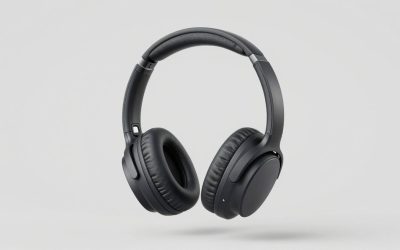
Floriogra 2 Pack 34dB Noise Canceling Headphones
Two pairs of 34dB-rated muffs at a budget price means one stays at the bench and the other goes in the range bag. The thickened headband distributes weight across a wider contact patch than thinner designs, reducing the headache risk that comes with poorly padded budget muffs. For shooters and workshop users who want strong passive attenuation without paying electronic premiums, this is a straightforward answer.
- 34dB rated attenuation is among the highest passive values on this list
- Two-pack pricing keeps the per-pair cost low
- Ear cups are shallow and smaller heads may need to adjust the band tightly
Skip this if you have a larger head size, since the cups may sit on the outer ear rather than enclosing it fully on first wear.
Floriogra 3 Pack Noise Reduction Ear Protection SNR 34dB
The three-pack format makes sense for households with multiple shooters, families taking kids to the range, or small crews that need uniform protection. SNR 34dB is the top-rated passive attenuation here, and the headband is adjustable across a wide range to accommodate both adult and older-child head sizes. With a low per-pair cost, the economics are hard to argue with.
- SNR 34dB matches the highest passive ratings available in this price tier
- Three pairs cover family use or crew distribution without repeated purchases
- Ear pads are foam-based and will compress and soften faster than gel alternatives
Skip this if you need electronic amplification or Bluetooth, since these are strictly passive designs with no active features.
Peltor Sport Tactical 100 Electronic Hearing Protector
The Peltor Sport Tactical 100 is 3M’s straightforward electronic muff for the range and the main alternative to the Walkers Razor Slim above. It carries an NRR of 22 dB. Stereo microphones amplify conversation and range commands, while loud impulse noise such as gunfire is compressed to a safer level. It runs on AAA batteries, includes an auxiliary audio input, and comes from a long-established hearing-protection brand.
- Excellent microphone quality for range commands and conversation
- Established safety brand with simple, straightforward controls
- Higher price than passive options that offer equal or greater SNR
Skip this if your primary use is mowing or woodworking at a fixed location, since passive muffs deliver similar protection at a fraction of the cost.
Howard Leight Leightning L1
The Leightning L1 is a budget single pair from Howard Leight, rated NRR 25 under the US method, which is solid protection for mowing, power tools and outdoor shooting. Its slim cups and light weight make it easy to wear alongside other safety gear and to keep in a tool bag. The headband is simple and lightly padded, adequate for most sessions but less cushioned over several hours than bulkier muffs.
- Established safety brand at a budget tier
- Simple single-use design with no batteries or electronics to maintain
- NRR 25 is lower than the 33-34 dB muffs above, so add earplugs for very loud work
Skip this for extended wear sessions. Buy a pair for occasional use, as a backup, or for situations where losing your muffs is likely.
Pro For Sho 34dB NRR Ear Protection
Pro For Sho positions this model squarely at the construction and industrial end of the spectrum. The NRR 34dB rating covers sustained low-frequency machinery noise effectively, and the foldable frame stores easily in a tool bag. The grey colorway and utilitarian build suit job sites where hi-vis or camouflage aesthetics are irrelevant. It competes directly against the Floriogra line but offers a slightly more compact folded profile.
- Compact folded size fits in a tool pouch or jacket pocket
- NRR 34dB handles sustained industrial noise bands well
- Ear cup foam is firm and takes a long break-in period before sealing comfortably
Skip this if you need a pair you can wear from the first minute without adjustment, or if you prefer gel padding over dense foam.
Howard Leight Impact Sport
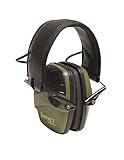
The Impact Sport is one of the most widely recommended electronic earmuffs in the shooting world, and it is the natural alternative to the Walker’s Razor Slim models above. It carries an NRR of 22 dB and uses two stereo microphones to amplify range commands, conversation and ambient sound, then cuts amplification the moment a sound crosses about 82 dB, so gunfire is compressed to a safer level while normal speech stays audible.
Power comes from two AAA batteries, and Howard Leight quotes around 350 hours of runtime. A four-hour automatic shutoff protects the batteries if you forget to turn the muffs off in your range bag, which is a genuinely useful detail for occasional shooters. The cups fold inward for compact storage, the headband is low profile, and a 3.5 mm audio input lets you plug in a phone or radio. There is no Bluetooth, so you will need a cable if you want music.
Who it suits: shooters, hunters and range officers who want clear ambient sound and dependable impulse compression, plus anyone who has to hold conversations while working near intermittent loud noise.
- Strength: Clear stereo amplification with a fixed 82 dB cutoff for impulse noise.
- Strength: Long AAA battery life with automatic shutoff and a folding design.
- Drawback: NRR 22 is modest; indoor ranges and heavy calibers call for adding earplugs underneath.
- Drawback: Wired audio input only, no Bluetooth.
How it compares: Against the Walker’s Razor Slim models, the Impact Sport sits in a similar mid-range tier with a similar NRR. The Razor Slim’s thinner cups are slightly better for cheek weld on a rifle, while the Impact Sport is often praised for its sound pickup and battery longevity. Both offer far less raw attenuation than the passive 33-34 dB muffs in this list, which is the trade-off for hearing your surroundings.
3M Peltor Optime 105 (H10A)
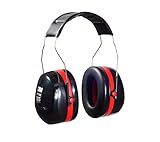
The Optime 105 is the reference passive earmuff for people who need serious attenuation by the US standard. 3M rates it at NRR 30 dB, which the company describes as the highest available in its over-the-head earmuff style. That is a meaningful distinction: many of the 34 dB figures quoted for budget muffs are SNR (European) ratings or less rigorously documented, while NRR 30 under the US EPA method is a demanding result for a muff.
The performance comes from mass and design. Each earcup uses a double-shell construction, two cups joined by a foam inner layer, to reduce resonance and improve blocking across both low and high frequencies. The cushions are liquid and foam filled, which helps them conform to the shape of your head for a better seal. A stainless steel headband resists bending, spreads weight for lower pressure, and the cups pivot to adjust to different head shapes. The muffs are also dielectric, which matters on job sites where metal-free protection is required.
Who it suits: chainsaw and heavy machinery operators, workshop users running planers and routers, indoor shooters who want maximum passive protection, and anyone exposed to sustained very loud noise.
- Strength: NRR 30 dB, among the highest passive ratings for a headband muff.
- Strength: Liquid and foam cushions and a durable steel headband for long shifts.
- Drawback: Large, heavy cups are bulky with a rifle stock and in a small bag.
- Drawback: Blocks speech heavily, with no electronic way to hear people around you.
How it compares: It is the step up from the Pro For Sho and Floriogra passive muffs in this list. Those budget options cost less and fold smaller, but the Optime 105 brings an established industrial brand, a documented NRR 30 and cushions designed for full-shift wear. If you need to communicate, pair it with an electronic muff for other tasks rather than expecting one product to do both.
3M WorkTunes Connect

The WorkTunes Connect is 3M’s answer to the PROHEAR 037: a hearing protector that streams audio from your phone over Bluetooth so long mowing, snow blowing or shop sessions are less tedious. Ratings vary slightly by version, with the standard foam-cushion model rated around NRR 24 dB and other versions a point or two either side, so check the exact listing. That is lower than passive muffs, but enough for typical lawn and yard equipment.
The key safety feature is that audio output is limited to a safe level, so you cannot simply turn the music up to drown out the mower and defeat the purpose of the protection. Audio Assist reads out settings such as volume and battery status, and a built-in microphone handles hands-free calls. Depending on the version, power comes from a built-in rechargeable battery or standard AA cells, and some variants add AM/FM radio. The controls are large enough to use with work gloves.
Who it suits: homeowners and landscapers who want podcasts or music during yard work, DIYers who spend hours with moderately loud tools, and anyone who prefers a recognized safety brand over generic Bluetooth earmuffs.
- Strength: Bluetooth streaming with a volume limit designed to protect your hearing.
- Strength: Glove-friendly controls, voice prompts and hands-free calling.
- Drawback: Mid-20s NRR is not enough for chainsaws or gunfire without earplugs.
- Drawback: Bulkier and heavier than passive muffs; specs vary between versions.
How it compares: The PROHEAR 037 offers a longer advertised runtime and newer Bluetooth version at a similar or lower tier, while the WorkTunes Connect brings 3M’s safety pedigree and protective volume limiting. If music is secondary and protection is the priority, a passive muff like the Optime 105 blocks considerably more noise.
Walker’s XCEL 500BT Digital Electronic Muff

The XCEL 500BT is Walker’s step up from the Razor Slim, adding Bluetooth and smarter sound processing for shooters who want one muff for the range, the field and the drive home. Retailers list it around NRR 25 to 26 dB, a little higher than the Razor Slim, helped by cups designed with fewer openings. It uses digital processing with variable sound suppression rather than a simple cut-off, which aims to keep ambient sound natural while still clamping down on gunshots.
Four listening modes, universal, high frequency, speech clarity and power boost, let you tune what you hear: speech clarity helps with range commands and conversation, while power boost suits hunters listening for movement. Wind noise reduction and voice-guided mode navigation round out the electronics, and Bluetooth lets you take calls or stream audio. It runs on AAA batteries, with a low battery warning and selectable auto shutoff.
Who it suits: hunters and regular range shooters who want Bluetooth and adjustable sound profiles, and anyone who found basic electronic muffs too harsh or tinny.
- Strength: Four listening modes, wind reduction and Bluetooth in one muff.
- Strength: Slightly higher NRR than most slim electronic muffs.
- Drawback: Premium tier compared with the Razor Slim and Impact Sport.
- Drawback: Bulkier cups than the Razor Slim for rifle cheek weld.
How it compares: If the Walker’s Razor Slim entries above cover your needs, the XCEL 500BT is an upgrade rather than a necessity. It makes sense when you value tunable hearing modes and Bluetooth; for occasional range days, the Razor Slim or Impact Sport deliver the core electronic benefits for less.
Dr.meter EM100

The EM100 is a lightweight passive earmuff sold for both kids and adults, and it fills the gap this list has for younger users and sensory-sensitive wearers. The brand lists it at SNR 27.4 dB, which corresponds to roughly NRR 20 dB by the US method. That is far below the 33-34 dB muffs above, but it is a sensible level for fireworks, motorsport events, concerts, loud classrooms and noisy family outings, where the goal is comfort and protection rather than blocking a chainsaw.
The shell is ABS with thick noise-reducing foam, the headband adjusts across a wide range to fit small children through adults, and the muff is light enough that kids are more likely to keep it on. Several colors make it easy to tell family members’ pairs apart, and multi-pack options exist for classrooms.
Who it suits: parents bringing children to loud events, people with noise sensitivity who need relief in busy environments, and gamers or students who want a simple way to cut background noise in a shared space.
- Strength: Light, adjustable and comfortable for kids and smaller heads.
- Strength: Budget tier with no batteries to manage.
- Drawback: Lower attenuation, not suitable for shooting or heavy power tools.
- Drawback: Lighter build is less durable than industrial muffs.
How it compares: The Floriogra 3 Pack is the alternative for families who also need stronger protection, but its cups and clamp force are designed for adults and older children. For toddlers and young kids at events, the EM100’s lower weight and gentler fit are more important than maximum rating.
Walker’s Razor Slim Passive Earmuff

The Razor Slim Passive takes the low-profile shell that makes the electronic Razor Slim popular with shooters and removes the electronics. The result is a lighter, simpler muff with a higher rating: Walker’s lists it at NRR 27 dB, five points above many basic electronic muffs, with no batteries to run flat on the way to the range.
The ultra low-profile cups are the reason to choose it over bulkier passive muffs. They are shaped to reduce contact with a rifle or shotgun stock, so you can keep a natural cheek weld rather than tilting your head to make room. A sound-dampening composite housing, soft cushions, a padded headband over a metal wire frame and a rubberized finish round out the design, and the muff folds down small enough for a jacket pocket or range bag side pouch. It weighs about 10 ounces, light enough for long sessions.
Who it suits: rifle and shotgun shooters who want more attenuation than an electronic muff without the bulk of an industrial muff, and anyone who wants a slim, reliable backup pair that never needs batteries.
- Strength: NRR 27 in a slim, stock-friendly profile.
- Strength: Lightweight, foldable and battery-free at a budget tier.
- Drawback: Blocks conversation and range commands; you will lift a cup to hear instructions.
- Drawback: Lower rating than full-size passive muffs like the Optime 105.
How it compares: It sits between the electronic Walker’s Razor Slim models and the full-size passive muffs in this guide. Compared with the electronic versions, it gives up ambient amplification but gains extra attenuation and never needs AAA batteries. Compared with the ProCase or Floriogra muffs, it is the better choice when a slim cup matters more than the highest printed rating.
Electronic Earmuff Features Worth Paying For
Not every electronic feature makes a practical difference. These are the ones that do:
- Stereo microphones: One microphone per cup lets you tell which direction a sound comes from, important for hunting and range safety. Single-mic muffs flatten everything into the center.
- Fast attack time: The circuit should cut amplification almost instantly when a shot fires. Established brands publish compression behavior; generic models often do not.
- Automatic shutoff: Saves batteries if you forget to switch off after a session, a common reason muffs are dead on the next range day.
- Replaceable cushions and gel options: Gel cushions seal better over safety glasses and can be swapped when worn.
- Audio input or Bluetooth: Useful for long sessions, as long as audio output is volume-limited.
Buying Guide
Understanding SNR vs NRR Ratings
SNR (Single Number Rating) and NRR (Noise Reduction Rating) are not interchangeable. SNR is a European standard that typically produces higher numbers than NRR, the US standard, because of different weighting methodologies. A 34dB SNR muff is roughly equivalent to a 25-28dB NRR muff. Always compare ratings within the same standard, and understand that real-world attenuation is almost always lower than lab-rated figures due to imperfect seals from glasses, hair, or jaw movement.
Passive vs Electronic Protection
Passive muffs use dense foam and physical barriers to block all sound equally. They are simpler, cheaper, require no batteries, and often deliver higher rated attenuation. Electronic muffs use microphones and circuitry to amplify ambient sound below a safety threshold while compressing loud impulsive sounds almost instantly. They excel for hunting, shooting, and supervised work environments where hearing instructions matters. Choose passive for consistent sustained noise like mowing; choose electronic when you need to hear people around you.
Fit, Seal, and Comfort Over Hours
No muff works if it leaks sound. The ear cup must fully enclose the ear without touching the outer edge, and the headband must apply even pressure around the entire circumference. Glasses break the seal significantly, so if you wear them, choose thin-temple frames and soft cushions that conform around the arms. Gel-infused pads stay cooler than plain foam and maintain their seal over more hours before softening. If you plan to wear muffs for more than two hours at a stretch, prioritize pad material and headband padding over marginal rating differences.
How Much Protection Do You Actually Need?
Noise damage depends on both loudness and duration. US workplace guidance from NIOSH recommends limiting exposure to 85 dBA averaged over eight hours, and the safe time halves with every 3 dB increase. That means a sound at 94 dBA is only considered safe for about an hour, and 100 dBA for roughly 15 minutes. Gunshots are a different category: impulse noise from firearms commonly peaks between about 140 and 170 dB, enough to cause damage from a single exposure.
Typical sources and sensible protection levels:
- Lawn mowers, leaf blowers, vacuums and loud gaming events (about 85-100 dB): a muff in the low to mid 20s NRR is usually enough, including Bluetooth models.
- Power tools, table saws, routers and chainsaws (about 95-115 dB): aim for NRR 25-30, especially for long sessions.
- Outdoor shooting: NRR 22 or higher electronic muffs, and add earplugs for magnum calibers.
- Indoor ranges and rifles under cover: double up with foam earplugs under a muff.
Reading Ratings Realistically
Lab ratings are measured with an ideal fit, so real-world protection is lower. A common OSHA method for estimating field protection from NRR is to subtract 7 and divide by 2; 3M simply suggests cutting the NRR roughly in half. By either rule, an NRR 30 muff realistically reduces noise by about 11-15 dB and an NRR 22 muff by roughly 7-11 dB. When you double up with earplugs and muffs, you do not add the two ratings together; the combined protection is roughly the higher rating plus about 5 dB.
Bluetooth and Volume Limiting
Bluetooth earmuffs make long chores more pleasant, but they introduce a risk: turning music up to overpower the noise you are trying to block. Look for models that cap audio output, as protective brands typically do, and keep volume as low as practical. If you can hear the mower clearly over your music, the music is not too loud; if you need it near maximum, move to a muff with a higher NRR instead.
Comparison of the Additional Picks
| Model | Type | Rating | Power | Best for | Price tier |
|---|---|---|---|---|---|
| Howard Leight Impact Sport | Electronic | NRR 22 | 2 x AAA | Outdoor shooting, hunting | Mid-range |
| 3M Peltor Optime 105 (H10A) | Passive | NRR 30 | None | Chainsaws, heavy machinery, indoor ranges | Budget to mid-range |
| 3M WorkTunes Connect | Bluetooth | Around NRR 24 (version-dependent) | Rechargeable or AA (version-dependent) | Yard work with audio | Mid-range |
| Walker’s XCEL 500BT | Electronic with Bluetooth | Around NRR 25-26 | AAA | Hunting, frequent range use | Premium |
| Dr.meter EM100 | Passive | SNR 27.4 (about NRR 20) | None | Kids, events, sensory relief | Budget |
Care and Maintenance Tips
- Inspect cushions often. Cracked, flattened or hardened cushions break the seal. Many manufacturers suggest replacing cushions and foam liners about twice a year with regular use, and replacement kits exist for popular models.
- Clean gently. Wipe cushions with mild soap and water and let them dry fully. Avoid solvents and alcohol, which can harden the material.
- Do not bend the headband. Stretching a headband to relieve pressure reduces clamp force and protection. If a muff is too tight, try a different model rather than modifying it.
- Remove batteries for storage. For electronic muffs stored for weeks at a time, take batteries out to prevent corrosion.
- Keep hair and hats out of the seal. Pull long hair back and avoid thick caps or hoods under the cushions. Low-profile safety glasses with thin temples reduce leakage.
- Store out of heat. A hot vehicle dashboard can deform cushions and shorten battery life.
Our Verdict
The top pick is the ProCase Hearing Protection Ear Muffs SNR 33dB: strong passive attenuation, comfortable padding, and a budget price make it the easiest recommendation for workshops, yard work and spare pairs. For shooting or hunting, where you need to hear commands, the Walkers Razor Slim Electronic Earmuffs are the better fit. For pure value, the Floriogra 3 Pack SNR 34dB delivers three pairs of top-rated passive protection for less than a single electronic muff, making it the smart budget choice for families or crews. The PROHEAR 037 wins outright if you need Bluetooth audio and long battery life during mowing or snowblowing sessions where entertainment matters as much as safety.
FAQ
Is a higher SNR or NRR always better?
Higher ratings mean more attenuation, which is good for very loud environments. However, in situations where you need to hear speech, machinery alarms, or range commands, excessive passive attenuation can be a liability. Match the rating to your actual noise exposure rather than simply choosing the highest number available.
Do hearing protection headphones work with glasses?
Passive muffs can lose a noticeable amount of rated protection when worn over glasses frames because the seal is broken. Electronic muffs do not fix a broken seal either; thin-temple safety glasses and soft or gel cushions that conform around the frames are the better solution for anyone who wears eyeglasses daily.
How long do electronic earmuff batteries last?
Battery life depends on the model and usage, but typical electronic muffs run between 150 and 350 hours on standard AAA cells. Bluetooth models with rechargeable cells like the PROHEAR 037 advertise playtime figures in the hundreds of hours, though the hearing-protection amplifier circuit itself may have a different runtime than the Bluetooth audio component.
Can I use passive muffs for sleep or study?
Passive earmuffs reduce volume without eliminating sound, and their bulky form factor makes side-sleeping impractical. For sleep or quiet study, purpose-built sleep headphones or low-profile earplugs will provide more comfort at a similar attenuation level. Muffs are designed for upright work environments where the headband pressure is manageable.
Part of our headphones buying guide hub.
Are noise cancelling headphones the same as hearing protection?
No. Consumer active noise cancelling headphones are designed to reduce steady background noise for comfort, and they generally carry no NRR or SNR rating. They are not built or certified to protect against loud machinery or gunfire. For hazardous noise, use a rated earmuff or earplug.
Should I wear earplugs under my earmuffs?
For indoor shooting, magnum calibers, or very loud equipment, yes. Doubling up adds meaningful protection, though the combined rating is roughly the higher of the two plus about 5 dB rather than the sum. Electronic muffs over foam plugs still let you hear speech reasonably well.
How often should ear cushions be replaced?
Check them whenever you use the muffs and replace them once they crack, harden or no longer spring back. With regular use, that is often about every six months. Fresh cushions restore the seal and much of the original protection.
Can children use adult earmuffs?
Older children can often use adult muffs with a well-adjusted headband, but younger kids need models designed for smaller heads so the cups seal properly and the clamping force is comfortable. Lightweight kids’ muffs are the better choice for events and fireworks.
Can I use hearing protection earmuffs at gaming events or LAN parties?
Large esports arenas and gaming conventions can be loud for hours, so a lightweight passive muff or high-fidelity earplugs are reasonable for spectators. For your own gaming setup at home, normal headphones at moderate volume are fine; the bigger risk there is listening too loud for too long, so keep volume limits enabled on your devices.