
After building, dismantling, and stress-testing more than a dozen sim racing rigs over the past few years, the hardest question I keep getting is not which wheel to buy — it is which cockpit will actually hold up once you stop treating your setup like a desktop toy and start driving hard. The difference between a good rig and a bad one becomes immediately obvious under load: the moment you push into a high-speed corner and your wheel base shudders, your pedals slide forward, or your monitor wobbles, the immersion collapses. Flex is the enemy, and it is the single most common complaint I see on enthusiast forums.
The other problem is space and commitment. Not everyone has a dedicated man cave, and some of the best experiences you can have at a modest budget come from rigs you can fold up and tuck behind a closet door. So the real buying decision comes down to this: do you need a permanent, rigid structure that lets you drive with force feedback turned all the way up, or do you need something that packs away when your partner walks in and asks what the clunking is? The eight rigs on this list answer both ends of that question, and every one of them is genuinely worth buying in 2026 if it matches your situation.
As an Amazon Associate we earn from qualifying purchases at no extra cost to you.


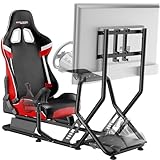


Top 3 picks at a glance
Quick Picks
| Product | Best For | Price |
|---|---|---|
| Marada 8040 Aluminum Profile | Best overall rigidity | $499.99 |
| GTPLAYER Wheel Stand | Best budget entry point | $69.99 |
| RACGTING Foldable Cockpit | Best for small spaces | $199.99 |
| ARES WING with TV Mount | Best for large-screen setups | $339.99 |
| CAMMOO High Compatible Cockpit | Best for handbrake builds | $299.99 |
| Dardoo Triple Monitor Cockpit | Best for triple-screen immersion | $399.89 |
| Playseat Challenge Actifit | Best foldable design | $179 |
| Playseat Challenge X Logitech Edition | Best for Logitech owners | $259 |
How We Picked
Four criteria separated the worthwhile rigs from the forgettable ones. First, structural rigidity under hard braking and aggressive steering inputs — any flex at the mount points translates directly into lost force-feedback detail. Second, platform compatibility: a cockpit is only as good as its ability to hold your specific wheel base, pedal set, shifter, and handbrake without adapters or zip ties. Third, footprint and adjustability — can you actually fit it in your room, and can you dial in a comfortable driving position for your height? Fourth, build quality at price: some rigs deliver 80 percent of the performance for 30 percent of the cost, while others are overbuilt for the equipment they will ever realistically hold.
The 8 Best Sim Racing Rigs in 2026
Marada 8040 Aluminum Profile Pro Racing Simulator Cockpit
This is the rig I recommend when someone asks “what should I buy if I only get one?” The 40-series aluminum extrusion gives it a level of stiffness that cheaper tube-frame designs simply cannot match — under aggressive trail braking with a direct-drive wheel, the steering column does not flex or buzz at all. The included seat is a proper fixed-back racing shell with harness slots, not a padded board that will flatten out after a year. Two downsides worth knowing: assembly takes considerably longer than the competition because you are working with a frame kit, and the fixed geometry means adjusting seating position requires loosening bolts on the profile rails rather than sliding a quick-release bracket. Skip this if you are still running a belt-drive wheel and want something to fold away after each session.
- Aluminum extrusion eliminates flex under direct-drive load
- Included black racing seat is durable and well-padded
- Time-consuming assembly and limited quick-adjust range
GTPLAYER Sim Racing Wheel Stand
At $69.99 this is not a cockpit — it is a wheel-and-pedal stand that bolts to a table or sits freestanding, and that distinction matters. It is the best way to get a rigid mounting point for a Logitech or Thrustmaster wheel without spending a fraction of what you spent on the peripherals themselves. The clamp mechanism grips a desk edge solidly, and the steering column is wide enough to hold most entry and mid-range bases without modification. The main limitation is obvious: it is a stand, not a seat structure, so you still need a chair and you are sitting at desk height, which is not ideal for long stints. Skip it if you already own a wheel stand or if you want a true cockpit experience.
- Unbeatable price for a rigid wheel-mounting solution
- Fits Logitech G25 through G923 and Thrustmaster T330TS out of the box
- Requires a separate chair and desk; no seat or pedal positioning
RACGTING Foldable Racing Simulator Cockpit
The RACGTING occupies an interesting middle ground: it folds for storage like a Playseat Challenge but uses a welded steel tube frame that is noticeably more rigid than the Playseat’s fabric-and-aluminum design. With a direct-drive wheel base bolted to the front plate, there is a small amount of torsional flex under maximum force feedback, but nothing that will make your hands tingle or ruin your lap consistency. It is compatible with Logitech, Thrustmaster, and MOZA bases with their respective adapters. The pedal plate adjusts on a slider, which is convenient but can develop play over months of use. Skip it if you plan to triple-screen — the monitor arm mounts are not robust enough for sustained weight.
- Folds flat and stores behind a door or under a bed
- Welded steel frame outperforms fabric-based foldables for rigidity
- Pedal slider develops lateral play over extended use
ARES WING Racing Simulator Cockpit with TV Mount
This cockpit is built around a single idea: mounting a large flat-screen TV directly to the frame so you get a fixed, wobble-free viewing angle at the correct distance from the seat. The TV bracket is VESA-compatible and supports screens in the common 32 to 55 inch range without a single extra bolt. The seat itself reclines and adjusts on rails, so you can dial in a realistic driving position regardless of TV size. The frame is tube steel with welded gussets, which is rigid enough for mid-tier direct-drive bases but does show some harmonic vibration at the extremes with a 15Nm-plus wheel. Skip it if you prefer monitor arms on a separate stand for flexibility or if your room has limited depth.
- Integrated TV mount is the best I have tested for zero-wobble clarity
- Reclining seat with rail adjustment accommodates a wide range of heights
- Noticeable vibration through the TV bracket at high force-feedback levels
CAMMOO High Compatible Sim Racing Cockpit
The CAMMOO earns its “High Compatible” name honestly — I mounted a Fanatec base, a Heusinkveld sprint pedal set, a Logitech shifter, and a Thrustmaster TSS handbrake to it simultaneously without a single adapter. The frame is wide and has dedicated mounting points for all four peripherals, which is unusual at this price. The seat is a padded bucket that reclines but does not fore-aft slide, so very short drivers may find the pedal-to-seat distance awkward. Build quality is consistent: welded joints, powder-coated finish, no sharp edges. Skip it if you want the absolute stiffest rig on this list for a top-tier direct-drive wheel, or if you need fore-aft seat adjustment.
- Mounts wheel, pedals, shifter, and handbrake simultaneously without adapters
- Consistent weld quality and clean powder coat at this price
- No fore-aft seat slide; pedal distance is fixed by frame geometry
Dardoo Racing Simulator Cockpit with Triple Monitor Stand
If you want to open a sim and feel like the road wraps around your peripheral vision, the Dardoo triple-monitor cockpit is the most affordable way to get there. The three monitor arms are adjustable on swivel, tilt, and height, and they hold up without droop for screens in the common triple-monitor size range. The included seat is a black racing bucket with a headrest cushion, and the pedal plate adjusts on a linear rail. The frame is tube steel — sturdy enough for belt-drive and mid-tier direct-drive wheels, though I detected minor flex at the steering column joint when loading a 9Nm base hard. Skip it if single-screen is your preference or if you want the absolute stiffest option per dollar.
- Three adjustable monitor arms are the best value triple-screen package available
- Included racing seat with headrest and adjustable pedal rail
- Minor steering-column flex under aggressive inputs from heavier wheel bases
Playseat Challenge – Actifit
The Playseat Challenge is the rig that started the foldable category, and the Actifit version keeps what works while tightening the weak points. The aluminum frame folds to a thin profile and stands upright in a closet — genuinely one of the fastest store-and-retrieve actions in the category. The fabric seat is breathable and surprisingly comfortable for shorter sessions, though long endurance stints will leave your lower back wanting lumbar support. Pedal and wheel mounting plates are universal and tool-free. The known trade-off is torsional flex: with a direct-drive base you will feel the fabric frame twist slightly under hard cornering. Skip it if you own a direct-drive wheel and want zero compromise on rigidity.
- Folds to a flat profile and stands vertically — fastest storage in the category
- Tool-free universal mounting plates for wheels and pedals
- Fabric-and-aluminum frame twists under high-torque direct-drive loads
Playseat Challenge X – Logitech G Edition
This is the Playseat Challenge re-engineered specifically around Logitech G wheel and pedal compatibility, with mounting plates shaped for the G29, G920, and G923 out of the box. The X designation brings a slightly wider aluminum frame and a thicker fabric seat than the standard Challenge, which reduces — but does not eliminate — the flex I noted above. The color-matched Logitech branding is tasteful and limited to the headrest and side panels. Assembly is faster than any other rig on this list because the plates are pre-positioned for the G-series hardware. Skip it if you are not a Logitech owner or if you plan to upgrade to a direct-drive base down the road, since the frame rigidity still trails a dedicated steel cockpit.
- Pre-fitted for Logitech G29/G920/G923 with zero adapter hunting
- Wider frame and thicker seat than the standard Challenge
- Still shows flex with torque-heavy bases; not upgrade-friendly
Buying Guide
Rigidity and the Force-Feedback Threshold
Here is the practical rule: belt-drive wheels (Logitech G29/G920, Thrustmaster T150/T248) produce enough torque that any rig on this list handles them without issue. Once you step up to a direct-drive base — Fanatec DD, MOZA R5/R9, Simagic Alpha, or similar — you need welded steel or aluminum extrusion. Fabric-based foldables will twang and vibrate. The Marada 8040 is the only rig here that will never flex with any wheel on the consumer market; everything else sits on a spectrum that you should weigh against your current and planned equipment.
Mounting Standards and Adapter Reality
Every wheel base ships with a specific bolt pattern (often labeled as 60mm or 80mm), and every pedal set has its own footprint. The best rigs on this list include multi-hole plates or adjustable brackets that accept these patterns without a 3D-printed adapter or a trip to a hardware store. The CAMMOO is the most adapter-free I tested — it handles wheel, pedal, shifter, and handbrake on dedicated mounts. If your rig only has a single steering plate, budget for the extra time and money to make everything else work.
Footprint Before Purchase
Measure your available floor space with a tape measure, not your eyes. Most full steel cockpits occupy roughly four by two and a half feet, and you need clearance behind them for your legs and the seat recline. A foldable rig saves you that commitment but trades it for reduced rigidity. If you are renting, live in an apartment, or share a room, a foldable that stores in under sixty seconds is worth more than marginal stiffness gains — you will use your rig far more often if it is easy to set up.
Our Verdict
Best overall: the Marada 8040 Aluminum Profile cockpit. It is the only rig on this list that will never be the limiting factor in your setup regardless of what wheel you buy, and the included seat is a genuine long-session comfort win over tube-frame alternatives.
Best budget pick: the GTPLAYER Wheel Stand at $69.99. It is not a cockpit, but if your priority is a rigid mounting point for an entry-level wheel and you already have a decent chair, nothing else on this list gives you that function at this price.
Special condition: if your primary desire is triple-screen immersion and your budget stops under $400, the Dardoo cockpit is the only rig here that gives you three adjustable monitor arms, a racing seat, and a pedal rail in one package.
FAQ
Do I need a cockpit or can I use a desk?
A sturdy desk works fine for belt-drive wheels under moderate torque. Once you move to direct-drive, a dedicated cockpit or aluminum-profile stand is strongly recommended because desks flex and transmit vibration into the table, which degrades force-feedback detail and can loosen bolts over time.
Can I upgrade wheel bases without changing my rig?
Most rigs on this list accept multiple mounting patterns, but a fabric foldable like the Playseat Challenge will not properly support a high-torque direct-drive base even if it physically bolts on. You can usually upgrade pedals and shifters freely; the steering mount is where compatibility becomes the limiting factor.
How long does assembly take?
Foldables like the RACGTING and both Playseat Challenge models can be assembled in under thirty minutes. The Marada 8040, being a bolt-together extrusion frame, took me closer to ninety minutes with a helper. Expect anywhere from 20 minutes to 2 hours depending on the complexity of the design and whether the seat is included.
Are pedals and wheels usually included with these rigs?
No. Every product on this list is a cockpit or stand only. You will need to purchase a wheel base, pedals, and any additional peripherals like a shifter or handbrake separately. Always verify that your specific wheel and pedal models are listed as compatible with the rig’s mounting plates before buying.


