For many sim racers, load cell pedals change how a brake zone feels more than any other rig upgrade. The difference is not subtle: instead of guessing how hard you are standing on the pedal based on spring compression, you get a direct reading of force in kilograms. That means consistent braking points, better threshold control under trail-braking, and feedback that actually scales with how hard you are working.
The problem for most buyers in 2026 is that the market has split into three very different tiers. You have cheap mods that bolt onto existing pedals and give you a taste of load cell feel without replacing your whole set. You have dedicated entry-level units with real load cell sensors but questionable build quality. And then you have serious hardware that pairs load cells with hydraulic dampers and haptic reactor support for a force-feedback brake that mimics a real race car. Picking the wrong tier wastes money and can leave you rebuilding twice.
As an Amazon Associate we earn from qualifying purchases at no extra cost to you.


Our Top Picks


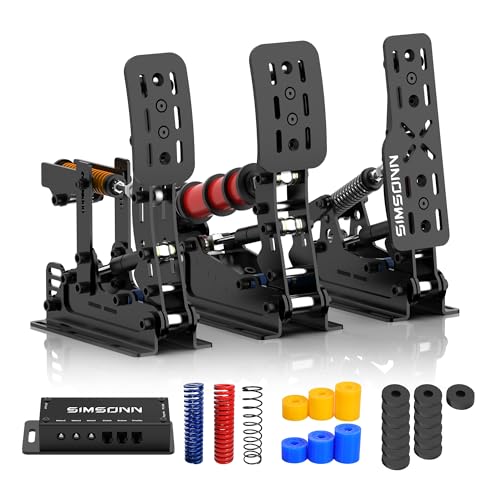

Top 3 picks at a glance
Quick Picks
| Product | Best for | Price |
|---|---|---|
| SimSport Gadget Brake Mod for Logitech Pro Racing | G PRO pedal owners wanting a firmer brake feel | Check on Amazon |
| Logitech G RS Sim Racing Pedals | Mid-range load cell performance out of the box | Check on Amazon |
| Asetek La Prima Pedals (Brake and Throttle) | Premium-brand two-stage load cell brake on PC | Check on Amazon |
| Simjack UT Sim Racing Pedals with 200KG Load Cell | Heavy braking force on a budget | Check on Amazon |
| SIMSONN PRO X Ultra (P3-H3) | High-end haptic-ready setups | Check on Amazon |
| SIMSONN Plus X (P3-H3) | Haptic-ready setups below the flagship tier | Check on Amazon |
| Compatible 3Pcs Hydraulic Load Cell Pedals | Universal rig integration | Check on Amazon |
| Logitech G PRO Racing Pedals | Proven 100 kg load cell reliability | Check on Amazon |
How We Compared
We evaluated these best load cell pedals for sim racing rigs on four criteria. First, sensor quality: does the load cell deliver a linear, repeatable reading across its full range, or does it drift after a few sessions? Second, brake modulation: how well can you hold a mid-sweep pressure without the pedal fighting you, which is where hydraulic dampers separate from spring-only designs. Third, ecosystem compatibility: whether the pedals work cleanly with your existing base, pedal plate, or haptic hardware without adapter headaches. Fourth, value: a budget upgrade to pedals you already own can make more sense than a premium set if you only race occasionally.
The Best Load Cell Pedals For Sim Racing Rigs in 2026
SimSport Gadget Brake Mod for Logitech Pro Racing Load Cell Pedals Sim Rig
This is one of the cheapest meaningful brake upgrades you can make if you already own Logitech G PRO Racing Pedals. The G PRO brake already uses a 100 kg load cell; this kit swaps the stock brake elastomers for a set of elastomers and solid spacers in different lengths, giving a stiffer pedal with shorter travel and a firmer two-stage feel without buying an entirely new set. The build is utilitarian but functional, and the installation is straightforward if you are comfortable with a screwdriver and a few minutes of work.
- Pro: Dramatically improves brake feel for the price.
- Pro: No driver changes needed; your existing calibration software still works.
- Con: Fits only Logitech G PRO Racing Pedals, and it changes pedal feel rather than the sensor.
Skip it if you do not already own Logitech G PRO Racing Pedals, since the kit does nothing for other pedal sets.
Logitech G RS Sim Racing Pedals (with 75 kg Load Cell Brake)
The G RS sits in that awkward middle ground between toy and tool, but its 75 kg load cell brake is genuinely good hardware. The pedal travel is short and progressive, and the brake response scales well from light trail-braking to full lock. The set ships with throttle and brake only, with a Hall effect throttle and an optional clutch module, so you are buying primarily for the brake channel. Its steel and plastic build sits below the aluminum G PRO pedals.
- Pro: 75 kg load cell brake provides linear, repeatable force readings.
- Pro: Plug-and-play with Logitech’s software ecosystem.
- Con: Two pedals out of the box; the clutch is a separate purchase.
Skip it if you want three pedals out of the box or plan to add haptic reactor support later.
Asetek La Prima Load Cell Sim Racing Pedals (Brake and Throttle)
La Prima is the entry point to Asetek’s pedal line and a sturdy choice for PC racers who want a premium-brand load cell brake without stepping up to a true hydraulic system. The brake uses Asetek’s Mechanical Load Cell Powered Cylinder, which senses up to 180 kg at the pedal face and gives a two-stage soft-then-hard feel, with hand-adjustable initial firmness and three elastomers in the box. The throttle uses a 16-bit contactless Hall sensor with curves set in Asetek’s RaceHub software, and the brake cylinder can later be upgraded to Asetek’s T.H.O.R.P. hydraulic unit.
- Pro: Two-stage load cell brake rated up to 180 kg with a realistic feel.
- Pro: Upgrade path to Asetek’s hydraulic brake cylinder.
- Con: PC only, limited adjustability, and the clutch is a separate purchase.
Skip it if you race on console or want three pedals out of the box.
Simjack UT Sim Racing Pedals with 200KG Load Cell Sensor Adjustable Hydraulic Metal Pedals for PC Racing Simulator
This is Simjack’s UT platform with a 200KG load cell sensor and adjustable hydraulic resistance. The high-rated cell gives plenty of headroom, and you can set the maximum brake force in software to match the pressure you actually use. The metal construction adds heft and rigidity. Adjustable damping lets you dial in the pedal feel from light and fast to heavy and progressive. In the mid-range tier, it competes directly with pricier sets.
- Pro: 200KG cell leaves headroom for heavy braking setups.
- Pro: Adjustable hydraulic damping accommodates different driving styles.
- Con: Software interface is clunky compared to Logitech or SIMSONN options.
Skip it if you prioritize a polished software experience and firmware update support.
SIMSONN PRO X Ultra Sim Racing Pedals PC Racing Simulator Load Cell HE Hydraulic Pedals Support Haptic Reactor (PRO X Ultra P3-H3)
The PRO X Ultra P3-H3 is SIMSONN’s flagship, and it earns the position. The haptic reactor support means you can pair these with a tactile transducer for brake lockup and ABS feedback that most other pedals in this price bracket cannot deliver. The load cell is well-calibrated out of the box, and the hydraulic section has a noticeably smoother sweep than cheaper competitors. Build quality is excellent throughout. This is what you buy when you want one pedal set to last years.
- Pro: Native haptic reactor support adds a layer of immersion few pedals offer.
- Pro: Exceptional build quality and factory calibration consistency.
- Con: Upper mid-range tier, and the haptic reactors cost extra.
Skip it if you do not plan to add haptic hardware and will not use the reactor channel.
SIMSONN Plus X Sim Racing Pedals Support Haptic Reactor (Black P3-H3)
The Plus X sits below SIMSONN’s PRO X Ultra flagship and is the value entry point into the brand’s haptic-ready line. This three-pedal P3-H3 set pairs a dual-stage load cell brake rated up to 200 kg with Hall effect sensing and factory-fitted hydraulic dampers, and it supports SIMSONN’s optional haptic reactors for ABS and lockup cues. The reactors and a baseplate are sold separately, so plan for both if you want the full setup.
- Pro: Haptic reactor support for less than the flagship.
- Pro: Compatible with SIMSONN’s broader ecosystem for future upgrades.
- Con: PC only, and the haptic reactors and baseplate cost extra.
Skip it if you race on console or will never use haptic feedback.
Compatible For 3Pcs Sim Racing Pedals Hydraulic Load Cell PC Racing Rig
This three-piece set covers throttle, brake, and clutch with a hydraulic load cell design. The word “Compatible” in the title is doing real work here: it is a universal-style unit that can bolt onto various rigs without proprietary adapters. It occupies a fair middle ground. The brake has a progressive hydraulic sweep, and the listing describes a load cell design, so confirm which pedals use it before buying. The main trade-off is software support, which is minimal.
- Pro: Three pedals with a load cell design and hydraulic damping.
- Pro: Universal mounting works across multiple rig brands.
- Con: Minimal companion software; calibration is largely manual and imprecise.
Skip it if you want a plug-and-play experience with reliable firmware updates.
Logitech G PRO Racing Pedals Simulator with 100kg Load Cell Brake
The G PRO Racing Pedals with its 100 kg load cell brake remain the most well-known load cell option in the sim racing world for good reason. The sensor is consistent, the travel is linear, and Logitech’s software handles calibration cleanly. In the premium tier, you are paying a brand premium, but you also get a proven track record and wide compatibility with existing Logitech wheel bases. The build feels solid.
- Pro: Proven 100 kg load cell with excellent long-term consistency.
- Pro: Full ecosystem support from Logitech’s software and wheel bases.
- Con: No hydraulic damping means the brake feels less progressive than modern competitors.
Skip it if you prefer hydraulic brake feel and do not need Logitech ecosystem lock-in.
MOZA CRP2 Load Cell Pedals
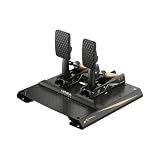
The MOZA CRP2 is the mid-range load cell set that competing 2026 guides recommend most often for PC and Xbox racers, and it fills an obvious gap in our list: a polished, ecosystem-backed set between the Simjack 200KG set and the SIMSONN flagship. The brake combines a 0 to 200 kg load cell with a 15-bit magnetic angle sensor, and MOZA blends both signals with what it calls a fusion algorithm, so early pedal travel feels natural before force takes over as the main input.
Build quality is a step above most sets here. The pedal bodies are CNC-machined aerospace-grade aluminum, the heel plate is carbon fiber and the base is steel. The brake offers 115 standard feel adjustments out of the box, and MOZA’s optional Performance Kit adds springs and damping blocks for 1,764 combinations, enough to simulate a stiff formula-car brake or a softer GT feel. Throttle and clutch travel, pedal angle and face height are all adjustable, and the set supports inverted mounting for cockpits that hang pedals from above. It connects to a MOZA base over RJ45 or directly over USB, and it is configured in MOZA Pit House.
Pro: 200 kg load cell with fusion sensing for a natural brake sweep. Pro: aluminum and carbon construction with wide adjustment and inverted mounting. Con: the standard set is throttle and brake only; the clutch is a separate purchase. Independent reviews also note slippery pedal faces that work best with shoes on.
Compared with the Logitech G PRO pedals, the CRP2 offers twice the load cell range and more tuning options at a similar upper mid-range tier, but no PlayStation support. Compared with the Simjack 200 kg set, it trades hydraulic damping for far more mature software and a proven ecosystem.
Skip it if you race on PlayStation, or if you want hydraulic damping rather than an elastomer stack.
MOZA SRP2 Load Cell Pedals (100 kg)

The SRP2 is MOZA’s lower-tier load cell set and a strong alternative to the Logitech G RS for PC and Xbox drivers on a tighter budget. It pairs a 0 to 100 kg load cell with a 15-bit angle sensor in the same hybrid arrangement as the CRP2: early travel reads position, then pressure takes over as you push harder. That hybrid behavior makes the jump from spring pedals easier to adapt to than a pure load cell with almost no travel.
The set is built mainly from high-strength steel with polished steel shafts and soft-limit cushioning to reduce noise. Out of the box you get 25 standard brake configurations from three elastomer springs, and the optional Performance Kit shared with the CRP2 takes that past 1,000. Pedal face angle has two positions, spacing adjusts by 15mm either side and height has a 36mm range. A clutch pedal and rear support bracket are sold separately.
Pro: 100 kg load cell brake with hybrid sensing in the budget-to-mid-range tier. Pro: real-time pedal output and curve adjustment in MOZA Pit House. Con: two pedals as standard, and steel construction is heavier and less refined than the CRP2. Platform listings vary, with MOZA listing PC and Xbox while some retailers list PC only, so confirm before buying for console use.
Compared with the Logitech G RS, the SRP2 offers a higher-rated load cell at a similar tier, while the G RS wins on PlayStation support. Compared with the SIMSONN Plus X, it lacks hydraulic damping and haptic reactor support but has a larger ecosystem behind it.
Skip it if you need three pedals out of the box or race on PlayStation.
Thrustmaster Raceline Pedals III LC

The Raceline Pedals III LC is Thrustmaster’s modern load cell set and the strongest new option here for PlayStation racers who are not tied to Logitech. The brake uses a load cell rated up to 100 kg with 24-bit resolution, while the throttle and clutch use Thrustmaster’s contactless H.E.A.R.T. Hall effect sensors. All three pedals are metal, and the set is fully modular, so you can space the pedals as you like and move from a desk setup to a cockpit without new hardware.
Brake stiffness is configurable from 25 to 100 kg through four configurations, three springs and an elastomer buffer, plus a preload dial for fine adjustments of about 5 kg either way. Settings such as dead zones can be adjusted from the T598 wheel base’s Race Dash screen or the My Thrustmaster Panel software on PC. The set works on PC over USB-C and on PS5, PS4 and Xbox when connected through an officially licensed Thrustmaster wheel base for that console.
Pro: 100 kg load cell with 24-bit resolution and Hall effect throttle and clutch. Pro: three metal pedals with broad console support through Thrustmaster bases. Con: on consoles it requires a compatible Thrustmaster wheel base, so it is not a fit with Logitech or MOZA bases there. Owners of Raceline Pedals III or LTE can buy the cheaper Raceline LC Upgrade kit instead of a whole new set.
Compared with the Logitech G PRO pedals, the Raceline III LC has the same rated load cell range and three pedals in a similar tier, so your choice mostly depends on which wheel base you own. Compared with the G RS, it adds a higher-rated cell and metal construction.
Skip it if your wheel base is a Logitech, Fanatec or MOZA unit and you race on console.
Fanatec CSL Elite Pedals V2

The Fanatec CSL Elite Pedals V2 are the go-to load cell upgrade for anyone already in the Fanatec ecosystem, and one of the few sets in this guide with a credible path to PlayStation and Xbox through a wheel base. The brake uses a load cell rated well above 200 kg internally, which Fanatec tunes to an adjustable 90 kg at the pedal plate, with the minimum brake force settable to around 10 kg in the base’s tuning menu or the Fanatec Control Panel on PC.
Brake feel comes from a two-stage stack: a metal spring for the initial travel followed by an elastomer. Three elastomers of different hardness are included and swap without tools, and a stiffer spare spring is in the box. The throttle and clutch use contactless Hall effect sensors, while the pedal arms, faces and heel rest are cast and machined aluminum with a powder-coated finish. Pedals slide sideways along the heel rest for spacing, and the set can run as two or three pedals.
Pro: adjustable 90 kg load cell brake with a two-stage spring and elastomer feel. Pro: aluminum construction, three pedals and console support via Fanatec bases. Con: console use requires a Fanatec wheel base connected over RJ12; on its own over USB it works on PC only. The 90 kg ceiling suits most drivers but is lower than MOZA’s CRP2 or the Simjack 200 kg set.
Compared with the Logitech G PRO pedals, the CSL Elite V2 offers a similar tier and three-pedal layout, with the choice driven by which ecosystem your wheel base belongs to. Compared with the SIMSONN PRO X Ultra, it gives up hydraulic damping and haptic reactor support but offers better console compatibility.
Skip it if you do not own, or plan to buy, a Fanatec wheel base and race on console.
Asetek Invicta S-Series T.H.O.R.P. II Hydraulic Pedals

The Asetek Invicta S-Series T.H.O.R.P. II is the premium choice in this guide and a deliberate outlier: instead of a load cell, the brake uses a true hydraulic system with an automotive-grade pressure sensor. T.H.O.R.P. stands for Twin Hydraulic Opposing Rapid Pistons, and the design delivers a soft first stage followed by a hard second stage, the same two-phase feel a real race car brake gives as pads bite and the system firms up. The sensor reads 0 to 100 bar, which Asetek says equals about 180 kg of force at the pedal plate.
The second-generation design adds up to 40 percent more travel than the original and reaches the second stage with less force. Brake feel is tuned with five swappable elastomers plus a manual adjustment for first-touch firmness, and the throttle uses a 16-bit Hall effect sensor with curves set in Asetek’s RaceHub software. Pedals can be mounted inverted, every adjustable part is tool-free, and RGB lighting can sync to in-game telemetry. The set is throttle and brake only; a clutch is a separate add-on.
Pro: genuine hydraulic brake with a realistic two-stage feel and high pressure range. Pro: tool-free adjustment and inverted mounting for serious cockpits. Con: premium tier by a wide margin, PC only over USB-C, and no clutch in the base set. Because it measures hydraulic pressure rather than using a load cell, sim software sees it the same way, but the physical feel is closer to a real car than elastomer-based load cell sets.
Compared with the SIMSONN PRO X Ultra, the Asetek offers a more developed hydraulic system and a larger software platform at a much higher tier. Compared with the CRP2, it trades load cell simplicity for a more authentic brake sweep.
Skip it if you race on console, share a rig with others who prefer lighter brakes, or are still building your braking technique on a first load cell set.
Buying Guide
Load Cell vs. Hydraulic: Why Both Matter
A load cell measures force directly, eliminating the spring-rate inconsistencies you get with pot-based pedals. But a load cell alone does not tell you how the pedal moves under your foot. That is where hydraulic damping comes in: it adds resistance to the pedal sweep, mimicking how a real brake caliper loads up. The best load cell pedals for sim racing rigs combine both, giving you accurate force data and a progressive physical feel. If a set only has a load cell, the brake may snap to full travel too quickly, making threshold control harder.
Check the Sensor Range Before You Buy
Load cell range is about headroom, not precision. A higher-rated cell does not automatically give finer steps at the pressures you use; if anything, a cell rated far above your braking force spreads its measurement range over forces you never reach. Most drivers rarely exceed 60-70 kg during normal racing, so a 75 to 100 kg cell is enough for most, and good electronics plus a software maximum-force setting matter more than the headline number. Do not assume a higher number means a harder pedal either; stiffness comes from the springs and elastomers.
Haptic Reactor Support and Ecosystem Lock-In
If you plan to add a haptic transducer for brake lockup or ABS feedback, confirm that the pedal set exposes a signal channel compatible with your chosen hardware. SIMSONN and some universal sets offer this natively. Logitech options generally do not, meaning you would need external hardware to extract brake signals for haptic feedback. Decide your upgrade path before committing, because switching pedal brands later means re-mounting, re-calibrating, and sometimes replacing your base plate.
Platform Compatibility: The Detail That Decides Your Shortlist
Load cell pedals connect in one of two ways: directly to a PC over USB, or to a wheel base that passes their signal to a console. On PC almost any set works with any wheel. On PlayStation and Xbox, pedals generally need to plug into a licensed wheel base from the same brand, so your existing base narrows the choice more than any spec sheet.
| Pedal set | PC | PlayStation | Xbox |
|---|---|---|---|
| Logitech G RS / G PRO pedals | Yes | Via compatible Logitech base | Via compatible Logitech base |
| MOZA CRP2 | Yes | No | Via MOZA Xbox base |
| MOZA SRP2 | Yes | No | Listed by MOZA; check retailer listing |
| Thrustmaster Raceline Pedals III LC | Yes | Via licensed Thrustmaster base | Via licensed Thrustmaster base |
| Fanatec CSL Elite Pedals V2 | Yes | Via Fanatec base | Via Fanatec base |
| Simjack, SIMSONN, universal 3-pedal sets | Yes | No | No |
| Asetek Invicta S-Series T.H.O.R.P. II | Yes | No | No |
Comparison of the Added Picks
| Pedal set | Brake sensing | Rated brake range | Pedals included | Tier |
|---|---|---|---|---|
| MOZA CRP2 | Load cell plus angle sensor | Up to 200 kg | Throttle, brake (clutch optional) | Mid-range |
| MOZA SRP2 | Load cell plus angle sensor | Up to 100 kg | Throttle, brake (clutch optional) | Budget to mid-range |
| Thrustmaster Raceline Pedals III LC | Load cell, 24-bit | 25 to 100 kg adjustable | Throttle, brake, clutch | Mid-range |
| Fanatec CSL Elite Pedals V2 | Load cell | Up to 90 kg adjustable | Throttle, brake, clutch | Mid-range |
| Asetek Invicta S-Series T.H.O.R.P. II | Hydraulic pressure sensor | About 180 kg at the plate | Throttle, brake (clutch optional) | Premium |
Setting Brake Force: Stiffer Is Not Always Faster
A common mistake with a first load cell set is cranking the maximum brake force to the top of the range because real race cars need huge pedal pressure. In practice, the right setting is one you can reach and repeat comfortably at the end of a long session. A good starting point is to set full braking somewhere around the force you can apply firmly without lifting yourself off the seat, then adjust. If you cannot reach 100 percent brake while seated, lower the maximum force in the pedal software; if you lock up constantly, raise it slightly or soften the response curve. Stiffer elastomers make the pedal feel more solid but do not by themselves improve consistency; repeatable force does.
Mounting, Rigidity and Seating Position
Because a load cell measures force, anything that moves under your foot steals accuracy. A desk chair that rolls backward, a pedal tray that flexes or a set sliding on the floor all show up as inconsistent brake readings. At minimum, mount pedals to a rigid plate and brace your seat. For 100 kg and above, a cockpit or wheel stand with a dedicated pedal deck is effectively part of the purchase. Inverted mounting, supported by sets like the MOZA CRP2 and the Asetek T.H.O.R.P. II, hangs pedals from above for a formula-style position and keeps your heels free. Whatever the layout, aim for a slight knee bend at full brake so your leg pushes through its strongest range.
Upgrade Kits vs. Complete Sets
If you already own a decent pedal set, an upgrade kit can be the best value. Thrustmaster sells a Raceline LC Upgrade for Raceline Pedals III and LTE owners, Fanatec offers a load cell kit for its CSL Pedals, and MOZA sells Performance Kits for the CRP2 and SRP2 that change brake feel without replacing the set. A complete set makes more sense when your current pedals are plastic, lack a load cell mounting point, or belong to a different ecosystem than the wheel base you plan to keep.
Setup Checklist for Load Cell Pedals
- Install the latest firmware and companion software before calibrating.
- Calibrate the load cell maximum to a force you can repeat comfortably, not your absolute maximum.
- Add a small dead zone at the top of the brake so resting your foot does not drag the brakes.
- Check in-game brake input with a telemetry or input display to confirm 0 and 100 percent are reachable.
- Choose one elastomer or spring setup and keep it for a week before changing; muscle memory needs consistency.
- Re-check bolts and mounting after the first few sessions, since load cell sets put more force through rigs than spring pedals.
Which Tier Fits Your Racing?
- Casual and console racers: stay inside your wheel base’s ecosystem. The Logitech G RS for Logitech bases, the Thrustmaster Raceline Pedals III LC for Thrustmaster bases and the Fanatec CSL Elite Pedals V2 for Fanatec bases give force-based braking without compatibility headaches.
- PC racers on a budget: the MOZA SRP2 and the Simjack 200KG set deliver a real load cell brake in the budget to mid-range tier. Choose MOZA for software polish, Simjack for hydraulic damping.
- Committed PC league racers: the MOZA CRP2 and SIMSONN PRO X Ultra offer higher load cell ranges, deeper tuning and, in SIMSONN’s case, haptic reactor support for ABS and lockup cues.
- Cockpit builders chasing realism: the Asetek Invicta S-Series T.H.O.R.P. II is the premium hydraulic option, best paired with a rigid rig and inverted mounting.
Our Verdict
Our top pick for most racers is the Logitech G RS Sim Racing Pedals: a 75 kg load cell brake and Hall effect throttle that work on PC and, through compatible Logitech bases, on PlayStation and Xbox. PC racers building a haptic-ready rig should choose the SIMSONN PRO X Ultra P3-H3, which combines factory calibration, a smooth hydraulic sweep and native haptic reactor support. If you already own Logitech G PRO Racing Pedals, the budget SimSport Gadget Brake Mod is an easy way to firm up the brake feel. And if you want a universal three-pedal set outside the big ecosystems, the 3Pcs Hydraulic Load Cell set is the most flexible choice in this group.
FAQ
Do load cell pedals require different setup than spring-based pedals?
Yes. You need to calibrate the maximum force range in your sim software or companion app, which means pressing the brake to full travel several times during setup. Most load cell pedals also benefit from adjusting the dead zone and curve to match your foot’s natural pressure range.
Is 75 kg of load cell range enough for sim racing?
For most road car and GT racing, yes. Formula-style braking or endurance prototypes with heavy pedal loads can push past 75 kg during a full stop from speed. If you race open-wheel or LMP cars frequently, a 100 kg or 200 kg range gives you more headroom for heavy braking.
Can I use load cell pedals without a racing rig frame?
You can, but you will lose consistency. Load cells measure absolute force, so if the pedal flexes or shifts against the floor under your leg, your readings drift. A solid base plate or rig mount eliminates that variable and is strongly recommended even for entry-level load cell sets.
Do I need hydraulic damping, or is a load cell alone sufficient?
A load cell alone gives you accurate force data, which is the critical part for your sim. Hydraulic damping is a physical-feel enhancement that makes the pedal sweep feel more like a real brake. If your budget is tight, prioritize the load cell. Add hydraulic damping when you want the physical experience to match the data.
Which load cell pedals work on PS5?
On PlayStation, pedals generally need to connect through a licensed wheel base. Logitech’s G RS and G PRO pedals work through compatible Logitech PlayStation bases, the Thrustmaster Raceline Pedals III LC works through licensed Thrustmaster bases such as the T598, and the Fanatec CSL Elite Pedals V2 work through Fanatec PlayStation bases. The Simjack, SIMSONN, MOZA and Asetek sets in this guide are PC-focused.
Do I need a clutch pedal?
Only if you drive cars with manual gearboxes or want clutch control at race starts. Most modern GT, prototype and formula cars use paddle shifters with automatic clutch, so a two-pedal throttle and brake set covers them. Sets like the MOZA CRP2, MOZA SRP2 and Asetek T.H.O.R.P. II sell the clutch separately, which saves money if you will not use it.
What is the difference between a load cell and a hydraulic brake?
A load cell is a force sensor that measures how hard you press; feel comes from springs and elastomers. A true hydraulic brake, like the Asetek T.H.O.R.P. II, pushes fluid against a pressure sensor, which produces a realistic soft-then-hard brake sweep. Many affordable “hydraulic” sets pair a load cell with a hydraulic damper that mainly shapes pedal feel. Either approach gives force-based braking; hydraulic systems mostly change how the pedal feels under your foot.
Can I mix pedal and wheel brands?
On PC, yes. Most sims let you assign the brake, throttle and clutch from any USB device, so a MOZA wheel with Fanatec or Thrustmaster pedals works fine. On consoles, mixing brands is usually not possible because pedals must pass through a licensed wheel base. Some PC racers also prefer USB-connected pedals because they keep working when you change wheel bases.
How long does it take to adapt to load cell braking?
Most drivers need a few sessions to recalibrate their foot from distance-based to pressure-based braking. Expect early lockups while you learn the new force range, then steadier braking as muscle memory builds. Keeping the same brake force setting during this period speeds up the adjustment.