Most sim racing cockpits fail the moment you bolt on a direct drive base. The frame flexes, the wheel mount oscillates under load, and the pedals shift every time you trail-brake into a corner. If you have ever spent money on a quality DD wheel only to feel the steering force leak into a wobbly aluminum chassis, you know the frustration. The best premium sim racing cockpits with direct drive wheel bases need to do one thing above all else: hold the wheel rock-solid at 10Nm and above while letting you adjust the geometry to match your arms, legs, and seating position.
What separates a good cockpit from a mediocre one comes down to mount rigidity, adjustability range, and whether the manufacturer actually tested the frame under direct drive loads rather than just marketing it as “compatible.” Foldability is a bonus for apartment racers, but it should never come at the cost of stiffness. Here is how these eight frames compare for direct drive use, based on manufacturer ratings and published specifications.
As an Amazon Associate we earn from qualifying purchases at no extra cost to you.


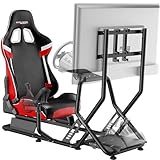
Our Top Picks
 Gazzyt Foldable Racing Simulator Cockpit for 10Nm Directsim racing cockpit58.39 x 42.52 x 23.82 inchesCheck on Amazon
 ARES WING Adjustable Sim Racing Cockpit with Seat17.7 x 17.7 x 42.5 inches72.31 PoundsCheck on Amazon
 Marada X Frame Steering Wheel Stand Racing Simracing game steer wheel stand-2935.4 x 30 x 28.3 inches31.5 poundsCheck on Amazon
 VankRing Upgraded Racing Wheel Cockpit with Monitor Mount54.3 x 21.6 x 39.4 inches54.3 x 39.4 x 21.6 Inches51.48 PoundsCheck on Amazon


Top 3 picks at a glance
Quick Picks
| Product | Best for | Price tier |
|---|---|---|
| Gazzyt Foldable | Space-constrained DD owners | Budget |
| ARES WING Blue | Full cockpit with seat included | Mid-range |
| Next Level Racing F-GT Pro | Formula and GT positions with bases up to 25Nm | Premium |
| Next Level Racing GTTrack | Complete steel cockpit with seat, motion-ready | Premium |
| Marada X Frame | Seat-slot flexibility | Budget |
| VankRing Heavy Duty | Monitor-mounted single-screen rigs | Budget to mid-range |
| RACGTING Foldable | Multi-brand foldable setups | Budget |
| ARES WING TV Mount | Single large-TV rigs | Mid-range |
How These Cockpits Were Compared
Each cockpit is compared on four criteria: mount rigidity under direct drive torque (does the wheel flex at 10Nm and above?), adjustability range for wheel and pedal distance, build quality relative to price, and real-world compatibility with popular DD bases. A cockpit that holds its geometry under load and lets you dial in a race-car seating position matters far more than a sleek paint job.
The 8 Best Premium Sim Racing Cockpits With Direct Drive Wheel Bases in 2026
Gazzyt Foldable Racing Simulator Cockpit
This is the go-to choice if you need a foldable frame that actually resists DD oscillation. It is rated specifically for 10Nm wheel bases, and the steel construction keeps flex minimal at that torque level. The folding mechanism is designed to lock firmly, which matters at this price level.
- Pro: Rated for 10Nm bases, with a steel frame built to limit flex at the wheel mount.
- Pro: Folds compactly and stores against a wall in seconds.
- Con: No seat included, so you need to source seating separately.
Skip it if your wheel base exceeds 10Nm, since Gazzyt does not rate it for higher torque loads.
ARES WING Sim Racing Cockpit, Blue
A complete cockpit solution that arrives with an integrated seat, making it ideal for racers who want to unbox, assemble, and start simming in a single evening. Rated for 16Nm bases, it is built to stay stable through aggressive trail braking. The blue finish stands out from the usual black aluminum frames on the market.
- Pro: Seat included, so there is no separate seat to source.
- Pro: Rated by the maker for 16Nm direct drive bases.
- Con: Heavy once assembled; not a cockpit you want to move between rooms.
Skip it if you already own a bucket seat you prefer or need portability.
Next Level Racing F-GT Pro
The F-GT Pro is Next Level Racing’s round-tube flagship, built from a 50 mm tubular steel frame with reinforced mid-frame bracing. Next Level Racing states that it handles direct drive bases up to 25Nm and load cell pedals from brands such as Fanatec, Simucube, Moza and Simagic. It switches between Formula and GT seating positions without tools and supports drivers from about 155 to 200 cm tall and up to 150 kg.
- Pro: Rated for direct drive bases up to 25Nm, well above the 16Nm ARES WING frames.
- Pro: Tool-free switching between Formula and GT positions.
- Con: Heavy at about 49.5 kg and firmly in the premium tier.
Skip it if you need a foldable frame or plan to run a wheelbase above 25Nm.
Next Level Racing GTTrack
A complete steel cockpit with a reinforced racing bucket seat, seat slider and four-point harness included, built with the rigidity to support direct drive wheels and professional pedal sets. It weighs about 48 kg, supports drivers from about 120 to 210 cm tall and up to 150 kg, and adds lockable castors and height-adjustable rubber feet. It is pre-drilled for Logitech, Thrustmaster and Fanatec mounts, and Next Level Racing’s Motion Platform V3 bolts straight on if you plan to add motion later.
- Pro: Seat, harness, shifter holder and handbrake plate included.
- Pro: Ready for Next Level Racing motion platforms.
- Con: Next Level Racing does not publish a maximum Nm figure for this frame.
Skip it if you need a foldable rig or want aluminum profile mounting flexibility.
Marada X Frame Steering Wheel Stand
The seat slot is the defining feature here, letting you bolt a racing seat directly to the frame instead of relying on a separate stand. This pulls your seating position closer to the pedals and wheel in a compact footprint. Steel construction gives it more rigidity than aluminum competitors in the same price range.
- Pro: Integrated seat slot saves floor space and improves ergonomics.
- Pro: Steel build resists flex better than comparable aluminum frames.
- Con: Assembly takes noticeably longer than competitors due to more fasteners.
Skip it if you want a fully adjustable cockpit with rail-mounted pedal and wheel plates.
VankRing Upgraded Racing Wheel Cockpit
A heavy-duty iron chassis frame-only design that pairs with any seat you prefer. The built-in monitor mount is a genuine differentiator at this price, eliminating the need for a separate TV stand or desk clamp. It is compatible with a wide range of bases including Logitech, Thrustmaster, Fanatec, and Moza.
- Pro: Integrated monitor mount saves space and cable clutter.
- Pro: Iron construction is built for more torque than lightweight wheel stands.
- Con: Frame only, so total cost rises once you add a seat and monitor arm.
Skip it if your monitor setup already has a dedicated stand or mount solution.
RACGTING Foldable Sim Racing Cockpit
Designed for Logitech, Thrustmaster, and MOZA bases with a folding design that collapses to a fraction of its racing footprint. The wheel and pedal plates adjust independently, which is uncommon at this price. Assembly requires no tools for the folding hinge and minimal effort for the rest.
- Pro: Independent wheel and pedal plate adjustment for precise positioning.
- Pro: Folds flat for storage without disassembly.
- Con: Not rated for high-torque direct drive; best for mid-range bases.
Skip it if you need a cockpit for a 15Nm+ DD base with full-force feedback.
ARES WING Racing Simulator Cockpit with TV Mount
One of the most complete cockpits on this list, shipping with an integrated TV mount rated for large single displays. If your sim setup lives in a living room or shared space, this frame eliminates the separate TV stand entirely. The 16Nm rating matches the other ARES WING models, and the TV arm adjusts for depth and angle.
- Pro: TV mount built in saves cost and floor space versus a separate stand.
- Pro: Rated by the maker for 16Nm direct drive bases.
- Con: The mount only fits one display, so triple-screen racers need a separate stand.
Skip it if you run triple monitors or prefer a VR headset for immersion.
Is aluminum profile always better than a steel tube cockpit?
For high-torque direct drive bases, aluminum profile is usually the safer choice because the rails are stiff, components can be positioned anywhere along them, and the frame can be extended with monitor stands, button boxes or motion later. Well-designed steel tube cockpits, such as the Playseat models, can be perfectly adequate for mid-torque bases and are often easier to assemble and lighter. The deciding factor is the torque of your wheelbase and how much you expect to upgrade.
Why do many cockpits not list a maximum torque rating?
Rigidity depends on more than the frame: wheel deck design, mounting style, how tightly bolts are torqued, seat weight and driver strength all play a part. Many manufacturers therefore list compatible wheelbases instead of a single Nm figure. When no rating is published, compare the strongest base the maker lists as compatible and look for consistent reports from owners running similar torque.
Do I need a cockpit at all, or can I clamp a direct drive base to a desk?
Some lower-torque direct drive bases include a desk clamp, and this can work at modest settings. However, desks are not designed for repeated twisting loads, the chair rolls back under braking, and pedals slide on the floor. A cockpit keeps the wheel, pedals and seat in a fixed relationship, which improves consistency and protects your desk.
Can I use my office chair with a frame-only cockpit?
Many frame-only cockpits, including wheel stands and compact frames, are designed to be used with a chair placed behind them. This works for casual racing, but office chairs roll and swivel. Locking casters or a chair mat help, and a dedicated seat mounted to the frame is better if you use load cell pedals or strong force feedback.
How much space does a full aluminum profile rig need?
Typical profile rigs occupy roughly 140 to 160 cm in length and 55 to 70 cm in width before screens. A triple-monitor stand adds considerably to the width. Measure the room including space to get in and out of the seat, and remember that profile rigs are heavy and are usually assembled where they will stay.
Stiffer alternatives for higher-torque direct drive bases
Most of the eight cockpits above are steel tube or compact designs, and apart from the F-GT Pro their published ratings top out around 10 to 16 Nm. That covers entry and mid-level direct drive bases, but owners of stronger wheelbases, load cell pedals or plans for motion and triple screens usually move to aluminum profile rigs or to tube cockpits from established sim racing brands. The six options below fill that gap. Where a manufacturer does not publish a maximum torque figure, we say so rather than guess.
Next Level Racing GTElite Wheel Plate Edition

The GTElite is Next Level Racing’s mid-range aluminum profile cockpit and the most rigid of its non-flagship designs. The frame uses 4080 anodized aluminum profile with factory-machined holes, joined to the uprights by 8 mm carbon steel mounting plates and full-width spring-ball T-slot nuts, with through-bolts at high-load points. Next Level Racing’s published plate data puts the folded steel wheel deck at the stiffness equivalent of 14.3 mm steel or about 20.9 mm aluminum, and the pedal deck at roughly 10.8 mm steel.
The rig accommodates drivers from about 120 to 210 cm tall and up to 150 kg, and weighs roughly 34 kg. In the box you get seat brackets, a shifter and handbrake plate, height-adjustable shock-absorbing feet, a ButtKicker Gamer 2 adapter and cable clips. It can later be adapted to Next Level Racing’s Motion Platform V3 and Traction Plus with an add-on kit.
The Wheel Plate Edition is designed for bottom-mounted wheelbases such as most Fanatec, Moza and Thrustmaster direct drive units. If your base mounts from the front or the side, such as a Simucube 2, the separate Front and Side Mount edition is the correct version. Next Level Racing does not publish a maximum Nm figure for this rig, but its profile construction and stiffened decks put it in a different class from the tube frames above.
Who it suits: owners of 12 to 20 Nm-class bases who want an aluminum profile rig with a recognized brand, clear documentation and an upgrade path to motion.
Strengths: 4080 profile with reinforced steel plates, very stiff wheel and pedal decks, wide driver size range, motion and tactile upgrade options, accessories included.
Drawbacks: no seat included; heavier and harder to move than the folding frames; no official torque rating; premium tier once a seat and monitor stand are added.
Compared with the ARES WING cockpits above, the GTElite is a step up in structure and adjustability rather than convenience. It is the most logical upgrade for someone who already owns a direct drive base and is noticing flex in a tube rig.
Playseat Trophy
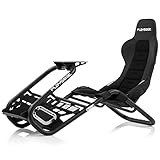
The Playseat Trophy is a light, low-slung GT and formula-hybrid cockpit with an integrated seat, sold by Playseat as recommended for direct drive wheels from Logitech G, Fanatec, Simucube, Heusinkveld and others. It uses a carbon steel tube frame with multiple bolts at each joint, and Playseat lists it at around 16 to 17 kg, with a recommended driver height of 120 to 220 cm.
The appeal is the all-in-one design. The seat is a molded, fabric-covered shell built into the frame, the wheel deck and pedal plate adjust for distance and angle, and the result is a compact rig that looks tidy in a living space. Published reviews have run it with 11 Nm-class bases such as the Logitech G Pro, and reports describe it holding well in that range. Playseat does not publish a maximum Nm figure, and some reviewers express reservations above roughly 15 Nm.
The low seating position and reclined back give a sensation between GT and formula, which many drivers like for open-wheel titles. Taller drivers and those who prefer a very upright GT position should check the geometry before buying, as the seat is not interchangeable.
Who it suits: drivers with mid-torque direct drive bases who want a complete cockpit with a comfortable integrated seat and a light, compact footprint.
Strengths: integrated seat, light weight for a direct drive-ready rig, sturdy multi-bolt joints, good adjustability for its class, clean appearance.
Drawbacks: no official torque rating; not foldable; seat cannot be swapped; tube design is less future-proof than aluminum profile for 15 Nm-plus bases.
Against the ARES WING cockpits with seats, the Trophy costs more but is a more refined design with a better-documented direct drive record. It is the premium choice for the 8 to 12 Nm range rather than a high-torque rig.
Playseat Sensation Pro

The Sensation Pro is Playseat’s larger GT and rally cockpit. It uses a heavier carbon steel tube frame with a matte black powder coat, weighs about 38 kg and comes with a bucket-style seat covered in Playseat’s ActiFit microfiber. Playseat lists driver height from 120 to 220 cm and weight up to roughly 122 kg, with adjustable seat tilt and pedal-to-wheel distance.
It is marked as supporting direct drive wheelbases, and the pedal plate is reinforced for load cell brakes. One important detail from the listing is that additional braces are sold separately; owners of strong direct drive bases may need them to keep the wheel deck fully stable. Playseat does not publish a torque limit.
A useful bonus is the integrated VESA monitor mount support for screens up to about 43 inches, which removes the need for a separate TV stand in a single-screen setup. The seating position is more upright than the Trophy, which suits GT, touring car and rally titles.
Who it suits: GT and rally drivers who want a heavy, complete cockpit with a seat and single-monitor support from a long-established brand.
Strengths: heavy, solid steel frame; comfortable ActiFit seat; reinforced pedal plate; monitor mounting provision; upright GT position.
Drawbacks: extra braces sold separately for high-torque bases; heavy and not foldable; tube frame offers less mounting flexibility than profile; premium tier.
Next to the ARES WING TV Mount model above, the Sensation Pro is heavier and more polished, with a better seat. Next to the GTElite, it is more complete out of the box but less adjustable and less suited to future upgrades.
Fanatec CSL Cockpit V1.5
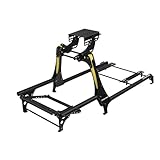
The CSL Cockpit is one of the most compact direct drive-capable frames available. It uses a trapezoid frame of aluminum tubes with steel brackets, and its angled uprights are designed to spread loads more effectively than a rectangular frame. The footprint is roughly 107 by 58 cm, which makes it far smaller than a full aluminum profile rig.
The V1.5 revision, released in 2025, solves the main limitation of the original. The first version only supported side-mounting, which meant Fanatec bases only. The V1.5 adds bottom-mount and clamp-mount options through a universal bracket, so Moza, Simagic, Thrustmaster and other bases can be fitted. The bracket offers stepless angle and distance adjustment and can be flipped for a karting position. Fanatec has long marketed the CSL Cockpit as capable of handling its full direct drive range, including the 25 Nm Podium DD2, and its pedal plate is built for load cell brakes.
The cockpit is frame-only. You add your own seat or Fanatec’s matching CSL seat, plus an optional monitor holder that supports VESA screens up to 34 inch widescreen or 49 inch ultrawide.
Who it suits: drivers who need a direct drive-capable frame in a small room, or who want to use an existing seat or office chair.
Strengths: very compact, light aluminum tube frame, universal mounting in V1.5, high rated capacity from the manufacturer, compatible accessory ecosystem.
Drawbacks: seat and monitor mount cost extra; some reviewers note the new bracket raises the wheel quite high for shorter drivers; less adjustable than a profile rig.
Compared with the folding Gazzyt and RACGTING frames, the CSL Cockpit takes up similar space but is built for much higher torque. It does not fold, though its small footprint makes that less important.
Marada 8040 Aluminum Profile Pro Cockpit with Seat

Marada’s 8040 Pro is a complete aluminum profile cockpit that includes a seat, which makes it a direct alternative to the seat-included ARES WING frames above but with profile construction. The frame is built from 8040 and 4040 aluminum profile with non-slip base pads, and the seat, wheel deck, pedal deck and accessories slide steplessly along the rails rather than using fixed holes.
The wheel and pedal plates adjust for height and tilt, the shifter mount can be moved to either side, and the included seat has PU leather, foam padding, lumbar and neck pillows and a reclining backrest. Marada lists compatibility with Fanatec CSL DD and GT DD Pro, Thrustmaster T598 and T818, Logitech G Pro and Moza R5 to R16 bases. Marada does not publish a maximum torque rating for this model; owner reports commonly describe it running 8 to 12 Nm bases without issue.
Who it suits: buyers who want aluminum profile rigidity and adjustability with a seat included, at a lower tier than the big-brand profile rigs.
Strengths: profile construction, stepless adjustment, seat included, broad wheelbase compatibility, monitor-stand versions available.
Drawbacks: no official torque rating; included seat is a comfort-oriented reclining type rather than a firm bucket; documentation is less detailed than Next Level Racing’s.
Against the Marada X Frame above, this is a completely different class of product: a full profile rig rather than a compact stand. It is the most direct upgrade for anyone who likes the brand but needs proper direct drive stiffness.
Anman GT/F1 8040 Aluminum Profile Cockpit
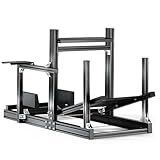
The Anman GT/F1 cockpit is a frame built entirely from 8040 aluminum profile with anti-oxidation treatment and reinforced connectors. As the name suggests, it can be configured for an upright GT position or a lower, more reclined formula-style position. Seat position, wheel angle and distance and pedal position adjust steplessly, and the shifter mount swaps sides.
Anman lists compatibility with Logitech G29 to G923, Thrustmaster T300 through T818, Fanatec CSL DD and GT DD Pro, and Moza R5 to R16. The listing does not state a maximum Nm figure. Third-party guides commonly quote around 18 Nm, and a related Anman 8040 cockpit with a triple-screen mount is officially marketed as supporting 25 Nm, but neither number is an official rating for this specific frame.
This version is the stand without seat or screen mount, so you can pair it with a seat you already own. That makes it the leanest way into a profile rig in this guide, and the 8040 rails accept the wide range of third-party accessories built for that standard, from phone holders and button boxes to keyboard trays.
Who it suits: drivers who already have a seat, want a profile rig for a mid to high-torque base, and like the option of GT or formula geometry.
Strengths: full 8040 profile, GT and F1 configurations, stepless adjustment, accessory-friendly rails, lower tier than branded profile rigs.
Drawbacks: seat not included; no official torque rating; quality control and instructions vary more than with established sim brands.
Compared with the VankRing frame above, the Anman offers profile construction and more geometry options; compared with the GTElite, it gives up some engineering refinement and brand support in exchange for a much lower tier.
Comparison of the additional picks
| Cockpit | Frame type | Seat included | Wheel mounting | Published torque guidance | Price tier |
|---|---|---|---|---|---|
| Next Level Racing GTElite Wheel Plate | 4080 aluminum profile | No | Bottom mount (front/side edition sold separately) | No official Nm figure | Premium |
| Playseat Trophy | Carbon steel tube | Yes, integrated | Bottom mount plate | Direct drive recommended, no Nm figure | Premium |
| Playseat Sensation Pro | Carbon steel tube | Yes, ActiFit bucket | Bottom mount plate, extra braces optional | Direct drive supported, no Nm figure | Premium |
| Fanatec CSL Cockpit V1.5 | Aluminum tube, steel brackets | No | Side, bottom and clamp mount | Marketed for Fanatec DD range up to 25 Nm | Mid-range |
| Marada 8040 Pro with Seat | 8040/4040 aluminum profile | Yes, reclining | Bottom mount plate | No official Nm figure | Mid-range |
| Anman GT/F1 8040 | 8040 aluminum profile | No | Bottom mount plate | No official Nm figure | Mid-range |
How to choose a cockpit for a direct drive wheel base
Match the frame type to your torque
The single most important decision is frame construction, and it should follow the peak torque of the wheelbase you own or plan to buy within the next couple of years.
| Wheelbase peak torque | Typical frame that works | What to watch for |
|---|---|---|
| Up to about 8 Nm | Good folding frame or heavy-duty wheel stand | Wheel deck flex during quick direction changes; pedal plate lifting under braking |
| 8 to 12 Nm | Heavy steel tube cockpit or compact aluminum tube frame | Joint bolts loosening over time; deck vibration on curbs and impacts |
| 12 to 20 Nm | 8040 or 4080 aluminum profile rig | Wheel deck thickness and how the uprights brace to the base |
| 20 Nm and above | Heavy aluminum profile, ideally 160×40 or reinforced 8040 | Front or side-mount brackets, cross bracing, solid seat mounting |
Flex is not just an annoyance. Any movement in the frame absorbs part of the force feedback signal, so detail that a strong base produces is lost before it reaches your hands. On a very flexible rig, sudden force spikes can also make the whole deck oscillate.
Check how your wheelbase mounts
Direct drive bases attach in one of three ways: bottom mount (bolts through a flat wheel deck, used by most Fanatec, Moza, Thrustmaster and Logitech bases), front mount (bolts to a vertical plate, common on Simucube and Simagic) and side mount (brackets clamp the sides of the motor). Confirm that the cockpit offers the right style before buying, or budget for a compatible bracket.
GT, formula or hybrid position
GT position puts you upright with the pedals below seat height, as in a road car. Formula position lowers the seat and raises the pedals, reclining the driver as in an open-wheel car. Hybrid rigs such as the Anman GT/F1 can convert between the two. If you mostly drive GT3, touring cars or rally, choose a GT rig; if you mostly drive single-seaters, a formula or hybrid frame is more convincing.
Plan for load cell pedals
Load cell brakes measure pressure rather than travel, and realistic settings can require very high pedal force. A pedal deck that flexes or a seat that slides back under braking undermines the benefit. Look for a thick, braced pedal plate and a seat mounted solidly to the frame, not resting on the floor.
Decide on displays early
A single monitor can sit on a desk or stand behind the rig, but a cockpit-mounted screen moves with the frame and keeps the distance consistent. Triple screens and large TVs usually need a dedicated stand, either attached to the rig or freestanding. Freestanding stands isolate the screens from vibration; attached mounts save space and keep alignment fixed.
Setting up your cockpit
- Set seat position first. Adjust seat height and recline until you can see the screen comfortably and your back is supported, then build everything else around that position.
- Position the pedals. With the brake pedal fully pressed, your leg should still have a slight bend at the knee. A locked leg reduces control and is uncomfortable over long sessions.
- Set wheel distance and height. With your shoulders against the seat, your wrists should rest on top of the wheel rim with arms extended. Holding the wheel at the 9 and 3 positions, your elbows should be comfortably bent. The top of the rim should not block the upper part of the screen view.
- Tighten every bolt, then re-check after a week. New frames settle, especially tube rigs and T-slot connections. Re-torque the wheel deck and pedal plate bolts after the first few sessions.
- Calibrate field of view. Once the seat and screen are fixed, measure the distance from your eyes to the screen and set a mathematically correct field of view in each game. It improves judgment of speed and braking points more than most hardware upgrades.
- Protect the floor and reduce noise. A dense rubber floor mat under the rig stops it creeping on hard floors and reduces vibration transmitted to downstairs neighbors, especially with tactile transducers fitted.
- Manage cables along the frame. Route power and USB cables along the profile or tubes and secure them with clips so nothing can catch on your feet or be pulled by wheel rotation.
Upgrades that matter once the frame is solid
A rigid cockpit is the foundation, but a few additions change the experience more than spending extra on the frame itself. Prioritize them in roughly this order.
- A proper seat. If your cockpit is frame-only, a fixed-back bucket seat mounted with sliders keeps you planted under braking and cornering forces. Reclining office-style seats are comfortable but can move slightly under load.
- Tactile transducers. Bass shakers mounted to the seat or pedal deck transmit engine vibration, gear shifts, curbs and wheel slip through the frame. They work best on stiff rigs, because a flexible frame dampens the effect. Several rigs, including the GTElite, include mounting provisions or adapters.
- A quick release on the wheel. If you swap between GT and formula wheels, a quality quick release makes changes fast and keeps the wheel firmly locked. Make sure it matches your base’s ecosystem.
- Accessory mounts. Profile rails accept phone holders, button boxes, keyboard and mouse trays and cup holders without drilling. Tube frames usually need clamp-on mounts, which are more limited.
- Load cell pedals. Once the pedal deck is stiff enough, load cell brakes are often the single biggest improvement in lap time consistency, because they let muscle memory work on pressure rather than travel.
Avoid spending on cosmetic upgrades until these are in place. A frame that holds its geometry, a seat that does not move and well-placed controls will do more for both comfort and pace than lighting or decorative panels.
Frequently asked questions
Which cockpits include a seat?
The ARES WING Blue cockpit and the Next Level Racing GTTrack include a seat. The Marada X Frame includes a seat slot, allowing you to bolt a racing seat directly to the frame, while the Gazzyt and VankRing models do not include seating. The foldable frames are sold without a seat.
Which cockpit should I choose for a high-torque direct drive wheel base?
For bases up to 25Nm, the Next Level Racing F-GT Pro is the highest-rated frame in the main list, while the ARES WING Blue and ARES WING model with TV mount are rated for 16Nm. The Gazzyt is rated for 10Nm. RACGTING is best suited to mid-range bases rather than 15Nm or higher.
Which models are easiest to store in a small space?
The Gazzyt and RACGTING are the most storage-friendly choices because both have folding designs. Gazzyt folds compactly and can be stored against a wall, while RACGTING folds flat without disassembly. Foldability is useful for apartment racers or shared rooms, but it should not come at the cost of frame stiffness.
Which cockpits support a monitor or TV mount?
The VankRing includes a built-in monitor mount for single-screen setups, while the ARES WING Racing Simulator Cockpit with TV Mount includes an integrated TV mount rated for large single displays. The ARES WING TV mount adjusts for depth and angle. That model is not intended for triple-monitor setups.
Can these cockpits work with Logitech, Thrustmaster, Fanatec, or Moza equipment?
Compatibility varies by model. The Next Level Racing GTTrack is pre-drilled for Logitech, Thrustmaster, and Fanatec mounts. VankRing is compatible with Logitech, Thrustmaster, Fanatec, and Moza. RACGTING is designed for Logitech, Thrustmaster, and MOZA bases. The F-GT Pro supports Fanatec, Simucube, Moza and Simagic bases up to 25Nm.