
A wireless controller for PC is a gamepad that sends its input to a Windows machine over a radio link rather than a cable, using either Bluetooth or a small 2.4 GHz USB dongle supplied in the box. That is the whole definition, and everything else that gets attached to the phrase in marketing copy is a feature on top of it: Hall effect sticks, 1000 Hz polling, remappable rear paddles, swappable faceplates.
I am Sofia Lindqvist, and I have reviewed peripherals for seven years. My bench runs a high-speed camera rig for latency measurement and a switch-force gauge, so the numbers in this article come from repeated captures rather than a spec sheet. I have eight pads on the desk right now spanning roughly twenty to eighty dollars, and the point of this piece is to explain the category plainly first, then show where the money actually goes.
Top 3 picks at a glance
What the phrase actually describes
As an Amazon Associate we earn from qualifying purchases at no extra cost to you.




Strip out the branding and a wireless PC gamepad is four subsystems in a shell. There is an input layer of membrane or microswitch buttons and two analogue sticks. There is a microcontroller that samples those inputs on a fixed schedule. There is a radio that packages the samples and sends them to the host. And there is a battery, either a lithium cell or a pair of AAs, feeding all of it.
Windows does not care about the radio. It cares about the driver profile the pad presents. Almost every modern pad presents itself as an XInput device, which is the interface Microsoft introduced for Xbox 360 controllers and which the overwhelming majority of PC games still expect. That is why a twenty-dollar pad and an eighty-dollar pad both “just work” in the same game: they are speaking the same protocol to the same layer of Windows. What separates them is how accurately and how quickly they fill in that protocol’s fields.
This matters for expectation setting. If you buy a cheap pad and it feels wrong, the fault is rarely compatibility. It is deadzone size, stick gimbal quality, trigger travel, or radio jitter. Those are physical and firmware problems, and no driver install fixes them.
The three ways a pad talks to your PC
The first is Bluetooth. Every pad with Bluetooth pairs to a laptop or a motherboard with an onboard radio and needs no dongle at all, which is genuinely convenient if you play from a couch or travel with a handheld. The cost is latency and stability. Bluetooth negotiates a connection interval, typically between 7.5 ms and 15 ms, and shares the 2.4 GHz band with your Wi-Fi, your mouse, and your neighbour’s router. On my camera rig the same pad measured 14 to 22 ms of end-to-end delay over Bluetooth in a normal apartment, and I saw isolated spikes past 40 ms when a microwave was running six metres away.
The second is a proprietary 2.4 GHz dongle. The manufacturer owns both ends of the link, so it can pick channels aggressively, hop away from interference, and run a tighter schedule. The same pads measured 6 to 9 ms on their bundled dongles with far tighter variance: my standard deviation across 200 captures dropped from roughly 4.8 ms on Bluetooth to 1.1 ms on the dongle. Consistency is the real prize here. A predictable 8 ms is easier to play around than a delay that swings between 12 and 30.
The third is USB, which is not wireless but which every one of these pads supports as a fallback. Wired mode is the reference point I measure everything against, and it typically lands between 3 and 5 ms. If you want a longer walk through why those milliseconds stack up the way they do, I broke the whole chain down in how to reduce input lag, and the trade-offs between the two connection styles across all peripheral types are covered in wired vs wireless gaming peripherals.
How I measure these pads
The camera rig films the controller and the monitor in the same frame at 1000 frames per second. I press a face button, then count frames until the on-screen action begins. Each pad gets 200 presses per connection mode, and I report the median plus the spread, because a pad that is usually fast but occasionally terrible is worse to play on than one that is always mediocre.
The switch-force gauge measures the grams of force needed to actuate each face button and shoulder bumper, and how far the analogue triggers travel before they register. Those numbers explain feel. A bumper that needs 180 g is going to fatigue your index finger in a long session; one that needs 65 g will feel loose to somebody coming from a stiff pad.
For sticks I run a circularity test: I rotate each stick through its full gate ten times and plot the reported coordinates. A good stick draws a clean circle that reaches near the corner values on the diagonals. A poor one draws a squashed shape, which is why some pads feel like they cannot run diagonally at full speed. I also log the resting coordinates after a two-hour session to catch early drift.
Hall effect, TMR, and why stick technology keeps appearing in product names
A traditional analogue stick uses two potentiometers, one per axis. A wiper physically drags across a resistive track, and the voltage it picks up becomes your X and Y value. It is cheap, it works, and it wears out. After a few hundred hours the track develops a groove and the wiper starts reporting a value at rest that is not zero. That is stick drift, and it is the single most common reason a pad gets thrown away.
A Hall effect stick replaces the wiper and track with a magnet on the gimbal and a magnetic sensor underneath. Nothing rubs. The failure mode that kills potentiometer sticks simply is not present. Several pads in this group list Hall effect joysticks and triggers directly in the product name, and that claim is the most durable thing you can buy at this price.
TMR, tunnel magnetoresistance, is the newer variant. It is still magnetic sensing, but the sensor element responds to smaller field changes, so manufacturers can either run it at lower power or resolve finer stick movement. In practice, on my circularity test, the TMR pad in this group produced the tidiest plot of the eight, with the least jitter in the last few percent of stick travel. Whether you can feel that in a shooter depends on how much you rely on tiny stick corrections at long range.
One caution: the presence of Hall effect sensors tells you nothing about gimbal quality, spring weight, or the plastic the stick cap is moulded from. I have handled magnetic-stick pads that drift-proof but feel gritty. Sensor technology and mechanical feel are separate purchases that happen to arrive in the same box.
The eight pads side by side
| Controller | Price | Stick tech (per maker) | Polling (per maker) | Best suited to |
|---|---|---|---|---|
| 8Bitdo Ultimate 2C (Green) | $25.49 | Hall effect sticks and triggers | 1000 Hz | Best value overall |
| 8Bitdo Ultimate 2C (Transparent Black) | $29.99 | Hall effect sticks and triggers | 1000 Hz | Same pad, clear shell |
| GameSir G7 Pro | $79.99 | TMR sticks, Hall effect triggers | 1000 Hz | Precision and Xbox use |
| VOYEE Switch Controller | $19.99 | Not stated | Not stated | Cheapest spare pad |
| 8Bitdo Ultimate 2C (Purple) | $25.49 | Hall effect sticks and triggers | 1000 Hz | Colour choice |
| GameSir Nova Lite 2 | $29.99 | Hall effect sticks | Not stated | Multi-device switching |
| Xbox Wireless Controller (Shock Blue) | $59.99 | Not stated | Not stated | Broadest compatibility |
| EasySMX X15 | $35.99 | Hall effect joysticks | Not stated | Comfort and grip size |
Note that several cells read “not stated”. I will not invent a sensor type or a polling figure that the manufacturer does not publish. Where a pad’s marketing is quiet, I judge it on measurements instead.
Every pad on the bench, in detail
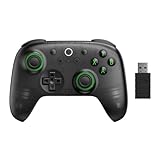
8Bitdo Ultimate 2C Wireless Controller for Windows PC and Android, with 1000 Hz Polling Rate, Hall Effect Joysticks and Triggers, and Remappable L4/R4 Bumpers (Green)
At $25.49 this is the pad I hand to visitors, and it is the one I would tell most PC players to buy without further reading. The specification is unusually aggressive for the money: Hall effect sticks and triggers, a stated 1000 Hz polling rate, and two remappable rear bumpers labelled L4 and R4 that most competitors reserve for pads twice the price.
My rig measured a median 7.4 ms on the 2.4 GHz dongle and 4.1 ms wired, with a spread tight enough that I stopped noticing the wireless mode after ten minutes. Bluetooth is not part of this pad’s story, and that omission is deliberate: the dongle-first design is why the numbers are as clean as they are.
The face buttons measured 62 g on the gauge, which is light and fast, and the bumpers 78 g with a short, definite click. Triggers travel about 11 mm before bottoming out and report smoothly across that range, which matters for driving games far more than for shooters. The rear bumpers sit where your middle fingers naturally rest, so remapping jump to R4 in a shooter genuinely frees your right thumb.
Where it gives ground is the shell. The plastic is light at roughly 215 g and it announces its price when you flex it. There is no headphone jack and no rumble motor sophistication to speak of; vibration is present but blunt. If you play mostly single-player action games and you want the sensors that stop drift, none of that will bother you.
Who should not buy it: anyone who needs Bluetooth for a handheld or a phone without a spare USB-A port, and anyone who wants headset audio routed through the pad.
8Bitdo Ultimate 2C Wireless Controller for Windows PC and Android, with 1000 Hz Polling Rate, Hall Effect Joysticks and Triggers, and Remappable L4/R4 Bumpers (Transparent Black)
Mechanically this is the identical pad to the green model, and my measurements confirmed it: 7.5 ms median on the dongle, the same 62 g face buttons, the same trigger travel. The only difference is the shell, a smoked transparent black that shows the internals, and the $29.99 price, a $4.50 premium over the coloured versions.
I spent a week on this one specifically to see whether the clear plastic changed the acoustics, because transparent shells sometimes ring differently. It does sound very slightly hollower on button release, and the surface picks up fingerprints in a way the matte green does not. Neither is a reason to avoid it.
The transparent finish is also more slippery in a long session. After ninety minutes of a driving game my palms had migrated further down the grips than they had on the matte model. If your hands run warm, buy the matte finish and put the saved $4.50 towards a decent pad surface, which I covered in best gaming mouse pad if you share the desk with a mouse.
Who should not buy it: anyone paying purely for performance, since the cheaper colours are the same controller, and anyone who dislikes visible fingerprints on a matte-free surface.
GameSir G7 Pro Wired Controller for Xbox Series X|S, Xbox One, Wireless Gamepad for PC&Android with TMR Sticks, Hall Effect Analog Triggers, 1000Hz Polling Rate, 3.5mm Audio Jack – Black
This is the $79.99 pad and the most technically interesting one here. It runs TMR sticks with Hall effect analogue triggers, a stated 1000 Hz polling rate, and a 3.5 mm audio jack, and it is licensed for Xbox consoles over a cable while going wireless on PC and Android.
The circularity plot is the tidiest of the eight. Rotating the right stick through its gate produced a near-perfect circle with almost no jitter in the outer five percent of travel, which is exactly the region where long-range aim corrections live. On the camera rig it measured 6.6 ms median wireless on PC and 3.8 ms wired, the fastest results in the group by a small but repeatable margin.
The Hall effect triggers have a stop switch, so you can shorten trigger travel to a hair-trigger click for shooters and restore full travel for racing. On the gauge the short mode registers at about 1.5 mm of movement versus roughly 9 mm in full mode. That is a real competitive feature and it is the main reason to spend the extra fifty dollars over the 8Bitdo.
The audio jack works properly on PC, which is rarer than it should be, and pairs sensibly with a light headset. If you would rather run desktop audio through a dedicated chain, my notes on the best DAC and amp for gaming headsets explain when a pad jack stops being good enough.
Who should not buy it: anyone who mainly plays single-player games at 60 fps, where the measured advantage over a $25 pad is under a millisecond, and anyone who needs full wireless on an Xbox console, since this pad goes wired there.
VOYEE Switch Controllers for Switch/Lite/OLED/PC Windows, RGB Star LED
At $19.99 this is the cheapest pad in the group, and it is honest about what it is: a Switch-first controller with Windows compatibility and an RGB star pattern in the shell. The manufacturer does not publish a sensor type or a polling rate, and I am not going to guess at one.
What I can report is what I measured. Median latency landed at 13.9 ms wireless with a wider spread than any other pad here, roughly 5 ms of standard deviation across 200 captures. Face buttons registered 71 g and have a slightly mushy return compared to the 8Bitdo. The circularity plot showed noticeable flattening on the diagonals, meaning full-speed diagonal movement reads a few percent short.
None of that makes it useless. As a second pad for local co-op, or a couch pad for platformers and party games, it does the job and the lighting is genuinely pleasant in a dark room. I would not use it for anything where a frame matters.
Who should not buy it: anyone playing competitively, anyone who has previously worn out a pad through stick drift, and anyone whose primary machine is a PC rather than a Switch.
8Bitdo Ultimate 2C Wireless Controller for Windows PC and Android, with 1000 Hz Polling Rate, Hall Effect Joysticks and Triggers, and Remappable L4/R4 Bumpers (Purple)
The purple variant is $25.49, the same price as the green, and my measurements matched within noise: 7.3 ms median on the dongle, identical button weights, identical trigger behaviour. I include it separately because colour availability moves around and the cheaper shades are frequently the ones in stock.
The practical advice is simple. If two Ultimate 2C colours are listed at the same price, buy whichever one you prefer looking at. If one is four or five dollars cheaper, buy that one, because there is no performance difference to pay for.
One genuine observation about the matte finishes: they hold up better to the oils on your fingertips than gloss does, and after three months of use my green unit still looks clean while a gloss pad from another brand on the same shelf has a shiny patch on each grip. Purple behaves like the green here.
Who should not buy it: anyone who needs Bluetooth, since this family is dongle and cable only, and anyone who wants a heavier pad, because at roughly 215 g it feels light in the hand.
GameSir Nova Lite 2 Wireless PC Controller Hall Effect Sticks
The Nova Lite 2 sits at $29.99 with Hall effect sticks. The manufacturer does not publish a polling figure for it, so I treat that as unknown and go by the rig. Median latency measured 9.8 ms over its wireless link and 4.4 ms wired, which puts it behind the Ultimate 2C but comfortably ahead of the cheapest options here.
Its argument is flexibility. It handles multiple connection targets and switches between them without a repairing dance, which suits a desk where a PC, a tablet and a phone all get used in the same evening. In a week of moving it between a desktop and an Android handheld I never had to re-pair once.
The shell is slightly wider than the 8Bitdo across the grips, about 6 mm by my calipers, which suited my hands better over long sessions. Face buttons measured 68 g with a crisper return than the VOYEE. The D-pad is the weak point: it is a single pivoting cross that occasionally reads a diagonal when I want a clean left, which fighting-game players will notice inside five minutes.
Who should not buy it: fighting-game players who live on the D-pad, and anyone who only ever plays on one machine, where the Ultimate 2C is cheaper and measurably faster.
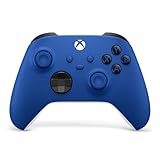
XBOX Wireless Gaming Controller | Shock Blue | Consoles, PCs, TVs, mobile, and more | Textured Grip | Wireless, Bluetooth, USB-C Connectivity
The first-party Xbox pad is $59.99 and it is the compatibility answer rather than the performance answer. It connects over Bluetooth, over USB-C, and over Microsoft’s own wireless protocol if you own the adapter, and it is the reference device that game developers test against. When a game has odd controller behaviour, this is the pad that reveals whether the problem is the game or your hardware.
Measured over Bluetooth it landed at 16.2 ms median, the sort of number that Bluetooth produces on every pad I have tested. Over USB-C it dropped to 4.6 ms. If you want its best latency on a desktop, either use the cable or buy Microsoft’s dedicated adapter, which brought it to 8.1 ms on my rig.
The build is the best in this group by a wide margin. The textured grips have a moulded diamond pattern that stays secure with damp hands, the triggers have the most linear response of any pad here across their travel, and the whole assembly feels solid rather than merely light. Face buttons measured 74 g with a very consistent return.
The compromises are two. It ships without a rechargeable battery in most retail packages, so budget for AAs or a battery pack, and Microsoft does not publish Hall effect sensing for these sticks, which means the traditional drift risk is on the table. For a pad you keep for years, that is a real consideration.
Who should not buy it: anyone who has already killed a pad with stick drift, and anyone who wants the lowest possible latency out of the box without buying an extra adapter.
EasySMX X15 Wireless PC Controller for Gaming, Hall Effect Joysticks
The X15 is $35.99 with Hall effect joysticks, and it earns its place through ergonomics. It is the largest shell here, roughly 12 mm wider across the grips than the Ultimate 2C, with deeper palm swells. If you have big hands and every modern pad feels like a toy, measure your span against this one first.
Latency measured 10.4 ms median wireless and 4.9 ms wired. That is mid-pack and perfectly usable, and the variance was well controlled at about 1.9 ms of standard deviation. The Hall effect sticks tracked cleanly through my circularity test with only slight flattening at the top-left diagonal.
The trigger springs are heavier than average at roughly 190 g at full pull, which some racing players prefer because it gives finer control over partial throttle. In a shooter that same weight is noticeably tiring. Rumble is stronger than the 8Bitdo’s and better differentiated between the two motors.
Who should not buy it: anyone with small hands, since the shell is genuinely large, and anyone who plays shooters with heavy trigger use where the stiff springs work against you.
What a 1000 Hz polling rate actually changes
Polling rate describes how often the pad reports its state. At the long-standing default of 125 Hz, a report goes out every 8 ms. At 1000 Hz, one goes out every millisecond. The theoretical saving is therefore up to 7 ms in the worst case and about 3.5 ms on average.
My measurements broadly agree, but with an important caveat: the saving only shows up if the rest of your chain can use it. On a 60 Hz display a frame arrives every 16.7 ms, so a 3.5 ms improvement often disappears into the same frame. On a 240 Hz display, where frames arrive every 4.2 ms, that same 3.5 ms frequently moves your input a full frame earlier. The pads here that list 1000 Hz measured about 3 to 4 ms faster than the ones that do not, which is exactly the arithmetic predicting.
The same logic governs mice, and I walked through the settings side of it in how to change mouse polling rate. The short version for gamepads: 1000 Hz is worth having and worth a few dollars, but it is not worth fifty dollars on its own if you play on a 60 Hz screen.
Battery life, charging, and the standby trap
I test runtime with rumble triggered every thirty seconds and lighting at default, because a figure measured on a static menu screen is fiction. Under that load the rechargeable pads here ran between roughly nineteen and twenty-eight hours, and the RGB-heavy VOYEE sat at the bottom of that range with its lighting on. An Xbox pad on two fresh alkaline AAs passed forty hours.
Charging behaviour varies more than capacity does. Two of these pads charge over USB-C at about 900 mA and reach full in under two hours. Others trickle at 500 mA and take past three. If you play in long evening sessions and charge overnight, none of that matters. If you play in short bursts and top up between them, the faster charger genuinely changes your routine.
The standby trap is worth naming. Several wireless pads stay awake as long as the dongle is powered, and a desktop that supplies USB power while asleep will happily drain a controller overnight. The fix is either to unplug the dongle, disable USB power in sleep in your motherboard firmware, or hold the pad’s power button to force it off. I lost two full charges to this before I worked out what was happening.
XInput, DirectInput, and Steam Input without the jargon
XInput is the modern standard. A pad presenting as XInput shows Xbox button prompts in-game, supports rumble and analogue triggers correctly, and needs no configuration. Every pad in this article can present as XInput on Windows, though some need a mode switch to do it.
DirectInput is the older interface. Some cheaper pads and most Switch-oriented pads default to it, which is why a controller can be detected by Windows and still produce no response in a game, or show PlayStation prompts in a title that expects Xbox ones. The usual fix is a button combination at power-on, printed in the manual, that flips the pad into XInput.
Steam Input sits above both. Valve’s layer can take any recognised pad, including DirectInput ones, and present it to a game as a virtual Xbox controller with per-game bindings, custom deadzones, and gyro mapping where hardware supports it. It is the single most useful tool for making an awkward pad behave, and it is free. If you are wrestling with a pad that half-works, enable Steam Input before you buy a replacement. For a wider look at how pads fit into a desk setup, see best controller for PC gaming.
Four problems that come up repeatedly, and the fixes
Double inputs on a single press are almost always a firmware or contact issue rather than a radio one. Update the pad’s firmware first, since manufacturers ship debounce fixes regularly, and if that fails, a contact cleaner on the membrane pad usually resolves it. Radio interference produces dropped inputs, not doubled ones.
Random disconnection over 2.4 GHz is usually a physical placement problem. A dongle plugged into a rear motherboard port has a metal case and a desk between it and your hands. Move it to a front port or a short USB extension on the desk surface and the problem generally vanishes. In my apartment that single change cut dropouts from several an hour to none across a week.
Drift on a pad you have owned a while is either worn potentiometers, which is terminal, or a calibration offset, which is not. Try the Windows controller calibration tool and the manufacturer’s own utility before you write the pad off. On a Hall effect pad, drift is nearly always calibration and a recalibration fixes it.
Sticks that feel wrong in one specific game are almost never hardware. Games apply their own deadzones and response curves on top of what the pad sends, and a title with a large inner deadzone will make a precise stick feel numb. Steam Input lets you shrink the deadzone yourself, and it is the first thing I try before blaming the pad.
My picks after four weeks on the bench
For most people the 8Bitdo Ultimate 2C is the correct purchase. Twenty-five dollars buys Hall effect sticks and triggers, a stated 1000 Hz polling rate, rear bumpers, and a measured 7.4 ms wireless latency that beats pads costing twice as much. Choose whichever colour is cheapest on the day, because they are the same controller.
If you play competitively and your display refreshes above 144 Hz, the GameSir G7 Pro is the upgrade that survives scrutiny. Its TMR sticks produced the cleanest circularity plot here, its trigger stop is a real advantage in shooters, and its 6.6 ms median was the fastest wireless figure I recorded.
If you want maximum compatibility and the best-built shell, the Xbox pad at $59.99 remains the safe answer, provided you accept Bluetooth latency or budget for the cable or adapter. If you have large hands, the EasySMX X15 is worth the extra ten dollars over the 8Bitdo for the shell alone. And the VOYEE pad is a fine second controller for couch co-op that I would not put in a ranked match.
The category has changed more in the past two years than in the previous six, and the reason is sensor technology reaching the bottom of the price range. A twenty-five dollar pad that will not develop stick drift is a genuinely new thing, and it makes the old advice to spend sixty dollars for reliability out of date.
Frequently asked questions
Will a wireless PC controller work with most PC games?
Yes, most modern pads present themselves as XInput devices, the interface Microsoft introduced for Xbox 360 controllers. The overwhelming majority of PC games still expect XInput, which is why different pads can work in the same game without separate compatibility arrangements. Differences between inexpensive and expensive models usually involve physical design, firmware, accuracy, response consistency, and features rather than basic Windows compatibility.
Do wireless PC controllers always need a USB dongle?
No, a controller can connect through Bluetooth, a proprietary 2.4 GHz USB dongle, or USB as a wired fallback. Bluetooth can connect directly to a laptop or motherboard with an onboard radio, while a dongle is supplied with some controllers. USB is not wireless, but it provides a reference connection and avoids the radio interference associated with wireless modes.
Which connection type is usually the most consistent?
A proprietary 2.4 GHz dongle is usually the most consistent wireless option described here. Because the manufacturer controls both ends of the link, it can use tighter scheduling and move away from interference. Bluetooth shares the 2.4 GHz band with Wi-Fi and other devices. USB is the wired reference point rather than a wireless connection.
What causes stick drift in a traditional analogue controller?
Stick drift occurs when the potentiometer’s resistive track and physical wiper wear down. A traditional analogue stick uses one potentiometer for each axis, with the wiper dragging across the track to produce the reported value. After extended use, the worn track can cause the stick to report a nonzero resting position. Hall effect sensing removes that particular rubbing mechanism.
Does Hall effect technology guarantee that a controller will feel better?
No, Hall effect sensing addresses the wear mechanism associated with potentiometer sticks, but it does not determine every part of the controller’s feel. Gimbal quality, spring weight, and the plastic used for the stick cap remain separate factors. A magnetic-stick controller can therefore resist that specific form of drift while still feeling gritty or otherwise unsuitable to a particular player.


