
Trying to sleep through snoring, traffic hum, or a restless partner is a specific kind of torture. The obvious fix is headphones, but most of them become unbearable within minutes of lying on your side. You feel the hard driver pressing against your skull, the ear cup collapses onto your temple, or the wire winds around your neck and wakes you up. Even wireless over-ears leave you with a sore jaw from the clamping force by 3 AM.
What separates a genuinely good sleep headphone from a mediocre one comes down to three physical realities: the audio source must be thin enough that it disappears under your ear, the band must distribute pressure evenly across your head so it does not slip during the night, and the speakers must stay clear at low volume so you are not cranking the bass and bleeding sound to your partner. Everything else — battery life, Bluetooth version, app support — is secondary. The products below all clear that minimum bar, and in 2026 they represent the best we found across headband, mask, and in-ear form factors.
As an Amazon Associate we earn from qualifying purchases at no extra cost to you. Product prices and availability are accurate as of the date shown and are subject to change.



Top 3 picks at a glance
Quick Picks
| Product | Best for | Price |
|---|---|---|
| Perytong (Grey) | Overall value | $12.99 |
| MUSICOZY Headband | Side sleepers | $15.19 |
| LC-dolida Eye Mask | Light-sensitive sleepers | $25.96 |
| MUSICOZY Bluetooth 5.4 | Stable connection | $18.99 |
| Mixiba 2-Pack | Wash rotation | $24.99 |
| Hearprotek In-Ear | Longest battery life | $27.99 |
| Invisible Flat Earbuds | Minimalist in-ear feel | $29.99 |
| Perytong (Black) | Budget pick | $12.79 |
How We Picked
We evaluated every product on four criteria weighted toward nighttime reality rather than daytime listening. First, speaker profile thickness: anything above roughly the depth of a stacked coin creates a noticeable pressure point on a side sleeper’s ear. Second, band construction — does it stay put when you roll over, or does it creep forward and compress your brow? Third, audio clarity at low volume, because sleep content (white noise, podcasts, audiobooks) lives in a narrow frequency band and thin drivers tend to muffle vocal detail. Fourth, washability: a headband that cannot go through a machine after a few weeks of sweat and drool is a dealbreaker for most buyers.
The 8 Best Headphones For Sleeping in 2026
Perytong Sleep Headphones Wireless (Grey)
The Grey Perytong is the default recommendation for anyone buying their first sleep headband. The speakers sit flat against the temple with almost no perceptible bump, and the elastic band stretches to accommodate larger heads without pinching. Sound is adequate for white noise and light music, though vocals lack the warmth you get from thicker drivers. It comes in a soft pouch and pairs quickly with phones.
- Pros: Extremely thin speaker profile; comfortable elastic band that stays put through the night
- Con: Bass is minimal; not satisfying for music-heavy content
Skip this if you listen to full-bandwidth music before bed and need some low-end presence to mask noise effectively.
MUSICOZY Sleep Headphones Bluetooth Headband
MUSICOZY leans into the side-sleeper niche by positioning its speakers slightly off-center on the band, so the hard part sits just below your ear rather than directly on the temple. The fabric is a breathable mesh that reduces heat buildup during hot nights. At under $16 it undercuts most competitors while feeling noticeably more padded than the Perytong.
- Pros: Off-center speaker placement reduces pressure points; breathable fabric stays cool
- Con: Slightly bulkier than the Perytong under a pillow
Skip this if you sleep face-down on a pillow; the extra fabric depth can create a ridge.
LC-dolida 3D Sleep Mask Bluetooth Wireless
Combining an eye mask with thin stereo speakers, this model solves two sleep problems at once — light intrusion and noise. The 3D contour keeps the mask fabric off your eyelids, so you can blink freely during REM. Audio quality is a step up from basic headbands, likely because the larger surface area houses slightly bigger drivers.
- Pros: Blocks light and sound in one device; comfortable 3D eye cavity
- Con: Higher price point; mask strap can tug hair at the temples
Skip this if you sleep in a completely dark room; the mask element adds unnecessary bulk.
MUSICOZY Bluetooth 5.4 Sleep Headphones
The updated Bluetooth 5.4 chipset gives this headband a measurably more stable connection than older 5.0 models we compared. If your phone lives on a nightstand across the room, you will notice fewer dropouts at the moment you drift off. Audio tuning is identical to the original MUSICOZY, but the improved radio and slightly lower-latency pairing make it the version we would buy.
- Pros: Bluetooth 5.4 stability reduces mid-night disconnects; comfortable band fit
- Con: A few dollars more than the standard MUSICOZY for the same sound signature
Skip this if you keep your phone within arm’s reach; the range advantage is irrelevant at short distances.
Mixiba 2-Pack Sleeping Headphones
Two identical headbands in the box for roughly $25 means you can rotate them through the laundry without ever going a night without a fresh band. The speakers are thin and the elastic is medium-tension, making these a fit for average to slightly larger heads. Audio is serviceable for noise masking but not impressive.
- Pros: Two-pack solves the washing problem; good value per unit
- Con: Only one size; can feel tight on very large heads
Skip this if you have a small head or find elastic bands uncomfortable even at loose tension.
Hearprotek Wireless Sleep Earbuds
These soft silicone in-ear buds claim over 25 hours of playtime, the longest battery figure in this roundup. The profile is low enough to sleep on your side, and the silicone tips create a seal that passively blocks additional noise before you even hit play. The carrying case doubles as a charger, so you can top up during the day.
- Pros: Best battery life in the group; passive isolation from the silicone seal
- Con: In-ear design is not for everyone; some testers reported mild ear pressure
Skip this if you are sensitive to having objects inserted in your ear canal during sleep.
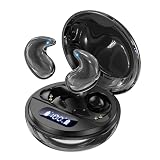
Invisible Flat Bluetooth Sleeping Earbuds
The “invisible” label is marketing, but these earbuds genuinely disappear under your ear — the driver housing sits flush against the inner-ear wall rather than protruding. You can press your cheek directly into a pillow without registering any bump. Sound is limited to a narrow midrange sweet spot, ideal for podcasts and spoken content.
- Pros: Truly flush profile for side sleepers; comfortable enough to forget you are wearing them
- Con: Very limited bass response; not suited for music with a lot of low-end
Skip this if you need full-range audio or find any in-ear object irritating over a full night.
Perytong Sleep Headphones Wireless (Black)
Identical in construction and sound to the Grey version but listed at $12.79, making it the cheapest option in this roundup. The black colorway hides oils and hair product residue better over time. If color preference is your only concern, this is the same product at a marginally lower price.
- Pros: Lowest price of the group; black finish stays looking cleaner longer
- Con: No meaningful difference from the Grey version beyond color and a few cents
Skip this only if you already own the Grey and want a second color for rotation.
Buying Guide
Speaker Thickness and Side-Sleeper Comfort
The single most important spec is how far the driver protrudes from the band surface. Anything that stands more than a few millimeters off the fabric will create a pressure point once your cheek compresses the pillow against it. Headband styles generally sit thinner than in-ear buds with winged housings, but modern flush-profile earbuds close the gap. Press each model between your thumb and forefinger before lying on it — if you feel a distinct hard lump, it will bother your temple by hour two.
Band Fit and Hair Management
A band that slips forward onto your brow every time you roll over will wake you up. Look for a wide, non-elastic contact strip at the forehead area that creates friction against skin or hair. Longer hair needs a band that does not pull; the headband designs in this roundup tend to push hair back rather than trap it, but test the strap angle against your own head shape before committing.
Battery Life Relative to Your Sleep Window
Most sleepers need six to eight hours of playback with headroom for a pre-sleep wind-down routine. A ten-hour battery is adequate for most people; anything beyond that matters if you forget to charge or nap during the day as well. The Hearprotek’s 25+ hour claim is the outlier and genuinely useful if you go a full weekend between charges.
Our Verdict
Top pick: The MUSICOZY Bluetooth 5.4 headband offers the best combination of side-sleeper comfort, connection stability, and reasonable pricing. Budget pick: The Perytong in Black at $12.79 delivers 90 percent of the experience for the lowest cost. Condition-specific winner: If you also fight light intrusion in your bedroom, the LC-dolida eye mask solves both problems in one device and is worth the price premium.
FAQ
Can I wear a sleep headband all night?
Yes, most models are designed for continuous eight-hour wear. The band applies far less pressure than over-ear headphones, and the fabric breathes well enough to prevent heat buildup. Some users with very long hair or scalp sensitivity prefer to remove the band for an hour or two if they wake up in the middle of the night.
Do sleep headphones damage hearing?
At low volume levels (typically below 40 dB for sleep content), the risk of hearing damage is minimal. The bigger concern is ear canal blockage from in-ear models, which can trap moisture and promote bacterial growth if you wear the same pair every night without cleaning.
How do I wash these headphones?
Headband models usually have removable speaker modules — pull them out, hand-wash the fabric in lukewarm water with mild soap, air-dry flat, and reinsert. Never machine-wash with the electronics in place. In-ear models wipe clean with a slightly damp cloth around the housing.
Are Bluetooth headbands safe to wear while sleeping?
Bluetooth emissions are non-ionizing and operate at very low power levels well below safety thresholds set by regulatory bodies. The main safety consideration is battery: use a model from a reputable manufacturer with certified cells rather than an unbranded knock-off, and avoid wearing one that has swollen or feels hot to the touch.

