
The best gaming recliners for long sessions are the RESPAWN 900 for an integrated footrest and wide seat, a well-built padded wall-hugger recliner for maximum everyday comfort, and a compact manual rocker recliner when room space matters more than gaming-specific styling.
As an Amazon Associate we earn from qualifying purchases at no extra cost to you.


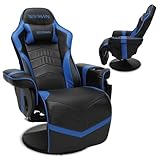
Top 3 picks at a glance
Quick comparison
| Option | Typical recline | Seat width | Published/typical capacity | Best fit |
|---|---|---|---|---|
| RESPAWN 900 | About 90–155 degrees | About 18–19 inches | Up to about 275 lb | PC or console gaming in a dedicated chair position |
| Standard manual rocker recliner | About 90–145 degrees | About 19–22 inches | Usually 250–350 lb | Living rooms and mixed gaming use |
| Wall-hugger recliner | About 90–140 degrees | About 18–21 inches | Usually 250–350 lb | Small rooms with limited clearance |
| Big-and-tall recliner | About 90–140 degrees | About 21–24 inches | Usually 350–500 lb | Taller or broader users needing stronger framing |
Dimensions and weight limits vary by production run and retailer, so check the current manufacturer specification before buying. The ranges above are useful for comparing chair classes, not a substitute for the exact listing.
Best gaming recliners by use case
Best gaming-specific choice: RESPAWN 900
The RESPAWN 900 is one of the clearest choices if you specifically want a gaming recliner rather than an office chair with a backrest tilt. It combines a broad seat, padded arms, an integrated footrest, and a reclining back. Its roughly 90–155-degree range covers upright controller play, relaxed single-player gaming, and near-flat lounging.
The main advantage is convenience: there is no separate ottoman to position, and the footrest deploys with the chair. The trade-off is footprint. The fixed pedestal-style base and extended footrest need more usable floor depth than a conventional desk chair. It also suits a controller better than a keyboard and mouse. You can use it at a desk, but arm height and seat position may not align comfortably with a standard desktop.
Its bonded or faux-leather upholstery is easy to wipe clean, but it can feel warmer than fabric during long sessions. Keep it away from direct sunlight and avoid harsh cleaners, which can accelerate surface cracking.
Best for a shared living room: a manual rocker recliner
A conventional manual rocker recliner is often a better long-term purchase than a racing-style gaming recliner when the chair must also work for television, reading, and guests. Look for a steel reclining mechanism, a kiln-dried or reinforced wood frame, high-density foam, and a seat cushion that can be replaced or repaired.
Fabric upholstery usually breathes better and hides minor wear, while microfiber is soft and comparatively easy to clean. Faux leather gives a more gaming-oriented appearance and resists spills, but lower-grade polyurethane coatings may peel after several years, especially where the thighs and armrests contact the chair.
Rocker recliners are usually wider than the RESPAWN 900 and may have better lumbar and head support, but they do not always open as far. A 135–145-degree recline is enough for most gaming; you do not need a nearly flat position unless you regularly nap in the chair.
Best for a small room: a wall-hugger
A wall-hugger recliner is the sensible choice when the back of the chair cannot move far backward. Many need only a few inches of wall clearance, although the exact requirement can range from roughly 3 to 12 inches. This can save more space than choosing a physically smaller chair.
Measure the chair in both positions. A model may fit between a desk and wall when upright but project 60–75 inches into the room when fully reclined. Also measure doorways, stair turns, and lift access. A recliner that arrives fully assembled can be difficult to move into an upstairs gaming room.
Best for larger users: a big-and-tall recliner
Choose a big-and-tall model based on frame capacity and usable seat dimensions, not just the advertised weight limit. A 400-pound capacity does not automatically mean a 24-inch usable seat; thick arms can consume several inches of the nominal width.
For long sessions, look for at least 21 inches of clear seat width, a seat depth that supports your thighs without pressing behind the knees, and a footrest rated for your full leg weight. A higher seat can make standing easier, but it may leave shorter users with unsupported feet and increased pressure behind the knees.
What matters more than the gaming label
Recline range and posture
Prioritize a recliner with a stable lock or friction mechanism at several positions. An upright setting around 100–110 degrees works well for active controller play. Around 115–130 degrees is usually more comfortable for long games because it reduces the need to hold your head forward. Beyond 140 degrees is useful for films and rest, but it can make a keyboard, mouse, or monitor difficult to use without a separate lap surface.
Padding and support
Soft padding feels comfortable during the first few minutes but can allow your pelvis to sink and your lower back to round. Dense foam with a softer top layer is a better compromise. Check whether the lumbar area is actually supported when reclined; some gaming designs add thick shoulder padding but leave a hollow at the waist.
The seat should support your thighs without forcing your knees upward. If the front edge presses behind your knees, the seat is too deep or too high for you. If your shoulders do not reach the headrest when sitting upright, the backrest may be too tall or shaped for a different body type.
Upholstery
- Fabric: cooler and less prone to peeling, but more vulnerable to stains.
- Microfiber: soft, breathable, and practical for living rooms; inspect cleaning instructions before purchase.
- Bonded or faux leather: easy to wipe down and visually consistent, but quality varies considerably.
- Genuine leather: durable when maintained, usually more expensive, and less common in gaming-branded recliners.
Room-fit calculation before ordering
Use a simple clearance calculation rather than relying on the chair’s upright dimensions. Add the chair’s fully reclined depth to the clearance you need for walking behind it:
Required floor depth = reclined chair depth + walking clearance.
For example, if a recliner extends 68 inches from the wall when open and you want a 24-inch walking path in front, reserve about 92 inches of room depth. If the chair sits at a desk, also reserve at least 8–12 inches for your feet and cable routing. This is why a chair that appears compact in a product photo can overwhelm a small bedroom.
Decision matrix
| Your situation | Recommended class | Why | Main compromise |
|---|---|---|---|
| Controller gaming, no separate footstool | RESPAWN 900-style gaming recliner | Integrated footrest and deep recline | Large footprint and warmer upholstery |
| Gaming plus television and reading | Manual rocker recliner | More neutral styling and broad comfort | Less gaming-specific support |
| Less than 12 inches behind the chair | Wall-hugger | Reclines without consuming as much rear clearance | Often a shorter recline range |
| Over 6 feet 2 inches or above average build | Big-and-tall model | More seat width, stronger mechanism, longer back | Higher price and larger room requirement |
| Keyboard-and-mouse gaming at a desk | Recliner plus adjustable lap desk, or an ergonomic reclining chair | Better alignment than forcing a recliner under a desk | Two-piece setup and less compact storage |
Assembly and durability checks
Most recliners require attaching the back to the base, fitting side panels, and installing the footrest or handle. Allow two people for bulky models, even when assembly is technically simple. Before tightening bolts, confirm that the chair is level and that the mechanism operates without scraping.
For long-term durability, inspect the return policy for mechanism failure, frame noise, and upholstery defects rather than focusing only on appearance. Avoid using the footrest as a step, dragging the chair while occupied, or placing it on an uneven floor. Tighten accessible fasteners after the first month, then check them every six months.
Typical market pricing is about $200–$350 for basic manual recliners, $300–$600 for gaming-branded or better-equipped models, and $600–$1,200 or more for premium leather, power, heated, or big-and-tall designs. Spend extra on the frame, dimensions, and upholstery quality before paying for speakers, lighting, or decorative panels.


