
The best KVM switches for gaming and work are usually DisplayPort 1.4 or HDMI 2.1 models with USB 3.x, EDID emulation, and enough independent outputs for every monitor you use; for a single 4K monitor, a reliable 2-PC/1-monitor switch is the sensible starting point, while dual-monitor desks should look for a true 2-PC/2-monitor KVM rather than a basic HDMI selector.
As an Amazon Associate we earn from qualifying purchases at no extra cost to you.


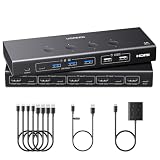

Top 3 picks at a glance
What to compare before buying a KVM switch
A KVM switch shares one keyboard, mouse, and monitor setup between two or more computers. The important specifications are not just the number of ports. Video bandwidth, USB speed, monitor-count support, hotkey behavior, and display detection determine whether the switch feels like part of your desk or an obstacle in it.
- Port count: Confirm both the number of computers and the number of monitors. “2-port” often means two computers, not two displays.
- Video standard: DisplayPort 1.4, HDMI 2.1, and older HDMI 2.0 products have very different refresh-rate ceilings.
- USB standard: USB 2.0 is adequate for keyboards, mice, and printers. USB 3.x is preferable for external SSDs, webcams, capture devices, and card readers.
- EDID emulation: This helps the computer retain the monitor’s identity while you switch away from it, reducing window reshuffling and display re-detection.
- Switching method: Front-panel buttons, wired remotes, keyboard hotkeys, and software commands vary in reliability and convenience.
- Power: A powered KVM is more dependable when using long cables, several USB devices, or high-bandwidth peripherals.
Best KVM switch categories for different desks
| Desk setup | Recommended KVM class | Useful minimum specification | Why it fits |
|---|---|---|---|
| One gaming PC and one work laptop, one monitor | 2-PC/1-monitor DisplayPort or HDMI KVM | 4K at 120 Hz, USB 3.x, EDID emulation | Simple switching without sacrificing a high-refresh display |
| Two computers, one 1440p high-refresh monitor | 2-PC/1-monitor gaming KVM | 1440p at 240 Hz or 4K at 120 Hz; correct adaptive-sync support | Good match for competitive gaming and office use |
| Two computers, two monitors | 2-PC/2-monitor dual-head KVM | Two independent video inputs per computer and dual-display EDID | Preserves an extended desktop instead of mirroring one screen |
| Three or four computers | 4-port enterprise or enthusiast KVM | 4K at 60 Hz minimum, USB 3.x, selectable hotkeys | More convenient than stacking multiple inexpensive switches |
| Gaming PC with USB SSD or capture hardware | Powered USB 3 KVM with high-speed hub | 5Gbps USB 3.0 or faster per the product specification | Prevents the KVM from becoming a bottleneck |
| 4K at 144–240 Hz | HDMI 2.1 or DisplayPort 1.4 with DSC KVM | At least 40–48Gbps HDMI 2.1, or DP 1.4 plus verified DSC support | Older 4K60 KVMs cannot carry these modes |
DisplayPort versus HDMI for gaming KVMs
DisplayPort 1.4 is often the easier choice for a desktop gaming PC. It supports high refresh rates at 1440p and 4K, and DisplayPort is common on graphics cards and PC monitors. The limitation is that uncompressed 4K at very high refresh rates may require Display Stream Compression, or DSC. A KVM must explicitly support the relevant DSC path; otherwise it may fall back to a lower refresh rate or fail to produce a picture.
HDMI 2.1 is the safer choice for newer laptops, consoles, OLED televisions, and monitors that reserve their highest refresh rates for HDMI. Look for a switch rated for 40Gbps or 48Gbps rather than one described only as “8K.” Resolution labels can hide an important limitation: an “8K” switch may support 8K only at 30 Hz while offering 4K at 60 Hz.
Worked bandwidth example: 4K high refresh
A 3840 × 2160 image contains 8,294,400 pixels per frame. At 144 Hz, that is about 1.19 billion pixel updates per second before blanking, encoding overhead, and color depth are included. With 10-bit color and RGB-style data, the raw active-image calculation is approximately:
3840 × 2160 × 144 × 30 bits = about 35.8Gbps
That is not the final cable requirement. Blanking and link overhead push the practical requirement higher, which is why uncompressed 4K144 commonly needs DisplayPort 2.x, HDMI 2.1, or compression. A KVM rated only for HDMI 2.0 or DisplayPort 1.2 should not be expected to deliver 4K144 reliably. For a 4K240 monitor, HDMI 2.1 at 48Gbps or a suitable DisplayPort 2.x solution is more appropriate than an older “8K” KVM.
USB standards matter more than many listings suggest
USB 2.0 runs at 480Mbps theoretical signaling speed and is perfectly suitable for a keyboard, mouse, headset dongle, and most printers. It is a poor choice for moving large files to an external SSD or feeding a high-resolution webcam.
USB 3.0, also called USB 3.2 Gen 1 in many specifications, provides 5Gbps theoretical signaling. USB 3.2 Gen 2 raises that to 10Gbps, although the KVM’s internal hub, cable quality, and connected computer may reduce real throughput. If you use a USB SSD that can reach around 900MB/s on a direct 10Gbps connection, a 5Gbps KVM can become the limiting component.
Check whether the advertised USB ports are actually switched between computers. Some products include charging-only ports or a shared hub that behaves differently from the keyboard-and-mouse ports. A powered model is preferable when you connect a webcam, audio interface, external drive, and several low-power peripherals at once.
Models and product families worth considering
Level1Techs DisplayPort KVMs
Level1Techs’ DisplayPort KVM range is aimed at enthusiasts who need demanding PC refresh rates, multi-monitor configurations, and features such as EDID management. These switches are commonly positioned at the premium end of the market, usually several hundred dollars and sometimes more depending on the number of displays and ports. They are attractive for a workstation/gaming desk where display behavior matters more than the lowest price.
StarTech dual-monitor DisplayPort KVMs
StarTech offers established dual-monitor DisplayPort KVM families, including models designed for two computers and two displays. They are a practical fit for office users who need extended desktops, not merely a duplicated image. Check the exact model’s maximum resolution and refresh rate carefully: business-oriented versions often prioritize 4K60 compatibility and broad operating-system support over 144Hz gaming.
TESmart and AV Access HDMI KVMs
TESmart and AV Access sell a wide range of HDMI KVMs, from compact 2-PC/1-monitor units to multi-monitor and higher-refresh products. Their catalogs include different generations of HDMI and USB support, so the brand name alone is not enough to identify a suitable model. Confirm whether the particular switch supports HDMI 2.1, the required refresh rate, VRR or adaptive sync, and USB 3.x. Many affordable models are best treated as 4K60 work-and-console switches unless the specification clearly says otherwise.
Simple UGREEN or Cable Matters KVMs
Compact KVMs from brands such as UGREEN and Cable Matters can work well for a basic two-computer desk, particularly at 1080p or 1440p. They are often less suitable for a 4K high-refresh gaming monitor because inexpensive models may top out at 4K60, use USB 2.0, or lack robust EDID handling. Choose this class when price and simplicity matter more than maximum gaming bandwidth.
How to avoid switching and wake-up problems
- Use the same video input type on both computers. Avoid mixing adapters unless necessary. A direct DisplayPort-to-DisplayPort or HDMI-to-HDMI path removes one possible handshake failure.
- Connect the KVM’s power supply. Bus power may be adequate for a keyboard and mouse but unstable with a webcam, drive, or long cable run.
- Set a fixed refresh rate while troubleshooting. Start at 60 Hz, confirm a picture, then try 120 Hz, 144 Hz, or 240 Hz. This identifies whether the failure is a bandwidth problem rather than a switching problem.
- Disable deep sleep or input auto-switching on the monitor. These features can make the monitor search for another source just as the KVM changes computers.
- Enable EDID emulation or EDID copy mode. EDID is the monitor’s capability information. Keeping it present while switching prevents the operating system from treating the display as disconnected.
- Use the included or certified cables first. For HDMI 2.1, use Ultra High Speed HDMI cables. For DisplayPort, use a cable rated for the target mode; a cable that works at 4K60 may fail at 4K144.
- Try the front button or wired remote. If that works but a keyboard hotkey does not, the issue is likely the hotkey combination, keyboard firmware, or a conflict with software rather than the video path.
Choosing the right KVM in one decision
Buy a USB 2.0 4K60 KVM if you only share ordinary office peripherals and do not use a high-refresh monitor. Choose a USB 3.x 4K60 model for an office workstation with storage or a webcam. For 1440p at 165–240 Hz, select a model whose specification explicitly names that refresh rate rather than inferring it from an “8K” label. For 4K144 or 4K240, prioritize HDMI 2.1 or DisplayPort 1.4/2.x with clearly documented DSC and adaptive-sync behavior.
For two monitors, count the video connections from each computer: a dual-display KVM normally needs two video inputs per computer and two outputs to the monitors. If one computer has only one video output, a dual-head KVM cannot create a second independent desktop without a separate display adapter. The most reliable purchase is therefore the one whose port count, video bandwidth, USB speed, and EDID features match your actual desk—not the one with the largest resolution printed on its box.
Frequently asked questions
Will a KVM reduce gaming performance?
A properly functioning KVM does not normally reduce GPU rendering performance. It can restrict the available resolution, refresh rate, HDR mode, or adaptive-sync support if its video link is below the monitor’s requirements.
Can one KVM switch a keyboard, mouse, and two PCs while each PC uses two monitors?
Yes, but it must be a 2-PC/2-monitor KVM with two video paths per computer. A one-monitor KVM combined with a separate monitor switch usually provides a less consistent experience.
Is 8K support useful for a 4K gaming monitor?
Only if the specification also states the desired 4K refresh rate. “8K” alone does not guarantee 4K120, 4K144, VRR, HDR, or DSC compatibility.


