
As an Amazon Associate we earn from qualifying purchases at no extra cost to you. Product prices and availability are accurate as of the date shown and are subject to change.


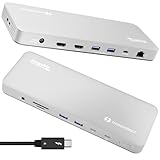

Buying a Thunderbolt dock shouldn’t be hard, yet most people get it wrong in one of three ways: they buy more dock than their laptop can use, they buy a hub thinking it’s a dock, or they spend $400 on bandwidth they’ll never touch. A Thunderbolt dock is a long-term purchase — the right one lasts through two or three laptops, while the wrong one ends up in a drawer within six months. This guide cuts through the marketing and focuses on what actually determines whether a dock will work for you.
One mistake worth flagging early: many “Thunderbolt” docks are actually USB-C docks with Thunderbolt branding slapped on the box. A true Thunderbolt 4 or 5 dock carries 40Gbps of data, supports at least dual 4K displays at 60Hz on most laptops, and delivers 85W or more of charging power. If the spec sheet doesn’t say those things explicitly, keep shopping.
Top 3 picks at a glance
Decide These 3 Things First
Before comparing any products, answer these questions. They eliminate half the market immediately.
1. What Thunderbolt version does your laptop have? A Thunderbolt 4 laptop cannot use Thunderbolt 5 bandwidth — you’ll be capped at 40Gbps regardless of what the dock supports. If your machine has Thunderbolt 3 or 4 ports (most Intel laptops from 2020 onward, every Apple Silicon MacBook), a Thunderbolt 4 dock is the sweet spot. Thunderbolt 5 docks only make sense if your laptop specifically lists Thunderbolt 5 support.
2. How many external displays do you need? Thunderbolt 4 guarantees two 4K displays at 60Hz; Thunderbolt 5 pushes that to three or more 4K panels. If you run a single monitor, you’re paying for capability you won’t use.
3. How much power does your laptop need? Check your charger. Thin laptops need 60–65W, most 14- and 16-inch laptops need 90–100W, and some gaming and workstation machines want 140W or more. A dock that delivers less means slow charging under load or a drained battery during heavy work.
Ports and Bandwidth: The Whole Reason You’re Buying
The core spec is data bandwidth: Thunderbolt 4 moves data at 40Gbps, and Thunderbolt 5 roughly doubles usable throughput. In practice, the difference shows up when you’re moving large files to external NVMe SSDs — a 100GB video project transfer takes around 25–30 seconds on Thunderbolt 4 and closer to 12–15 seconds on Thunderbolt 5 with a compatible drive.
Count the ports you actually need, then add two. A solid mid-range configuration looks like the UGREEN 8-in-1: three downstream Thunderbolt 4 ports, plus USB-A, Ethernet, and audio. That covers a monitor chain, an external drive, and peripherals without constant swapping. Heavier users — say, someone daisy-chaining two drives, two displays, and running a card reader — should look at 12+ port configurations like the Anker Prime, which spreads 14 ports across data, video, and networking.
Display support specifics to check:
– Thunderbolt 4 minimum: two 4K displays at 60Hz, or one 6K/8K display
– Thunderbolt 5: up to three 4K displays at 144Hz or dual 6K panels
– If you use HDMI monitors, confirm the dock has native HDMI 2.1 rather than relying on an included adapter — adapters are the first thing to fail
Power Delivery: The Number That Matters Most Day to Day
Power delivery wattage determines whether your laptop stays charged while you work. Here’s the honest breakdown:
– 60–65W: Fine for ultrabooks and 13-inch laptops at idle and light work. Marginal under sustained CPU load.
– 90–100W: The standard for serious docks. The Plugable and Lenovo ThinkPad docks both deliver 100W, which keeps most professional laptops fully charged under load.
– 140W+: Required for 16-inch workstations and gaming laptops, and increasingly standard on Thunderbolt 5 docks.
Also look at total power budget, not just laptop wattage. A dock with a 180W adapter delivering 100W to the laptop has only 80W left for everything else — displays, drives, and peripherals draw from the same pool. Premium docks run 230W adapters to avoid throttling. If a dock doesn’t publish its adapter wattage, that’s a reason to be suspicious.
Size, Build, and Where It Actually Lives
Docks fall into two physical categories, and choosing wrong is a common regret.
Compact docks (under 0.5 lb, roughly 5 x 3 inches): Designed to sit on a desk or travel in a bag. Better for laptop users who move between home and office. The tradeoff is thermal headroom — small enclosures throttle sustained transfers sooner.
Full-size docks (1–2.5 lb, roughly 8 x 3.5 inches): Meant to sit under or behind a monitor and stay put. Larger chassis means better heat dissipation and room for more ports. The ThinkPad Smart Dock and similar enterprise-oriented units fall here, and many include mounting holes for under-desk or VESA installation — worth checking if you hate visible cable clutter.
On build: an aluminum enclosure dissipates heat noticeably better than plastic and resists the scuffs of desk life, but plastic isn’t a dealbreaker for a dock that lives behind a monitor. What matters more is the cable. A permanently attached Thunderbolt cable (like the ThinkPad’s integrated 1-meter cable) removes the most common failure point — loose removable cables cause intermittent disconnections that are miserable to diagnose. If the cable is removable, buy a replacement from the dock manufacturer rather than a generic cable; Thunderbolt 4 cables are precision-built and cheap knockoffs cause exactly the dropouts people blame on the dock.
Performance in Real Use: Displays, Drives, and Networking
Rather than quoting synthetic benchmarks, focus on these practical performance markers:
– Display stability: Dual 4K@60Hz should run for hours without flickering or dropping. Dock reviews mentioning “monitor blinks” are usually describing bandwidth conflicts — docks that dedicate display bandwidth separately handle dual displays more reliably.
– Ethernet: 2.5GbE is now standard on mid-range and premium docks; 1GbE is acceptable but dated. Remote workers should treat 2.5GbE as a minimum for large file syncs.
– SD card readers: If you shoot photos, check the card speed — many built-in readers bottleneck at UHS-I speeds (roughly 100MB/s), which wastes a UHS-II card’s 300MB/s capability.
– Front-facing vs. rear ports: At least two easily reachable front ports for headphones and flash drives make a real difference in daily use.
Price Tiers: What Your Money Buys
Budget ($130–$180): Thunderbolt 4 certification, 60–100W power delivery, 8–11 ports, dual 4K@60Hz. The UGREEN at around $170 is representative. This is the right tier for most people with a single or dual-monitor setup.
Mid-range ($180–$260): Better power budgets, 2.5GbE Ethernet, longer or integrated cables, and enterprise features. The Plugable ($199.95) and ThinkPad Smart Dock ($244.99) sit here. The ThinkPad adds remote hardware management — genuinely useful if IT manages your fleet, irrelevant for a home desk.
Premium ($300–$450): Thunderbolt 5, 12+ ports, 140W+ laptop charging, and support for high-refresh multi-display arrays. The Anker Prime at $399.99 targets users with Thunderbolt 5 machines and demanding display setups. If your laptop doesn’t support Thunderbolt 5, this tier is wasted money today.
Warranty and Support
Thunderbolt docks fail more often than they should — power adapters and Thunderbolt chips both run hot. Look for:
– 2–3 year warranty minimum. Anker, Plugable, and Lenovo all offer at least two years; several cover three. Anything under two years suggests the manufacturer expects early failures.
– Replacement-first support. Brands like Plugable have reputations for shipping replacements quickly rather than making you troubleshoot for weeks. Check recent reviews specifically for support experiences.
– Certification matters here. Intel Thunderbolt certification means the dock passed compatibility testing. Uncertified docks work most of the time — which is the problem.
Delivery and Setup Considerations
Docks are small and ship cheaply, so delivery isn’t a major differentiator — expect standard retail shipping timelines. Setup is where you should plan: a quality dock is genuinely plug-and-play on Thunderbolt 4 Macs and Windows 11 machines, but older Windows laptops may need a firmware or driver update from the dock manufacturer. Budget 30 minutes for first-time setup including monitor configuration. Download the dock’s firmware utility before you need it; updates occasionally fix display-dropout bugs.
Spec Checklist
| Spec | Budget ($130–$180) | Mid-Range ($180–$260) | Premium ($300–$450) |
|---|---|---|---|
| Thunderbolt version | TB4 | TB4 | TB5 |
| Bandwidth | 40Gbps | 40Gbps | 80Gbps+ |
| Laptop charging | 60–90W | 100W | 140W+ |
| Display support | Dual 4K@60Hz | Dual 4K@60Hz | Triple 4K or dual 6K |
| Port count | 8–11 | 11–14 | 14+ |
| Ethernet | 1GbE | 2.5GbE | 2.5–10GbE |
| Warranty | 18–24 months | 2–3 years | 2–3 years |
Red Flags
– “Thunderbolt compatible” instead of “Thunderbolt certified.” Compatible often means USB-C with a TB logo nearby. Look for the explicit certification.
– No published adapter wattage. If they won’t say the power budget, it’s probably thin.
– HDMI caps at 4K@30Hz. That’s 2013-era output and makes any HDMI-connected monitor feel sluggish for text scrolling.
– Only 1GbE on a $250+ dock. Inexpensive corner-cutting.
– No firmware update utility. Every dock ships with bugs; a manufacturer with no update path abandons you after purchase.
– Removable cable with no cable spec published. Cheap cables are the top cause of disconnection complaints.
– Reviews mentioning “monitor flickers” or “disconnects after an hour.” Heat-related throttling — usually a compact chassis pushed past its thermal design.
FAQ
Do I need a Thunderbolt dock if my laptop only has USB-C?
Check whether that USB-C port supports Thunderbolt. If it doesn’t, a Thunderbolt dock will work in a limited fallback mode but you’ll lose bandwidth and possibly multi-display support. A good USB-C hub with 100W power delivery is the better match and costs $60–$120 less.
Will a Thunderbolt 5 dock work with my Thunderbolt 4 laptop?
Yes — Thunderbolt is backward compatible — but you’ll get Thunderbolt 4 speeds and capabilities only. There’s no harm, just money spent on performance your laptop can’t access. Buy TB5 only if your machine lists TB5 support.
Can a Thunderbolt dock charge my laptop and run two monitors at once?
That’s precisely the point of the category. A certified Thunderbolt 4 dock handles dual 4K@60Hz displays plus 85–100W charging over the single cable. Verify your laptop supports Thunderbolt and that the dock’s wattage meets or exceeds your charger’s rating.
How long should a Thunderbolt dock last?
Three to five years of daily use is a reasonable expectation for a certified dock with a decent warranty, often longer since Thunderbolt 4 docks remain fully useful as laptops come and go. Buy for the ports and power you’ll need across your next two laptops, not just the one on your desk.
Related guides
- What Size Monitor Stand for Two 27 Inch Monitors? Size Guide With Measurements
- How Much Desk Space Does a Kvm Switch Need? Size Guide With Measurements
- What Height Laptop Stand for Eye Level Typing? Size Guide With Measurements
- How Long Rgb Light Strip for Dual Monitor Setup? Size Guide With Measurements


