Our Top Picks

The Short Answer
Yes, a monitor light bar is worth it for eye strain — but only if you work for long stretches in a dim or unevenly lit room. If you already have a bright, diffused overhead light with no glare on your screen, you will see little benefit.
The single condition that makes or breaks the value is contrast. Eye strain at a desk in 2026 is rarely caused by the monitor alone. It is caused by the bright rectangle of your screen floating in a dark room. Your pupils constantly adjust between the bright display and the dark wall and desk around it. A light bar fixes that by washing your desk in soft, even light without adding reflections to your screen, which reduces that harsh contrast. If that describes your setup — late-night work, a dark home office, a single ceiling light behind you that creates glare — a $14 to $40 bar is one of the cheapest ergonomic upgrades you can make. If you work in a well-lit office with natural light all day, save your money.
As an Amazon Associate we earn from qualifying purchases at no extra cost to you.

What You Actually Get
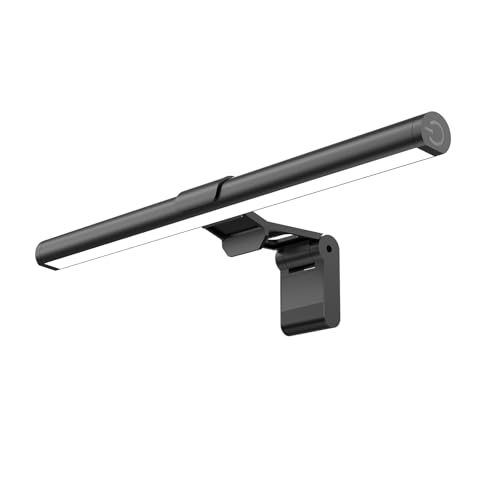
A monitor light bar is not a regular desk lamp bent into a new shape. It is an asymmetrical LED bar that sits on top of your monitor, usually held by a weighted clip or gravity clamp that grips the top bezel. The optics angle light forward and down onto your desk at about 45 degrees, while shielding your eyes and your screen from direct light.
Most models share the same core specs. The bar itself is typically 11.8 inches wide for compact models up to 19.7 to 20.5 inches for full-size versions designed for 27-inch and larger monitors. Weight is minimal, usually 0.4 to 0.9 pounds including the clip, so it does not tip most monitors. Power draw is low, around 3 to 5 watts, and nearly all models run on 5V USB power from your monitor, PC, or a wall adapter. You get a touch bar or physical dial for control, with stepless dimming from roughly 10% to 100% brightness and adjustable color temperature from 2700K warm white to 6500K cool white.
More expensive bars, like those in the $35 to $45 range, add features such as auto-dimming sensors that adjust brightness to ambient light, a remote puck, higher color rendering (Ra >95), and a rear-facing fill light to soften the wall behind your monitor. Budget options around $14 to $20 keep it simple: three fixed color temperatures, manual dimming, and front light only. Both styles free up desk space because they eliminate the lamp base and arm that usually competes with your keyboard and mousepad.
What you do not get is a direct cure for eye strain. The American Academy of Ophthalmology notes that eye strain is driven by prolonged focus, dryness from reduced blinking, and uncorrected vision issues as much as by lighting. A light bar improves one piece of that puzzle — ambient illumination — but it cannot fix strain from staring at a screen for four hours without a break or from a monitor that is too bright for the room.
Pros
- Reduces contrast glare without screen reflection. Traditional desk lamps spill light onto your screen and create hot spots and reflections. The asymmetrical lens design of a light bar lights the 2 to 3 feet of desk in front of you while keeping light off the display, which is the entire point for eye comfort in a dark room.
- Frees up serious desk space. No base, no clamp arm, no pole. For small desks, dorm rooms, and standing desk converters, gaining back 30 to 40 square inches of usable surface is a tangible upgrade.
- Gives you adjustable, eye-friendly light at desk level. Being able to drop brightness to 20% with a 3000K warm tone for late-night email or raise it to 100% at 4000K to 5000K for paperwork means you can match light to the task without getting up to flip a ceiling light.
- Low power and low heat. At under 5 watts, it costs pennies to run for thousands of hours and adds no noticeable heat to your face like a halogen task lamp.
- Helps with bias lighting. Models with a backlight create a soft halo on the wall behind the monitor. That gentle background glow further lowers the luminance difference between screen and surroundings, which many people find more comfortable than a bar with front light alone.
- Easy to install and power. Most clips fit monitors with bezels from 0.2 to 1.2 inches thick, including curved displays, and install in under 30 seconds with no tools. USB-C or USB-A power means one less wall plug.
Cons
- It does not replace proper room lighting. If your overhead light is too dim, too harsh, or positioned to cast shadows, a light bar is a patch, not a fix. A well-placed ceiling diffuser or floor lamp may serve you better during the day.
- Build and light quality varies sharply by price. Budget bars under $20 often have visible flicker at low brightness, less accurate color rendering, and limited dimming range. Warmer tones can look slightly green or pink, which matters if you do photo or design work.
- Compatibility is not universal. Ultra-thin monitors, laptops, monitors with a top-mounted webcam bump, or thick curved gaming monitors with a deep back housing can prevent the clip from seating securely. Always check your bezel depth and camera placement before buying.
- Touch controls can be annoying. Capacitive touch bars are easy to bump when adjusting your monitor angle and can be hard to use in the dark without a tactile reference. A physical dial or wireless remote is more precise but usually costs more.
- USB power can create cable clutter. If your monitor does not have a powered USB port, you will need to route a cable to your PC or to an adapter, which partly defeats the clean-desk promise.
- It will not fix non-lighting causes of strain. Dry eyes, an incorrect prescription, a monitor set to 100% brightness at midnight, or viewing distance closer than 20 inches will still cause fatigue even with perfect ambient light.
Who Should Buy It
You are the ideal buyer if you work or game for more than three hours at a time after sunset, your desk is in a bedroom, basement, or home office with a single overhead light or no overhead light at all, and you notice tired, dry, or aching eyes by the end of the evening. It is especially useful for people with a 24-inch to 34-inch monitor who want to keep the desk clear for writing, drawing, or a large mouse area, and for anyone who has tried a traditional desk lamp and gave up because of glare on the screen.
Students, remote workers, programmers, writers, and gamers who prefer a dark room with focused task lighting will get the most immediate comfort improvement. If you are sensitive to overhead fluorescents and tend to turn them off, a light bar is a far better alternative than working by screen light alone.
Who Should Skip It
Skip it if you already work in a bright room with diffuse natural or ceiling light that evenly illuminates your desk without reflecting on your screen. In that scenario, the benefit is minimal and the money is better spent on a monitor arm to fix viewing height or on blue-light filtering settings you will actually use.
Also skip it if you do color-critical work on a budget bar. For photo editing, illustration, or video grading, inaccurate color temperature and a low CRI can mislead your eyes. In that case, invest in a high-CRI task light rated at Ra95+ or a proper studio light instead. Finally, if your monitor has an unusually thick or irregular top bezel, a built-in light bar may not mount stably, and a conventional lamp will be less frustrating.
Cheaper Alternatives
| Option | Cost | Trade-off |
|---|---|---|
| Bright overhead or floor lamp with diffuser | $25 – $60 | Evenly lights the whole room and helps eye strain, but takes floor or ceiling space and can still cause screen glare if not diffused |
| Bias lighting LED strip behind monitor | $10 – $18 | Reduces contrast between screen and wall for very little money, but does not light your desk for reading or writing |
| Traditional LED desk lamp with adjustable arm | $20 – $45 | More flexible positioning and often higher brightness (600+ lumens), but creates reflections on the display and uses desk space |
| Lower monitor brightness + 20-20-20 rule | $0 | Free and effective for strain from over-bright screens and staring, but does not fix a dark, high-contrast room |
FAQ
Do monitor light bars actually reduce eye strain or just make the desk look better?
They help with one specific cause of strain: high contrast between a bright screen and a dark surround. By adding even, glare-free light to the desk and wall, they reduce how hard your eyes work to adapt between light and dark areas. They do not reduce strain from dry air, too little blinking, or an incorrect glasses prescription, so think of them as supportive lighting, not medical treatment. If strain persists, adjust monitor brightness to roughly match the desk surface and take regular breaks.
What color temperature and brightness should I use?
For evening computer work, most people are comfortable around 2700K to 3500K warm white at 30% to 60% brightness, which feels relaxing and reduces that harsh, office-like feel. For daytime paperwork, reading, or detailed tasks, move toward 4000K to 5000K neutral white at 70% to 100% brightness for better clarity. Start with a lower brightness than you think you need and increase until the desk looks evenly lit without the light bar itself becoming a glare source. A simple test is that a white piece of paper on your desk should not look noticeably brighter than your monitor’s white background.
Will a light bar fit my monitor, especially a curved or laptop screen?
Most bars are designed for flat desktop monitors from 21 to 34 inches with a top bezel thickness of 0.2 to 1.2 inches. Thin, weighted clips work on many curved monitors, but very deep or sloped back housings can prevent the counterweight from sitting flush. For laptops, only compact 11 to 13-inch bars are stable, and many users prefer a standalone lamp instead. Check your monitor’s top edge for a webcam, light sensor, or raised plastic seam, and confirm the clip dimensions listed by the seller before ordering.
Is the $14 bar as good as the $40 bar?
For basic eye comfort, a budget bar around $14 to $20 will do the job if you only need front light and manual control. You get a functional LED bar, three color temperatures, and dimming. Stepping up to the $35 to $45 tier typically buys you auto-dimming, smoother flicker-free dimming at low levels, higher color accuracy for more natural skin tones and paper colors, a rear bias light, and better build quality with a metal bar instead of plastic. If you work long hours or care about light quality, the upgrade is noticeable. If you just want to test the concept, start cheap.