
The Short Answer
Yes, a powered USB hub is absolutely worth it for streaming, but only on one condition: you are running three or more high-bandwidth, power-hungry peripherals simultaneously. If your stream relies on a combination of an external capture card, a 1080p or 4K webcam, a USB condenser microphone, and a stream deck, your computer’s motherboard simply cannot supply enough stable power or bandwidth through a single standard USB port. A dedicated, wall-powered USB hub prevents device dropouts, audio crackling, and sudden camera disconnections by supplying direct, independent electricity to each port.
What You Actually Get
To understand why a powered USB hub is a game-changer for a streaming desk, you have to look at how computers handle power. A standard motherboard USB 3.0 port outputs a maximum of 0.9 amps at 5 volts, which equals 4.5 watts of power. If you plug a cheap, unpowered (bus-powered) splitter into that port and daisy-chain a webcam (which draws about 1.5 to 2.5 watts), a USB microphone (drawing 1 to 2 watts), and a stream controller, you will instantly overload the port. The result is a cascade of system errors: your camera might freeze, your microphone might start crackling, or your capture card might drop its signal entirely mid-broadcast.
As an Amazon Associate we earn from qualifying purchases at no extra cost to you.
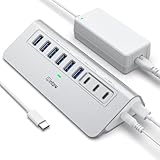

A powered USB hub solves this by bypassing your computer’s power supply for its downstream devices. It plugs directly into a wall outlet via an AC adapter, delivering a constant stream of electricity to every connected device. This frees your computer’s internal USB controller to focus strictly on data transfer rather than struggling to keep your accessories powered.
When shopping, you will generally encounter two tiers of powered hubs:
- The Compact Desktop Hub: Units like the SABRENT 4-Port Powered USB 3.0 Hub (HB-UMP3) are priced around $19.99. These are highly compact, measuring roughly 3.5 x 1.5 x 0.6 inches and weighing under 2 ounces. They offer individual LED power switches for each port, allowing you to manually cut power to your webcam or microphone when you are off-camera. This tier is perfect for budget-conscious creators who need to connect a few low-to-medium draw devices.
- The Heavy-Duty Production Hub: High-end units like the intpw Powered USB Hub retail for around $55.99. This hub offers 9 ports (including high-speed USB 3.2 and USB-C connections), operates at blistering 10Gbps data transfer speeds, and is backed by a robust 65W power adapter. Built with an aluminum chassis, these heavier hubs stay planted on your desk, making them ideal for complex setups with multiple camera angles, external SSDs, and professional audio interfaces.
Pros
- Eliminates Device Disconnections: By providing dedicated, external wall power, your high-draw streaming equipment (like external capture cards and ring lights) will never shut down due to power starvation.
- Hardware Privacy Control: Hubs featuring individual power toggles (like the Sabrent model) allow you to physically turn off your camera and microphone with the press of a button, ensuring absolute privacy when your stream is offline.
- Protects Your Motherboard: Drawing too much power through your PC’s built-in USB ports can eventually damage the motherboard’s USB controllers. A powered hub acts as a buffer, shielding your expensive PC components from electrical strain.
- High-Speed Data Lanes: Premium hubs utilizing USB 3.2 Gen 2 standards support up to 10Gbps data transfer, ensuring that 4K camera feeds or external game drives experience zero bottlenecking.
- Cleans Up Desk Clutter: Instead of routing five different cables behind your PC tower, you can run one clean cable from your computer to a powered hub mounted under or on your desk, streamlining your workspace aesthetics.
Cons
- Added Cable Clutter: Because these hubs require an external power source, you must manage another power brick and plug it into your wall outlet or surge protector.
- Potential Ground Loop Noise: If a powered hub lacks proper electrical isolation, it can introduce a low, annoying ground loop hum or hiss into your USB-connected microphones or audio mixers.
- Physical Footprint: High-wattage hubs with 60W to 90W power bricks can be bulky, requiring dedicated routing and mounting solutions underneath your streaming desk.
- Higher Initial Cost: Unlike passive splitters that cost less than ten dollars, a reliable powered hub ranges from $20 to $60 depending on port count and speed.
Who Should Buy It
You should absolutely invest in a powered USB hub if you stream from a laptop. Laptops have notorious power-saving protocols that aggressively throttle USB power, making it almost impossible to run a steady stream setup without external help. You should also buy one if you are a multi-camera streamer, a console streamer using an external capture card, or a creator who keeps their PC tower far away from their actual desk surface.
Who Should Skip It
If you are a casual streamer who only plugs in a simple USB headset and a standard 1080p webcam directly into a desktop PC tower, you can easily skip this purchase. Modern ATX motherboards usually have 6 to 10 USB ports on the rear I/O panel, which is more than enough to handle a minimal, low-draw setup without experiencing power limitations.
Cheaper Alternatives
If you are trying to optimize your budget, you do not always have to buy a premium powered hub. Below is a breakdown of alternative options, their typical price ranges, and the functional sacrifices you will make by choosing them.
| Option | Cost | Trade-off |
|---|---|---|
| Passive (Bus-Powered) USB Hub | $8.00 – $15.00 | Shares the host port’s tiny 4.5W limit. High risk of device dropouts if you connect a webcam and microphone together. |
| PCIe USB Expansion Card | $15.00 – $30.00 | Requires an open PCIe slot inside your PC tower and manual installation. Completely incompatible with laptops. |
| Direct Motherboard Routing | $0.00 | No added cost, but severely limits cable management options and forces you to crawl behind your desk to plug in gear. |
FAQ
Does a powered USB hub introduce input lag to my mouse, keyboard, or stream deck?
Technically, passing any USB signal through an intermediary controller adds a fraction of a millisecond of latency. However, in real-world streaming environments, this latency is completely imperceptible (under 1-2 milliseconds). To ensure zero lag for critical inputs, keep your gaming mouse and keyboard plugged directly into your motherboard, and route your streaming peripherals through the powered hub.
Can I run my external capture card through a powered USB hub?
Yes, but with one major caveat: the hub must support high-speed data transmission (at least USB 3.0/5Gbps, or ideally USB 3.2/10Gbps like the intpw model). If you run a high-end capture card through an older USB 2.0 hub, your video feed will be severely compressed, laggy, or fail to load entirely in your streaming software.
How do I stop my USB microphone from buzzing when connected to a powered hub?
If your microphone buzzes, it is likely due to an electrical ground loop created by the hub’s AC adapter. To fix this, plug both your computer’s power supply and the USB hub’s power adapter into the exact same high-quality surge protector. Avoid plugging the hub into a separate wall outlet across the room.
Is it safe to leave a powered USB hub plugged in and turned on 24/7?
Yes. High-quality powered hubs are designed with over-current, over-voltage, and short-circuit protection. As we head toward 2026, manufacturers have built highly efficient standby modes into these devices, meaning they draw negligible power when your computer is shut down or asleep. However, choosing a hub with manual toggle switches allows you to easily cut power to individual devices when they are not in use, prolonging their operational lifespan.


