A clean, organized desk is the hallmark of modern home office design. However, a beautiful workspace can quickly descend into chaos when your external hard drives disconnect unexpectedly, your keyboard lags, or your phone refuses to charge. These frustrating issues usually stem from a single, overlooked culprit: insufficient power output from your USB hub.
As a home office design specialist, I look at desktop accessories through two lenses: aesthetic integration (how much physical space they occupy on your desk) and functional capacity (how well they power your daily workflow). Choosing the right USB hub requires balancing these two factors. You need to calculate both the physical dimensions that fit your desk layout and the electrical wattage required to keep your devices running smoothly.
As an Amazon Associate we earn from qualifying purchases at no extra cost to you.


Our Top Picks


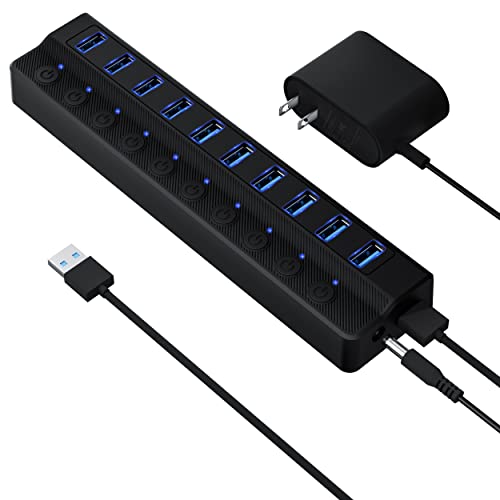
Top 3 picks at a glance
The Short Answer
How much power output you need for a USB hub depends entirely on the types of devices you plan to connect. If you only need to plug in low-power peripherals like a wired mouse, a keyboard, and a standard USB flash drive, an unpowered (bus-powered) USB hub is sufficient. These hubs draw their power directly from your computer’s port, providing a modest 4.5 to 7.5 Watts of shared power across all ports.
However, if you are connecting power-hungry devices—such as external desktop hard drives, webcams, audio interfaces, or if you want to charge your phone and tablet—you must use a powered (self-powered) USB hub with an external wall adapter. For these setups, look for a hub that delivers a minimum of 15 to 30 Watts of dedicated power for a 4-to-7-port setup, and 36 to 60 Watts for a heavy-duty 10-port setup. This ensures each port receives its native power allocation without causing device dropouts.
Standard Sizes
When planning your desk layout, you must consider both the physical footprint of the hub and its power capacity. High-output hubs require larger internal circuit boards and bulkier external power adapters (often called “power bricks”) which must be tucked away in your desk’s cable management tray.
The table below outlines the standard physical dimensions, power outputs, and typical price ranges for the most common USB hub sizes on the market today:
| Hub Category & Port Count | Physical Dimensions (Inches) | Physical Dimensions (cm) | Power Output Range (Watts) | Average Weight (oz / g) | Price Range (USD) |
|---|---|---|---|---|---|
| Ultra-Compact Unpowered (4 Ports, e.g., Acer style) |
3.8″ L x 1.2″ W x 0.4″ H | 9.6 x 3.0 x 1.0 cm | 4.5W – 7.5W (shared) | 1.5 oz / 42 g | around $8 – around $15 |
| Compact Powered (4 Ports, e.g., Sabrent style) |
3.4″ L x 1.4″ W x 0.6″ H | 8.6 x 3.5 x 1.5 cm | 10W – 15W (dedicated) | 1.6 oz / 45 g (hub only) | around $15 – around $25 |
| Mid-Size Powered (7-9 Ports, e.g., TP-Link style) |
6.5″ L x 2.6″ W x 0.7″ H | 16.5 x 6.6 x 1.8 cm | 24W – 48W (dedicated) | 5.1 oz / 145 g (hub only) | around $25 – around $45 |
| High-Capacity Powered (10+ Ports, e.g., ONFINIO style) |
7.5″ L x 2.1″ W x 1.0″ H | 19.0 x 5.3 x 2.5 cm | 36W – 60W (dedicated) | 7.2 oz / 204 g (hub only) | around $18 – around $40 |
How to Measure Your Space
Integrating technology seamlessly into your home furniture requires precise physical planning. Follow these steps to measure your desk space and power capacity before purchasing a USB hub:
- Calculate Your Device Power Load: Add up the power requirements of the devices you plan to plug in simultaneously. A standard USB 3.0 hard drive needs about 4.5 Watts (900mA at 5V). A smart-charging phone needs 10 to 12 Watts. If your total exceeds 7.5 Watts, cross unpowered hubs off your list; you need a powered hub.
- Measure the Desk Footprint: Clear a spot on your desk near your laptop or computer tower. Measure the width and depth of this zone. A 4-port hub takes up less than 4 inches of linear space, while a 10-port hub requires at least 8 inches of flat space to allow cables to bend naturally without straining.
- Account for Cable Clearance: Do not just measure the hub itself. Add at least 2 inches (5 cm) of clearance to the front and back of the hub to accommodate the stiff plastic collars of your USB cables. If the ports are positioned on top of the hub, ensure you have vertical clearance if the hub sits on a keyboard tray or shelf.
- Measure Your Under-Desk Cable Tray: Powered hubs require an external AC power adapter. These power bricks can measure up to 3″ x 2″ x 1.5″ (7.6 x 5.0 x 3.8 cm). Ensure your under-desk cable organizer or power strip has enough physical space to house this brick without blocking adjacent outlets.
By Room or Use Case
The ideal balance of power output and physical footprint changes depending on how and where you work. Here is how to choose a hub for different home environments:
The Minimalist Home Office Desk
If your daily work consists of typing documents, checking emails, and occasional video calls, your desk should remain as clean and cable-free as possible. For this setup, a compact 4-port unpowered hub is ideal. It easily tucks behind a laptop riser or mounts to the side of your desk monitor using double-sided mounting tape. Because it draws its 4.5W to 5W of power directly from your computer’s USB port, you don’t have to worry about hiding an extra power brick or running cords down to the floor.
The Creative Studio & Editing Suite
Photographers, videographers, and music producers deal with high-volume data transfers and power-heavy peripherals. Running multiple external solid-state drives (SSDs), audio interfaces, and memory card readers simultaneously requires a robust, self-powered 7-to-10-port hub with at least 36 to 48 Watts of dedicated power output. As we design high-efficiency creative spaces looking toward 2026, mounting these heavier, metal-housed hubs directly underneath the desktop using screw-in brackets keeps the workspace clean while preventing heavy cables from dragging the hub off the desk.
The Multi-Device Charging Station
If your desk doubles as a charging hub for your household’s smartphones, tablets, smartwatches, and wireless headphones, look for a hub with dedicated smart-charging ports. These ports bypass data transfer to focus entirely on power delivery, often supplying up to 2.4 Amps (12 Watts) per port. A larger, weighted mid-size powered hub (offering 40W to 60W of total output) is best suited here, preventing the hub from sliding around when you plug and unplug devices throughout the day.
Common Sizing Mistakes
- Forgetting the “Power Brick” Factor: Many buyers choose a sleek, tiny powered hub online, only to be shocked when it arrives with a massive, heavy wall adapter that ruins their minimalist desk aesthetic. Always check the size of the power adapter in the product specifications.
- Underestimating Cable Lengths: Many compact hubs come with permanently attached host cables that are only 6 to 12 inches long. If you use a standing desk or have your PC tower sitting on the floor, these short cables will leave the hub dangling in mid-air, straining your computer’s ports. Look for hubs with detachable host cables or at least 2 to 3 feet of cord length.
- Crowding the Port Spacing: If you use thick, rugged USB flash drives or wide security keys, standard port spacing (often only 0.2 inches apart) will prevent you from using adjacent ports. Choose a hub with slightly wider spacing or ports angled at 45 degrees to maximize usability.
- Using Unpowered Hubs for External HDDs: Trying to run two external spinning hard drives on a single unpowered hub is a recipe for data corruption. When the drives spin up, they draw more current than the computer port can supply, causing the drives to repeatedly mount and unmount.
FAQ
What is the difference between a powered and unpowered USB hub?
An unpowered (or bus-powered) hub plugs directly into your computer and splits the computer’s existing port power (usually 4.5W to 7.5W) among its ports. A powered (or self-powered) hub plugs into a wall outlet, drawing its own electricity to provide dedicated, stable wattage to every connected device, regardless of how much power your computer’s port can output.
How many watts do I need to charge a laptop through a USB hub?
To charge a laptop through a USB hub or docking station, you need a hub that supports USB-C Power Delivery (PD) with a minimum output of 45 Watts for ultraportable laptops, and 60 to 100 Watts for larger professional workstations. Standard USB-A hubs cannot output enough power to charge a laptop.
Can a USB hub damage my computer if the power output is too high?
No. Modern USB hubs and computers are built with smart circuitry that negotiates power delivery. Devices only draw the specific amount of current (Amps) they need. A high-wattage powered hub (such as a 60W unit) will not push excess power into your computer or peripherals; it simply offers a larger “reservoir” of available power for devices to draw from safely.
How much desk space should I allocate for a 10-port powered USB hub?
You should allocate a flat, stable desk area of at least 10 inches wide by 6 inches deep (25 cm x 15 cm). While the physical hub itself may only measure 7.5 inches long, you must leave extra breathing room for the thick power input cable on one end, the host computer cable on the other, and the sweep of the 10 USB cables plugging into the face of the unit.