A marine battery has to do two very different jobs, and the label on the case tells you which one it prefers. Starting batteries throw out a burst of cranking power to turn an engine over, while deep-cycle batteries sip power for hours to run a fish finder, bilge pump, lights, or a trolling motor. Dual-purpose models try to split the difference. Buying the wrong type is the single most common reason a boat battery dies early, so the decision this guide addresses is which category your boat actually needs.
The seven options below are all sealed AGM designs that name boats or marine use in their listings, so there is no flooded-cell maintenance and no acid leaking into a bilge. They are written up for 2026 shoppers who run outboards, small fishing boats, pontoons, or RV-boat dual setups. Each comparison sticks to figures that appear in the product titles: amp-hours, cold cranking amps, group size, and use case.
Our Top Picks

Top 3 picks at a glance
Quick Picks
As an Amazon Associate we earn from qualifying purchases at no extra cost to you.


| Product | Best for | Key spec from the title |
|---|---|---|
| Interstate Group 24 70Ah | Small boats needing dual-purpose power | 12V 70Ah, 750CCA, Group 24 AGM |
| OPTIMA D34M BlueTop | Starting plus house loads on one battery | 750 CCA, dual terminal, sealed AGM |
| Newport 50Ah AGM | Kayaks and light deep-cycle duty | 12V 50Ah, deep cycle, for trolling motors |
| Interstate Group 31M 100Ah | Larger house battery needs | 12V 100Ah, 825CCA, Group 31M AGM |
| Interstate Group 31 31-AGM5 | High cranking with big capacity | 100Ah, 925CCA, 1110CA |
| Mighty Max MM-G24M | Dual-purpose use with detailed ratings | 90Ah, 550 CCA, 700 MCA, 145 RC |
| UPLUS Group 24M | Navigation electronics and lights | 79AH, 550CCA, BCI Group 24M |
How to Choose
Starting, deep cycle, or dual purpose
Choose a starting battery if the only job is cranking an outboard and you carry a separate house battery. Pick a deep-cycle if you power electronics, a trolling motor, or lights for hours at a time. A dual-purpose battery fits boats that have room for only one, but it compromises on both ends: its plates are thicker than a starter’s yet thinner than a true deep-cycle. Titles that list both cold cranking amps and amp-hours, like the OPTIMA and UPLUS, are in that middle group.
Read the numbers: Ah, CCA, MCA, RC
Amp-hours measure how long a battery can power a load, so a 100Ah battery has roughly double the stored energy of a 50Ah one. Cold cranking amps show starting strength at freezing temperature, while marine cranking amps are measured at a warmer temperature and read higher on paper. Reserve capacity, shown as RC on the Mighty Max, is the number of minutes the battery can sustain a load before falling below usable voltage. For typical outboards, an engine’s manual lists the minimum cranking amps required, so check it first.
Group size and fit
Group 24 and 24M batteries are shorter and lighter than Group 31 and 31M units, which are noticeably longer and heavier. Measure the battery tray and the box lid before you buy, because a Group 31 will not fit a space made for Group 24. Check the terminal layout too: dual-terminal designs, like the OPTIMA, let you attach both ring terminals and accessory leads.
What to ignore and where budgets cut corners
Ignore the largest CCA number if you do not own a large engine, because it does not translate into longer runtime for electronics. Budget batteries often shave cost by using thinner plates, which lowers cycle life when drained deeply. Avoid discharging any lead-acid battery below about half its capacity on a regular basis, whatever the listing implies, and size the battery bank accordingly. Finally, check that your charger or onboard charging system supports AGM batteries, since the wrong charge profile can shorten life even for a well-built unit.
The 7 Best Options
Interstate Group 24 70Ah
A 12V 70Ah AGM marine and RV battery with 750CCA in a Group 24 case. It suits small to mid-size boats where one battery must start the motor and also carry a modest electronics load. The mix of capacity and cranking power is a sensible midpoint for weekend boaters.
- 750CCA is strong cranking power for a Group 24.
- Marine and RV labeling covers both use cases.
- Trade-off: 70Ah gives less runtime than the 100Ah Group 31 models.
Pontoon owners and fishermen who rarely run more than a sonar unit and a couple of lights are the natural fit, because the battery rarely needs to be drained deeply. Skip it if you run a large electronics suite or an electric trolling motor for long periods.
OPTIMA D34M BlueTop
A dual-purpose boat and RV sealed AGM battery with 750 CCA and dual terminals, described as high performance and capable of both deep-cycle and starting duty. The dual terminal arrangement is a convenience for boats with extra accessories hooked to the battery.
- 750 CCA supports starting duty on engines that need strong cranking.
- Dual terminals simplify accessory wiring.
- Trade-off: the title does not state an amp-hour figure, so runtime is harder to estimate.
Boat-and-RV households that want one battery chemistry across both vehicles will also appreciate the dual labeling. Skip it if you need a published capacity figure to size a battery bank.
Newport 50Ah AGM
A 12V 50Ah deep-cycle AGM marine battery described as rechargeable and sealed lead acid, aimed at trolling motors, kayaks, and small boats. It is a light-duty, compact option for anglers who need steady low-power runtime instead of cranking strength.
- Deep-cycle design suits long, low-draw loads.
- Kayak and small-boat positioning points to a compact build.
- Trade-off: 50Ah is the smallest capacity in the group.
Paddle anglers who carry the battery from a car to the water will care about handling, so confirm the weight and dimensions with the seller before buying. Skip it if you need to start an outboard, as the title does not list cranking amps.
Interstate Group 31M 100Ah
A 12V 100Ah AGM marine and RV battery with 825CCA in Group 31M. It pairs larger capacity with healthy cranking power, which is useful for boats that run a fish finder, livewell pump, and lights from the same battery that starts the engine.
- 100Ah is the top capacity among the listings here, shared with the 31-AGM5.
- 825CCA provides stout cranking power.
- Trade-off: Group 31M is a larger, heavier case than Group 24.
Bass boats and larger runabouts are the typical home for this size, where the battery box was designed around the longer Group 31 footprint from the start. Skip it if your battery box is sized for Group 24.
Interstate Group 31 31-AGM5
A 12V 100Ah AGM marine and RV battery rated 925CCA and 1110CA in Group 31, identified as the 31-AGM5 model. The extra cranking numbers make it the choice for larger engines or cold-weather starting, with the same capacity as its Group 31M sibling.
- 925CCA is the highest cranking figure in the roundup.
- 100Ah gives generous electrical capacity.
- Trade-off: the larger Group 31 case needs space and is heavy.
Anglers who launch early in spring or late in fall, when mornings are cold and engines turn over slowly, benefit most from the added headroom. Skip it if you do not need the extra cranking power, because the 825CCA model offers the same capacity.
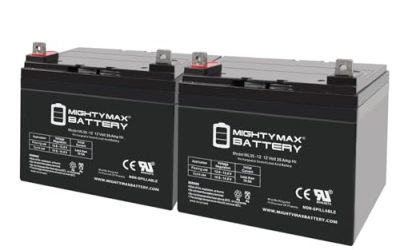
Mighty Max MM-G24M
A 12V 90Ah Group 24M deep-cycle marine AGM described as dual-purpose, with 550 CCA, 700 MCA, 145 RC, and a spill-proof design. It is the most transparent in listing its ratings, which helps you compare it against an engine manual’s requirements.
- Lists cold cranking, marine cranking, and reserve capacity figures.
- 90Ah in a Group 24M case is high for that size.
- Trade-off: 550 CCA is lower than the 750CCA options.
The spill-proof wording also matters on boats that rock at a dock or get trailered over rough ramps. Skip it if your motor needs more than 550 CCA to start reliably.
UPLUS Group 24M
A BCI Group 24M dual-purpose AGM marine battery at 12V 79AH and 550CCA, built for starting and deep-cycle duty on RVs and boats, and mentioned for navigation devices and lights. It targets owners who run electronics from the same battery that starts the engine.
- Dual-purpose rating covers starting and house loads.
- Specifically mentions navigation devices and lights.
- Trade-off: 79AH and 550CCA sit below the larger Group 31 options.
Owners of mid-size boats and weekend RV campers who split one battery between a boat and a trailer will see the point of the dual use. Skip it if your engine or electronics load needs more capacity.
Which One Fits Your Situation
You run a small outboard and a few electronics
The Interstate Group 24 70Ah offers 750CCA and enough capacity for a modest setup, while the UPLUS Group 24M is a lighter alternative for navigation devices and lights. Both fit a Group 24 tray, so a swap needs no new battery box.
You fish with an electric trolling motor
The Newport 50Ah AGM is aimed squarely at trolling motors and kayaks, though anyone running longer sessions should consider a 100Ah model. Remember that a trolling-motor battery is usually separate from the engine’s starting battery, so this pick does not replace a cranking unit.
You have a bigger boat with heavy accessories
The Interstate Group 31M 100Ah or the 31-AGM5 are the stronger picks, and the 31-AGM5 fits when cold starting is a priority.
You want a single battery that does everything
The OPTIMA D34M BlueTop and the Mighty Max MM-G24M are both dual-purpose, with the Mighty Max offering more fully listed ratings.
Common Mistakes
- Buying a pure starting battery for a boat that runs electronics for hours.
- Choosing by the highest CCA number even though runtime depends on amp-hours.
- Ignoring group size and discovering the battery does not fit the tray.
- Draining a lead-acid battery to empty regularly, which shortens its life.
- Skipping a check of the engine manual for its minimum cranking amps.
Related guides
- What Is The Best Budget Most Responsive Gaming Mouse Wired
- Low Latency Gaming Headphones Usb-C 2.4 Ghz Wireless
- Mechanical Gaming Keyboards Competitive Pc Gaming
Frequently Asked Questions
What is the difference between CCA and MCA?
CCA is measured at a freezing temperature and MCA at a warmer one, so MCA numbers run higher for the same battery. Use CCA when comparing batteries in cold climates.
Can I use a dual-purpose battery for a trolling motor?
You can, but a dedicated deep-cycle usually tolerates repeated deep discharges better. Dual-purpose models are best for boats that start the engine and run lighter electronics.
Why choose AGM over a flooded battery?
AGM batteries are sealed, spill-resistant, and generally maintenance-free, which suits the vibration and tilt of a boat. The trade-off is a higher purchase cost than flooded types.
How many amp-hours do I need?
Add up your electronics, estimate the hours of use, and keep the draw within roughly half of the battery’s rated capacity. Larger loads and longer days point toward 90 to 100Ah. As an example, a fish finder and a few lights running through a full day may fit comfortably in a 70Ah battery, while adding a livewell pump and a trolling motor changes the math quickly.