A car, boat, or camper that sits for weeks loses charge slowly, and a 12V lead-acid battery that stays partly discharged ages faster than one that stays topped up. A solar trickle charger solves this without an outlet: the panel sits on a dashboard or hangs from a window, and a small controller feeds a gentle current to the battery. The decision behind this keyword is not “how much solar can I buy” but “how little panel keeps my battery healthy without overcharging it.”
This guide is for owners of vehicles that rarely move: weekend boats, classic cars, trailers, RVs, and seasonal equipment parked far from power. Every pick below is a 12V solar maintainer kit, and the notes focus on wattage, controller type, waterproof rating, and how the kit connects to the battery. As 2026 begins, the main split is simple: lower-wattage kits for pure maintenance, and 12W to 20W kits with MPPT controllers for bigger batteries or weaker sun.
Our Top Picks
Top 3 picks at a glance
Quick Picks
As an Amazon Associate we earn from qualifying purchases at no extra cost to you.


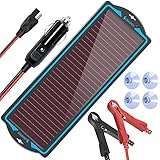


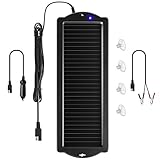
| Product | Best for | Key spec from the title |
|---|---|---|
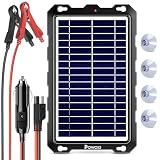
| POWOXI 7.5W Kit | Car and boat maintenance on a simple setup | 7.5W, 12V, smart charge controller, waterproof |
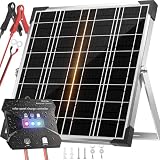
| Voltset 20W Kit | Larger batteries and RVs | 20W, 12V, smart controller, safety protections |
| Generic 7.5W IP68 Kit | Outdoor-parked vehicles in wet climates | 7.5W, IP68 waterproof |
| SUNER POWER 12W Pro | Mid-size batteries with a smarter controller | 12W, built-in MPPT controller |
| SUNAPEX 12V Kit | Portable use on a car dashboard | Overcharge prevention, waterproof portable panel |
| Generic 20W MPPT Kit | RVs and trailers needing more output | 20W, MPPT, 8 protection functions, IP68 |
| Marsrut 5W Portable | Light maintenance and small batteries | 5W, USB connector, suction cups, IP65 |
| Sunway Cigarette Plug Kit | Cars with an always-on lighter socket | Cigarette lighter plug plus battery clamp |
How to Choose
Match wattage to the battery, not to your ambition
Maintenance only needs to cancel the slow self-discharge of a healthy battery. For a car or motorcycle battery, 5W to 7.5W is typically enough in decent sun. Boats, RVs, and trailers with larger or deeper-cycle batteries, or vehicles parked in shade, are better served by 12W to 20W. A bigger panel will not harm a battery that sits behind a proper controller, but it adds cost and bulk you may not need. A quick sanity check: a battery that sat unused for a month and still starts the engine only needs the panel to cover tiny losses, while a battery running an alarm, a tracker, or a bilge pump draws more and deserves the larger panels.
Controller type: PWM versus MPPT
Every kit here lists some form of smart controller. MPPT controllers, named in the SUNER POWER and the 20W generic kit, extract more usable power from the panel across changing light. A basic controller still protects against overcharge, which is the feature that matters most for a kit left connected for months. Look for reverse-polarity, short-circuit, and overcharge protection in the title or description. A controller that also lists over-discharge or temperature protection is a bonus, since a parked vehicle sees hot afternoons and freezing nights.
Waterproofing and mounting
IP65 means protection against water jets; IP68 means the enclosure is rated for continuous immersion under specified conditions. For a boat deck or a trailer roof, IP68 is the safer reading. For a windshield or dash, the suction cups on the Marsrut kit matter more than the rating, because the panel never sees rain. Also check cable length: a short lead forces the panel into a poor position, and a panel that cannot face the sun for most of the day wastes its rated wattage.
Connection method and what to ignore
Battery clamps or ring terminals suit permanent setups; a cigarette lighter plug suits a car whose socket stays powered with the ignition off, which many modern cars do not allow. Ignore flashy sales claims about “fast” charging, since a trickle charger is slow by design. Budget kits cut corners on cable gauge, connector quality, and panel durability, so favor listings that name specific protections. Also remember that the wattage on the box is a peak figure under ideal sun; real daily output is a fraction of it, which is why a modest margin above your minimum is sensible.
The 8 Best Options
POWOXI 7.5W Solar Maintainer
The POWOXI is a straightforward 12V kit with a smart charge controller, waterproof construction, and intelligent safety protections. It is aimed at cars, boats, and similar vehicles that need light, steady upkeep rather than real charging power.
- Strength: the smart controller and listed safety protections suit a connect-and-forget routine.
- Strength: 7.5W sits in the sweet spot for maintaining a typical car battery.
- Trade-off: the title does not name MPPT, so output in weak light may be modest.
Skip it if you own a large house battery bank or park permanently in deep shade.
Voltset 20W Solar Maintainer
Voltset steps up to 20W while keeping the same smart controller, waterproof design, and safety protections. That extra output makes sense for RVs, marine batteries, and trailers where a small panel might struggle to keep up.
- Strength: 20W gives headroom on overcast days or with larger batteries.
- Strength: the listing names safety protections alongside the controller.
- Trade-off: a larger panel is harder to hide on a dashboard and needs a proper mounting spot.
Skip it if you only need to keep a small motorcycle battery alive on a garage shelf.
Generic 7.5W IP68 Solar Kit
This unbranded kit pairs 7.5W with an IP68 waterproof rating and safety protections, plus a smart charge controller. It targets cars, boats, RVs, and trailers that live outside year-round.
- Strength: IP68 is the highest water-resistance claim in the 7.5W group.
- Strength: the same 7.5W output as the POWOXI at a similar maintenance level.
- Trade-off: with no brand name in the title, support and long-term durability are harder to judge.
Skip it if you want a recognizable manufacturer behind the warranty, or if the vehicle is parked indoors where waterproofing adds nothing.
SUNER POWER 12W Pro
The SUNER POWER Pro offers 12W and a built-in MPPT charge controller, which is the main differentiator in this lineup. It is a middle path between the 7.5W kits and the 20W options.
- Strength: MPPT control is designed to squeeze more from variable sunlight.
- Strength: 12W suits mid-size batteries without being oversized.
- Trade-off: the title lists fewer protection details than some competitors.
Skip it if your battery is tiny and a 5W panel would cover it comfortably, or if you want a longer list of protections in the listing.
SUNAPEX 12V Solar Maintainer
SUNAPEX emphasizes preventing overcharging through a smart controller and sells the kit as a waterproof, portable solar panel. It is meant for car owners who want a simple dashboard-style setup.
- Strength: overcharge prevention is the headline feature, which is the right priority for long storage.
- Strength: portable and waterproof, so it moves between vehicles.
- Trade-off: the listing does not state wattage, so buyers must confirm output on the product page.
Skip it if you need a published wattage before comparing against other kits.
Generic 20W MPPT Solar Kit
This 20W kit combines an MPPT charge controller with eight protection functions and IP68 waterproofing. On paper it has the strongest spec sheet in the group for big-battery use.
- Strength: 20W plus MPPT is the most output-focused combination listed.
- Strength: eight protection functions and IP68 suit harsh outdoor parking.
- Trade-off: no brand in the title means less certainty about quality control.
Skip it if a compact panel for a small car battery is all you need.
Marsrut 5W Portable Solar Charger
Marsrut is the smallest panel here at 5W, with a USB connector, suction cups, and an IP65 waterproof rating. It is built for gentle maintenance and flexible placement on glass.
- Strength: suction cups make window or windshield mounting quick.
- Strength: the USB connector adds flexibility beyond a battery clamp.
- Trade-off: 5W gives little margin for cloudy weather or larger batteries.
Skip it if you have a boat or RV battery that needs real input.
Sunway Solar Car Battery Maintainer
Sunway ships with both a cigarette lighter plug and a battery clamp, giving two ways to connect. It is pitched at cars and automotive use where a lighter socket is available.
- Strength: two connection options let you pick the one that fits your vehicle.
- Strength: the lighter plug avoids opening the hood for quick top-ups.
- Trade-off: many cars cut power to the lighter socket when off, which defeats that connection.
Skip it if your vehicle’s socket shuts off with the ignition.
Which One Fits Your Situation
You store a boat on a mooring or trailer
The Generic 20W MPPT Kit or the Voltset 20W gives the output and weather resistance a marine battery usually needs. If you want the stronger spec sheet, pick the 20W MPPT; if a named brand matters, pick Voltset.
You park a daily driver for a two-week trip
The POWOXI 7.5W is enough to offset self-discharge on a normal car battery. Place it on the dashboard with a clear view of the sky and let the controller handle the rest. If you park in a covered garage, the generic IP68 kit with a long lead could be run to a window instead.
You want a no-tools dashboard setup
The Marsrut 5W with suction cups mounts on glass in seconds. It works best on a small battery in a vehicle that sees at least some daily sunlight.
Your RV spends winter in uneven light
The SUNER POWER 12W Pro, with MPPT, is a reasonable middle option when light changes through the day and a full 20W panel would be overkill. Mount it on the south-facing side of the roof or a window and angle it toward the winter sun, which sits lower in the sky.
Common Mistakes
- Buying a huge panel for a small battery when 5W to 7.5W would suffice.
- Choosing a cigarette lighter kit without confirming the socket stays powered when the car is off.
- Placing the panel behind tinted glass, which cuts output noticeably.
- Ignoring the controller and relying on a bare panel that has no overcharge protection.
- Assuming an IP65 panel is suitable for submersion or constant spray on a boat deck.
Related guides
- What Is The Best Budget Most Responsive Gaming Mouse Wired
- Low Latency Gaming Headphones Usb-C 2.4 Ghz Wireless
- Low Latency Gaming Headphones Usb-C Dongle 2.4 Ghz
Frequently Asked Questions
Can a solar trickle charger revive a dead battery?
No. These kits are maintainers, built to offset slow discharge. A deeply drained battery needs a proper plug-in charger first, and then the solar kit can hold it at full.
Is MPPT worth it on a small panel?
It helps more as wattage and battery size grow. On a 5W to 7.5W kit, a basic smart controller with overcharge protection is usually enough, while 12W and 20W kits benefit more from MPPT.
Can I leave the kit connected all the time?
Kits with an overcharge-preventing controller are designed for continuous connection. Check that the listing names that protection before leaving it for months.
Does cloud cover stop the charging?
Output drops but does not stop entirely in bright overcast conditions. Heavy shade or snow cover on the panel can bring it to near zero, so brush the panel clear when you can.