When the grid goes down, an emergency solar charger has one job: keep a phone alive long enough to receive alerts, call for help, and share a location. That narrows the decision more than the product category suggests. A device that looks great on a camping trip may be a poor emergency tool if it needs hours of direct sun, lacks a flashlight, or cannot tell you the weather. The useful comparison is between stored capacity you can rely on right now and the ability to top up when the stored energy runs out.
This guide is for households building a go-bag, outdoor hikers who want a backup, and anyone preparing for storm season. The models below mix large-capacity solar power banks, one hand-crank version, and one emergency weather radio with a solar panel. They are judged only from the facts their listings state, so no battery-life promises are made beyond the capacities shown. As of 2026 the market is crowded with near-identical 20000 to 50000 mAh banks, which makes the differences in extras, cables, and charging methods the real way to choose.
Our Top Picks
 FEELLE Solar Power Bank 50000mAh Magnetic Portable Charger7.24 x 3.54 x 1.97 inches1.1 poundsCheck on Amazon
 SOARAISE Solar Power Bank 48000mAh Wireless Portable Charger6.38 x 3.43 x 1.57 inchesCheck on Amazon



Top 3 picks at a glance
Quick Picks
As an Amazon Associate we earn from qualifying purchases at no extra cost to you.




| Product | Best for | Key spec from the title |
|---|---|---|
| FEELLE 50000mAh Hand Crank Bank | Last-resort charging without sun | 50000mAh, hand crank, magnetic |
| BLAVOR 10000mAh Solar Bank | Light go-bag backup | 10,000mAh, 20W USB-C, IPX5, 2 flashlights |
| SOARAISE 48000mAh Solar Bank | Family and multi-device use | 48000mAh, 4 cables, PD QC 3.0 |
| YELOMIN 38800mAh Solar Bank | Fast USB-C charging | 38800mAh, USB-C fast charging, dual LED flashlight |
| BLAVOR 20000mAh Solar Bank | Phones and Apple Watch | 20000mAh, 4 built-in cables, 20W USB-C |
| Emergency Weather Radio | Storm alerts plus charging | 12000mAh, AM/FM/NOAA, hand crank, SOS alarm |
How to Choose
Capacity and what it really means
Capacity is quoted in mAh, but what matters is how many phone charges that represents. A typical phone battery is around 4000 to 5000 mAh, and conversion losses mean a 10000 mAh bank delivers roughly one and a half to two full charges. A 20000 mAh bank gives several days of basic use, and 40000 mAh or more suits a family. Bigger banks weigh more and take much longer to refill, so choose capacity based on how many people depend on it and how long you expect to be without power.
Solar panel realism
A built-in panel on a power bank adds a trickle, not a charge. Direct sun for many hours may add only a fraction of a phone battery, so treat solar as an emergency top-up and charge the bank from a wall outlet before storms. Models with several foldout panels collect more than a single small panel but still trail a dedicated foldable solar panel. Be wary of any claim that a solar bank can fully recharge itself in a day.
Output ports and charging speed
Look for USB-C with Power Delivery or a stated wattage, such as 20W or 22.5W, if you want modern phones to charge quickly. Built-in cables are handy in a crisis because they cannot be forgotten, but confirm they include the connector types you use. Wireless charging is convenient but slower and wastes energy, so treat it as a bonus. Multiple output ports help when a family needs to share one bank.
Emergency extras and what to ignore
Flashlights, an SOS alarm, and a weather band are more valuable in a blackout than a decorative design. A hand crank adds an energy source that works at night, though it is slow and tiring. Ignore giant capacity numbers from unknown sources without port details, and check for splash protection such as an IPX5 class if you expect rain. Water-resistant does not mean submersible, and a lanyard loop or hook is a small feature that matters when you hang the unit as a lamp.
The 6 Best Options
FEELLE 50000mAh Hand Crank Bank
The FEELLE stands out for pairing a huge 50000mAh capacity with a hand crank, giving a way to add a little energy when there is no sun and no outlet. It is a magnetic portable charger, so the magnet may help it attach to compatible phones or surfaces. For a household that worries about a multi-day outage and wants several layers of backup, the combination of stored capacity and a manual option is the main attraction, even if the crank itself only adds a small amount of energy per minute of effort.
- Strength: Hand crank provides a no-sun backup source.
- Strength: 50000mAh capacity can serve several devices.
- Trade-off: Cranking is slow compared with the size of the battery, so it is a last resort.
Skip it if you want a light go-bag item or a stated fast-charging wattage in the title.
BLAVOR 10000mAh Solar Bank
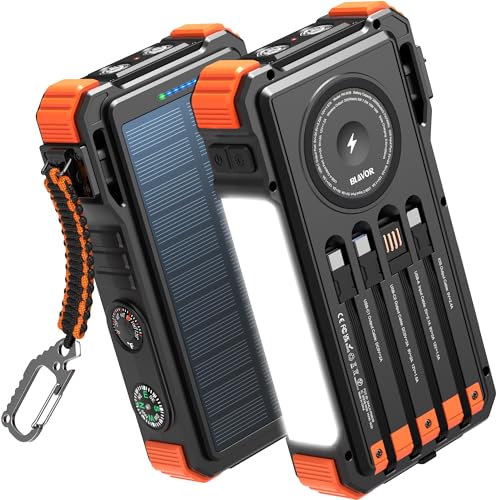
This is the compact option, and its listing shows a 10,000mAh battery, 20W USB-C output, wireless charging, IPX5 waterproofing, and two flashlights. It is the one to throw in a jacket pocket or a small emergency kit, where weight matters more than long autonomy. Commuters, students, and people who keep a small kit in a car can treat it as insurance for a dead phone rather than a power station, and the pair of flashlights make it useful when the lights go out at home.
- Strength: 20W USB-C output fast-charges compatible phones.
- Strength: IPX5 protection and two flashlights suit a storm kit.
- Trade-off: Capacity is the smallest here, so it will not support a family for long.
Skip it if you need to power several devices over multiple days.
SOARAISE 48000mAh Solar Bank
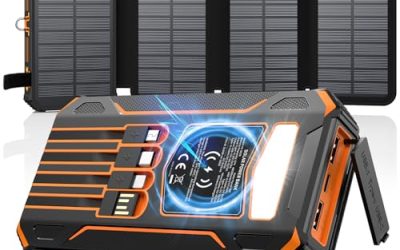
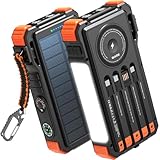
The SOARAISE bundles a massive 48000mAh capacity with four cables, wireless charging, four solar panels, and PD and QC 3.0 fast charging. It reads like a camper and family-kit product, with enough built-in connectors for mixed phones and tablets. The multiple foldout panels aim to collect more light than a single flat surface, though any solar gain on a bank this size will be slow compared with the amount of stored energy, so charging it before an event remains the smarter habit.
- Strength: Four cables mean fewer things to forget.
- Strength: Four panels collect more light than a single small one.
- Trade-off: The large capacity makes it heavy and slow to refill.
Skip it if you only need a pocket-size backup.
YELOMIN 38800mAh Solar Bank
The YELOMIN offers 38800mAh with USB-C fast charging for iPhone and Samsung, a dual LED flashlight, and multiple output options. It sits between the compact and the extra-large models, a reasonable pick for a couple or a small apartment kit. The fast-charging claim matters in an emergency because you may only have a short window of sun or a brief moment to top up before moving on, and the dual lights add basic lantern duty at night.
- Strength: USB-C fast charging, compatible with both iPhone and Samsung.
- Strength: Dual LED flashlight doubles as a lantern in a power cut.
- Trade-off: Shares its basic features with several rivals, so it stands out little.
Skip it if you want a hand crank or radio.
BLAVOR 20000mAh Solar Bank
This BLAVOR targets users who want a mid-size bank with built-in cables. The listing mentions wireless charging for phones and Apple Watch, four built-in cables, 20W USB-C fast charging, and IPX5 protection. The mix of capacity and built-in cables makes it simple to hand to a family member without explaining which adapter goes where, which counts for a lot when people are stressed or working in the dark.
- Strength: Four built-in cables remove the need to carry spares.
- Strength: 20000mAh offers several charges for phones.
- Trade-off: Less capacity than the 38800 and 48000 models.
Skip it if you plan to charge tablets or share among a large family.
Emergency Weather Radio
This one is a different tool: an emergency radio with a large solar panel, a 12000mAh battery, a hand crank, and AM, FM, and NOAA bands. It adds a flashlight, a reading lamp, and an SOS alarm, making it the most storm-ready option. Unlike the plain power banks, it gives information as well as energy, and it keeps working as a lamp for reading or finding a path when the household has no lighting at all.
- Strength: NOAA band delivers weather alerts when cell service fails.
- Strength: Hand crank, solar panel, and SOS alarm cover multiple emergencies.
- Trade-off: It is bulkier than a power bank and not designed for camping weight.
Skip it if phone charging is your only concern.
Which One Fits Your Situation
You live in a storm-prone area
The Emergency Weather Radio is the strongest fit, thanks to its NOAA band, solar panel, and SOS alarm, which cover alerts and light as well as charging.
You need a family go-bag
The SOARAISE 48000mAh Solar Bank has the capacity and cables to cover several phones, so one person can manage the family’s charging. Label the cables and keep the bank near a window if you want to use the panels.
You want a pocket-sized backup
The BLAVOR 10000mAh Solar Bank packs IPX5 protection and two flashlights into a small body, ideal for a jacket or glove box. It is also the easiest to carry on a hike.
You expect to lose power for days
The FEELLE 50000mAh Hand Crank Bank adds an energy source that works at night, which suits a long outage. Keep in mind that cranking is a supplement and that the stored charge does most of the work.
Common Mistakes
- Relying on the solar panel as the main way to recharge instead of filling the bank in advance.
- Buying on mAh alone without checking output ports and wattage, which leaves a huge battery that charges a phone slowly.
- Skipping a periodic check, so the bank sits empty when the storm hits.
- Assuming water resistance means the unit can be dunked or left in rain for days.
- Forgetting that large banks add weight and are awkward to carry on foot, so the heaviest option may stay at home when you need it most.
Related guides
- What Is The Best Budget Most Responsive Gaming Mouse Wired
- Low Latency Gaming Headphones Usb-C 2.4 Ghz Wireless
- Low Latency Gaming Headphones Usb-C Dongle 2.4 Ghz
Frequently Asked Questions
How often should I recharge an emergency power bank?
Top it up every few months, and mark the date on a piece of tape. Lithium batteries slowly lose charge in storage, so a bank in a drawer may be half empty when you need it.
Is wireless charging worth using?
Only when convenient. It is slower and wastes more energy than a cable, so use cables when capacity is limited and keep wireless pads for situations where a cable is missing or broken.
Can solar panels on a power bank keep a phone alive?
They can add a small top-up in strong sun. They are not a replacement for a full charge beforehand, and clouds or a window will cut the gain further.
Why consider a weather radio?
Cell networks can fail in a major storm. A NOAA-capable radio gives alerts without any network, and a hand crank or solar panel keeps it running.