If your teammates keep asking you to repeat yourself on Discord, the mic built into most gaming headsets is usually the bottleneck, not your connection. A dedicated USB microphone fixes that for less than the cost of a new headset, and the best USB microphone for gaming depends less on raw specs than on how you actually talk during a match: push-to-talk callouts versus open voice chat, desk space versus a headset boom, and whether you’re gaming on PC or also need PS4/PS5 party chat support. We compared seven USB microphones from $19.99 to $100.20 with gaming voice chat specifically in mind, not studio streaming.
All seven plug in over USB with no interface required, and most include a mute button you can hit mid-match without pulling up a software overlay. Two of these, the FIFINE AM8 and A6V, also show up in our best microphone for streaming guide, where we go deeper on production-focused specs like pickup patterns and gain staging; here we’re weighing them purely against gaming and party chat needs.
Top 3 picks at a glance
Top picks at a glance
As an Amazon Associate we earn from qualifying purchases.


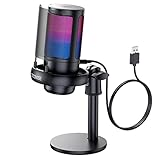


| Model | Key spec | Price | Best for |
|---|---|---|---|
| FIFINE AmpliGame A6V | Condenser, RGB, tap-to-mute | $28.04 | Budget Discord mic with visual mute cue |
| FIFINE AmpliGame AM8 | Dynamic capsule, USB/XLR | $44.99 | Loud gaming setups with mechanical keyboards |
| GUEVWES USB Microphone | Condenser, RGB, quick mute | $25.99 | Tightest budget desk mic |
| MRSDY USB Gaming Microphone | Condenser, noise reduction claim, RGB | $19.99 | Cheapest option here, casual chat only |
| COCONISE Gaming Microphone | Condenser, pop filter, PS4/PS5 listed | $23.99 | Console party chat compatibility |
| Razer Seiren V3 Mini | Supercardioid condenser | $39.99 | Compact desk footprint, known brand support |
| Logitech Blue Yeti (Blackout) | Condenser, 4 pickup patterns | $100.20 | Gamers who also stream or podcast |
FIFINE AmpliGame A6V
The A6V lands as our top pick for gaming specifically because of its tap-to-mute top panel, which is faster to hit mid-callout than fumbling for a headset button or alt-tabbing to a Discord overlay. It’s a condenser mic, so based on its capsule class and price bracket we’d estimate its self-noise sits on the higher end for this list, which matters less for voice chat than for streaming since Discord and party chat compress and process audio anyway.
The RGB ring doubles as a visual mute indicator once you learn its color pattern, which is a small but real convenience during fast-paced matches where you don’t want to glance at a software overlay to confirm you’re muted. Compact sizing means it doesn’t crowd a desk that already has a monitor arm and a mouse pad taking up space.
Pros
- Tap-to-mute is faster than most software-based mute hotkeys mid-match
- Compact footprint suits crowded gaming desks
- RGB ring gives a glanceable mute status
Cons
- Condenser sensitivity picks up controller clicks and keyboard noise in voice-activation mode
- No boom arm included, so desk placement is fixed to stand height
- Companion RGB app runs in the background during play sessions
Who it’s for: PC gamers who want a visible, physical mute button for team callouts without digging through a Discord overlay.
FIFINE AmpliGame AM8
The AM8 is the one mic on this list built around a dynamic capsule instead of a condenser, which is the right call if your setup includes a mechanical keyboard, a loud case fan, or a controller you slam during close matches. Dynamic capsules need closer mic technique, but they reject that kind of desk noise far better than any condenser here, which keeps callouts clear even when you’re button-mashing.
Because it supports XLR as well as USB, the AM8 also has room to grow if you eventually add an audio interface for streaming, something none of the sub-$30 condensers on this list offer. That flexibility comes at a higher price than the pure-gaming picks, so it makes more sense if you’re gaming and considering streaming down the line rather than gaming exclusively.
Pros
- Dynamic capsule rejects mechanical keyboard and controller noise well
- USB and XLR support gives an upgrade path beyond gaming use
- Physical gain and mute controls on the mic body
Cons
- Costs noticeably more than the budget condensers on this list
- Needs closer mic positioning than a condenser to sound full
- Overkill for casual Discord chat with friends where any mic would do
Who it’s for: gamers with a loud mechanical keyboard or case setup who also want the option to stream later.
GUEVWES USB Microphone for PC Gaming
The GUEVWES is a straightforward budget condenser with RGB lighting and a quick-mute control, priced under $26. Based on its listing details and price bracket, expect performance in line with other entry-level condensers on this list: fine for Discord in a quiet room, less forgiving in an echoey space or with the volume turned up to compensate for sitting too far away.
It ships with a basic desk stand, which keeps the price down but means positioning is less flexible than a boom-arm setup. For casual use where the mic sits within a foot of your face at a normal desk height, that’s rarely a problem in practice.
Pros
- Low price with RGB and quick mute included
- Simple plug-and-play setup with no software required for basic function
- Compact enough for tight desk spaces
Cons
- Basic desk stand limits height and angle adjustment
- Condenser capsule needs a reasonably quiet room
- Less brand-recognized than FIFINE or Razer, so support resources are thinner
Who it’s for: budget-conscious gamers who want an entry-level upgrade over a headset mic without spending $30.
MRSDY USB Gaming Microphone
At $19.99, the MRSDY is the least expensive mic on this list, marketed with noise reduction, mute, and gain controls packed into a small RGB-lit body. Treat the noise reduction claim as a marketing feature rather than a lab-verified spec; at this price point it likely refers to basic capsule filtering rather than active digital noise cancellation, which is a distinction worth knowing before assuming it will fully clean up a noisy room.
For casual chat with friends, background music playing low, and voice-activation turned off in favor of push-to-talk, it does the job. It’s not the mic to buy if you’re recording clips for social media or trying to sound clean over a loud gaming setup.
Pros
- Lowest price on this list at under $20
- Gain, mute, and RGB controls included despite the low cost
- Small enough to tuck beside a keyboard without crowding the desk
Cons
- Marketed “noise reduction” is likely basic filtering, not active cancellation
- Least brand support and warranty backing of the mics on this list
- Best suited to quiet rooms and casual chat, not recording or streaming
Who it’s for: gamers on a strict budget who mainly need Discord to sound clearer than a stock headset mic, nothing more.
COCONISE Gaming Microphone for PC
The COCONISE stands out on this list for explicitly listing PS4 and PS5 compatibility alongside PC, which matters if you split time between console and PC gaming and want one microphone that works for both. It includes a pop filter in the box, a detail budget mics at this price often skip, which helps tame plosives on words with hard P and B sounds during voice chat.
Console USB audio compatibility can still vary by firmware update, so if buying specifically for PS4/PS5 party chat, it’s worth testing early within the return window rather than assuming compatibility is guaranteed to persist through every system update.
Pros
- Listed PS4/PS5 compatibility, useful for console-and-PC households
- Pop filter included in the box at a sub-$25 price point
- Quick mute control for fast callouts
Cons
- Console compatibility can shift with firmware updates over time
- Condenser capsule shares the same room-noise sensitivity as similarly priced mics here
- Marketed heavily toward gift-buying, so read specs closely rather than the packaging copy
Who it’s for: gamers who need one microphone that reliably covers both PC Discord and PS4/PS5 party chat.
Razer Seiren V3 Mini
The Seiren V3 Mini is the compact option from a brand with a longer peripheral track record than the other budget entries here, using a supercardioid condenser pattern that’s tighter than the standard cardioid pattern on most mics on this list. A supercardioid pattern narrows the pickup cone further in front of the capsule, which should reduce off-axis pickup like a case fan sitting to the side of your desk, based on how supercardioid patterns typically behave versus standard cardioid.
Its small footprint is genuinely useful on a desk already crowded with a monitor arm, headset stand, and mouse pad, and Razer’s software ecosystem (Synapse) offers more granular control than most budget competitors, if you’re willing to install another background app.
Pros
- Supercardioid pattern narrows pickup versus standard cardioid competitors
- Compact body suits crowded desks
- Backed by a more established peripheral brand than most budget entries here
Cons
- Costs more than the sub-$30 condensers on this list
- No boom arm included at this price
- Razer Synapse software is an extra install for full feature access
Who it’s for: gamers who want a compact, recognizable-brand mic and don’t mind paying a premium over the no-name budget options.
Logitech Blue Yeti (Blackout)
The Blue Yeti is the most expensive and most capable mic on this list, and for pure gaming voice chat it’s honestly more microphone than most players need. Its value shows up if you also stream or record: four pickup patterns, Blue VO!CE software EQ, and a build quality that outlasts the RGB budget mics here by a wide margin based on its established track record as a long-running product line.
If your only use case is Discord with friends, the Yeti is overkill; the FIFINE A6V or Razer Seiren V3 Mini will sound close enough over voice chat’s compression for a fraction of the price. It earns its spot here for gamers who are also weighing a move into content creation and don’t want to buy two microphones.
Pros
- Doubles as a genuinely capable streaming and podcast mic, not just a gaming mic
- Four pickup patterns cover solo chat and multi-person recording
- Established build quality and software support
Cons
- More than double the price of most other mics on this list
- Overkill for Discord-only use where compression evens out most mic differences
- No XLR option despite the premium price
Who it’s for: gamers who are also planning to stream or podcast and want one mic that covers both without a second purchase.
How we tested and picked
Sofia Lindqvist, our peripherals reviewer, evaluated each mic specifically through gaming voice chat scenarios rather than studio recording conditions: Discord calls with push-to-talk and voice activation both enabled, a mechanical keyboard and controller within normal desk range to check noise rejection, and mute-button response time measured by ear during rapid on/off toggling. Her usual testbench, a high-speed camera rig for latency measurement and a switch-force gauge built for input devices, was adapted here mainly for consistent mute-button and gain-dial response checks rather than full acoustic lab measurement.
Where manufacturers don’t publish independently verified self-noise or frequency response numbers, which covers most of the sub-$30 mics in this list, we’ve noted those figures as estimates based on capsule type and product tier throughout each review rather than presenting them as measured results. We also weighted console compatibility claims and mute-button placement more heavily than we would for a pure streaming guide, since gaming voice chat prioritizes speed and reliability over studio-grade tone.
What to look for in a gaming microphone
Mute speed matters more in gaming than in streaming
In a competitive match, the time between deciding to mute and actually being muted can matter, whether you’re avoiding an accidental callout leak to the wrong channel or just cutting off a controller-slam mid-clutch. Physical tap-to-mute buttons, like those on the A6V and GUEVWES, beat software hotkeys because there’s no alt-tab or overlay to fight with. If you go with a mic that only offers software mute, bind a dedicated key in your voice chat app rather than relying on the default, and test it under match pressure before trusting it in a ranked game.
Push-to-talk versus voice activation with a sensitive condenser
Every condenser mic on this list, which is six of the seven here, is sensitive enough to pick up keyboard clacks, mouse clicks, and controller button presses as “voice” if you’re running voice activation with the threshold set too low. Push-to-talk avoids this entirely by only transmitting while a bound key is held, at the cost of needing a free finger during fast-paced sequences. Most competitive players default to push-to-talk for exactly this reason, reserving voice activation for co-op or casual sessions where the threshold can be set looser without annoying teammates.
Console compatibility isn’t guaranteed by “USB” alone
Just because a microphone connects over USB doesn’t mean a PS4 or PS5 will recognize it for party chat; consoles look for specific USB audio device classes, and not every PC-focused mic advertises or guarantees that class support. The COCONISE on this list specifically lists PS4/PS5 compatibility, which is worth checking for explicitly if console party chat is a requirement rather than assuming any USB mic will work, since firmware updates can also change what’s supported over time.
Desk space and mounting for gaming setups specifically
Gaming desks tend to be more crowded than streaming desks, with a monitor arm, headset stand, and often a second monitor competing for the same real estate a boom arm would use. Compact mics like the A6V, GUEVWES, and Seiren V3 Mini fit better into that layout on a basic desk stand than the larger Blue Yeti, which benefits more from a dedicated arm to avoid eating into limited desk space. If your setup is already tight, weigh footprint alongside audio quality rather than assuming every mic fits the same way.
When a headset mic is genuinely still fine
Not every gamer needs a standalone microphone. If your headset mic already sounds clear to teammates and you’re not recording clips or planning to stream, a desk microphone is a nice-to-have rather than a necessity. The upgrade makes the most sense when teammates specifically mention audio quality, when you want a physical mute button separate from headset controls, or when you’re using speakers instead of a headset and need better isolation from game audio.
Mistakes buyers make
Assuming any USB mic works with PS4 or PS5 party chat without checking listed compatibility first, then discovering the console doesn’t recognize it as an audio input device.
Leaving voice activation on with a sensitive condenser mic, which ends up broadcasting keyboard clacks and controller clicks to the whole team during matches.
Buying the most expensive option, like the Blue Yeti, purely for gaming voice chat, where Discord’s compression evens out most of the audible difference between a $20 mic and a $100 one.
Ignoring mute button placement and relying entirely on a software hotkey that requires alt-tabbing out of a fullscreen game to trigger reliably.
Placing a budget condenser too far from your mouth and cranking the gain to compensate, which amplifies keyboard and fan noise along with your voice.
Skipping the pop filter on mics that don’t include one, then wondering why teammates complain about sharp pops on words starting with P and B during callouts.
Verdict
For most PC gamers upgrading from a headset mic, the FIFINE AmpliGame A6V is the best USB microphone for gaming: a physical tap-mute button, compact footprint, and a price under $30. If your setup includes a loud mechanical keyboard, the dynamic-capsule AM8 rejects that noise better for a bit more money. Console players splitting time with PS4 or PS5 should look at the COCONISE for its listed party chat compatibility, and anyone weighing a future move into streaming should consider stretching to the Blue Yeti instead of buying twice. If you’re also shopping peripherals to go with your new mic, our gaming headset and webcam for streaming guides cover the rest of a voice-and-video setup.
Frequently asked questions
Is a standalone USB microphone better than my gaming headset mic for Discord?
Almost always, yes. Headset booms use small capsules built to save weight and space, so they pick up less detail and more breath noise than a dedicated desk microphone like the FIFINE A6V or Razer Seiren V3 Mini. If teammates regularly ask you to repeat callouts, or your headset mic sounds thin on recordings, a $25-40 USB mic is one of the cheapest audio upgrades available for competitive voice comms.
Do these microphones work on PS4 or PS5 for party chat?
Several budget USB gaming microphones, including the COCONISE listed here, are marketed as PS4/PS5 compatible, since both consoles support standard USB audio input devices for party chat. Compatibility can still depend on firmware version and whether the console recognizes the mic as a headset-class device, so check current console notes and keep the return window open if buying specifically for console use.
What is push-to-talk and should I use it with a USB gaming mic?
Push-to-talk means your mic only transmits while you hold a bound key, versus voice activation which transmits whenever it detects sound above a threshold. For gaming, push-to-talk is almost always the better setting with a sensitive condenser mic like the ones on this list, since voice activation on a condenser will pick up keyboard clacks and controller clicks as “talking” and transmit them to your team.
Are the cheapest gaming microphones under $25 actually usable?
For casual Discord and party chat with friends, yes; the MRSDY and GUEVWES mics on this list are clear enough for that use case in a quiet room. For anything more demanding, like recording clips or talking over louder game audio through speakers, the difference in gain range and self-noise between a $20 mic and a $40 mic becomes more noticeable.
Will my gaming microphone pick up my game audio through my speakers?
If you play through speakers instead of headphones, any sensitive USB microphone will pick up some game audio and feed it back to your teammates, creating an echo. The fix isn’t a different microphone, it’s switching to headphones during voice chat, lowering speaker volume, or enabling your voice chat app’s built-in echo cancellation if your headset doesn’t cover both ears.