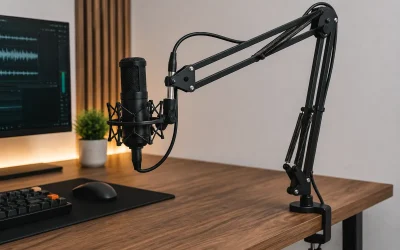
A cheap mic on a plastic stand wobbles every time you lean forward for your keyboard, and it can knock a headphone cable off the desk. A proper boom arm changes not just audio quality but the physical workflow of sitting at a desk for six or eight hours a day. If you are serious about streaming, recording gameplay commentary, or even just being heard clearly in Discord calls, a microphone arm is one of the highest-leverage upgrades you can make for a small step up from a standalone mic.
The problem is that most arms sold under the banner of “gaming” are either flimsy desk clamps that sag within a week or bundles that pair a mediocre mic with an even more mediocre arm. The better ones share a few traits: solid internal spring tension, a clamp that grips without needing a screwdriver, and enough reach to pull the mic in front of your mouth without blocking your screen.
As an Amazon Associate we earn from qualifying purchases at no extra cost to you.

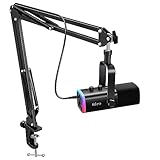
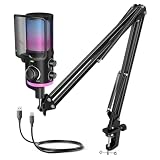


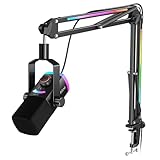


Top 3 picks at a glance
Quick Picks
| Product | Best for | Price |
|---|---|---|
| TONOR TC310+ | Complete beginner setup | Check on Amazon |
| FIFINE AM8T | XLR/USB hybrid flexibility | Check on Amazon |
| FIFINE AM6T | Budget simplicity | Check on Amazon |
| Generic Gaming USB Mic | Ultra-low-cost full package | Check on Amazon |
| MAONO DGM20S | Voice clarity priority | Check on Amazon |
| FIFINE AM8PROT | Premium build quality | Check on Amazon |
| InnoGear Gaming Mic | Small desk setups | Check on Amazon |
| FIFINE A6T | Mid-range sweet spot | Check on Amazon |
How We Compared
Four criteria drove every decision in this roundup: arm stability under repeated adjustment, mic capsule quality judged on how it handles keyboard noise and fan noise, onboard control accessibility during live sessions, and long-term build durability. Kits whose arm designs are prone to elbow-joint wobble after repeated repositioning were ranked lower, no matter how good they look on day one. Price was the last factor, not the first.
The 8 Best PC Gaming Microphone Arms in 2026
TONOR Gaming Microphone Set with Boom Arm (TC310+)
This is for beginners or anyone who wants a complete setup on a budget. The TC310+ pairs a USB condenser mic with a boom arm and includes RGB lighting that actually helps when you are setting up in a dim room.
- Gain control on the mic body lets you dial levels without touching software; tap mute is a genuine lifesaver when a household member walks in mid-stream
- The included cable is short and thin, so you will likely need a USB extension if your PC tower sits far from the desk edge
Skip it if you already own a decent condenser mic and only want the arm, because this forces a bundled package you cannot split.
FIFINE AmpliGame AM8T
This is for gamers who want the option to upgrade to an interface later. This dynamic mic with XLR/USB hybrid connectivity gives you genuine future-proofing that most kits in this price range simply do not offer.
- Dynamic capsule rejects background noise far better than the condensers in this list, making it ideal for rooms with mechanical keyboards or desk fans; the included arm has internal spring tension that holds position well
- It sits in a higher price tier than the USB-only kits, a premium that only makes sense if you actively value the XLR path
Skip it if you will never add a dedicated audio interface, because the extra cost over a USB-only kit is hard to justify.
FIFINE AM6T
This is for the budget buyer who wants decent audio and handy controls in one kit. The AM6T is a USB condenser on a basic arm with tap-to-mute, a gain knob, a headphone volume knob, a game/chat balance dial, and RGB lighting.
- Solid pickup pattern for a budget mic; the arm, while simple, does not creak or drift during a session
- The bundled arm is basic, and the condenser capsule is more sensitive to room noise than a dynamic mic
Skip it if your room has significant background noise; the condenser’s sensitivity will work against you and you should look at a dynamic like the AM8T instead.
Gaming USB Microphone with Boom Arm (Noise Cancellation Kit)
This is for streamers on the tightest budgets who still want a full package. At a budget price, this kit includes noise cancellation, reverb adjustment, and headphone monitoring — features that would cost extra on pricier brands.
- Reverb control is unusual at this price and useful for podcasting; the monitoring headphone jack lets you hear yourself without software latency
- The brand is essentially unknown and the included arm is the thinnest metal in this roundup, so expect visible flex if you bump it
Skip it if you need something that will survive daily use for a year or more; step up to the FIFINE or TONOR options with better arm construction.
MAONO DGM20S Gaming Microphone
This is for content creators who prioritize voice clarity above all else. MAONO has built a reputation for clean audio on a budget, and the DGM20S delivers on that promise with aggressive noise reduction that still keeps your voice sounding natural rather than compressed.
- Noise reduction works without sounding robotic; the mic body is compact enough to clear wide monitor bezels without repositioning
- As a condenser, it still picks up more room noise than a dynamic capsule, and the finer noise-cancellation software is Windows-only
Skip it if you need XLR connectivity or plan to add an interface later; this is USB-only and will not grow with your setup.
FIFINE AmpliGame AM8PROT
This is for the person who wants the best possible kit in this list and does not mind paying a premium. The AM8PROT is the more premium kit in FIFINE’s XLR/USB dynamic AmpliGame line, targeting streamers who record long sessions and need stability over hours.
- Dynamic XLR/USB capsule keeps keyboard and fan noise down, and the kit is built for long sessions rather than occasional calls
- For casual gaming and Discord calls, the price is overkill when cheaper options in this list cover the same use cases
Skip it if you are building your first streaming setup; start with a budget or mid-range kit and upgrade only when you identify specific limitations.
InnoGear Gaming Mic with Boom Arm Stand
This is for buyers who want a no-frills black setup that blends into a desk without drawing attention. The InnoGear delivers a simple USB condenser with a compact boom arm that works well for smaller desks or dorm-room setups.
- The matte-black finish and minimal design mean it does not clash with any monitor or keyboard aesthetic; setup takes under two minutes
- The included arm is shorter than others here, so tall monitors may still force you to pull the mic awkwardly close to your face
Skip it if you sit at a large desk or use ultrawide monitors, because the limited arm length becomes a daily frustration.
FIFINE AmpliGame A6T USB Gaming Microphone Kit
This is for mid-range buyers who want a complete kit with good audio and onboard controls without jumping to the XLR tier. The A6T hits a mid-range sweet spot with a condenser that sounds full-bodied on voice and an arm that feels like a step up from budget kits.
- Mute button and gain knob are both accessible on the mic body; the arm swivels smoothly without squeaking
- The condenser is still sensitive to room noise, so untreated spaces will hear some ambient hiss
Skip it if you need XLR future-proofing or you record in a loud environment; spend the extra on the AM8PROT.
Standalone Boom Arms Worth Considering
Every pick above is a microphone kit with an arm included. That is the right choice for a first setup, but it leaves out a big group of buyers: people who already own a mic they like, or who want an arm that will outlast the mic it holds. Editorial roundups of boom arms almost always lead with standalone models, and the arm in a budget kit is usually the first part to sag. The six arms below are sold on their own, cover every price tier, and fit most USB and XLR gaming mics through standard thread adapters.
RØDE PSA1+ Professional Studio Arm
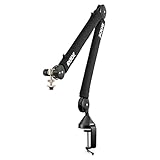
The PSA1+ is the arm most other boom arms get compared with, and it shows up as the top overall recommendation across many 2026 roundups. It is a classic two-section, parallelogram-spring design that rotates a full 360 degrees, with a horizontal reach of about 37 inches and a vertical reach of about 34 inches. That reach is more than enough to bring a mic in front of your mouth from the back corner of a large gaming desk or across an ultrawide monitor.
What separates it from cheaper spring arms is noise control. The internal springs are fully damped so they do not twang or creak, a neoprene sleeve wraps the arm, and rubber contact points at the joints help isolate the mic from desk bumps and keyboard vibration. If you move your mic often during a stream, that silence matters, because a squeaky arm is picked up clearly by any sensitive mic. RØDE rates it for mics weighing roughly 0.2 to 2.7 lbs, which covers almost every USB gaming mic and most broadcast dynamics, including heavier models.
The kit includes a desk clamp for surfaces up to about 70mm thick and a threaded desk insert for permanent mounting, plus integrated cable management for USB or XLR cables and a 3/8-inch thread with a 5/8-inch adapter.
Strengths: silent movement, long reach, broad payload range, and a proven design. Drawbacks: it sits in the premium tier, and its traditional over-the-top shape rises into your field of view, which some streamers dislike on camera. Very light mics at the bottom of the weight range can feel bouncy without a shock mount.
Compared with the arms included in the FIFINE and TONOR kits above, the PSA1+ is a long-term purchase: it will likely outlive two or three microphones. If you plan to upgrade to an XLR mic such as the FIFINE AM8T used through an interface, this is the arm to pair it with.
Elgato Wave Mic Arm LP

The Wave Mic Arm LP is built for the streamer whose camera, monitor, or ring light leaves no room for a tall arm. LP stands for low profile: the arm stays below shoulder level and extends horizontally toward you instead of arcing over the desk. Elgato lists a horizontal reach of about 29 inches, vertical reach of about 22 inches, and around 2.8 inches of clearance under the lower arm, enough to slide a keyboard or stream deck underneath.
It supports up to 2 kg (4.4 lbs) including accessories, uses all-metal anti-torsion construction so the mic does not twist out of position, and has tension-adjustable joints with a ball head for fine aiming. Cable management uses channels with magnetic covers, which keep an XLR or USB cable hidden and tidy. The padded desk clamp opens to about 2.4 inches, and adapters for 3/8-inch and 5/8-inch threads are included.
Strengths: clean look on camera, solid payload rating, magnetic cable channels, and a low line that keeps sightlines to your monitor clear. Drawbacks: premium pricing, and low-profile arms in general offer less vertical range, so they work best when the mic can sit at mouth height in front of you rather than angled down from above.
Compared with the InnoGear kit in the main list, which uses a shorter arm, the Wave Mic Arm LP solves the tall-monitor problem without forcing you to pull the mic close to your face.
Elgato Wave Mic Arm Pro

The Wave Mic Arm Pro is Elgato’s answer to heavier broadcast microphones. It is rated for loads up to 3 kg (6.6 lbs), far beyond what any mic in this roundup needs, and enough for a large dynamic mic with an inline preamp attached. Instead of the classic external springs, it uses a sealed, non-mechanical suspension system that lets the mic float and stay put without creaking, and the listing describes it as a gas-spring arm.
The geometry is different from most arms: a straight upper arm attaches to a lower section that hinges upward, so it can lie flat over the base for a low-profile look or angle up to meet a seated speaker. Elgato lists a reach of about 29.5 inches, a 360-degree swivel, and around 2.4 inches of desk clearance, rising to about 3.9 inches with the included riser. Cable channels are on the underside with magnetic covers, and the clamp opens to about 2.4 inches.
Strengths: very high payload capacity, silent and stable positioning, flexible low or raised layouts, and hidden cable management. Drawbacks: it is one of the most expensive arms you can buy for a gaming desk, it is heavy, and its strength is wasted on a light USB mic.
For anyone using the kits in this article, the Pro only makes sense as part of a bigger upgrade path, for example moving from the FIFINE AM8PROT to a heavier XLR broadcast mic later.
FIFINE BM88 Low Profile Boom Arm

The BM88 brings the low-profile style into the budget-to-mid-range tier, and several 2026 roundups name it the best value for mid-weight mics such as the FIFINE AmpliGame models in the main list. It extends to roughly 29 inches, rotates 360 degrees side to side, and has a wide vertical range, with a rotating ball head for aiming the mic. FIFINE rates it at 1.5 kg (3.3 lbs), which comfortably covers every kit mic in this article.
The BM88 uses a single central joint held by tension rather than springs, so there is nothing to twang. The spring-loaded ratchet clamp fits desks roughly 0.8 to 2.4 inches thick and installs quickly, and snap-in covers hide the cable along the arm. It is all metal and comes in black, white, and pink.
Strengths: low-profile layout at a much lower tier than Elgato, quick clamp installation, hidden cables, and a natural match with FIFINE mics. Drawbacks: the lower payload rating rules out heavy broadcast dynamics with preamps, and FIFINE’s own materials quote slightly different reach figures, so measure if every inch matters.
If you bought the FIFINE AM6T or A6T kit above and find the included arm too short or too visible on camera, the BM88 is the most natural upgrade. FIFINE also sells a BM88PRO variant with higher payload and RGB lighting.
NEEWER MS002 Low Profile Mic Arm

The NEEWER MS002 is a mid-range low-profile arm that targets heavier mics than the FIFINE BM88. It combines a pneumatic balancing system with integrated springs, and each joint has a damping adjustment so you can tune how firmly it holds. The rated maximum load is about 2.5 kg (5.5 lbs), enough for most broadcast dynamics.
NEEWER lists a horizontal reach of up to about 30 inches and a mic height range of roughly 3.7 to 15.6 inches above the desk. The C-clamp fits desks from about 0.4 to 3.1 inches thick, wider than most arms here, which helps on thick gaming desks. The mic mount pans 360 degrees and tilts 160 degrees, a 1/4-inch screw with 3/8-inch and 5/8-inch adapters is included, and an internal channel hides cables.
Strengths: high payload for the tier, adjustable damping, a wide clamp range, and smooth, quiet movement. Drawbacks: the joints cannot be fully locked, and NEEWER warns that the arm can spring back during adjustment, so keep your face clear when loosening it. It is also heavier than simple tension arms.
Choose the MS002 over the BM88 if you run a heavier XLR mic or might upgrade to one. It sits between the FIFINE and Elgato arms in price, while offering a payload close to the Elgato LP.
InnoGear Scissor Boom Arm
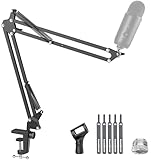
InnoGear’s classic scissor arm is the budget standalone choice that many beginner guides recommend, and it is a sensible replacement when the arm in an ultra-cheap kit starts to sag. It uses steel construction with external springs and an extra positioning hole so you can increase tension for heavier mics, with a typical rated load of about 1.5 kg (3.3 lbs). The zinc alloy desk clamp has an anti-scratch pad and opens to about 2 inches.
A 5/8-inch to 3/8-inch adapter is included for popular USB mics such as the Blue Yeti family, and the arm works with the FIFINE, TONOR, and MAONO mics in this roundup as well.
Strengths: the lowest-tier way to get a separate, adjustable arm, simple setup, and a load rating that covers most USB mics. Drawbacks: exposed springs can make noise when you move the arm, it may wobble under heavy typing, and the traditional shape sits in your line of sight more than a low-profile design.
Compared with the generic noise cancellation kit in the main list, which uses the thinnest arm in this roundup, the InnoGear arm is a cheap and immediate stability upgrade. Compared with the PSA1+, it is noisier and less refined, but it costs a fraction as much.
Buying Guide
Kit or Standalone Arm: Which Should You Buy?
The first decision is whether you need a microphone at all. If you are starting from nothing, a kit such as the TONOR TC310+ or FIFINE A6T is the simplest route: the mic, arm, and cable are matched, setup takes minutes, and you avoid compatibility guesswork. The weak point in almost every budget kit is the arm itself, which is built to a cost and sized for a single light mic.
A standalone arm makes more sense in three situations. First, you already own a mic you are happy with and only want better positioning. Second, the arm in your current kit has started to sag or wobble, and replacing the arm is cheaper than replacing the whole kit. Third, you plan to upgrade to a heavier XLR mic later, and want an arm that will carry it. In those cases, buying a quality arm once and changing mics around it is the better long-term spend.
A practical approach many streamers follow is to start with a mid-range kit, use it until the limits are clear, then upgrade the arm before the mic. A steady arm that holds a mic close to your mouth often improves perceived audio quality more than a pricier capsule held at the wrong distance.
Arm Reach, Clamp Type, and Spring Tension
The two failure points on any budget boom arm are the clamp and the elbow joint. C-clamp arms grip the desk edge with a screw mechanism, while newer kits use a spring-loaded clamp that is faster to install but harder to remove. Look for an arm with internal spring tension at the elbow rather than friction hinges alone, because friction hinges loosen within weeks. Reach matters more than people expect: you want at least thirty inches of horizontal extension so the mic can sit directly in front of your mouth while your keyboard and mouse remain unobstructed.
Dynamic vs. Condenser Capsules in a Gaming Room
Condensers are more sensitive, which means they pick up your voice more naturally but also capture every mechanical keyboard clack and desk fan hum. Dynamic capsules reject most of that ambient noise at the cost of sounding slightly flatter if your gain staging is poor. For untreated rooms, a dynamic capsule like the AM8T or AM8PROT will save you from spending on acoustic panels. For quiet, carpeted rooms where audio fidelity matters more, a condenser with onboard noise reduction — the MAONO approach — gives you the best of both worlds.
USB, XLR, and the Upgrade Path
USB mics include the preamp and converter inside the body, so they plug straight into a PC or console and are easy to manage. XLR mics send an analog signal that needs an audio interface or mixer, which adds cost and cables but lets you upgrade each part of the chain separately. Hybrid mics such as the FIFINE AM8T and AM8PROT offer both outputs, so you can start on USB and move to an interface later without buying a new mic.
The arm matters here because XLR setups tend to be heavier. A broadcast dynamic mic with a shock mount and an inline preamp can easily exceed the load rating of a kit arm. If an XLR path is in your plans, factor in a standalone arm with a higher payload rating, such as the NEEWER MS002 or one of the Elgato arms, and choose one with cable channels wide enough for a thick XLR cable.
Console players should also note that USB mics are generally the easier option on PS5, since an XLR mic requires an interface that the console recognizes. Check compatibility for your platform before planning an XLR upgrade.
Onboard Controls and Software Dependency
A mute button on the mic body is not a luxury; it is a functional necessity when someone walks into your room or a household member starts a conversation. Gain knobs let you adjust levels on the fly without alt-tabbing out of a game or stream. Kits that lack both force you into software adjustment, which means you either mute by hitting a keybind that sometimes does not register or leave your levels set too hot and clip during louder moments. Prioritize physical controls over RGB or extra features.
Payload: Match the Arm to the Mic
The single most important spec on a standalone arm is its payload range. Add up the weight of your mic, any shock mount, a pop filter, and an inline preamp if you use one, then choose an arm rated comfortably above that total. An overloaded arm droops slowly during a session; an underloaded spring arm can do the opposite and push a light mic upward. Spring arms usually list both a minimum and a maximum weight for this reason. Most USB gaming mics sit well inside the range of every arm in this article, while heavy broadcast dynamics are where the higher-rated arms earn their place.
Low-Profile vs. Traditional Arms
Traditional arms such as the RØDE PSA1+ and the InnoGear scissor arm rise above the desk and come down to the mic, which gives the most flexibility in placement. Low-profile arms such as the Elgato Wave Mic Arm LP, FIFINE BM88, and NEEWER MS002 stay at or below shoulder height and extend straight toward you. That keeps the arm out of your camera frame and away from your monitor, which is why streamers favor them. The trade-off is less vertical range, so low-profile arms work best when the mic can sit at mouth height in front of you.
Mounting Options and Thread Sizes
Most arms ship with a desk clamp, and a few include a grommet or threaded insert for a permanent mount through a hole in the desk. Check the clamp’s maximum opening against your desk thickness, and remember that a lip, cable tray, or monitor arm base can block the clamp. On the mic side, the common thread sizes are 5/8 inch (the standard for most mic mounts), 3/8 inch, and 1/4 inch. Every arm here includes adapters, but confirm that your mic or shock mount matches one of them.
Comparison of the Standalone Arms
| Arm | Style | Rated max load | Approx. horizontal reach | Cable management | Price tier |
|---|---|---|---|---|---|
| RØDE PSA1+ | Traditional spring, damped | About 2.7 lbs | About 37 in | Integrated | Premium |
| Elgato Wave Mic Arm LP | Low profile, tension joints | 4.4 lbs | About 29 in | Magnetic channels | Premium |
| Elgato Wave Mic Arm Pro | Low or raised, sealed suspension | 6.6 lbs | About 29.5 in | Magnetic channels | Premium |
| FIFINE BM88 | Low profile, tension joint | 3.3 lbs | About 26 to 29 in | Snap-in covers | Budget to mid-range |
| NEEWER MS002 | Low profile, pneumatic plus springs | 5.5 lbs | About 30 in | Internal channel | Mid-range |
| InnoGear Scissor Arm | Traditional, exposed springs | About 3.3 lbs | Varies by setup | Cable ties | Budget |
Setup Tips for a Quieter, Cleaner Mic Position
- Clamp at the back corner on your non-mouse side. This keeps the arm away from your mouse sweep and lets the mic swing in from the side, which also reduces keyboard pickup.
- Position the mic two to six inches from your mouth. Closer placement improves voice clarity and lets you lower the gain, which reduces background noise, especially for condenser mics.
- Aim the capsule at your mouth, not your keyboard. Angle the mic slightly from the side or from above so the keyboard falls outside the main pickup area of a cardioid mic.
- Use a shock mount if you type hard. Desk vibrations travel through the clamp and the arm; a shock mount absorbs most of that thump.
- Balance the tension after mounting the mic. Adjust the joints or spring holes with the mic attached so the arm stays where you leave it without drifting up or down.
- Route the cable through the arm with a little slack at each joint. A cable that is too tight pulls the arm out of position and strains the mic connector.
- Set gain before you go live. Speak at your normal game volume, including excited moments, and adjust gain so the loudest peaks stay clear of clipping in your recording or streaming software.
Our Verdict
Top pick: The TONOR TC310+ wins this category for most buyers because it is the most complete budget package, and its onboard gain control and tap mute put pricier kits to shame in daily usability. Upgrade pick: The FIFINE AmpliGame AM8T delivers the best balance of noise rejection, arm quality, and upgrade path, thanks to its dynamic capsule and XLR/USB output. One alternative wins under a specific condition: if you record in a quiet, carpeted room and have zero interest in XLR, the MAONO DGM20S, a condenser with onboard noise reduction, delivers clean, natural voice output.
FAQ
Do I need a boom arm if I already have a mic stand?
A tabletop stand occupies desk real estate and positions the mic below your mouth, forcing you to hunch or angle your voice upward. A boom arm pulls the mic in front of your lips at the correct angle while freeing the desk surface beneath it, which matters when you are working with a full keyboard, mouse pad, and monitor setup.
Will a condenser mic pick up my mechanical keyboard?
Yes, almost certainly if the keyboard is directly under or in front of the mic capsule. A dynamic mic is far more forgiving in this scenario. If you already own a condenser, repositioning the arm so the mic points toward your mouth from the side rather than directly above the keyboard reduces the problem significantly.
How much desk edge do I need for a clamp mount?
Most kits in this category require roughly two inches of clear desk edge without a lip, cable channel, or monitor arm base blocking the clamp jaws. Measure before ordering, especially if your desk has a raised back panel or under-desk tray.
Is XLR actually useful for a first-time gamer?
Not immediately, and an audio interface adds a budget-tier cost on top. The value of XLR in these kits is that the mic itself remains useful if you later upgrade to a standalone interface. If you have no intention of doing that, a USB-only kit is the better spend.
Can I put a different mic on the arm that came in my kit?
Usually, yes. Most kit arms use a standard 5/8-inch thread with an adapter, so they accept other mics. The limit is weight: kit arms are sized for the light mic they ship with, so a heavier XLR dynamic may droop. If that happens, a standalone arm with a higher payload rating is the fix.
Are low-profile arms better for streaming?
They are better for keeping the arm out of the camera frame and away from your monitor. A traditional arm gives more vertical range and can bring the mic down from above, which some people prefer for posture. If you stream on camera, a low-profile arm generally looks cleaner.
Why does my boom arm make noise when I move it?
Exposed springs vibrate and rub, and those sounds travel straight into the mic. Arms with damped internal springs, sealed suspension, or simple tension joints are much quieter. A shock mount helps, and so does muting your mic before repositioning the arm.
Do I need a pop filter with a boom arm?
A pop filter or foam windscreen softens hard consonants such as P and B sounds that hit the capsule directly when the mic is close to your mouth. Many gaming kits include one; if yours does not, a foam cover is an inexpensive addition.
Will a heavy-duty arm damage my desk?
Clamps concentrate force on a small area, so thin glass desks and soft particleboard can crack or dent over time. Use the padded clamp surface, avoid overtightening, and consider a reinforcement plate under the clamp on thinner desks.