
Your monitor is probably sitting on a plastic stand that came free in the box, eating up desk space and locking your screen at one height. A monitor arm fixes that. But once you start shopping, you hit the real decision: do you buy a single arm for the one monitor you have now, or commit to a dual monitor arm setup for the two screens you might run someday? The right answer depends less on specs and more on how you actually work, how much desk real estate you have, and whether you’re willing to spend roughly twice as much up front for flexibility later. Here’s how the two options genuinely compare.
Top 3 picks at a glance
Quick Verdict
If you use one monitor and value a clean, open desk, a single monitor arm is the smarter buy — it costs $25–$40, frees up your entire base area, and takes 15 minutes to install. If you regularly juggle two apps side by side, work in spreadsheets all day, or want a dedicated secondary screen for calls and chat, a dual monitor arm setup is worth the $50–$60 entry price. Don’t buy a dual arm “just in case”: the second arm clutters a single-monitor desk and the center pole can get in the way. Buy the setup that matches the screens you’ll use in the next 12 months, not the ones you might buy in five years.
As an Amazon Associate we earn from qualifying purchases at no extra cost to you.


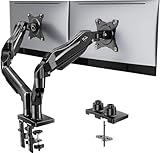
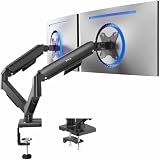
Side by Side
| Factor | Single Monitor Arm | Dual Monitor Arm Setup |
|---|---|---|
| Comfort & ergonomics | Raises one screen to eye level; easy to pull close | Same benefit per screen, plus side-by-side viewing that reduces window switching |
| Price range | $25–$40 (e.g., ErGear single at $26.99, HUANUO FlowLift at $35.99) | $50–$60+ (HUANUO FlowLift dual at $59.99, VIVO STAND-V002O at $49.99) |
| Weight capacity | Typically 4.4–19.8 lbs per arm, fits 13–34 inch panels | Same 4.4–19.8 lbs per arm; total capacity is shared across two screens |
| Desk space freed | Removes the stock stand’s footprint (often 8–10 inches deep) | Frees similar space, but the center pole and clamp occupy the middle of the desk |
| Installation | 10–20 minutes; many models are tool-free at the VESA plate | 25–45 minutes; heavier unit, more cable routing |
| Cable management | Simple — one monitor’s cables to route along one arm | Twice the cables; integrated channels help but it’s a bigger job |
| Maintenance | Occasional tension-knob adjustment; joints may need tightening yearly | Same per arm, plus the desk clamp bears more weight — check it a bit more often |
| Look | Minimal; one arm floating one screen looks cleanest | Commanding, symmetrical setup — great for gaming and trading stations |
| Resale/portability | Easy to sell or move; works with almost any desk | Needs a sturdy desk (clamp mounts need 0.8–3 inches of edge thickness); bulkier to resell |
| Best for | One-screen users, small desks, rentals, minimal setups | Multi-taskers, gamers, developers, traders, content creators |
Where Single Monitor Arm Wins
Small desks. A single arm like the ErGear single monitor arm fits 13–34 inch screens and holds up to 19.8 lbs, with a clamp that needs only a few inches of clearance under the desk edge. On a 40-inch desk, that one clamp in the back corner barely registers. A dual arm’s center pole sits in your sightline and steals a chunk of middle-desk space.
Budget. You can get fully adjustable ergonomics — height, tilt, swivel, and rotation from landscape to portrait — for under $30. The tool-free VESA mount on models like the ErGear means no screwdriver hunt, and integrated cable channels keep a single monitor’s wiring tidy with almost no effort.
Simplicity. One arm means one tension knob to dial in, one set of cables, one clamp. If you move your desk or rearrange your office even once a year, a single arm like the HUANUO FlowLift single mount (13–32 inches, clamp and grommet base options) is dramatically easier to uninstall and reinstall.
Laptops as second screens. Plenty of people pair one armed monitor with a laptop on a riser. That combo gives you two surfaces without paying for or mounting a second arm.
Where Dual Monitor Arm Setup Wins
Real multitasking. If you keep email on one screen and your actual work on the other, you know that Alt-Tabbing costs time and focus. Studies on multi-monitor productivity are mixed, but the daily experience of side-by-side windows is hard to argue with once you’ve had it.
Per-screen value. A dual arm effectively costs $25–$30 per monitor — the same as a decent single arm. The HUANUO FlowLift dual stand supports two 13–32 inch screens at up to 19.8 lbs per arm, with full VESA 75×75 and 100×100 compatibility and your choice of C-clamp or grommet mounting. You’re not paying a premium for going dual; you’re just buying more arms.
Symmetrical positioning. Dual arms share a center pole, which keeps two monitors perfectly aligned and lets you reclaim both monitors’ stock stands in one purchase. Gaming setups and trading desks almost always look better this way than with two separate single arms crowding the desk edges.
Fewer desk-edge clamps. One clamp versus two matters on thin desks or grommet-equipped surfaces. The VIVO dual stand (17–32 inch screens, up to 19.8 lbs per arm) clamps once at the center, leaving both corners of your desk free for speakers, a lamp, or nothing at all.
Cost Over 5 Years
Monitor arms are a low-cost, long-life category — quality gas-spring and mechanical-spring arms routinely last a decade, so five-year cost is mostly the purchase price plus small extras.
Single arm path: $27–$36 up front. Add maybe $5 for replacement cable clips or a spare VESA screw kit. Five-year total: roughly $30–$45.
Dual arm path: $50–$60 up front for a quality mount like the VIVO STAND-V002O or HUANUO dual. If you later upgrade one monitor and need a higher-capacity arm, add $30–$50. Five-year total: roughly $55–$110, still modest.
The real five-year cost difference isn’t money — it’s the second monitor you’ll likely buy ($100–$250 for a 24–27 inch 1080p or 1440p panel). If you go dual-arm, budget for that screen too. If you won’t buy it, don’t buy the dual arm.
Which One for Your Home
Small Apartment or Studio
Go single. You’re likely working from a 40–47 inch desk or even a dining table, and the last thing you need is a center pole splitting your usable surface. A single arm takes one back-corner clamp position and lifts the monitor off the desk entirely, freeing room for a notebook, coffee, or dinner. The ErGear single arm at $26.99 with its tool-free VESA mount is the classic choice here — easy to move when you relocate.
Family with Kids or Pets
Single arm, mounted well. One clamp point means one thing that can get bumped, and a floating monitor high on an arm is far harder for a toddler or cat to reach than a screen on a footed stand. Route cables through the arm’s channels and zip-tie the slack under the desk. If you genuinely need two screens, the HUANUO dual’s single center clamp is actually tidier and more knock-resistant than two separate arms.
Rental or Short-Term Living
Single arm — or dual if you’re a heavy multitasker who’ll be there two-plus years. Both clamp-mount designs install without drilling and remove cleanly; the only residue is a felt-pad mark and four small screw holes in the VESA plate that live on your monitor, not the wall. Check your desk’s under-edge clearance (most clamps need 0.8 inches minimum) before ordering. A single HUANUO FlowLift with both clamp and grommet hardware included covers whichever desk your rental gives you.
Long-Term Home Office
This is where a dual monitor arm setup earns its keep. If you own your desk and expect your workload to grow, buy dual once and skip the upgrade cycle. The VIVO dual stand at $49.99 is a long-standing value pick for exactly this scenario, and by 2026 the ecosystem of arms, extensions, and laptop trays that bolt onto these mounts is mature enough that your setup can grow with you. Invest in the sturdiest desk you can — a solid 1-inch-thick top makes any arm feel more stable.
FAQ
Can I add a second arm later if I buy a single now?
Yes, but with a caveat. You can clamp a second single arm to the other side of your desk, though you’ll lose the clean symmetry of a purpose-built dual mount and use two clamp points instead of one. That’s fine on wide desks (55+ inches); on smaller desks, a true dual monitor arm setup is neater.
Will a monitor arm fit my monitor?
Check three things: screen size range, VESA pattern, and weight. Most arms on this list support VESA 75×75 and 100×100 patterns — the four-hole spacing on the back of nearly every 13–34 inch monitor — and hold 4.4 to 19.8 lbs per arm. A typical 27-inch monitor weighs 8–12 lbs, so capacity is rarely an issue.
Do monitor arms damage the desk?
Clamp mounts leave a small indentation on the underside edge and a felt-pad mark on top; neither affects the desk’s use. Grommet mounts require drilling a 0.4–0.6 inch hole, so only use them on desks you own. On glass or very thin tops (under 0.8 inches), check the manufacturer’s compatibility notes first.
Are dual monitor arms harder to install?
Somewhat. Expect 25–45 minutes versus 10–20 for a single, mostly because you’re assembling two arms on a shared pole and routing two sets of cables. Everything goes easier if you mount the clamp and pole first, attach both VESA plates to the monitors while they’re flat on the desk, then hang them one at a time.


