
Your monitor probably came with a stand, and it works — until you realize it’s eating six inches of desk depth, sits at the wrong height, and forces you to hunch every time you settle in for a long session. If you’re shopping for a small desk setup, you’ve probably landed on the classic crossroads: keep (or buy) a monitor stand riser, or upgrade to a monitor arm that clamps to the desk and floats the screen in midair. Both fix the “monitor too low” problem. They solve it in completely different ways, and the right answer depends less on specs and more on your desk, your living situation, and how you actually work.
Here’s the honest framing of the decision: a monitor stand (or riser) lifts your screen up while keeping it planted on the desk surface — simple, cheap, portable. A monitor arm replaces the factory stand entirely, clamps to the desk’s edge or a grommet hole, and suspends the screen on an adjustable pole and jointed arm — freeing up the entire footprint underneath. One buys you height and simplicity; the other buys you back your desk. Let’s break down which trade-off makes sense for your home.
As an Amazon Associate we earn from qualifying purchases at no extra cost to you. Product prices and availability are accurate as of the date shown and are subject to change.



Top 3 picks at a glance
Quick Verdict
Choose a monitor arm if desk space is your biggest pain point. A single arm typically reclaims 5–8 inches of depth beneath the screen — enough to fit a full-size keyboard, a notebook, and even a compact keyboard tray on a 40-inch desk. Budget-friendly options like the ErGear Single Monitor Arm ($26.99, fits 13–34 inch screens up to 19.8 lbs) make this upgrade cheaper than most people expect.
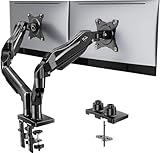
Choose a monitor stand if you rent, move often, or want zero installation risk. A riser like the WALI adjustable stand ($9.99, holds up to 44 lbs) needs no clamping, fits any desk (including glass and thin-top desks), and packs into a moving box in seconds. For dual-screen users who still want flexibility, the HUANUO FlowLift Dual Monitor Mount ($59.99, 13–32 inch screens, C-clamp or grommet base) splits the difference.
Tiebreaker: if your desk is under 24 inches deep and you work on it daily, go arm. If your desk doubles as a dining table or gets disassembled regularly, go stand.
Side by Side
| Factor | Monitor Arm | Monitor Stand / Riser |
|---|---|---|
| Ergonomic height range | Excellent — typically raises screens from desk level to 16–22 inches above it, with tilt and swivel | Good — most risers add 3–5 inches of height; stacking or adjustable legs add a bit more |
| Desk space reclaimed | 5–8 inches of depth under the screen; base footprint of roughly 3–4 inches in one corner | None — the riser itself occupies 10–16 inches of width and 8–10 inches of depth |
| Price range | $20–$60 single arm; $45–$90 for dual arms | $10–$35 for most quality risers |
| Installation | Clamp or grommet mount; 10–20 minutes with the included hardware; most modern arms (like ErGear’s tool-free VESA design) need no drill | None — unpack and place; under 2 minutes |
| Desk compatibility | Needs a desk edge 0.4–3 inches thick and a flat underside; problematic on glass, beveled, or very thin desktops without a grommet hole | Works on literally any surface, including glass, standing desks, and folding tables |
| Weight capacity | Per-arm ratings of roughly 4.4–19.8 lbs, which covers nearly every 13–34 inch monitor | Risers commonly hold 44 lbs and up — fine for a monitor plus laptop, books, or a speaker |
| Maintenance | Occasional tension adjustment at the joints; gas spring may need retightening after a year or two | Virtually none — wipe clean, check that foldable hinges stay snug |
| Cable management | Built-in channels route power and display cables along the arm — a cleaner look | Cables drape behind the riser; you’ll manage them yourself with ties or a tray |
| Portability / resale | Removable in minutes, but used arms sell for a modest amount; many buyers keep them for decades | Holds value poorly but costs so little it barely matters; easy to donate or regift |
| Best for | Daily workers on small or shallow desks, dual-monitor setups, anyone craving a clean under-screen workspace | Minimalist budgets, renters, glass desks, secondary/ guest-room setups, laptop-plus-monitor hybrids |
Where Monitor Arm Wins
Maximum space recovery on a small desk. This is the headline reason. A typical factory stand base spans 8–10 inches deep; an arm’s clamp base needs about 3–4 inches at the desk’s rear corner. On a 24-inch-deep desk, that’s the difference between your keyboard sitting 10 inches from your chest versus a comfortable 16–18 inches.
Superior ergonomics. Ergonomists recommend the top of your screen sit at or slightly below eye level, roughly an arm’s length away. Arms raise a 27-inch monitor to eye height even if you’re tall, and the tilt, swivel, and pivot joints let you rotate the screen to portrait mode for coding or reading long documents — something almost no riser can do.
Dual monitors without desk clutter. Two factory stands side by side can consume 20+ inches of width. A dual mount like the HUANUO FlowLift holds two 13–32 inch screens (4.4–19.8 lbs per arm) on one central pole with a single C-clamp or grommet base, and lets you push both screens back against the wall when not in use.
Cleaner aesthetics and cable routing. With the monitor floating and cables running through the arm’s channel, the desk reads as one clean surface. If your small desk doubles as a video-call backdrop, this matters more than you’d think.
Where Monitor Stand for Small Desk Wins
Universal desk compatibility. Arms need a solid, flat clamping surface. Glass desks, desks with beveled edges, and some hollow-core or ultra-thin desktops either won’t accept a clamp or risk damage. A riser like the WALI stand simply sits on top — no surface requirements at all.
Zero installation and zero commitment. No clamp torque, no checking VESA hole patterns (though most 13–34 inch monitors do use standard 75×75 or 100×100 mounts), no worrying about weight limits. Place it, set the monitor on it, done. For a guest room, dorm, or a setup you reconfigure monthly, that simplicity is worth a lot.
Extra functionality under the screen. A riser isn’t just a platform. Models like the Klearlook foldable stand ($29.79) include a storage drawer, a tablet/phone slot, and a fold-flat design for easy storage — turning dead vertical space into usable organization, which matters on desks under 40 inches wide.
Budget ceiling. You can solve the “monitor too low” problem for under $15. If your setup is temporary, seasonal, or shared, spending $30–$60 on an arm may be overkill.
Load flexibility. A sturdy riser holding up to 44 lbs can carry a monitor, a laptop on a shelf beside it, reference books, or a small speaker — it’s a shelf, not just a mount.
Cost Over 5 Years
Monitor arm path: A quality single arm runs $20–$45; expect $50–$70 for dual-arm models. Gas-spring arms are mechanically simple, and most manufacturers back them with 5–10 year warranties. Realistic 5-year cost: $25–$60, with maybe $5 in replacement cable ties or a felt pad under the clamp. If you upgrade monitors once in that span, a standard VESA arm carries over — no repurchase needed.
Monitor stand path: Entry risers run $10–$30. The catch: they don’t adapt. If you buy a taller chair, switch to a standing desk, or add a second monitor, you’ll likely stack risers or replace them — many people end up buying twice. Realistic 5-year cost: $20–$70 if you replace once, or as low as $10 if your setup never changes.
Hidden costs to weigh: an arm may require a desk mat or padding under the clamp ($5–$10) to protect a wood finish. A stand may require a separate keyboard tray or laptop shelf ($15–$25) to achieve comparable ergonomics if the riser alone can’t get your screen high enough. Over five years, both options land within about $50 of each other — so let your desk and lifestyle decide, not the price tag.
Which One for Your Home
Small Apartment or Studio
Your desk probably doubles as your dining table, craft station, or vanity. Go with a monitor arm. Pushing the screen flat against the wall when you’re done working lets the desk function as a table again in seconds — a riser can’t disappear. A single arm like the ErGear at $26.99 keeps the investment low while maximizing flexibility. If your desk is a folding or glass model, opt for a slim riser instead and accept the footprint.
Family with Kids or Pets
This is the stand’s quiet advantage. A floating monitor on an arm swings and pivots — irresistible to small hands and curious cats, and a toppled monitor is a $150–$400 mistake. A weighted riser keeps the screen stable and low to the surface, and you can push it back from the edge. If you do choose an arm, pick one with a locked tension setting and route cables through the arm’s channel so nothing dangles. A drawer-equipped riser like the Klearlook also hides chargers and small gadgets from little grabbers.
Rental or Frequent Mover
Check your lease and your desk first. Most arms clamp without drilling, so they’re landlord-safe — but if the provided desk is flimsy particleboard, or you move yearly, a riser is the smarter companion. It travels in its original box, works on whatever desk the next place has, and never leaves clamp marks. Hybrid tip: a foldable riser for the move, and if you land somewhere long-term, add the arm then.
Long-Term Home Office
If you work from this desk daily and expect to for years, the arm is the better investment, full stop. The ergonomic gain compounds: proper screen height reduces neck strain over thousands of hours, and the reclaimed depth lets your keyboard sit correctly so your elbows stay at 90 degrees. Dual-screen workers should look at a dual mount like the HUANUO FlowLift, which keeps both displays aligned on one pole and tucks away when the workday ends. With warranty coverage stretching past the five-year mark, the cost-per-use is pennies.
FAQ
Will a monitor arm damage my desk?
Generally no. C-clamps tighten onto the desk edge with padded faces, and a $5 felt pad adds protection on soft wood. Grommet mounts use an existing hole. The real risk cases are glass desktops, edges thicker than about 3 inches, or beveled fronts — check your desk’s specs before ordering. A freestanding riser eliminates the question entirely.
Can I use a monitor arm with any monitor?
Almost. Your monitor needs VESA mounting holes — 75×75 mm or 100×100 mm on most 13–34 inch screens — and its weight must fall within the arm’s rating (typically 4.4–19.8 lbs per arm). If your monitor came with a proprietary stand and no VESA holes, you’d need an adapter bracket, which can cost $15–$30 and isn’t always available.
How much height does a monitor stand riser actually add?
Most fixed risers add 3–4 inches, and adjustable models span roughly 4–6 inches. That’s enough for many seated users, but taller people (roughly 6 feet and up) often need more than a riser can offer to hit true eye-level screen height — which is where an arm’s 16–22 inch lift range earns its keep.
Is a dual monitor arm worth it over two separate stands?
On a small desk, yes. Two risers plus two factory bases can eat 20 inches of width; a dual mount uses one base and a single pole, and both screens align perfectly at the same height. Expect to pay $50–$70 for a solid dual arm versus $20–$50 for two risers — a modest premium for roughly double the reclaimed space.


