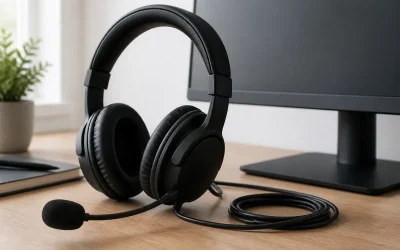
Modern home offices and gaming sanctuaries are no longer just functional spaces; they are curated expressions of personal style and efficiency. As wireless over-ear headphones have transitioned from niche audio gear to daily essentials for remote work, virtual meetings, and evening entertainment, a pressing organizational question has emerged: how do we store them? Leaving a premium $300 headset sprawling across a walnut desktop ruins the visual harmony of a room and risks scratching the ear cups.
When designing an organized workspace, the debate of a headset stand with charger vs standard headset holder often comes down to a clash of philosophies: high-tech utility versus minimalist simplicity. A charging stand acts as an active power hub, keeping your peripherals fueled and ready. A standard holder, on the other hand, acts as silent, structural architecture—holding your gear safely without demanding an outlet or adding extra cords to your desktop. Deciding between them requires looking beyond simple storage to evaluate your daily habits, cable management tolerance, and overall home aesthetic.
Quick Verdict
If your desktop is already a command station of multiple devices (such as wireless mice, phones, and keyboards) and you hate hunting for charging cables, choose a headset stand with charger. It consolidates power delivery into a single, neat footprint. However, if you favor a clean, cable-free aesthetic, value heirloom-quality materials like solid oak or brass, or want to reclaim desk space by mounting your gear under a shelf, a standard headset holder is the superior, more durable investment.
Side by Side
To help you visualize how these two storage solutions compare across key home-design and functional metrics, we have broken down their core characteristics in the table below.
| Metric | Headset Stand with Charger | Standard Headset Holder |
|---|---|---|
| Ergonomics & Comfort | Highly accessible; keeps charging ports at desk level to prevent bending down. | Extremely versatile; can be mounted at eye level, under desks, or on walls. |
| Durability & Lifespan | Moderate (3–5 years); internal circuit boards and USB ports can degrade. | Exceptional (10+ years); no moving parts or electrical components to fail. |
| Price Range | $35 to $120 (depends on wattage and materials). | $15 to $40 (premium wood/metal options can go higher). |
| Maintenance | Requires occasional dusting and cable checkups; sensitive to liquid spills. | Virtually maintenance-free; simple wipe-down with a damp cloth. |
| Space Needed on Desk | Requires a permanent 5″ x 5″ to 6″ x 6″ desk footprint near an outlet. | Zero desk footprint if using under-desk clamps or wall-mounted hooks. |
| Aesthetic Design | Modern, tech-forward; often features matte plastics, aluminum, or RGB lighting. | Minimalist, architectural; available in solid hardwoods, brass, and steel. |
| Resale & Future-Proofing | Lower; charging standards (like USB-C wattages) evolve rapidly. | High; a physical hook never goes out of style or becomes obsolete. |
| Best For | Heavy daily users, gamers, and multi-device tech enthusiasts. | Minimalists, renters, and those with limited desk surface area. |
Where Headset Stand with Charger Wins
The primary appeal of a charging headset stand lies in its ability to solve the “dead battery panic.” For professionals who jump from back-to-back video calls to evening gaming sessions, a headset that dies mid-conversation is a major frustration. An active stand ensures that whenever your headset is resting, it is also refueling.
These stands are far more than simple hooks; they are desk-level power distribution centers. Most premium charging stands feature built-in Qi wireless charging pads in their bases, delivering 5W, 7.5W, or up to 15W of power. This allows you to rest your wireless earbuds or smartphone on the base of the stand while your headset hangs above it. Additionally, integrated USB-A and USB-C pass-through ports (often rated at 5V/2.4A) let you plug in your headset directly or connect high-speed flash drives and receivers right at hand level, eliminating the need to crawl under your desk to reach your computer tower.
For those who appreciate customized ambient lighting, many charging stands also feature integrated smart LED or RGB lighting. These can be synchronized with your computer’s software to cast a soft, warm glow over your workspace or match your gaming setup’s color scheme. By consolidating a headphone hook, a phone charger, and a USB hub into a single 6-inch footprint, these stands dramatically reduce the number of individual charging bricks plugged into your wall outlets.
Where Standard Headset Holder Wins
While tech-infused stands offer undeniable utility, the standard headset holder remains a darling of interior designers and minimalist purists for a simple reason: it does its job flawlessly without demanding attention or an electrical outlet.
The greatest strength of a standard holder is its sheer placement flexibility. Because it requires no power cord, you are not tethered to a wall outlet. You can mount a standard aluminum clamp-on holder directly to the edge of a floating shelf, screw a wooden peg into a wall stud, or stick an adhesive hook under your desk. This completely frees up your desktop surface, which is a massive win for compact 40-inch or 48-inch writing desks where every square inch of space is premium real estate.
Standard holders also excel in material quality and longevity. Because manufacturers do not have to budget for internal circuit boards, voltage regulators, or LED strips, they can pour their resources into premium, tactile materials. You can easily find gorgeous holders crafted from solid American walnut, matte powder-coated steel, or hand-polished brass. These materials age beautifully, developing a rich patina over time that coordinates with high-end furniture. Without any electronic components to burn out or charging standards to become obsolete, a solid metal or wooden holder will easily last a lifetime.
Cost Over 5 Years
When calculating the true cost of ownership for a headset stand with charger vs standard headset holder, you must look beyond the initial checkout price and consider lifespan, energy usage, and potential replacement cycles.
A high-quality standard headset holder typically costs between $15 and $40. Because it has zero moving parts and no electrical components, its five-year maintenance cost is exactly $0. It uses no electricity, and barring physical abuse, it will look and function exactly the same in five years as it did on day one. Your total five-year investment remains locked at your initial purchase price.
Conversely, a reliable charging headset stand carries a higher initial price tag, usually ranging from $35 to $120. Over five years, you must also account for a tiny amount of passive electricity draw (phantom load), though at roughly 5 to 10 kWh per year, this amounts to less than $2 annually. The real cost factor is technological depreciation. USB ports can loosen over years of daily plugging, wireless charging coils can fail due to heat build-up, and power delivery protocols will inevitably advance. If you buy a stand with older USB-A ports today, you may find yourself wanting to upgrade to faster USB-C standards within a few years. Therefore, a charging stand has a higher probability of requiring replacement or repair within a five-year window, bringing its estimated five-year cost of ownership to $50 to $140.
Which One for Your Home
To determine which storage style fits your home ecosystem, let us look at how both options perform in real-world living situations.
Small Apartment
In a small studio or compact apartment, desk space is often shared with dining or living areas. Every object must justify its footprint. Here, a standard headset holder—specifically an under-desk clamp or a wall-mounted hook—is the clear winner. By hanging your headphones completely off the desk surface, you keep the tabletop clear for meals, paperwork, or crafting, maintaining a calm, clutter-free living zone.
Family with Kids or Pets
If your home includes curious toddlers or cats who love to swat at hanging objects, stability is your main priority. A heavy, standalone charging stand with a dangling power cord is an inviting target. A child or pet pulling on the power cable can easily bring a premium headset crashing to the hardwood floor. In this environment, a standard headset holder that is securely screwed into a wall stud or clamped tightly beneath a heavy desk is much safer, keeping expensive electronics safely out of reach.
Rental Home
Renters need organization solutions that leave no trace. While a wall-mounted holder is out of the question due to drilling restrictions, a weighted, standalone headset stand with charger is an excellent choice. It sits passively on top of your desk, provides immediate power without requiring any modifications to the walls, and can be packed into a box in ten seconds when it is time to move.
Long-Term Home
For those designing a permanent home office or a dedicated media room, the choice comes down to your design language. As we look ahead to 2026, home design trends are leaning heavily toward natural textures, concealed technology, and warm, organic modernism. If you want a timeless workspace that feels integrated with your home’s architecture, a premium, wooden standard headset holder mounted to the wall or integrated into custom shelving offers unmatched elegance. However, if you are building a high-performance smart home office with integrated cable management channels, a premium, flush-mounted charging stand will serve as an excellent central dock for your daily devices.
FAQ
Does a headset stand with a charger degrade my headset’s battery life?
Modern wireless headsets and charging stands use smart lithium-ion battery management systems. Once your headset reaches 100% charge, the stand reduces the current to a trickle charge or cuts power entirely, preventing overcharging. However, leaving any battery constantly at 100% charge on a dock can cause very minor capacity degradation over several years compared to letting the battery cycle naturally.
Can I mount a standard headset holder to any type of desk material?
Most clamp-on standard holders fit desks ranging from 0.5 inches to 2 inches in thickness and work beautifully on solid wood, metal, or thick plywood. However, you should exercise caution with hollow-core desks (like some budget honeycomb paper-filled options) or tempered glass tops, as excessive clamping pressure can warp or crack the surface.
How much power do charging headset stands typically provide?
Power output varies by model. Typically, the integrated USB ports on a charging stand output standard 5V power at 1A to 2.4A, which is ideal for charging headsets, keyboards, or mice. The built-in Qi wireless charging pads found in premium bases usually offer scalable outputs of 5W, 7.5W, 10W, or 15W to match your smartphone’s fast-charging capabilities.
Are there wireless charging headset stands that charge the headset wirelessly while it hangs?
Very few headsets support true wireless contact charging while hanging. Most headset stands with chargers require you to plug a short USB cable from the stand’s base into the headset. However, a few premium gaming headsets utilize proprietary magnetic base docks where the headset charges via contact pins when seated, though these are typically brand-specific rather than universal stands.