A dash cam earns its keep on the day someone clips your fender in a parking lot and walks off, or when a rear-end collision turns into a “your word against mine” insurance dispute. The halo drive dash cam category has matured to the point where 4K capture, multi-channel coverage, and usable night vision now sit comfortably under $200. What still separates a recorder that will actually protect you from one that will not comes down to a handful of hardware realities: the sensor behind the lens, how many angles the unit covers, the throughput of the WiFi module that dumps files to your phone, and whether the electronics survive months of summer heat inside a parked car.
Long-term owner reports consistently flag the same failure modes—corrupted memory cards after a few weeks, parking mode silently draining a battery overnight, and after-dark footage so noisy that license plates dissolve into gray mush. The eight units in this roundup avoid those traps to varying degrees. Some stack four or five channels to wrap the entire cabin and perimeter in lenses. Others invest in a single front-and-rear pair backed by a premium Sony STARVIS 2 sensor. Your choice depends on whether you need total situational awareness, the clearest possible nighttime image, or simply a dependable recorder that never surprises you mid-claim.
As an Amazon Associate we earn from qualifying purchases at no extra cost to you.




Our Top Picks




Top 3 picks at a glance
What the Halo Drive Dash Cam Actually Is
Most people searching for a Halo Drive dash cam review are looking at a specific product: the Halo Drive from Road Angel, a UK dash cam maker based in Nottinghamshire. It is a small, screenless front camera designed to tuck behind the rearview mirror, and it has become one of the brand’s most popular models because it keeps the feature list sensible and the price moderate.
Here is what the current Halo Drive offers, based on Road Angel’s published specifications and independent reviews:
- Resolution: 1440p Quad HD (2K) recording; a cheaper 1080p Full HD version also exists.
- Lens: 140-degree wide-angle lens with anti-distortion correction.
- Night recording: a “Super Night Mode” aimed at low-light clarity.
- Connectivity: built-in Wi-Fi for transferring clips to the Road Angel phone app.
- Impact detection: G-sensor that locks footage when it detects a collision.
- Parking mode: after roughly 15 minutes of inactivity it switches to time-lapse and resumes normal recording when the G-sensor detects movement. This requires the optional hardwire kit, which includes a low-voltage cut-off to protect the car battery.
- Halo Drive 2: the refreshed version moves to a USB-C connection.
Reviewers consistently praise the compact design, straightforward installation, and the near plug-and-play app setup. The recurring complaints are just as consistent: the hardwire kit is sold separately, a microSD card is not included, the status light and start-up sounds annoy some owners until they are switched off in settings, and customer support experiences are mixed. Availability is also strongest through UK retailers, which is why many US drivers end up comparing it with similar compact cameras sold locally.
That is the lens through which this guide works. The roundup below covers multi-channel units that go well beyond what a single Halo Drive can record, and a dedicated section further down covers the screenless, behind-the-mirror cameras that are the closest direct alternatives to the Halo Drive itself.
Quick Picks
| Product | Best for | Price |
|---|---|---|
| Icesky 4K Front + Rear + L/R | Wide-angle coverage on a budget | mid-range |
| ROVE R2-4K Dual | Night clarity with a bundled card | mid-range |
| 4K+4K+1080P 3-Channel AProX | Three-lens value | mid-range |
| REDTIGER 4K STARVIS 2 Dual | Proven sensor with fast transfer | mid-range |
| Neideso N800 5-Channel Telephoto | Maximum zoom and detail capture | mid-range |
| IIWEY N5 4-Channel | Affordable 360-degree coverage | budget |
| 360 View 4-Channel WDR | Feature-packed all-in-one under $100 | budget |
| Neideso 360° 4-Channel | Cabin and perimeter without a premium price | budget |
How We Picked
We shortlisted units by weighing four criteria drawn from published spec sheets and aggregated owner feedback: sensor generation (STARVIS 2 and equivalent back-illuminated CMOS chips consistently outperform older sensors in low light), channel count and placement (front-only coverage leaves blind spots that multi-angle rigs close), transfer speed and app reliability (a 5 GHz WiFi 6 module at 20 MB/s matters when you need to pull a two-minute clip at the scene of an accident), and parking-mode power strategy (supercapacitor designs resist heat swelling that kills lithium batteries in hot climates). Price-to-feature density was the final tiebreaker for near-identical spec profiles.
The Best Halo Drive Dash Cam in 2026
Icesky 4K Front, Rear, Left, Right with GPS and WiFi 6
This four-channel unit covers every side of the vehicle at a price that undercuts most dual-camera competitors. Owner feedback praises the GPS overlay for logging speed and coordinates directly onto footage, which insurers find useful. The WiFi 6 module hits the rated 20 MB/s, making file transfers genuinely quick from a phone. One recurring complaint centers on the mounting bracket design, which owners describe as bulky and noticeable on smaller windshields. Skip this one if you drive a compact car with limited dash space or if you want the absolute sharpest nighttime image, where older-sensor alternatives with dedicated night modes may edge it out.
- Four simultaneous lenses wrapping all sides of the vehicle
- GPS data embedded in video files automatically
- Mount is chunky and may obstruct sightlines in small cabins
ROVE R2-4K Dual with STARVIS 2 Sensor
ROVE has built a reputation in owner communities for software polish, and the R2-4K continues that tradition. The STARVIS 2 sensor is the same generation found in units costing significantly more, delivering the type of low-light clarity where plate text stays readable rather than smearing into noise. The free 128 GB card removes the immediate need for a separate purchase. The trade-off is channel count: this is front-and-rear only, so side and cabin angles go uncovered. If you park on busy streets where a door ding from the left is a realistic concern, a four- or five-channel option may serve you better.
- Premium STARVIS 2 sensor for excellent nighttime detail
- 128 GB card included in the box
- Only two channels; no side or interior coverage
4K+4K+1080P 3-Channel AProX HD Night Vision
Three lenses—two capturing in 4K and one at 1080P—cover front, rear, and cabin for under $120 with a bundled 128 GB card. The AProX night-vision pipeline draws favorable remarks from owners in dimly lit areas, who report legible plates at distances where budget single-channel cams produce only headlights and blur. The main gripe involves app stability; several long-term users note occasional connection drops between the camera and phone, requiring a power-cycle. If you want triple-lens coverage without breaking the bank, this is a strong candidate, but factor in the software friction.
- Two 4K channels plus a 1080P cabin cam in one unit
- 128 GB card included
- Companion app reliability is a common complaint
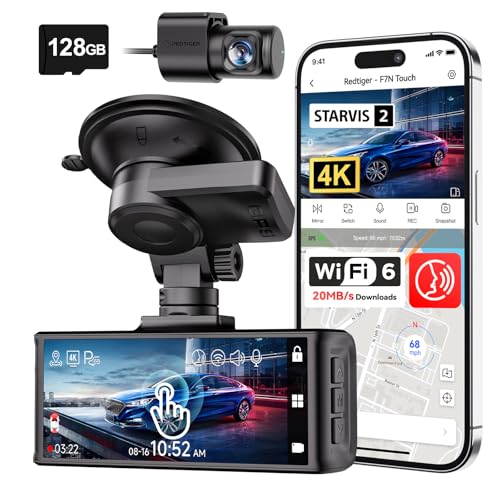
REDTIGER 4K STARVIS 2 Dual with 5 GHz WiFi
REDTIGER pairs the same STARVIS 2 sensor as the ROVE with a 5 GHz WiFi module rated at 20 MB/s, and a free 128 GB card. Owners frequently call out the build quality as feeling more solid than its price suggests, with tighter cable routing and a low-profile mount. Night footage is consistently praised for dynamic range—bright headlights do not blow out adjacent plate numbers. The con is identical to the ROVE’s: only two channels. Skip this if your parking environment demands side coverage, or if you already own a compatible high-endurance card and would rather put the savings toward a multi-lens rig.
- STARVIS 2 sensor with strong dynamic range in mixed lighting
- Fast 5 GHz WiFi with 20 MB/s transfer rate
- 128 GB card bundled in
Neideso N800 5-Channel Telephoto 4K
At the top of the price range, the N800 stacks five lenses including a telephoto module that pulls in distant detail—plate text two car-lengths ahead stays legible where wide-angle optics cannot resolve it. Owners describe the 360-degree perimeter view as giving them confidence in dense urban parking. The trade-off is complexity: five lenses mean five streams to manage, and some users note a learning curve with the interface and a larger footprint on the windshield. If you drive in crowded city lots daily and need the extra zoom to read plates at range, the premium is justifiable. Skip it if you want simplicity and only need front-rear documentation.
- Telephoto lens captures plate text at longer range than any competitor here
- Five channels provide near-total vehicle coverage
- Interface complexity and physical size are real considerations
IIWEY N5 4-Channel 2K Front with 1080P Rear
The cheapest four-channel option in this list undercuts most competitors by a meaningful margin while still delivering front, rear, left, and right coverage. Front capture lands at 2K rather than 4K, a downgrade owners note but one most call acceptable for the price. The included memory card is notably absent here—you will need to supply your own. If your budget is tight and total angle coverage matters more than pixel count, the N5 is the easiest entry point into multi-lens recording. Skip it if you need maximum nighttime clarity or 4K front resolution for plate identification at distance.
- Lowest-cost four-channel unit in this roundup
- Front, rear, left, and right covered simultaneously
- No memory card included; 2K front is below the 4K standard
360 View 4-Channel with GPS, WDR, and Supercapacitor
This unit crams a genuinely useful feature set into a sub-$100 price: GPS tagging, 160-degree wide angles, WDR for balancing bright and dark zones in the same frame, 24-hour parking mode, a supercapacitor that resists heat swelling, and a 128 GB card thrown in. Owners describe it as the best “all boxes checked” value, though the app design receives lukewarm feedback for feeling utilitarian. The supercapacitor is the quiet highlight for anyone in a warm climate. Skip it if you demand the absolute best night image, since the sensor here is competent rather than exceptional.
- Supercapacitor design handles hot parking without battery degradation risk
- 128 GB card, GPS, WDR, and 160-degree angles all included
- App interface is functional but lacks polish
Neideso 360° 4-Channel Front, Rear, and Inside
Neideso’s four-channel entry sits right below the 360 View in price and offers front, rear, and inside coverage for drivers who want cabin visibility without the complexity of a five-lens rig. Owner reports highlight easy installation and a low-profile mount that does not dominate the windshield. The night performance is described as adequate but not class-leading, and the absence of GPS overlay on footage comes up as a minor omission in several reviews. This is a sensible pick for rideshare drivers or anyone who wants to document passenger interactions alongside road incidents. Skip it if GPS-tagged footage is a priority for your insurance situation.
- Inside cabin lens useful for rideshare and passenger disputes
- Low-profile mount keeps sightlines clear
- No GPS overlay recorded onto video files
70mai T800E 3-Channel 4K Front, Rear, and Inside

The 70mai T800E fills a gap in the lineup above: a three-channel camera from an established brand that pairs 4K front recording with 1080p rear and 1080p interior cameras. It suits rideshare drivers and parents of teen drivers who want the road, the rear window, and the cabin documented in one system without stepping up to a four- or five-lens rig.
The feature set covers the essentials that cheaper three-channel units often skip. GPS is built in and logs location, speed, and route data with each clip. Wi-Fi 6 moves files to the 70mai app at up to 10 MB/s, noticeably quicker than older 2.4GHz-only models when you need to pull an incident clip at the scene. Voice control lets you lock footage, take a photo, or start recording without reaching for the camera. A 64GB card comes in the box, and the camera accepts cards up to 512GB.
The trade-offs are worth knowing before you buy. The rear and cabin channels record at 1080p, so the 4K label applies only to the front view. Parking monitoring needs the separate UP03 hardwire kit, which is also sold in bundles with the camera. With three streams writing at once, the included 64GB card fills quickly, so most owners will want a larger high-endurance card. Drivers who only need front and rear coverage can save money with a two-channel model from the list above.
- Best for: rideshare drivers and families who want cabin coverage alongside the road.
- Strengths: 4K front, built-in GPS, Wi-Fi 6, voice control, card included.
- Weaknesses: 1080p rear and cabin, hardwire kit extra for parking mode, small included card for three channels.
Compact Screenless Alternatives Closest to the Halo Drive
If what drew you to the Halo Drive was the small, hide-behind-the-mirror form factor rather than multi-angle coverage, these four cameras sit in the same class. Each records a single front view (or front plus rear in one case), runs from a supercapacitor instead of a battery, and relies on a phone app or voice commands instead of a large screen.
Garmin Dash Cam Mini 3

The Garmin Mini 3 is the most direct US-market answer to the Halo Drive’s design brief: a key-fob-sized front camera with no screen that disappears behind the mirror. It measures roughly 2 x 1.2 x 0.8 inches and weighs about 30 grams, which makes it one of the least visible dash cams you can mount.
Recording tops out at 1080p and 30fps through a 140-degree lens, the same field of view as the Halo Drive. What sets it apart is the built-in Garmin Clarity polarizer, which cuts dashboard reflections on the windshield, a common problem with small cameras mounted high on the glass. Garmin’s Clarity HDR optics help balance bright skies and shadowed road surfaces.
Voice control lets you say commands to save a clip or toggle audio recording without touching the camera, and a supercapacitor replaces the battery for better heat tolerance. Up to four Garmin cameras can auto-sync through the Garmin Drive app, so you can add a rear Mini 3 later.
The drawbacks are real. There is no GPS built in, so speed and location only appear when it is synced with a GPS-equipped Garmin camera. Remote Parking Guard alerts require a paid Vault subscription, an active Wi-Fi connection, and constant power. A microSD card is not included, and 1080p is a step below the Halo Drive’s 1440p.
- Best for: drivers who want the smallest, most discreet camera from a mainstream brand.
- Strengths: tiny footprint, built-in polarizer, voice control, multi-camera sync.
- Weaknesses: 1080p only, no GPS, parking alerts tied to a subscription.
VIOFO VS1 Mini 1440p STARVIS 2

Spec for spec, the VIOFO VS1 Mini is the closest match to the Halo Drive in this guide, and it adds a few things the Road Angel lacks. It records 2560 x 1440 at 30fps with HDR through a 140-degree lens, uses a Sony STARVIS 2 IMX675 sensor, and has no screen, so it tucks neatly behind the mirror.
The STARVIS 2 sensor is the main reason to choose it. VIOFO rates the IMX675 at roughly 2.5 times the dynamic range of the original STARVIS chip of the same size, which shows up as better plate legibility when headlights and dark roads share the frame. Independent reviewers have reported clear plates and road signs, though some noted 1440p detail is softer than the number suggests.
GPS is built in, which the Halo Drive and Garmin Mini 3 both lack, so speed and location are logged with every clip. Dual-band 2.4GHz and 5GHz Wi-Fi speeds up downloads to the VIOFO app, voice control handles hands-free saves, and an optional Bluetooth remote can lock a clip with one press. A 32GB card comes in the box, and the camera accepts cards up to 512GB.
Like the Halo Drive, parking mode needs a hardwire kit, sold separately. Frame rate is capped at 30fps, so there is no 60fps option for smoother motion.
- Best for: anyone who wants the Halo Drive form factor with a newer sensor and GPS.
- Strengths: STARVIS 2 sensor, built-in GPS, 5GHz Wi-Fi, card included.
- Weaknesses: 30fps maximum, hardwire kit extra for parking mode.
VIOFO A119 Mini 2 with 2K 60fps

The A119 Mini 2 shares the VS1 Mini’s STARVIS 2 IMX675 sensor and 140-degree F1.6 lens but adds two things enthusiasts care about: a 2K 60fps mode and a small 1.5-inch screen for aiming the lens during installation. It is not fully screenless, but the display is small enough that the camera still hides behind most mirrors.
The 60fps mode matters more than it sounds. At highway speeds, doubling the frame rate reduces motion blur on passing plates, and gives you more frames to pause on when you need to read a detail. When contrast is the bigger problem, you can switch to 2K 30fps with HDR to keep headlights from blowing out the scene. That flexibility is the main reason to choose it over the VS1 Mini.
A GPS module comes in the box, and the camera supports dual-band Wi-Fi, Bluetooth, and voice control. Parking mode options include event detection, time-lapse, low-bitrate recording, and buffered recording that captures the seconds before an impact. A supercapacitor handles power, rated from -4 to 149 degrees Fahrenheit.
Expect to buy a microSD card and the HK4 hardwire kit separately if you want parking coverage. Some owners also point out that enabling HDR drops the frame rate to 30fps, so you choose between smoothness and dynamic range rather than getting both.
- Best for: highway commuters who want smoother footage in a compact body.
- Strengths: 60fps option, STARVIS 2 sensor, buffered parking mode, GPS included.
- Weaknesses: no card included, HDR and 60fps cannot run together.
Vantrue S1 Pro Front and Rear STARVIS 2

The Halo Drive records only the road ahead, and Road Angel sells a separate model for rear coverage. The Vantrue S1 Pro is a compact two-channel option for drivers who want front and rear in one purchase without moving up to a large multi-lens unit.
The front camera uses a STARVIS 2 IMX675 sensor with an F1.8 lens and a 158-degree field of view. It records up to 2.5K (1944p) alongside a 1080p rear camera, or 1440p at 60fps on the front for smoother motion. The rear camera covers 165 degrees. Sources disagree on whether the rear sensor is STARVIS 2 or the original STARVIS on every production run, so expect the front image to be the stronger of the two.
Unlike the Halo Drive, it includes a 2-inch screen, built-in GPS, 5GHz Wi-Fi, voice control, and a supercapacitor. Parking mode offers 24-hour surveillance with collision detection and buffered recording that keeps up to 15 seconds of pre-event footage. Vantrue also lists driver-assist alerts such as lane departure and blind-spot warnings, and an optional polarizing filter.
The trade-offs: the body is larger than a screenless mini cam, the rear camera adds a cable run to the back window, and full 24-hour parking coverage still requires hardwiring.
- Best for: drivers who want front and rear coverage from one compact kit.
- Strengths: STARVIS 2 front sensor, 60fps option, GPS, buffered parking mode.
- Weaknesses: rear image weaker than front, bigger than screenless alternatives.
Halo Drive vs. the Closest Alternatives at a Glance
| Model | Max front resolution | Sensor | Field of view | Screen | GPS | Rear camera |
|---|---|---|---|---|---|---|
| Road Angel Halo Drive | 1440p | Not published | 140° | No | No | No |
| Garmin Dash Cam Mini 3 | 1080p 30fps | Not published | 140° | No | No | Sync a second unit |
| VIOFO VS1 Mini | 1440p 30fps | STARVIS 2 IMX675 | 140° | No | Built in | No |
| VIOFO A119 Mini 2 | 1440p 60fps | STARVIS 2 IMX675 | 140° | 1.5 inch | Module included | No |
| Vantrue S1 Pro | 1944p (1440p 60fps) | STARVIS 2 IMX675 front | 158° front | 2 inch | Built in | 1080p included |
The short version: the VIOFO VS1 Mini is the nearest like-for-like replacement, the Garmin Mini 3 is the most discreet, the A119 Mini 2 is the pick for smoother highway footage, and the Vantrue S1 Pro is the step up if you need the rear window covered too.
Buying Guide
Sensor Generation Decides Your Night Footage
Resolution on the box tells you pixel count; the sensor tells you how much usable light reaches those pixels at dusk. STARVIS 2 and equivalent back-illuminated CMOS sensors pull in enough signal to resolve plate characters under streetlights, while older or cheaper sensors produce footage where headlights dominate and everything nearby turns to noise. If most of your driving is after dark or through poorly lit areas, prioritize sensor generation over channel count.
Channel Coverage Matches Your Real Risk
Front-and-rear covers the most common claim scenarios: rear-end collisions and forward impact. Adding left, right, or inside channels addresses parking-lot door dings, side-swipe disputes, and rideshare passenger incidents. A five-channel rig gives you everything but adds cost and complexity. Map your daily environment to the number of lenses you actually need rather than buying maximum coverage as insurance against every hypothetical.
Storage Endurance and Power Strategy
Dash cams write constantly, and standard microSD cards degrade within months under that load. High-endurance-rated cards are the practical answer. For parking mode specifically, supercapacitor-based designs tolerate cabin temperatures that would swell or kill a lithium-ion battery, making them the safer choice for cars parked outdoors in warm climates. Verify whether a card is included and check its endurance rating before assuming it will last a full year.
Hardwiring and Parking Mode Without Draining Your Battery
Nearly every camera in this guide, including the Halo Drive, only records reliably while parked when it is hardwired to the fuse box. A cigarette-lighter plug usually loses power when the ignition turns off, so parking mode never starts. A proper hardwire kit taps a constant-power fuse and an ignition-switched fuse, which lets the camera know when the car is parked.
The feature to look for is a low-voltage cut-off. It shuts the camera down before the car battery drops below the level needed to start the engine. Most kits let you choose a threshold, typically around 11.8V to 12.4V for a 12V system. Pick a higher value if the car sits for days at a time or the battery is older.
Parking modes fall into three types. Event-only modes sleep until the G-sensor detects an impact, which saves power but can miss the seconds before the hit. Time-lapse modes record continuously at a low frame rate, the approach the Halo Drive uses. Buffered modes keep a rolling few seconds in memory and save them when an impact is detected, so the clip shows the approach as well as the contact. Buffered recording gives the most useful evidence for hit-and-run incidents.
Frame Rate, HDR, and Readable Plates
Resolution gets the headlines, but plate legibility depends just as much on frame rate and exposure. At 30fps a car passing at a 20 mph speed difference moves almost a foot between frames, which smears small characters. A 60fps mode halves that gap. HDR solves a different problem: it blends exposures so a bright headlight does not wash out the plate beneath it. Many cameras cannot run 60fps and HDR at the same time, so use 60fps for highway driving and HDR for night commutes in heavy traffic.
GPS, Wi-Fi, and the App You Will Actually Use
Built-in GPS stamps speed and location on every clip, which helps establish where and how fast you were traveling during a claim. The Halo Drive and Garmin Mini 3 skip it; the VIOFO and Vantrue alternatives include it. For Wi-Fi, 5GHz connections move large 4K files far faster than 2.4GHz, which matters when you need to save a clip to your phone at the roadside. Before buying, read recent owner comments on the companion app, since a camera with a crashing app is only useful once you pull the memory card.
Mounting Position and Legal Considerations in the US
Windshield-mount rules vary by state. Several states limit objects on the windshield to small zones, such as a square in the lower corner on the passenger side or a strip at the top within the wiper sweep. Mounting a compact camera behind the rearview mirror usually keeps it out of the driver’s line of sight, which is one reason small screenless designs are popular. Check your state’s vehicle code before installing.
Audio is the other legal point. Some states require consent from everyone being recorded for audio, which matters if you carry passengers or drive for a rideshare service. Most cameras here let you disable the microphone, and voice-controlled models such as the Garmin Mini 3 and VIOFO VS1 Mini can toggle audio recording with a spoken command. Rideshare drivers should also check their platform’s rules and post notice of recording where required.
Memory Card Sizing for Each Camera Type
A single-channel 1440p camera fills about 6GB to 10GB per hour depending on bitrate, so a 64GB or 128GB high-endurance card holds several hours before loop recording overwrites older files. Multi-channel 4K units consume storage much faster, which is why 128GB or larger cards are the practical minimum for the four- and five-channel picks above. Format the card in the camera every few weeks to keep the file system healthy.
Our Verdict
The REDTIGER 4K STARVIS 2 is the best choice if image quality matters most: premium sensor quality, fast WiFi, a bundled 128 GB card, and owner-verified reliability at a mid-range price. For the budget slot, the IIWEY N5 delivers four-channel coverage that competitors charge double for, making it the value leader despite its 2K front compromise. The Neideso N800 wins outright only in one condition: if you regularly need to read license plates at a distance—tight city parking, highway disputes—no wide-angle alternative here matches its telephoto reach, and the extra cost is justified by that single decisive advantage.
FAQ
How many channels do I actually need for a dash cam?
Front and rear covers the majority of accident scenarios and insurance claims. Add side channels if you park in tight lots where door dings or side-swipes are realistic, and add an inside channel if you drive passengers or rideshare routes.
Will a 4K dash cam still work if the sensor is mediocre?
Resolution without a capable sensor gives you more pixels of noise. A lower-resolution camera with a STARVIS 2-class chip will consistently produce clearer, more readable nighttime footage than a higher-resolution unit paired with a budget sensor.
Is a supercapacitor better than a battery for parking mode?
In hot climates, yes. Supercapacitors do not swell, leak, or degrade at high temperatures the way lithium batteries do, making them more reliable for units that sit in a parked car through summer afternoons.
Can I reuse any microSD card in a dash cam?
Physically any card will fit, but dash cams write continuously in a loop that destroys standard cards within months. High-endurance-rated cards are specifically built for this workload and will last several times longer under identical conditions.
Is the Road Angel Halo Drive worth buying?
It is a well-reviewed compact front camera with 1440p recording, a 140-degree lens, and an easy app. Budget for the hardwire kit and a memory card, since neither is in the box. If you want GPS or a STARVIS 2 sensor at a similar size, the VIOFO VS1 Mini covers both.
Does the Halo Drive have GPS?
No GPS is listed in Road Angel’s specifications for the Halo Drive. If GPS-stamped speed and location matter for insurance claims, choose a model with GPS built in or included as a mount module.
Can the Halo Drive record the rear of the car?
The Halo Drive is a front-only camera. For rear coverage, choose a dual-channel camera such as the Vantrue S1 Pro or one of the multi-channel units in this roundup.
Will a dash cam drain my car battery in parking mode?
Not if it is hardwired with a kit that has a low-voltage cut-off. The kit switches the camera off before the battery drops too low to start the engine. Plug-in cameras without hardwiring usually stop recording when the ignition is off.
Is 1440p enough, or do I need 4K?
For a front camera with a STARVIS 2 sensor, 1440p captures readable plates at typical following distances. 4K helps at longer range and when cropping, but file sizes grow and night quality depends more on the sensor than the pixel count.