
A surge protector stops spikes, but it does nothing when the power simply drops—and a hard shutdown mid-save can corrupt a game, a document, or in the worst case a drive’s file system. An uninterruptible power supply (UPS) keeps your PC and monitor alive for a few minutes so you can save and shut down gracefully, and it smooths out the brownouts and flickers that plague many homes. For a desk, you do not need a server-room unit; you need the right size and type.
Our Top Picks
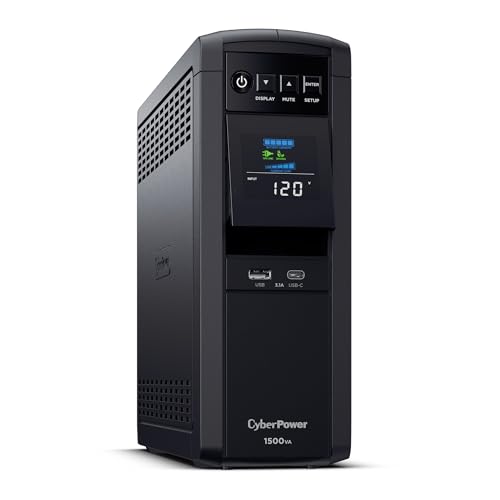 CyberPower CP1500PFCLCD PFC Sinewave UPS Battery Backup and1500VA14 x 3.9 x 11 inches24.9 poundsCheck on Amazon
 APC BR1500MS2 Pure Sine Wave UPS Battery Backup1500VA14.49 x 3.94 x 10.24 Inches27.55 PoundsCheck on Amazon
 APC Back-UPS Pro Gaming UPS 1500VA/900W Pure Sine1500VA / 900W16.06 x 4.13 x 11.45 inchesCheck on Amazon
 CyberPower CP1500AVRLCD3 Intelligent LCD UPS Battery Backup1500VA13.78 x 3.94 x 10.2 inches23.8 PoundsCheck on Amazon
 GOLDENMATE 1000VA/800W Lithium UPS Battery Backup & Surge1000VA/800W Standard12.99 x 4.13 x 9.84 inches12.3 PoundsCheck on Amazon
 Eaton Tripp Lite SMART1500SLT 1500VA Pure Sine Wave1500VA13.27 x 6.75 x 10.25 inches45 PoundsCheck on Amazon
Top 3 picks at a glance

Sizing the UPS to your gear
UPS capacity is rated in volt-amps (VA) and watts. The watt figure is the one that matters—add up your PC and monitor draw and leave headroom. A mainstream 1440p gaming PC pulls roughly 350–500W under load; add 30–60W for a monitor. A 900–1500VA unit (roughly 540–900W usable) covers that with enough reserve to give you 3–8 minutes of runtime—plenty to save and power down, though not enough to keep gaming through a long outage.
As an Amazon Associate we earn from qualifying purchases at no extra cost to you.
| Setup | Load | Recommended UPS | Rough runtime |
|---|---|---|---|
| Office PC + one monitor | 150–250W | 600–850VA | 8–15 min |
| 1440p gaming rig | 400–550W | 1000–1500VA | 4–8 min |
| High-end 4K rig | 600–750W | 1500VA+ | 3–6 min |
Which topology to buy
Line-interactive is the desk sweet spot
Cheap standby units cut over to battery only when power fails and do nothing about voltage sag. Line-interactive models add automatic voltage regulation (AVR) that trims high or low voltage without draining the battery—ideal for homes where lights dim when the AC kicks on. Double-conversion (online) units give perfect power but cost far more and hum with a fan; save those for workstations that never tolerate a millisecond of interruption.
Watch the waveform
Many modern PC power supplies use active PFC and dislike the “simulated sine wave” of budget UPS units, sometimes shutting off when they switch to battery. A pure sine wave UPS avoids that entirely and is worth the modest premium for any gaming PC. Confirm the spec explicitly says pure/true sine wave.
The best UPS units for a gaming desk
With sizing and topology covered, these are the battery backups that fit a home-office gaming desk best. All are line-interactive units with automatic voltage regulation, and five of the six deliver sine wave output on battery, which matters for the active PFC power supplies in most modern gaming PCs. Runtime figures are the makers’ published estimates and drop as load rises, exactly as the runtime section of this guide explains.
CyberPower CP1500PFCLCD PFC Sinewave UPS

The CP1500PFCLCD is the UPS most often recommended for gaming PCs, and the specs explain why. It is rated at 1500VA and 1000W, which is more usable wattage than most 1500VA units, and it outputs a true sine wave on battery, so active PFC power supplies switch over cleanly instead of shutting down. Its line-interactive design with AVR corrects sags and surges without draining the battery.
It has 12 outlets: six with battery backup and surge protection, six with surge protection only, and two of them widely spaced for bulky adapters. CyberPower lists a typical transfer time of 4 milliseconds, roughly 10 minutes of runtime at half load and about 2.5 minutes at full load, plus two USB charging ports, a color LCD showing load and battery status, and Ethernet surge protection. The batteries are hot-swappable, and the three-year warranty covers the batteries too.
Who it is for: mainstream to high-end gaming PCs drawing roughly 400 to 700W under load, plus a monitor and router. That covers the 1440p and 4K rows of the sizing table above.
Strengths: 1000W capacity, pure sine wave, fast transfer, plenty of outlets, color display, and shutdown software over USB.
Drawbacks: sealed lead-acid batteries need replacing every few years, the unit weighs around 11kg, and like any 1500VA unit it gives minutes, not hours, at gaming loads.
How it compares: it offers 100W more usable capacity than the 900W APC units below and a slightly faster transfer time. If you want one UPS that suits almost any single-GPU gaming PC, start here.
APC Back-UPS Pro BR1500MS2
APC’s Back-UPS Pro BR1500MS2 is the main alternative to the CyberPower, with a 1500VA/900W rating and pure sine wave output. It is line-interactive with AVR, transfers to battery in about 8 milliseconds, and includes 1080 joules of surge protection.
It has 10 outlets, six battery-backed and four surge-only, with two spaced for transformer plugs. A useful touch for a desk is the pair of built-in USB charging ports, one USB-C and one USB-A, so a phone or controller can charge without occupying an AC outlet. There is an LCD with load and battery bars, a USB data port for APC’s PowerChute shutdown software, network and coax surge protection, and a user-replaceable battery.
Who it is for: gaming PCs in the 350 to 600W range plus a monitor, and anyone who prefers APC’s software and replacement-battery availability.
Strengths: pure sine wave, AVR, USB-C charging, clear LCD, good battery availability, and a proven design.
Drawbacks: 900W is less headroom than the CyberPower’s 1000W, it sits in the premium tier, and lead-acid batteries degrade over three to five years.
How it compares: almost a like-for-like rival to the CP1500PFCLCD. Choose it for the USB-C port or if you already use APC equipment; choose the CyberPower if your rig draws close to 900W.
APC Back-UPS Pro Gaming BGM1500B

The Back-UPS Pro Gaming is APC’s version of the BR1500MS2 dressed for a gaming setup. It shares the same core spec of 1500VA/900W with pure sine wave output and AVR, but adds customizable RGB lighting and a slimmer tower shape that tucks beside a PC case.
It has 10 outlets, six with battery backup and four surge-only, plus USB-A and USB-C charging ports, an LCD, 1080 joules of surge protection, and network and coax protection. Retail listings give roughly 14 minutes at half load and under 5 minutes at full load, with a sealed lead-acid battery that the user can replace. APC lists a three-year warranty.
Who it is for: players who want a UPS that matches an RGB setup and sits in plain sight rather than hidden under the desk.
Strengths: pure sine wave, slim tower form, RGB lighting, USB-C charging, and APC’s PowerChute software.
Drawbacks: you pay a premium for the styling over the functionally similar BR1500MS2, the lighting adds nothing to protection, and some retailers list this model as being phased out, so stock can be patchy.
How it compares: electrically it is in the same class as the BR1500MS2. Buy it if the looks and slim footprint matter to you; otherwise the standard model does the same job.
CyberPower CP1500AVRLCD3 Intelligent LCD UPS

The CP1500AVRLCD3 is the value option for desks where a pure sine wave unit is not essential. It is a 1500VA/900W line-interactive UPS with AVR, 12 outlets split between battery-backed and surge-only, USB-A and USB-C charging ports, and an LCD panel showing load, battery, and input status.
The key difference is the waveform: on battery it outputs a simulated sine wave. As this guide’s waveform section explains, some active PFC power supplies dislike that and can shut down at the moment of switchover. Many PCs cope, but there is no way to be sure without trying it with your power supply, and a gaming PC is exactly where you least want that surprise.
Who it is for: office PCs, consoles, routers, NAS boxes, and monitors, or as a second UPS for network gear while a pure sine unit protects the gaming PC.
Strengths: mid-range pricing for 1500VA, AVR, lots of outlets, USB-C charging, and CyberPower’s shutdown software.
Drawbacks: simulated sine wave output is a risk with active PFC power supplies, and the batteries are lead-acid.
How it compares: it costs less than the pure sine units above, but for a gaming PC the CP1500PFCLCD is worth the step up. Use this one where waveform does not matter.
GOLDENMATE 1000VA/800W Lithium UPS

The GOLDENMATE is the long-life pick. Instead of the sealed lead-acid batteries in most desk UPS units, it uses a LiFePO4 lithium iron phosphate battery of about 230Wh, which the maker rates for thousands of charge cycles and a lifespan many times longer than lead-acid. That addresses the biggest running cost of owning a UPS: replacing the battery every few years.
It is a line-interactive unit with pure sine wave output, rated at 1000VA and 800W, with eight battery-backed and surge-protected outlets and an LCD. GOLDENMATE quotes up to around 30 minutes at a 300 to 400W reference load and recommends keeping the load around 480 to 560W. It is also much lighter than a lead-acid 1500VA unit, at roughly 5.5kg. The maker’s spec sheets do not list AVR on every version, so check the listing if voltage correction matters to you.
Who it is for: mid-range gaming PCs under about 500W plus a monitor, and anyone who wants to avoid regular battery replacements.
Strengths: lithium chemistry with a long cycle life, pure sine wave, light weight, and good runtime at moderate loads.
Drawbacks: 800W is too little for high-end rigs, published specs vary between listings, and it lacks the USB charging ports of the APC and CyberPower models.
How it compares: it gives up raw capacity to the 1500VA units but should need no battery swaps for many years. For a mid-range PC it can work out cheaper over the life of the unit, despite costing more up front than lead-acid units of similar capacity.
Eaton Tripp Lite SmartPro SMART1500SLT

The SMART1500SLT comes from Tripp Lite’s business-oriented SmartPro line, now sold under the Eaton name, and it brings that background to a home desk. It is a 1500VA/900W line-interactive tower UPS with sine wave output both on mains and on battery, so it is just as friendly to active PFC gaming power supplies as the APC and CyberPower sine wave units above.
Its AVR keeps output steady over a wide input range of about 95 to 145V, boosting during brownouts and trimming overvoltage without touching the battery. Eaton quotes around 20 minutes at half load and 8 minutes at full load, which is noticeably longer than most 1500VA desktop units at the same load. It has eight outlets, a 6-foot cord, a HID-compliant USB port that works with the built-in battery and shutdown features of Windows and macOS, network and phone line surge protection, hot-swappable batteries, and a slot for optional network management cards.
Who it is for: home-office desks where the gaming PC doubles as a work machine, and users who value longer runtime and a robust, business-grade build over gamer styling.
Strengths: sine wave output, generous runtime for its class, wide AVR range, cold-start capability to turn on during an outage, and no extra software needed for basic shutdown on Windows or macOS.
Drawbacks: no LCD on this model and no USB charging ports, a plainer and bulkier design than the desktop-styled units, and fewer outlets than the 10- and 12-outlet competitors. Its rated noise level is higher than silent desktop units, so place it under the desk rather than beside your chair.
How it compares: it matches the APC units at 900W and beats most of them on published runtime, but gives up the display and charging ports. Choose it if minutes of runtime and build quality matter more than convenience features.
UPS picks compared
Ratings come from the makers’ published specs. Runtime depends heavily on load, so use the sizing and runtime sections of this guide alongside this table.
| UPS | Capacity | Waveform on battery | Outlets (battery/surge-only) | Battery type | Best for | Price tier |
|---|---|---|---|---|---|---|
| CyberPower CP1500PFCLCD | 1500VA / 1000W | Pure sine | 6 / 6 | Lead-acid | Most gaming PCs, including high-end | Mid-range |
| APC BR1500MS2 | 1500VA / 900W | Pure sine | 6 / 4 | Lead-acid | Mainstream rigs, USB-C charging | Premium |
| APC Back-UPS Pro Gaming | 1500VA / 900W | Pure sine | 6 / 4 | Lead-acid | RGB setups, slim tower | Premium |
| CyberPower CP1500AVRLCD3 | 1500VA / 900W | Simulated sine | Mixed, 12 total | Lead-acid | Office PCs, consoles, network gear | Mid-range |
| GOLDENMATE 1000VA lithium | 1000VA / 800W | Pure sine | 8 / 0 | LiFePO4 | Mid-range PCs, low maintenance | Mid-range |
| Eaton Tripp Lite SMART1500SLT | 1500VA / 900W | Sine wave | 8 battery-backed | Lead-acid | Longer runtime, work-and-play desks | Mid-range |
More buying criteria for a desk UPS
Watts first, VA second
The VA figure is the larger, more marketable number, but your gear consumes watts. Two 1500VA units can differ by 100W or more of usable capacity, as the 1000W CyberPower and 900W APC models show. Compare the watt rating against your measured or estimated load and aim to keep the UPS at 60 to 70 percent of its watt rating during gaming. That leaves headroom for load spikes from modern graphics cards, which can briefly pull well above their average draw.
Battery-backed vs surge-only outlets
Every UPS splits its outlets. Count only the battery-backed ones when planning: the PC, the main monitor, and the router or modem are the priority. A second monitor, speakers, a desk lamp, and chargers belong on the surge-only side so they do not drain the battery or overload the UPS when the power goes out.
Transfer time
Line-interactive units switch to battery in a few milliseconds, typically 4 to 10. Most PC power supplies can bridge that gap easily, but a faster transfer and a pure sine wave together give the best chance of a seamless switchover with sensitive active PFC supplies.
Shutdown software and connectivity
A USB data cable and the maker’s software, PowerChute for APC or PowerPanel for CyberPower, let the PC save and shut down automatically when the battery runs low. Without it, the UPS only helps if you are at the desk when the power fails. Check that the software supports your operating system and that the UPS appears as a battery device once connected.
Lead-acid or lithium
Sealed lead-acid batteries are cheap and proven but lose capacity over three to five years and are heavy. Lithium iron phosphate batteries cost more up front, weigh far less, and last many more charge cycles, often removing the need for a replacement during the life of the unit. For a desk that sees frequent flickers or outages, lithium’s longer cycle life is a real advantage.
Display, alarms, and fan noise
An LCD showing load percentage and estimated runtime makes it easy to check that you are not overloading the UPS. Alarms are useful but can be loud; most units let you mute them in software. Many desk UPS units are silent on mains power, while some lithium and online units run a cooling fan, so check noise if the UPS will sit close to your chair.
Warranty and equipment protection
Look for a warranty that includes the battery, typically three years from APC and CyberPower, and note the connected equipment protection policy. Those policies have conditions, but they signal the maker’s confidence in its surge protection.
Setup and features that matter
Plug only the PC, monitor, and network gear into the battery-backed outlets; printers and speakers can go on the surge-only sockets to save runtime. Use the USB data cable and the bundled software so the PC auto-saves and shuts down when the battery hits a threshold. Expect to replace the internal battery every 3–5 years—runtime that suddenly drops is the tell.
How to estimate your real load
Guessing your PC’s wattage from its power supply label overestimates badly: an 850W power supply in a system that actually draws 450W while gaming does not need an 850W UPS. Use one of these methods for a realistic figure.
- Use a plug-in power meter. Plug the PC, monitor, and router into a power strip, plug that into an inexpensive wall power meter, and run a demanding game for 15 minutes. The peak reading is your gaming load.
- Read the UPS display. Most units with an LCD show load in watts or as a percentage. Connect your gear, play a demanding game, and watch the reading.
- Estimate from components. Add your graphics card’s rated board power, your CPU’s typical gaming draw, about 50 to 75W for the rest of the system, and your monitor’s rated consumption. Then add 20 percent for spikes.
Example loads
| Setup | Typical gaming draw | Suggested UPS |
|---|---|---|
| Mid-range PC with a 1080p or 1440p monitor and router | 300-400W | 1000VA pure sine, or 1500VA for longer runtime |
| Upper mid-range PC with a 1440p high-refresh monitor | 400-550W | 1500VA / 900-1000W pure sine |
| High-end PC with a 4K monitor | 550-750W | 1500VA / 1000W pure sine at minimum |
| Flagship GPU, dual monitors, and accessories | 750W+ | A larger unit or a model with external battery support |
Setting up your UPS step by step
- Charge it before use. Plug the UPS into the wall and let it charge for the time stated in the manual, often 8 hours or more, before relying on it.
- Plug it straight into a wall outlet. Not into a power strip or extension cord, and never plug a surge protector into the UPS’s battery outlets.
- Connect priorities to battery outlets. PC, main monitor, and modem or router. Your internet will stay up during short outages, which keeps online matches alive through a flicker.
- Install the shutdown software. Connect the USB data cable, install the software, and set it to save and shut down at a battery threshold, such as 30 percent or a few minutes of remaining runtime.
- Run a test. With your work saved, pull the UPS plug from the wall while the PC is running. The PC should stay on, the UPS should beep, and the software should report battery power. Plug it back in and confirm it returns to mains.
- Check the load. During a demanding game, make sure the display stays below about 70 percent load.
- Place it with airflow. Keep the UPS on the floor, away from heaters and out of direct sun, with space around its vents. Heat shortens battery life.
FAQ
Can a UPS let me keep gaming through a blackout?
Not for long. Desk-sized units give minutes, not hours—their job is a safe save-and-shutdown, plus riding out the brief flickers that would otherwise reboot your PC. For extended play you would need a large battery station or generator.
Do I still need a surge protector?
The UPS includes surge protection, so a separate strip is redundant on those outlets. Do not daisy-chain a power strip into the UPS—it defeats the protection and can overload the unit.
What size UPS do I need for a gaming PC?
For most single-GPU gaming PCs, a 1500VA unit rated at 900 to 1000W covers the PC, a monitor, and a router with enough headroom. A mid-range system drawing under 400W can use a 1000VA pure sine unit. Measure or estimate your actual gaming load rather than using the power supply’s rating.
Is a pure sine wave UPS really necessary?
For a modern gaming PC with an active PFC power supply, it is strongly recommended. Simulated sine wave units work with many PCs, but some active PFC supplies shut down or make buzzing noises when switched to battery, which defeats the purpose. For consoles, routers, and office PCs, simulated sine is usually fine.
Can I plug my monitor and router into the UPS too?
Yes, and you should. Without the monitor, you cannot see to save your work during an outage, and keeping the router powered keeps your internet connection alive through short flickers. Put secondary monitors and speakers on the surge-only outlets.
Does a UPS protect my PC from lightning?
It protects against typical surges and spikes, but no consumer device stops a direct or very close lightning strike. During severe storms the safest option is to shut down and unplug expensive equipment, including network cables.
How do I know when the UPS battery needs replacing?
Watch for a replace-battery warning, failed self-tests, a sudden drop in estimated runtime, or a battery that swells or smells. Many units let you trigger a self-test from the software. Replacement battery cartridges are widely available for popular APC and CyberPower models.
Is it safe to keep a UPS running all the time?
Yes. A UPS is designed to stay plugged in and charged continuously. Keep it in a cool, ventilated spot, do not cover its vents, and replace lead-acid batteries when the unit asks.
Why does my PC shut off when the UPS switches to battery?
The most common cause is a simulated sine wave UPS paired with an active PFC power supply, which can shut down when it sees the stepped waveform. Overload is the other usual culprit: if the load is near the UPS’s watt limit, the inverter cannot carry it on battery. A pure sine wave unit with headroom fixes both.
Do I need a UPS for a gaming laptop?
Usually not for the laptop itself, because its own battery already rides through outages. A small UPS is still useful for an external monitor, dock, and router, so your connection and second screen survive a flicker.
Can a UPS improve my PC’s performance or stability?
It will not raise frame rates, but a line-interactive unit with AVR can prevent the random reboots and crashes some homes see when voltage dips, such as when an air conditioner or fridge compressor starts. If your PC restarts at those moments, a UPS is a likely fix.
Runtime math and what to expect
People overestimate how long a UPS lasts, so set expectations with rough math. Runtime falls fast as load rises—a 1500VA unit that runs 20 minutes at 150W might give only 4–6 minutes at 500W, because battery capacity is fixed while draw is not. That is by design: the goal is a safe save-and-shutdown, not uninterrupted play. If you genuinely want more minutes, buy a higher-VA model or one that accepts an external battery pack rather than assuming a bigger number equals hours. Also budget for battery replacement—the internal sealed battery degrades over 3–5 years, and a UPS whose runtime suddenly collapses almost always needs a fresh battery, not a whole new unit. Most units self-test and will beep or flag a fault when the battery is failing, so do not ignore that chirp.
UPS or portable power station?
Portable power stations with large lithium batteries are increasingly marketed as home backup, and some offer a UPS or pass-through mode. They can run a gaming PC far longer than a desk UPS, but they are not a straight replacement.
- Switchover speed: a dedicated line-interactive UPS switches in a few milliseconds. Many power stations advertise “UPS mode” with transfer times of 20 to 30 milliseconds or more, which some PC power supplies will not ride through. Check the published switchover time carefully.
- Voltage regulation and shutdown software: desk UPS units correct brownouts with AVR and talk to your PC over USB to trigger a safe shutdown. Most power stations do neither.
- Runtime: here power stations win easily. A unit with 1,000Wh or more can keep a mid-range PC and monitor running for an hour or longer, where a 1500VA UPS gives minutes.
- Cost and size: power stations sit in the premium tier and take up more space, but double as camping or emergency power.
For most desks the best combination is a proper UPS for instant switchover and safe shutdown. If outages in your area last hours, add a power station for extended use and plug it in only once the UPS has done its job.
Quick picks by need
- Best all-round for gaming PCs: CyberPower CP1500PFCLCD, for its 1000W capacity and pure sine output.
- Prefer APC or want USB-C charging: APC Back-UPS Pro BR1500MS2.
- RGB setup or slim tower: APC Back-UPS Pro Gaming.
- Office PC, console, or network gear: CyberPower CP1500AVRLCD3.
- Longest runtime in a 1500VA tower: Eaton Tripp Lite SMART1500SLT.
- Mid-range PC and no battery swaps: GOLDENMATE 1000VA lithium.
Common UPS mistakes to avoid
- Sizing by the power supply label. A 1000W power supply does not mean a 1000W draw. Measure or estimate real gaming load, or you may overspend on capacity you never use.
- Running too close to the limit. A UPS at 95 percent load on mains has no room for graphics card spikes and may trip into overload just when power fails. Keep gaming load at or below about 70 percent.
- Plugging everything into battery outlets. Printers, laser printers in particular, space heaters, and high-draw devices can overload the inverter. Keep them off the UPS entirely.
- Skipping the shutdown software. If you are away from the desk when the power fails, the PC runs until the battery dies and then shuts off hard, which is exactly what you bought the UPS to prevent.
- Ignoring the beeps. Repeated chirps usually mean overload, a failed self-test, or a battery that needs replacing. Check the display or software rather than muting the alarm.
- Never testing it. Run a quick pull-the-plug test after setup and every few months, so you discover a weak battery before a real outage does.
- Hiding it in a hot cabinet. Heat is the main enemy of lead-acid batteries. A closed cabinet next to a PC exhaust can halve battery life.
Protecting the rest of your desk
A gaming desk often has more than a PC on it. Here is how to fit everything else around a UPS.
Consoles
Consoles draw much less than a gaming PC, typically around 150 to 230W for current models while gaming, so a 1000VA unit or the battery outlets of a shared 1500VA unit handle them easily. A sudden power cut during a system update is the main risk a UPS removes for consoles.
Network gear
Your modem and router draw only a few watts but are what keep online matches and voice chat running through brief flickers. If the PC’s UPS has no free battery outlet, a small separate unit near the router is inexpensive and gives the network hours of runtime.
Streaming and capture gear
Capture cards are powered by the PC, but external audio interfaces, mixers, and lights are not. Plug the audio interface into a battery outlet if losing it would crash a stream, and put lights on surge-only outlets to save runtime.
External drives and NAS
Drives are the components most at risk from sudden power loss. Put external drives on battery outlets, and if you run a NAS, connect it to a UPS with a data port so it can shut itself down cleanly.
Battery care and replacement
The battery is the part of a UPS that wears out, and a little care makes it last toward the top of its expected life.
- Keep it cool. Lead-acid batteries age much faster in heat. A spot on the floor with free airflow, away from the PC’s exhaust and radiators, is ideal.
- Leave it plugged in. A UPS keeps its battery on a maintenance charge. Storing it unplugged for months lets a lead-acid battery discharge and sulfate, which permanently reduces capacity. If you must store it, charge it fully first and top it up every few months.
- Let it self-test. Most units run periodic self-tests and flag a weak battery. You can also trigger a test from the software after a big outage.
- Recalibrate the runtime estimate occasionally. Some software offers a runtime calibration that discharges the battery under load to relearn its capacity. Do this rarely, with your work saved, because deep discharges add wear.
- Replace with the correct cartridge. APC and CyberPower sell replacement battery cartridges matched to each model, and many units allow hot-swapping. Using the right cartridge keeps runtime estimates accurate.
- Recycle the old battery. Sealed lead-acid batteries should never go in household trash. Many electronics retailers and local recycling centres accept them.
Lithium units change this picture. Their batteries tolerate far more charge cycles and age more slowly, so for many owners the battery will outlast the useful life of the rest of the unit.
Bottom line
Total your PC and monitor wattage, pick a line-interactive, pure sine wave UPS around 1000–1500VA for a gaming desk, and connect the shutdown software. You trade a hard crash and possible data loss for a calm few minutes to save—cheap insurance for an expensive rig.


