
Top 3 picks at a glance
Best Minn Kota Trolling Motors for Every Boat
The best Minn Kota trolling motor is the one that fits your boat’s weight and bow or transom layout, has enough thrust and shaft length for local conditions, and uses a control system and battery voltage you can support. For most freshwater fishing boats, a bow-mounted Ultrex or Terrova suits anglers who want hands-free positioning; a transom-mounted Endura is a simpler fit for small boats; and a Riptide model is the saltwater-oriented choice.
Choose by boat and fishing style
| Boat and typical use | Starting thrust range | Mount and control priorities | Model family to consider |
|---|---|---|---|
| Light jon boat, canoe, or small utility boat | 30–45 lb | Transom mount; simple hand or foot control | Endura or Endura Max |
| Small fishing boat, roughly 14–16 ft | 40–55 lb | Transom mount for portability, or bow mount for steering from the bow | Endura Max or a compatible bow-mount model |
| Bass boat, roughly 16–19 ft | 55–80 lb | Bow mount; GPS positioning is useful for holding on structure | Terrova or Ultrex |
| Heavy fiberglass boat or large walleye boat | 80–112 lb, depending on weight and conditions | Bow mount; verify voltage, shaft, and compatible electronics | Terrova, Ultrex, or a higher-thrust Riptide for saltwater use |
| Saltwater bay boat or coastal fishing boat | Choose by loaded weight, wind, and current | Corrosion-resistant saltwater model; bow or transom to suit layout | Riptide family |
These are starting points, not guarantees. Hull shape, passengers, gear, wind, weeds, and current can make two boats of the same length need different motors. Use the boat’s fully loaded weight—not its bare hull weight—when sizing thrust.
As an Amazon Associate we earn from qualifying purchases at no extra cost to you.
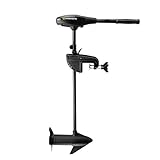


How to size the motor without guessing
1. Match thrust to loaded boat weight
A widely used planning rule is about 2 lb of thrust for every 100 lb of fully loaded boat weight, with extra capacity for wind, current, or a hull that pushes a lot of water. For example, a boat weighing 2,400 lb with people, batteries, fuel, and tackle points to roughly 48 lb of thrust as a baseline. In exposed or weedy conditions, moving up to the next practical thrust class gives more reserve; it does not mean the motor will always run at full power.
Thrust is not the same as speed. A trolling motor is meant for maneuvering and positioning, and adding thrust does not turn it into a main engine. A motor that is under-sized may run near maximum output for long periods, using more battery and leaving little control margin when conditions worsen.
2. Measure shaft length from the mounting point
Measure vertically from the spot where the motor will mount to the waterline, then allow enough shaft for the propeller to stay submerged as the bow rises and falls. On a bow mount, the deck can sit well above the water, so a shaft that looks long on paper may be marginal in chop. A too-short shaft ventilates or loses bite; an unnecessarily long one can be awkward to stow and use.
As a practical check, the motor head should remain comfortably above the deck while the propeller stays submerged in rougher water. Follow Minn Kota’s shaft-length guidance for the specific mount and boat, and recheck with the boat loaded as it will be on fishing days.
3. Confirm voltage and build a runtime estimate
Higher-thrust motors often require a 24- or 36-volt battery system, while smaller models may use 12 volts. The motor’s product specifications determine the required voltage; do not connect a motor to a different voltage because the battery “seems close.” A 24-volt setup commonly uses two 12-volt batteries in series, and a 36-volt setup uses three. Series wiring raises voltage, but amp-hour capacity remains that of one battery in the string.
Here is a useful runtime estimate. Suppose a 24-volt motor draws 30 amps at a representative operating level, and the battery bank is rated at 100 amp-hours. The simple calculation is 100 Ah ÷ 30 A = 3.3 hours. For a lead-acid bank, using only about half its rated capacity to avoid deep discharge gives roughly 1.7 hours under those conditions. Actual runtime changes with speed, load, battery age, temperature, and water resistance; high-speed operation can consume power much faster.
Pick the control system and mount you will actually use
- Transom mount: A practical choice for small boats, rentals, and anglers who want a removable, relatively simple motor. Endura and Endura Max are established Minn Kota transom-mount families. They are not substitutes for a bow-mounted motor when you need precise bow-first steering.
- Bow mount with foot pedal: Keeps both hands available for casting. Ultrex combines cable-steer responsiveness with electronic features, making it a strong option for anglers who prefer familiar pedal steering but want GPS-assisted functions.
- Bow mount with remote control: Terrova is a versatile option for anglers who want GPS positioning and remote operation. Check the exact version’s included control and compatible features before buying; offerings vary by model and generation.
- Saltwater model: Choose a Riptide model for saltwater applications rather than assuming a freshwater motor is suitable. Rinse the motor with fresh water after use and follow the manufacturer’s care instructions.
GPS features such as Spot-Lock can hold a boat near a chosen position, but they are not a substitute for adequate thrust. Wind and current can make the motor work harder to maintain position, shortening runtime. Before choosing based on sonar or network integration, confirm compatibility among the motor, fish finder, transducer, and any required accessories; similar product names do not guarantee that every generation works together.
Shortlist: which Minn Kota family fits?
Endura and Endura Max: portable, straightforward power
Choose an Endura-family transom mount for a small boat where simplicity, portability, and cost matter more than GPS anchoring. It is a sensible match for ponds, protected lakes, and short repositioning trips. For a heavier boat or frequent fishing in wind, first verify that the available thrust and shaft options meet the boat’s needs rather than buying only by price.
Terrova: GPS positioning and remote convenience
Terrova makes sense for anglers who want a bow-mounted motor with GPS-assisted positioning and remote operation, especially when fishing alone or moving between spots while keeping a rod in hand. It is a balanced choice for many multi-species and walleye boats. Confirm thrust, shaft length, voltage, and the exact control package for the particular model.
Ultrex: pedal-first control for bass fishing
Ultrex is worth considering when pedal feel and responsive steering are central to how you fish. Its cable-steer character appeals to anglers who work cover and make frequent direction changes, while GPS features add position-holding capability. It is typically a more involved investment than a basic transom motor, so its advantages matter most if you will use the pedal and positioning features regularly.
Riptide: saltwater-oriented options
Riptide is the Minn Kota family to investigate for coastal and saltwater boats. Select the mount and thrust class based on your hull and conditions, then check model-specific corrosion protection and maintenance instructions. Saltwater use still calls for routine rinsing and inspection; no motor is maintenance-free.
Before you buy: a fit check
- Weigh the boat as it will be used, including people, fuel, batteries, and gear.
- Choose thrust with reserve for the strongest wind, current, or vegetation you regularly encounter.
- Measure mounting height to the waterline and confirm the correct shaft for the mount.
- Match the motor’s specified voltage and plan for a compatible charger, batteries, wiring, and breaker.
- Check that the bow or transom has a suitable mounting surface and enough clearance to deploy and stow the motor.
- Verify control, GPS, sonar, and network compatibility for the exact model year and accessories.
For a light boat, start with an Endura or Endura Max transom mount. For a fishing boat that needs hands-free bow control, compare Terrova with Ultrex based on remote versus pedal preference. For saltwater, look at Riptide. In every case, a correct shaft, voltage, and thrust match will matter more on the water than choosing the most feature-packed model.
Frequently asked questions
Can I use a freshwater Minn Kota motor in saltwater?
A Riptide model is the saltwater-oriented choice, rather than assuming a freshwater motor is suitable. Select the mount and thrust class according to your boat and conditions, then follow the model-specific corrosion-protection and maintenance instructions. After saltwater use, rinse the motor with fresh water and inspect it routinely, because no motor is maintenance-free.
Is a bow-mounted motor better than a transom-mounted motor?
Neither mount is universally better; the right choice depends on your boat layout and how you fish. A transom mount suits small boats, rentals, and anglers who want a removable, relatively simple motor. A bow mount is better when you want bow-first steering, hands-free casting, GPS positioning, or remote operation.
What should I check before connecting the batteries?
Confirm the motor’s specified voltage before connecting any batteries, because a battery that seems close is not suitable automatically. A 24-volt setup commonly uses two 12-volt batteries in series, while a 36-volt setup uses three. Series wiring raises voltage, but the amp-hour capacity remains that of one battery in the string.
Will GPS positioning keep my boat in place in strong wind?
GPS features such as Spot-Lock can hold a boat near a chosen position, but they do not replace adequate thrust. Wind and current can make the motor work harder to maintain position, which shortens runtime. Choose enough thrust for the conditions you regularly encounter, and verify compatibility among the motor, fish finder, transducer, and required accessories.
Why does my boat’s loaded weight matter when choosing a motor?
Loaded weight matters because passengers, fuel, batteries, and gear can substantially increase the weight the motor must move. Use the boat’s fully loaded weight rather than its bare hull weight when sizing thrust. A widely used planning rule is about 2 lb of thrust for every 100 lb of loaded boat weight, with extra capacity for wind, current, or weeds.


