
The best mechanic creepers for garage repairs are low-profile models with at least 300 lb weight capacity, 1.5 inches of ground clearance, and 2-inch+ casters if your floor is sealed concrete, while thicker padding and larger 3-inch wheels are better for cracked or epoxy-coated floors and longer jobs under a truck or SUV.
As an Amazon Associate we earn from qualifying purchases at no extra cost to you.
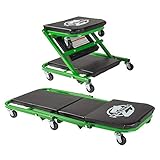


Top 3 picks at a glance
What Matters Most When Choosing a Creeper
Buying a creeper is not just about comfort. The wrong combination of frame height, wheel size, and padding will snag on floor seams, bottom out on uneven concrete, or leave you sore after 20 minutes under a car. Use these five criteria to match the creeper to your garage and the work you do most often.
1. Weight Capacity and Safety Margin
Most garage creepers are rated from 250 lb to 450 lb, with heavy-duty steel-frame models rated to 600 lb. The listed capacity is a static limit on a flat surface, not a dynamic load when you shift, push off, or carry tools on your chest.
Apply a simple safety margin calculation before you buy:
Required Rating = (Your Body Weight + 25 lb for Tools/Parts) x 1.25
For example, a 195 lb mechanic with a 15 lb tool pouch and a 10 lb part on their chest is carrying 220 lb total. 220 x 1.25 = 275 lb. A 300 lb rated creeper provides a safe margin. If you are 240 lb and often slide under a truck with an impact and socket set, you need 240 + 25 = 265 x 1.25 = 331 lb, so you should look at the 350-400 lb class.
Plastic blow-molded creepers usually cluster around 300-350 lb capacity and flex more under load. Tubular steel or heavy-duty aluminum frames with welded cross-braces maintain rigidity closer to their rated limit and are the better choice if you are near the upper end of the range.
2. Padding Type and Thickness
Padding determines how long you can stay under a vehicle without pressure points on your shoulder blades and lower back.
- Thin vinyl over hardboard (0.5 – 0.75 inch): Found on budget steel-frame creepers. Easy to wipe clean and resistant to oil and brake fluid, but transmits floor cold and causes fatigue quickly. Best for quick oil changes and brake jobs under 30 minutes.
- Medium-density foam with vinyl cover (1 – 1.25 inch): The sweet spot for most home garages. Provides lumbar support without raising your profile too much. Usually $50-$120 range.
- Contoured high-density foam / Bone-style ergonomic (1.5 – 2 inch): Models like the Bone 6031 Rough Rider use a one-piece contoured body with raised sides and headrest. They distribute weight better for transmissions, exhaust, or undercoating work that keeps you prone for an hour or more. Trade-off is 1-2 inches more overall height and a higher price, usually $120-$220.
Avoid open-cell foam or fabric-covered pads in a garage. They absorb oil and coolant and cannot be cleaned. Look for vinyl or chemical-resistant TPR that can be wiped down.
3. Wheel Clearance and Caster Design
Wheels are where cheap creepers fail. Two specs matter: wheel diameter and overall ground clearance.
- Wheel diameter: Standard casters are 1.5 to 2 inches. They roll fine on smooth, sealed concrete but stop at expansion joints, small pebbles, or floor cracks. 2.5 to 3-inch casters roll over debris and rough concrete with far less effort but raise the deck height.
- Ground clearance: Measured from the bottom of the frame to the floor. Most low-profile creepers provide 0.75 to 1.25 inches. If your garage has a raised lip at the door, chipped concrete, or epoxy flakes, 1.25 to 1.5 inches prevents the frame from dragging.
- Caster bearings and material: Non-marking polyurethane or TPR wheels are quieter and resist flat-spotting from being parked under a workbench. Steel ball-bearing swivels turn more easily under load than plain plastic bushings. Six-caster designs (two fixed center, four swivel) track straighter when pushing with your feet; full-swivel six-caster designs turn tighter in crowded garages.
If you have an interlocking tile or mat over concrete, choose larger, wider wheels. Narrow hard plastic wheels will sink and dig into the seams.
4. Frame Materials and Profile Height
Frame material controls weight, durability, and how low you can go.
- Blow-molded plastic: Lightest to carry (7-11 lb), corrosion-proof, and inexpensive. Flexes under heavier users and can crack if left in a hot car or dropped. Overall deck height is often 2.5 to 4 inches with pad.
- Tubular steel: Most common for garage use. Very rigid, usually powder-coated. Heavier (12-18 lb) and will rust if the coating chips and is left wet. Deck height around 3.5 to 4.5 inches.
- Hardwood or composite wood: Classic shop creeper style. Strong and very low (around 2.75 inches) but heavier and not oil-resistant without a sealed pad.
- Aluminum or hybrid aluminum/plastic: Corrosion-resistant and lighter than steel (9-13 lb) with good stiffness. Usually $90-$180.
Profile height matters more than it seems. Measure from your garage floor to the lowest point under your vehicle – often the pinch weld, subframe, or exhaust. Subtract 2 inches for clearance to move. If you work on a lowered sedan with 5 inches of clearance, you need a creeper with a total height under 3 inches. For a stock truck or SUV with 9+ inches, comfort can take priority over being ultra-low.
Decision Matrix: Match Your Garage Task to the Right Creeper Class
Use this table to map your most common repair to the spec class that will perform best, instead of guessing by price alone.
| Creeper Class | Typical Capacity | Pad Thickness | Wheel Size / Clearance | Total Deck Height | Best For |
|---|---|---|---|---|---|
| Low-Profile Plastic | 300-350 lb | 0.75-1.0 inch vinyl | 1.5-2.0 inch / 0.75-1.0 inch | 2.5-3.5 inches | Lowered cars, oil changes on smooth concrete |
| Standard Steel-Frame | 350-450 lb | 1.0-1.25 inch foam-vinyl | 2.0-2.5 inch / 1.0-1.25 inch | 3.5-4.5 inches | General DIY: brakes, exhaust, suspension |
| Heavy-Duty Steel | 450-600 lb | 1.0 inch dense vinyl | 2.5-3.0 inch steel-bearing / 1.25-1.5 inch | 4.0-5.0 inches | Heavier users, trucks, loaded with tools |
| Contoured Ergonomic (e.g., Bone 6031) | 350-400 lb | 1.5-2.0 inch molded TPR/foam | 3.0 inch TPR / 1.5 inch | 4.0-5.5 inches | Long jobs, rough or cracked floors, back support |
| Convertible Z-Creeper | 300-400 lb | 1.0 inch padded seat/creeper | 2.5-4.0 inch / 1.25 inch | 3.5 inches flat, 30+ inches as seat | Small garages where you alternate rolling and sitting |
Garage-Floor Performance in the Real World
Your floor decides wheel choice more than any marketing claim.
Smooth sealed concrete (most new garages): Any 2-inch caster will work. Prioritize low deck height and easy cleaning. A standard steel-frame creeper like the Pro-Lift C-2036D style or Lisle 97102 plastic model class rolls efficiently and stores vertically against the wall.
Older cracked or pitted concrete: Small wheels jam in cracks. You will spend more energy pushing than working. Choose 2.5-inch minimum polyurethane wheels and 1.25+ inches of ground clearance. Wipe wheels clean after use; grit in the bearing race is the main cause of hard rolling after a year.
Epoxy-coated or painted floors: Hard plastic wheels can mark or slip. Non-marking TPR or rubber-coated casters grip better and will not leave black streaks. Avoid steel wheels entirely.
Interlocking PVC tiles or rolled mats: These add seams and flex. Larger, wider casters (3-inch) bridge seams instead of falling into them. Very low-profile creepers often drag on tile edges – raise clearance over low height here.
Avoiding Common Creeper Problems
- Creeper drifts or spins: If all six casters swivel, the creeper will rotate when you push with one foot. Look for models with two fixed center casters if you want straighter travel along the length of the car.
- Back pain from thin pads: Add a 0.5-inch closed-cell foam kneeling pad on top of a thin creeper for long jobs rather than replacing the whole unit. It adds comfort without permanently raising height.
- Wheels clog with hair and dirt: Remove the caster bolt every 6-12 months, clear the axle of debris, and add a single drop of light machine oil. Do not use WD-40 as a long-term lubricant; it attracts dust.
- Frame bottoms out on jack stands: When using low jack stands, the creeper can hit the stand base. Keep 1.5 inches of clearance and approach from the side rather than head-on.
Which Models Fit Which User in 2026
Rather than chasing a single “best” pick, choose by spec class:
For maximum clearance under a low car on a perfect floor, the low-profile plastic class (exemplified by Lisle 97102 and similar blow-molded designs) offers the lowest deck and lightest weight, usually $40-$80.
For all-around home garage use that balances capacity, durability, and comfort, a tubular steel creeper with a 1-inch padded deck and 2-inch bearing casters is the default. This class includes models like the Craftsman and Pittsburgh Automotive steel creepers and Pro-Lift C-2036D types, usually $50-$110.
For rough floors or all-day comfort, a contoured ergonomic creeper such as the Bone 6031 Rough Rider justifies its price if you regularly spend 45+ minutes prone. The one-piece design prevents pressure points and the large TPR casters handle debris without jamming, usually $130-$220.
For tight one-car garages where you switch between under-car and wheel-well work, a Z-creeper that folds from a creeper to a seat saves space and eliminates a separate stool, usually $90-$160.
Final Buying Checklist
Before you order, run through this 60-second check:
- Calculate your required capacity with the 1.25x safety margin.
- Measure your vehicle’s lowest underbody point and subtract 2 inches to get your max creeper height.
- Check your floor: smooth and sealed = 2-inch wheels OK; cracked, tiled, or epoxy = 2.5-3 inch TPR needed.
- Confirm pad material is oil-resistant vinyl or TPR, not fabric.
- Verify total length is at least your height minus 4 inches so your head is supported without your feet hanging off and dragging.
When those four numbers line up, any creeper in the correct class will feel like one of the best mechanic creepers for your specific garage, not just a generic bestseller.
Frequently Asked Questions
What weight capacity do I really need?
Add your body weight plus about 25 lb for clothes, tools, and parts, then multiply by 1.25. That gives you the minimum rated capacity to avoid flex and premature wheel failure.
Are 6-wheel creepers better than 4-wheel?
Six wheels distribute weight better and reduce tipping when you reach to the side. Most 4-wheel creepers are now limited to small, ultra-low designs or convertible Z-creepers. For full-size adults, six casters are generally more stable.
Can a creeper be too low?
Yes. If the pad is under 0.75 inch or the frame rides under 0.75 inch off the floor, you will feel every pebble and the frame will drag on expansion joints. The practical minimum for comfort is about 1 inch of padding and 1 inch of ground clearance on smooth concrete.
How do I maintain the casters?
Keep the floor swept, wipe wheels after oily jobs, and periodically remove hair and grit from the axle. Store the creeper flat or hung vertically so wheels do not develop flat spots from constant load in one position.


