
The best laundry room storage systems with built-in folding station balance a 34 to 36-inch high folding surface, at least 24 inches of depth, durable countertop material, and cabinets sized to your wall width without blocking washer and dryer doors.
As an Amazon Associate we earn from qualifying purchases at no extra cost to you.
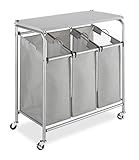

What Makes a Folding Station Actually Usable
Not all systems labeled as a folding station are comfortable to use. The critical factor is working height. Standard washer and dryer tops sit at 36 to 39 inches, but an ergonomic folding height for most adults between 5’4″ and 6’0″ is 34 to 36 inches. If the counter is too high, you will raise your shoulders and fatigue quickly; too low and you will hunch over. The best systems either provide an independent counter at 34.5 inches or use adjustable legs or wall-mounted brackets that let you set height independently of the appliances.
Depth matters just as much. A 20-inch deep surface fits a single laundry basket but leaves no room to unfold a shirt. Aim for 25 to 30 inches deep if you fold fitted sheets or large towels. If your laundry room is narrow, look for a hinged or pull-out folding shelf that provides full depth only when needed.
Countertop Materials Compared
Material choice affects durability, heat resistance, and how easy it is to keep the surface clean for folding clean clothes.
- Laminate over particleboard or MDF: Lightest and most affordable, usually $400–$700 for a full system. Resists stains but can swell if water seeps into seams. Best for dry, well-ventilated rooms.
- Solid surface or quartz: Non-porous, heat resistant, and will not warp from humidity or bleach splashes. Heavier and requires stronger wall support or base cabinets. Typically found in systems priced at $900–$1,600.
- Butcher block / solid wood: Warm appearance and can be sanded if scratched. Needs sealing every 6 to 12 months to prevent moisture staining. Better suited to larger laundry rooms where it is not directly exposed to constant steam.
- Powder-coated steel or aluminum worktop: Common in utility-style systems. Extremely durable and water resistant, but colder to the touch and noisier when setting baskets down.
Key Dimensions to Compare Before You Buy
Cabinet and counter sizing determines whether a system fits and functions, not just whether it fills the wall. Measure wall-to-wall width, ceiling height, and the required clearance in front of front-load washers and dryers before choosing a configuration.
| System Type | Total Width Range | Cabinet Depth | Folding Surface Height | Folding Surface Depth | Drawer Capacity (per drawer) |
|---|---|---|---|---|---|
| Wall-Mounted Counter + Upper Cabinets | 48–96 inches | 12–14 inches (uppers) | 34–36 inches (bracket set) | 25–30 inches | N/A – open hamper space below |
| Base Cabinet + Continuous Counter | 60–96 inches | 24 inches (base) | 34.5 inches (standard) | 25.5 inches | 35–45 liters, 35–50 lb rating |
| Freestanding Worktable with Shelving Tower | 48–72 inches | 18–20 inches (tower) | 34–36 inches (adjustable legs) | 24–28 inches | 25–30 liters, 25–35 lb rating |
| Stacked Washer/Dryer Surround with Fold-Down Shelf | 60–80 inches | 12–15 inches (overhead) | 36–38 inches (when folded out) | 20–24 inches | 20–30 liters, pull-out hamper |
Upper cabinets at 30 to 36 inches tall provide storage for detergent and supplies without interfering with the folding surface. Base cabinet systems offer the most drawer capacity for sorting, but they consume floor space and require level flooring. Wall-mounted systems keep the floor open for baskets and are easiest to install over existing appliances.
Drawer Capacity and Storage Layout
A folding station is only useful if you have somewhere to put clothes immediately after folding. Look at usable drawer volume, not just drawer count.
Shallow drawers 4 to 6 inches high are ideal for folded t-shirts, washcloths, and delicates. Deep drawers 10 to 12 inches high work better for pull-out hampers for dirty laundry or for storing bulky items like detergent jugs. Full-extension slides rated to 40 lb or more let you reach the back without the drawer sagging under a load of jeans.
For a household of 3 to 4 people, you need at least 120 liters of sorted storage near the folding surface to avoid piling clothes on the counter. That typically means three 40-liter pull-out hampers or two 45-liter drawers plus an open shelf for baskets. If your system has only upper cabinets, plan to place rolling hampers underneath the counter to make up the difference.
Installation Requirements: Wall-Mounted vs. Floor-Supported
Installation is where many buyers underestimate the work involved.
Wall-mounted counters and cabinets require attachment to studs or solid masonry. Drywall anchors alone will not support a loaded quartz or wood counter plus folded laundry. You need at least two studs per 36-inch cabinet and a ledger board or French cleat for the counter. The advantage is no plumbing or appliance movement is needed, and the system can be installed in a few hours with a drill, level, and stud finder.
Floor-supported base cabinets need level floors within about 1/4 inch over 6 feet. If your laundry floor slopes toward a drain, you will need adjustable leveling legs and a scribe to trim the toe kick. These systems are heavier and more stable for stone counters, but they often require disconnecting and sliding the washer and dryer to anchor the cabinets and counter.
Freestanding systems need no wall anchoring beyond an anti-tip strap for tall shelving towers. They are the best option for renters but will shift if not leveled, and they do not maximize vertical storage as effectively.
Check these clearances before ordering: allow 1 inch of air gap behind the washer and dryer for hoses and venting, 4 to 6 inches above the washer lid for top-load machines, and at least 48 inches of clear floor depth in front of front-load doors so you can stand and transfer clothes to the folding surface.
Small-Room Fit: How to Calculate If It Will Work
Small and galley-style laundry rooms under 60 square feet need a precise fit calculation. Use this worked example to avoid blocking doors or appliance access.
Worked calculation for a 72-inch wide by 84-inch deep room with side-by-side front-load machines:
Assume each machine is 27 inches wide, totaling 54 inches side-by-side, leaving 18 inches of wall space on one side. A base-cabinet system that is 60 inches wide will not fit along the appliance wall. Instead, a wall-mounted counter works as follows:
Wall width: 72 inches – 54 inches of machines = 18 inches left + 0.5 inch wall gap on each end = 17 inches usable. That is not enough for a permanent counter. Solution: install a 24-inch deep fold-down shelf on the opposite wall. When folded down at 35 inches high, it requires 24 inches of floor clearance. Room depth is 84 inches – 27 inches machine depth – 1 inch rear gap = 56 inches of open floor. With the shelf down, 56 – 24 = 32 inches of aisle remains, which is tight but passable for folding. When folded up, you regain full aisle width for loading.
For rooms narrower than 60 inches wide, avoid any permanent counter deeper than 20 inches on the opposite wall from the machines. Choose a pull-out or slide-out board that stores inside a 12-inch deep cabinet and extends to 28 inches only when in use.
Decision Matrix: Which Configuration Fits Your Situation
Match your room constraints and laundry habits to the system type.
| Your Situation | Best Configuration | Why It Fits |
|---|---|---|
| Rental, cannot drill into walls heavily | Freestanding worktable with shelving tower | No stud mounting, moves with you, adjustable legs handle uneven floors |
| Small closed room under 65 sq ft, front-load machines | Wall-mounted uppers + fold-down or pull-out shelf | Keeps floor open, provides full-depth folding only when needed |
| Large dedicated laundry room, family of 4+ | Base cabinets with continuous counter and pull-out hampers | Maximum drawer volume, permanent 25+ inch deep surface, handles heavy loads |
| Stacked washer/dryer in closet | Vertical surround with overhead cabinets and hinged shelf at 36 inches | Uses vertical space, shelf folds up to access stacked controls |
| Need to hide supplies, want clean look | Full-height cabinet wall with integrated counter | Concealed storage, quartz or laminate counter resists humidity |
What to Check Before Ordering
- Measure washer and dryer height with feet leveled. Order a counter height that is within 1 inch of that height if you want a continuous surface, or intentionally lower at 34.5 inches if ergonomics are the priority.
- Confirm stud locations and spacing. Systems wider than 48 inches require at least three studs for safe support of a loaded counter.
- Verify counter overhang. A 1 to 1.5 inch overhang beyond cabinet fronts prevents detergent drips from running down drawer faces.
- Look for soft-close hinges and full-extension slides. They add little to cost in the $600–$1,100 range but prevent slamming and make deep drawers usable.
- Check ventilation. If your room has no window or exhaust fan, prioritize moisture-resistant materials like laminate with sealed edges or powder-coated steel over raw wood.
FAQ
What height should a laundry folding station be?
For most adults, 34 to 36 inches high measured from the floor to the top of the counter is comfortable. If you are taller than 6’1″ or shorter than 5’3″, choose a system with adjustable legs or wall-mounted brackets that let you shift height by 2 to 3 inches.
Can I install a folding counter directly over front-load machines?
Yes, if the counter is wall-mounted and not resting on the machines. Leave at least 0.5 to 1 inch of clearance above the machines to absorb vibration during the spin cycle and to allow service access. Do not rigidly attach a counter to the appliances themselves.
How deep should drawers be for laundry sorting?
For sorting dirty laundry, 20 to 24 inches deep drawers that hold 35 to 45 liters each allow a full load per hamper. For storing folded clothes before they are put away, shallower 14 to 16 inch drawers prevent stacks from toppling.
Do I need base cabinets or will wall cabinets be enough?
Wall cabinets are sufficient if you fold small loads and use floor space for rolling hampers. Base cabinets are worth the floor space if you do 5 or more loads per week and want sorted hampers built into the system rather than sitting in the aisle.


