
A bed bug infestation is one of the most stressful household problems a person can face. These insects hide in mattress seams, box spring crevices, and baseboard gaps, and they reproduce fast enough that a single overlooked female can turn a manageable situation into a months-long battle. The right bed bug killer spray can break that cycle, but the market is crowded with products that range from genuinely effective residual formulas to watered-down aerosols that accomplish almost nothing.
What separates a worthwhile product from a waste of money comes down to a handful of measurable traits: kill efficacy data, whether the formula addresses eggs and resistant strains, residual duration after application, and safety profile for households with children and pets. We compared published specifications, owner-reported outcomes, and pricing across eight popular options available in 2026 to identify which sprays deliver on their claims and which ones leave buyers still calling exterminators.
As an Amazon Associate we earn from qualifying purchases at no extra cost to you.





Top 3 picks at a glance
Quick Picks
| Product | Best for | Price |
|---|---|---|
| EcoRaider 16 oz | Safe, certified plant-based kill with egg control | $19.95 |
| Ortho Home Defense Max Gallon | Broad-spectrum coverage for large areas | $19.48 |
| Ortho Home Defense Max Aerosol | Quick targeted applications on a budget | $12.27 |
| Harris Toughest Gallon | Maximum residual protection without odor | $59.99 |
| Harris 5 Minute Gallon | Fast-acting knockdown of visible populations | $69.99 |
| Hot Shot Ready-to-Use 32 oz | Convenience with no mixing required | $19.40 |
| EcoRaider 64 oz | Full-home eco-friendly treatment | $41.95 |
| Premo Guard | Proven kill rate backed by university testing | $29.97 |
How We Picked
We evaluated each product on four criteria that directly determine real-world outcomes: published kill efficacy (including whether the label confirms activity against eggs and pesticide-resistant populations), residual protection duration after a single application, safety and regulatory certification relevant to occupied bedrooms, and cost-per-ounce to gauge whether the price matches the volume delivered. A spray that kills on contact but offers no residual benefit forces repeated reapplication, and a spray that is safe but ineffective solves nothing. The best options balance all four factors.
The 8 Best Bed Bug Killer Spray in 2026
EcoRaider 16 oz EcoVenger
This USDA BIO-Certified formula is the strongest choice for households with children and pets that cannot tolerate synthetic pyrethroids. EcoRaider uses plant extract actives and reports 100% kill efficacy against bed bugs, mites, eggs, and resistant strains — a claim that stands out in this price tier.
- Pro: Verified 100% kill efficacy including eggs and resistant populations, backed by USDA certification
- Pro: Non-toxic and safe for use in bedrooms without ventilation downtime
- Con: The 16 oz bottle covers a limited area, so treating an entire bedroom or multiple rooms requires purchasing additional units
Skip this if you need immediate knockdown of a large visible population or if you are treating commercial spaces where synthetic residual performance matters more than safety certifications.
Ortho Home Defense Max Bed Bug, Flea & Tick Killer, 1 gal.
Ortho’s gallon jug is a workhorse product for anyone dealing with bed bugs alongside other crawling insects. The broad-spectrum label means one application addresses multiple pest types, which is practical when you are not certain what else has followed the bed bugs indoors.
- Pro: One gallon covers substantial floor and baseboard area at a very competitive per-ounce cost
- Pro: Addresses bed bugs, fleas, and ticks simultaneously, reducing the need for multiple products
- Con: Does not advertise specific egg or resistant-strain kill claims, so heavily established infestations may require supplemental treatment
Skip this if your primary concern is pesticide-resistant bed bugs or if you want a formula explicitly validated against eggs.
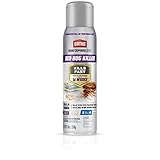
Ortho Home Defense Max Bed Bug Killer, Aerosol, 18 oz.
At just $12.27, this is the cheapest entry point on our list. The aerosol format suits people who want to spot-treat specific hiding spots — a headboard seam, a single box spring corner, or a small upholstered chair — without committing to a full liquid spray application.
- Pro: Lowest price on the list, making it accessible for renters or anyone treating a single room
- Pro: Convenient aerosol delivery with no pump sprayer needed
- Con: 18 oz is quickly exhausted on even a moderately sized treatment area, so it is impractical as a primary solution for anything beyond isolated spots
Skip this if the infestation has spread beyond a single piece of furniture, or if you need broad residual coverage across baseboards and carpet edges.
Harris Toughest Bed Bug Killer, Gallon
Harris positions this as their maximum-residual option, and the pricing reflects that ambition. At $59.99 per gallon, it is the most expensive broad-coverage liquid on our list, but the extended residual kill formula is designed to keep working after the initial application dries — critical for breaking the breeding cycle without constant reapplication.
- Pro: Odorless and non-staining, meaning it will not discolor light-colored bedding or carpet
- Pro: Extended residual formula reduces the frequency of follow-up applications
- Con: The price per ounce is roughly triple what Ortho charges for comparable volume, so budget-conscious buyers will balk
Skip this if you need immediate knockdown of a visible population or if your infestation is confined to a single room where a smaller aerosol would suffice.
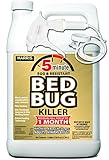
Harris 5 Minute Bed Bug Killer, 128 oz
When you can see the bugs crawling and want them dead within minutes, this is the product designed for that scenario. Harris engineered this formula for rapid contact kill while still maintaining an odorless, non-staining profile that makes bedroom application tolerable.
- Pro: Fast visible knockdown means you can confirm effectiveness within minutes of spraying
- Pro: The 128 oz container provides enough volume for a thorough multi-room treatment in a single purchase
- Con: At $69.99, it carries the highest price on this list, and the emphasis on speed means residual duration is not the primary selling point
Skip this if your main goal is long-term prevention rather than eliminating a population you can already see, or if you want a plant-based formula for safety.
Hot Shot Bed Bug Killer Ready-to-Use Spray, 32 oz
Hot Shot eliminates the mixing step entirely. This ready-to-use bottle comes with a trigger sprayer pre-attached, so you open it and start treating immediately. The 32 oz volume sits in the middle ground — enough for one full bedroom or a partial multi-room approach.
- Pro: No setup or dilution required, reducing preparation time to zero
- Pro: Trigger sprayer included, so you do not need to buy separate equipment
- Con: Does not highlight specific residual duration or egg-kill claims on the label, which can leave users reapplying more often than expected
Skip this if you need confirmed activity against pesticide-resistant strains or eggs, or if you are treating an area larger than a single room.
EcoRaider 64 oz EcoVenger
For households that want EcoRaider’s plant-based safety profile but need coverage across an entire apartment or home, the 64 oz bottle is the answer. Same certified 100% kill efficacy against bed bugs, mites, eggs, and resistant populations — just in a volume that makes whole-structure treatment realistic without buying multiple smaller bottles.
- Pro: Same USDA-certified efficacy as the 16 oz version at a lower per-ounce cost
- Pro: Safe for use in occupied bedrooms with children and pets present
- Con: $41.95 represents a significant upfront commitment, and the plant-based mechanism may act more slowly than synthetic pyrethroid alternatives on large visible populations
Skip this if you need same-day knockdown of a heavy infestation, or if your budget does not allow for the higher initial outlay.
Premo Guard Bed Bug & Mite Killer Spray
Premo Guard earns its place here because the 100% kill rate claim is attributed to university testing, which adds a layer of third-party validation that many competing labels lack. The price of $29.97 positions it as a mid-tier option between the budget aerosols and the premium gallon products.
- Pro: Kill efficacy claim backed by independent university research rather than manufacturer-only data
- Pro: Addresses both bed bugs and mites, broadening the range of pests controlled in a single application
- Con: Fewer published residual-performance details compared to Harris, so long-term prevention strategy may require a complementary product
Skip this if extended residual duration is your top priority, or if you are already using a synthetic pyrethroid product and want to avoid overlapping chemical exposure.
Buying Guide
Efficacy Claims: Contact Kill, Residual, and Egg Activity
Not all sprays do the same job. Contact kill means the product eliminates insects it hits directly, which is useful for visible populations but does nothing for eggs or bugs that were not present during application. Residual activity means the formula continues killing as bed bugs cross treated surfaces days or weeks later. Egg kill closes the breeding gap — if eggs hatch after your spray loses potency, the infestation restarts. Look for labels that confirm all three, and prioritize residual duration as the single most important factor for long-term resolution.
Safety Certifications and Occupied-Bedroom Use
A bedroom is where you sleep every night, so the safety profile matters more here than in a garage or basement. USDA BIO-Certification indicates the formula meets federal standards for reduced-risk pesticide status. Non-toxic plant extract products like EcoRaider allow treatment while children and pets remain in the home. Synthetic formulas are effective but typically require you to vacate the room during drying and ventilate afterward. Match the product’s safety profile to your household’s real constraints.
Volume, Cost Per Application, and Coverage Area
Buying the cheapest bottle is false economy if it runs out after one nightstand and a half-mattress. Calculate cost per application: a 32 oz ready-to-use spray that treats one bedroom versus a gallon that treats four rooms. A higher upfront price that covers your full infestation zone is cheaper in total than three small bottles that leave treated areas unprotected. Always buy for the actual scope of the problem, not the sticker price.
Our Verdict
The EcoRaider 16 oz EcoVenger is our top pick for most households because it is the only product under $20 that combines certified 100% kill efficacy against eggs and resistant strains with a USDA BIO-Certified safety profile that permits use in an occupied bedroom around children and pets. The budget pick is the Ortho Home Defense Max Aerosol at $12.27, ideal for a single isolated spot where the infestation has not spread. If your situation involves a large visible population requiring immediate knockdown across multiple rooms, the Harris 5 Minute formula wins on speed and volume despite its premium price.
FAQ
How long does a bed bug killer spray take to work?
Contact-kill formulas eliminate visible bed bugs within minutes of application, while residual products continue killing over days to weeks as insects cross treated surfaces. Complete resolution of an infestation typically requires the residual period to outlast the egg-hatching cycle.
Can I use bed bug spray on my mattress?
Only if the product label specifically lists mattress and bedding surfaces as approved application targets. Many liquid concentrates are meant for baseboards, carpet, and furniture frames but not the sleeping surface itself.
What is the difference between a residual spray and a contact spray?
A contact spray kills bugs it hits directly but loses effectiveness once dry. A residual spray leaves an active layer on surfaces that continues killing bed bugs for an extended period after application, making it the better choice for long-term control.
How do I know if the bed bugs are resistant to my spray?
If you apply a pyrethroid-based product and see no change in population density after the expected kill window, resistance is likely. Switch to a product with a different mechanism of action, such as a plant-extract formula or one that explicitly claims efficacy against resistant strains.


