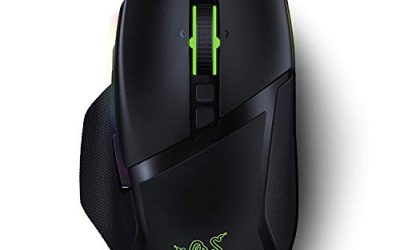
Yes — for the way most people actually move a mouse, the tracking hardware inside the Razer DeathAdder Essential covers the job comfortably, because its ceiling sits well above ordinary hand speed and ordinary sensitivity settings. Its optical unit tops out at a genuine 6,400 DPI, follows motion up to 220 inches per second, and reports position a thousand times each second. Players chasing the final edge in high-level competitive shooters are the main group likely to outgrow those limits.


As an Amazon Associate we earn from qualifying purchases
Key Facts About the Sensor
Five DPI Stages, and What Each One Feels Like
DPI is the link between hand movement and pointer movement: it sets how much cursor travel you get from each inch the mouse slides. A low setting turns a long arm sweep into a modest turn in a game, while a high setting turns a tiny wrist nudge into a large jump. Out of the box, this mouse cycles through five preset steps: 400, 800, 1,600, 3,200, and 6,400, with 1,600 selected as the starting point.
That spread is more useful than the headline maximum suggests. At 400 or 800, the pointer moves slowly enough for careful work: lining up a distant shot, tracing a precise line in an image editor, or nudging a selection box pixel by pixel. At 1,600, everyday desktop use feels balanced on a typical monitor, with a hand movement of a few inches crossing much of the screen. The 3,200 and 6,400 steps suit players who steer mostly from the wrist, use several monitors, or play on very high-resolution displays where low settings demand constant lifting and repositioning.
None of those presets is fixed. Through Razer Synapse 3 you can rewrite the stages, remove steps you never touch, and build a shorter cycle that matches your habits. A player who only ever alternates between a calm desktop setting and one gaming setting can keep just those two, which makes the on-the-fly switch faster and removes the risk of landing on an unfamiliar sensitivity mid-match. The important point is that 6,400 is a ceiling, not a recommendation. Most shooter players settle somewhere between 400 and 1,600, comfortably inside the range this hardware provides.
Tracking Speed and Acceleration, Translated
Two further figures describe how violently you can move the mouse before the sensor loses the surface. The first is tracking speed, quoted here as 220 IPS, meaning inches per second. In plain terms, you can drag the mouse across the pad at up to that pace and the pointer should still follow faithfully rather than skipping, stuttering, or spinning out. A fast flick in a shooter — the sudden snap toward an opponent appearing at the edge of your view — is exactly the movement this figure protects.
The second figure is acceleration tolerance, rated at 30 G. That describes how abruptly the mouse can change speed or direction without the tracking breaking down. Quick direction reversals, such as checking left then whipping right, stress this limit more than steady glides do. Together, 220 IPS and 30 G describe a sensor built for brisk, stop-start motion rather than only slow, deliberate aiming.
For context, relaxed and mid-paced play rarely pushes anywhere near either boundary. Large arm movements in low-sensitivity play can be fast, but they are usually smooth rather than violent. The players who approach these ceilings are those using extremely low sensitivity combined with huge mousepads and full-arm flicks, repeated many times a minute. If your style is calmer than that, the headroom here is generous.
Polling at 1,000 Hz and the One-Millisecond Report
Polling rate is how often the mouse tells the computer where it currently sits. This model uses Razer Ultrapolling at 1,000 Hz, which works out to one position report every millisecond. Each report is a fresh snapshot, so the gap between your hand moving and the machine learning about it stays very small and, just as importantly, very even.
Evenness matters more than raw speed for most people. A steady stream of updates produces smooth pointer motion, with no visible steps or judder as you draw a diagonal line or pan a camera. An uneven stream, by contrast, can feel gritty even when the average rate looks fine on paper. At 1,000 Hz, this mouse matches the long-standing standard used by the majority of wired gaming mice, so nothing about its reporting behaviour should feel dated in normal play.
Newer and pricier models now push polling far higher, and that difference can matter in a narrow set of circumstances: very high refresh-rate monitors, extremely fast flick shots, and players sensitive enough to notice tiny delays. For a 60 Hz or 144 Hz display and ordinary reaction times, a one-millisecond report interval is already far smaller than the other delays in the chain, from display response to your own hand.
Where This Sensor Genuinely Runs Out of Road
Every sensor has boundaries, and honesty about them helps you decide. The first boundary is the 6,400 DPI ceiling itself. It is a true optical rating rather than a software-inflated figure, which is good, but it is still lower than the ceilings on newer DeathAdder models by a wide margin. Anyone who plays at unusually high sensitivity — some arena shooter and real-time strategy players do — may find the top step limiting, especially across multiple large monitors.
The second boundary is customisation depth. There is no onboard memory on this model, so your rewritten DPI stages and button assignments live in the Synapse software rather than travelling inside the mouse. Plug it into another computer without that software installed and you return to the factory presets. For a single home setup that is a minor inconvenience; for someone who regularly plays on machines they do not control, it is a real drawback.
The third boundary is subtler. Higher-end sensors add refinements such as automatic surface calibration and smarter lift-off behaviour, which help when you frequently lift and set down the mouse or switch between very different desk surfaces. This simpler unit does not offer that layer of assistance. On a standard cloth pad at a fixed desk, you are unlikely to miss it. On varied surfaces, you might.
The Main Pick: Razer DeathAdder Essential (Black)
Beyond the sensor, the rest of the package is deliberately plain, and that plainness is part of the appeal. The shell keeps the familiar right-handed ergonomic outline the DeathAdder line is known for, with a raised hump that supports the palm and a shape that suits medium to larger hands. Five buttons can each be assigned independently, covering the two main clicks, the wheel click, and a pair of thumb buttons — enough for a reload, a melee action, a push-to-talk key, or a couple of everyday shortcuts without crowding your thumb.
The main switches are mechanical units from Razer with a rated lifespan of ten million clicks, and the lighting is a single green colour rather than a full spectrum system. The cable keeps the connection wired and dependable, with no battery to charge and no wireless link to drop. At roughly 96 grams before the cable, it is not an ultralight mouse, and that weight gives it a planted, deliberate feel that some players prefer for controlled tracking.
Specs
- Sensor: True 6,400 DPI optical sensor
- Default DPI stages: 400, 800, 1,600 (default), 3,200, 6,400
- Tracking speed: Up to 220 IPS
- Acceleration: Up to 30 G
- Polling: 1,000 Hz Ultrapolling, 1 ms response
- Buttons: 5 independently programmable Hyperesponse buttons
- Switches: Razer Mechanical Mouse Switches, rated for 10 million clicks
- Shape: Wired ergonomic right-handed shell
- Dimensions: Approx. 127 x 73 x 43 mm
- Weight: Approx. 96 g excluding cable
- Lighting: Single-colour green
- Software: Razer Synapse 3 enabled, DPI stages reprogrammable in Synapse
- Onboard memory: None
Alternatives Worth Comparing
The two models below are alternatives from the same family, included so you can judge the Essential against its own relatives rather than against unrelated designs. Both step up the sensor considerably, and both change other parts of the package at the same time.
Alternative: Razer DeathAdder V2 (Wired)
The V2 is the clearest step up if the Essential sensor numbers feel tight. Its Focus+ optical unit reaches 20,000 DPI and adds Smart Tracking, which helps the sensor adjust to the surface beneath it. Tracking headroom grows sharply as well, to 650 IPS and 50 G, so even very aggressive flick play stays well inside the envelope. You also gain three extra buttons, taking the total to eight, and optical switches with a much higher click rating of 70 million. At 82 grams it is noticeably lighter in the hand, which suits players who found the Essential a touch heavy for fast swipes.
Specs
- Sensor: Focus+ 20,000 DPI optical sensor with Smart Tracking
- Tracking speed: Up to 650 IPS
- Acceleration: Up to 50 G
- Buttons: 8 programmable buttons
- Switches: Optical switches, rated for 70 million clicks
- Weight: 82 g
- Connection: Wired
Alternative: Razer DeathAdder V3 (Wired)
The V3 pushes the same idea much further. Its Focus Pro 30K optical sensor reaches 30,000 DPI, tracks up to 750 IPS, and tolerates 70 G of acceleration, while polling can climb to 8,000 Hz through HyperPolling. Six programmable buttons sit in a shell weighing only 59 grams, and its third-generation optical switches are rated to survive 90 million clicks. This is the option aimed squarely at competitive players who want every sensor figure as high as it can go, in the lightest wired DeathAdder body of the three.
Specs
- Sensor: Focus Pro 30K optical sensor, up to 30,000 DPI
- Tracking speed: Up to 750 IPS
- Acceleration: Up to 70 G
- Polling: Up to 8,000 Hz HyperPolling
- Buttons: 6 programmable buttons
- Switches: Optical Switches Gen-3, rated for 90 million clicks
- Weight: 59 g
- Connection: Wired, Speedflex cable
Side-by-Side Comparison
| Product | Max DPI | Max Speed (IPS) | Buttons | Weight | Polling |
|---|---|---|---|---|---|
| Razer DeathAdder Essential | 6,400 | 220 | 5 | Approx. 96 g | 1,000 Hz |
| Razer DeathAdder V2 | 20,000 | 650 | 8 | 82 g | 1,000 Hz |
| Razer DeathAdder V3 | 30,000 | 750 | 6 | 59 g | Up to 8,000 Hz |
Read the table with your own habits in mind rather than treating the largest number as the automatic winner. If your chosen sensitivity sits at 800 and your flicks are measured rather than violent, the first row already exceeds what you ask of it, and the differences in the other rows will mostly go unused. If you play at very high sensitivity, lift the mouse constantly, or compete at a level where small delays register, the later rows describe real, usable headroom rather than decoration.
Who It Is For, and Who Should Skip It
This mouse fits players whose gaming lives at ordinary sensitivities: story-driven games, strategy titles, casual shooters, MOBAs, and mixed desktop use where one device handles work and play alike. It also suits someone who values a proven ergonomic shape, wants wired reliability without charging routines, and would rather have a short, understandable feature list than a long one. If your current mouse already tracks at similar figures and you have never caught it skipping or spinning out, this sensor will feel familiar in the best sense.
Skip it if you compete seriously in fast shooters and already know you exploit higher polling rates or extreme flick speeds. Skip it if you play at very high DPI settings, if you need settings stored inside the mouse for use on other computers, or if a sub-70-gram shell matters to your style. Left-handed players should also look elsewhere, because the sculpted body is right-handed only. In each of those cases, one of the alternatives above, or a different family entirely, will serve you better.
Frequently Asked Questions
Is 6,400 DPI high enough for shooters?
For the overwhelming majority of shooter players, yes. Competitive players commonly use effective sensitivities built on 400 to 1,600 DPI combined with an in-game multiplier, which sits far below this ceiling. You would only feel the limit if you deliberately play at very high sensitivity settings or pair a high setting with a large, high-resolution display setup.
What does 220 IPS actually protect against?
It protects against tracking failure during fast movement. When you snap the mouse sideways quickly, the sensor must keep reading the surface many times in rapid succession; exceed its speed rating and the pointer can skip or veer. At 220 inches per second, that failure point sits beyond the speed of typical flicks, so ordinary and even brisk play stays safely inside it.
Can the DPI stages be changed from the factory settings?
Yes. The five factory steps can be rewritten inside Razer Synapse 3, and you can reduce the cycle to fewer steps if you prefer. Remember that this model has no onboard memory, so those custom stages depend on the software being present on the computer you are using.
Does 1,000 Hz polling make a visible difference?
It makes motion smoother and more consistent compared with slower office-grade polling, because the computer receives a fresh position every millisecond. The benefit shows up as clean diagonal movement and steady camera pans. Gains beyond this rate exist on newer models, but they are far harder to notice on typical monitors.
Why would anyone need 20,000 or 30,000 DPI?
Very few players use settings anywhere near those figures directly. The higher ceilings arrive alongside sensors that also track faster, tolerate harder acceleration, and handle lift-off and varied surfaces more cleverly. In practice you are buying that broader headroom and refinement, not a sensitivity you will actually select.
Related guides
More from Amazon
Programs that pair well with the guide above. Offers and eligibility are set by Amazon and may change.
Free shipping on eligible items, Prime Video and more. Eligible new members can start with a free trial.
Start a Prime free trialAd-free music streaming. Eligible new subscribers can start with a free trial.
Try Music Unlimited freeA Prime membership for ages 18-24 with a trial period. Eligibility is set by Amazon.
See Prime for Young AdultsAudiobooks and podcasts to listen to on the go. Eligible new members can start with a free trial.
Try Audible freeAs an Amazon Associate we earn from qualifying purchases.