The best DisplayPort VR headsets share one simple advantage: a wired connection that carries the image from your graphics card to the headset without compression. That matters whenever you care about sharp text, fine detail, and a stable frame rate, from high-end PC games to simulation and creative work. A DisplayPort cable also keeps latency low, which is something you feel the moment you turn your head quickly.
This guide covers the headsets that connect to a PC over DisplayPort, either directly with a cable in the box or, for the PlayStation VR2, through a separate PC Adapter that uses a DisplayPort connection. Each pick is judged on resolution, field of view, refresh rate, tracking, and how straightforward the PC setup is.
Our Top Picks

Top 3 picks at a glance

What to Look For in a DisplayPort VR Headset
A DisplayPort headset is a PC peripheral first, so check the PC side of the setup as carefully as the headset itself. The right choice depends on your graphics card, your available ports, and how you play.
-
Native DisplayPort input: check whether the headset connects directly over DisplayPort or needs an adapter. A direct cable is simpler and avoids extra hardware.
-
GPU headroom: a high-resolution headset asks a lot of a graphics card. Match the headset resolution to a GPU that can hold a steady frame rate at that resolution.
-
Resolution per eye: higher pixel counts give sharper text and cleaner distant detail, which is the main reason to choose a wired headset over a wireless one.
-
Field of view: a wider view feels more immersive and shows more of the scene without head turning. Look for 110 degrees and above.
-
Refresh rate: 90 Hz is the baseline for comfortable VR, and 120 Hz gives smoother motion in fast games. Make sure your GPU can sustain the rate you choose.
-
Tracking type: base-station tracking is very stable but needs mounted sensors, while inside-out tracking needs no extra hardware and sets up faster.
The Picks
HTC VIVE Pro 2 Virtual Reality System
The Vive Pro 2 is the reference DisplayPort headset here, with a direct wired connection and SteamVR tracking.
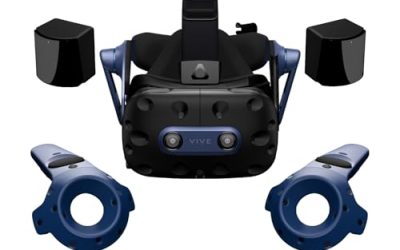
The HTC VIVE Pro 2 is a full PC VR system built around two LCD panels with a combined 4896 x 2448 resolution, a 120-degree field of view, and a 120 Hz refresh rate. It connects to a Windows PC over DisplayPort and USB, and it works with SteamVR. The full system in the listing includes the headset, two Base Station 2.0 units, and two wireless controllers, so the tracking setup is the familiar outside-in SteamVR arrangement with sub-millimetre tracking accuracy.
Comfort and fit get real attention here. The headset uses a balanced construction with an IPD adjustment dial, and it fits a wide range of head sizes and vision types, including glasses wearers. Built-in Hi-Res headphones provide 3D spatial sound without a separate headset, which keeps the cable run simpler on a desk.
Best for: PC VR users who want a wired DisplayPort connection, high resolution, and SteamVR tracking.
Keep in mind: this is a wired, base-station system, so it needs a clear play area, mounted or placed base stations, and a PC with a DisplayPort output.
Pimax Crystal Super VR Headset
The Crystal Super is the high-resolution DisplayPort option, with the widest view and the sharpest panels in this group.
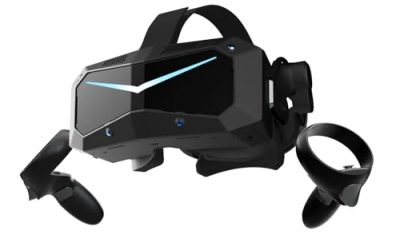
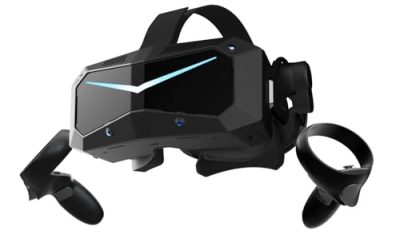
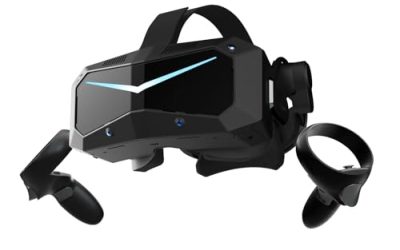
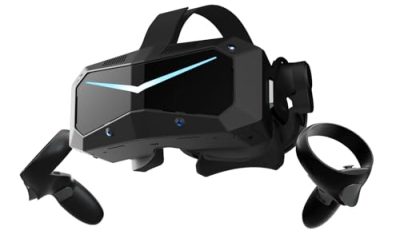
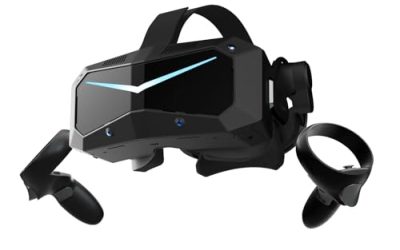
The Pimax Crystal Super is a PC VR headset built for visual breadth. The full payment version in the listing pairs 3840 x 3840 pixels per eye with an ultrawide 140-degree field of view, QLED panels with Mini-LED local dimming, and built-in eye tracking with automatic IPD adjustment from 58 to 72 mm. A DisplayPort cable is included in the box, and the headset connects to a Windows PC over DisplayPort 1.4a with USB.
Eye tracking here does more than move a cursor. It supports foveated rendering in compatible software, so the area you are looking at can be rendered in full detail while the periphery is rendered more lightly. Lighthouse tracking is available as an option for users who already own base stations, and the headset works with SteamVR and OpenXR content.
Best for: simulation and high-end PC VR users who want the widest field of view in this group and built-in eye tracking.
Keep in mind: this is a demanding headset that asks for a strong GPU, and the ultrawide view and high resolution need a PC that can drive them.
PlayStation VR2 (PSVR2)
The PSVR2 reaches PC VR through the separate PC Adapter, which connects over DisplayPort.
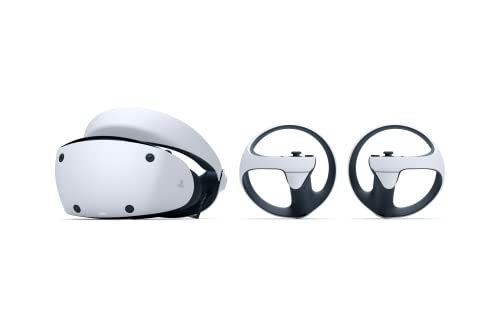
The PlayStation VR2 pairs 2000 x 2040 pixels per eye with a 110-degree field of view and 4K HDR visuals. Its PlayStation VR2 Sense technology includes eye tracking, headset feedback, and 3D Audio, and the Sense controllers add haptic feedback, adaptive triggers, and finger touch detection. The headset connects to a PlayStation 5 console with a single cable.
For PC use, Sony provides a separate PlayStation VR2 PC Adapter, which connects the headset to a Windows PC for SteamVR, and that adapter uses a DisplayPort connection. Confirm the adapter is included in the listing you choose, because the standard headset box on its own is built around the console connection.
Best for: PlayStation 5 owners who want eye tracking and strong haptics, and PC users willing to add the separate PC Adapter.
Keep in mind: PC use needs the separate adapter, and eye-tracking features depend on software support in each title.
Comparison Table
| Product | Key features | Best for |
|---|---|---|
| HTC VIVE Pro 2 Virtual Reality System | DisplayPort, 120-degree FOV, 4896 x 2448, 120 Hz, SteamVR | Wired PC VR with SteamVR tracking |
| Pimax Crystal Super VR Headset | DisplayPort, 140-degree FOV, 3840 x 3840 per eye, eye tracking | Wide-view simulation and eye tracking |
| PlayStation VR2 (PSVR2) | Eye tracking, 110-degree FOV, 2000 x 2040 per eye, PS5 and PC with adapter | PS5 play and PC VR with the separate adapter |
Frequently Asked Questions
What is a DisplayPort VR headset?
A DisplayPort VR headset connects to a PC graphics card over a DisplayPort cable, which carries an uncompressed video signal. That gives you a sharper image and lower latency than a wireless or USB-compressed connection, at the cost of a cable between you and the PC.
Do I need a DisplayPort output on my graphics card?
Yes, for a direct connection. Most modern desktop graphics cards include at least one DisplayPort output, but some laptops and compact PCs do not, so check the ports on your machine before you buy. If your only output is HDMI, a DisplayPort headset is not the right choice without an adapter, and adapters can limit resolution and refresh rate.
Is DisplayPort better than wireless PC VR?
For image quality, yes. A wired DisplayPort link avoids the compression that wireless streaming applies, so fine detail stays sharp. Wireless wins on freedom of movement, so the choice comes down to whether you value clarity or cable-free play more.
Can I use a DisplayPort headset with a laptop?
Sometimes. A laptop needs a DisplayPort output, or a USB-C port with DisplayPort Alt Mode, wired directly to the discrete GPU. Many laptops route the external display through the integrated GPU instead, which causes problems. Check the laptop manual or the manufacturer support page before you buy.
Does DisplayPort affect the field of view?
No. Field of view is a property of the lenses and the panels, not the cable. DisplayPort affects image quality and latency, while the field of view depends on the headset design. The two are often found together because high-end headsets tend to combine both.
Conclusion
The Vive Pro 2 is the safest all-round DisplayPort choice, because it connects directly, works with SteamVR, and covers resolution, field of view, and refresh rate in one system. The Pimax Crystal Super is the pick when maximum clarity and the widest view matter most, as long as your GPU can drive it. The PlayStation VR2 is the way in for console owners, provided you add the separate PC Adapter for PC use. Check your graphics card ports first, then choose the headset whose resolution your PC can sustain.
Disclosure: As an Amazon Associate, we may earn from qualifying purchases.
Related guides
More from Amazon
Programs that pair well with the guide above. Offers and eligibility are set by Amazon and may change.
Free shipping on eligible items, Prime Video and more. Eligible new members can start with a free trial.
Start a Prime free trialAd-free music streaming. Eligible new subscribers can start with a free trial.
Try Music Unlimited freeA Prime membership for ages 18-24 with a trial period. Eligibility is set by Amazon.
See Prime for Young AdultsAudiobooks and podcasts to listen to on the go. Eligible new members can start with a free trial.
Try Audible freeAs an Amazon Associate we earn from qualifying purchases.