Seated VR asks a headset to do something specific: give you a wide view of a world you explore mostly with your eyes. The best wide-field-of-view VR headsets for seated VR open up the scene so you can glance at a cockpit panel, a virtual desktop, or a cinema screen without turning your head, and they do it while you sit comfortably for an hour or more.
The picks below cover both wireless and wired ways to get that view. A standalone headset gives you a wide view with no cables and no PC, while a wired PC headset gives you the widest views of all, with sharper panels and a steadier image for long seated sessions.
Our Top Picks


Top 3 picks at a glance

What to Look For in a Seated Wide-View Headset
When you sit, the headset should disappear. Comfort, a wide clear view, and stable tracking matter more than room-scale features you will never use from a chair.
-
Field of view: 110 degrees is a wide view, 120 degrees is wider, and 140 degrees is the widest here. From a chair, the difference shows every time you glance sideways.
-
Comfort and balance: a headset that presses on the forehead will end a seated session early. Look for balanced weight, a good strap, and a soft facial interface.
-
Resolution per eye: seated play often means reading text, whether it is a cockpit instrument, a subtitle, or a virtual desktop. Higher pixel counts keep that text sharp.
-
Lens sweet spot: a large clear area keeps the image sharp when your eyes move, which is how you look around when seated.
-
Tracking stability: seated tracking should never drift. Both base-station and inside-out tracking work well here, as long as the setup is correct.
-
Audio: built-in headphones or good spatial audio keep the setup simple from a chair, where extra cables are a nuisance.
The Picks
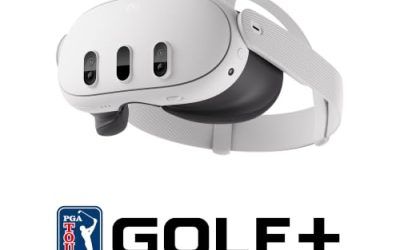
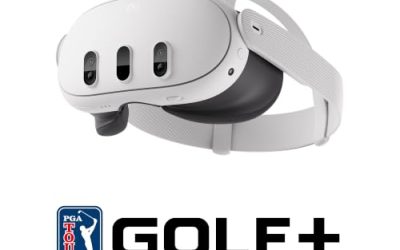
Meta Quest 3 512GB

The Quest 3 is the wireless seated pick, with a 110-degree view and no cables to manage from a chair.
The Meta Quest 3 512GB is a standalone mixed reality headset with 2064 x 2208 pixels per eye, a 110-degree field of view, and a refresh rate of up to 120 Hz. It runs on the Snapdragon XR2 Gen 2 processor with 8GB of RAM and 512GB of storage, and it ships with two Touch Plus controllers, a charging cable, and a power adapter. Full-colour passthrough blends virtual objects with the room around you.
Because it needs no PC and no external sensors, it is the simplest headset in this group to set up in a living room. It can also connect to a PC over USB-C or wirelessly for PC VR content, which makes it a flexible second option for households that already own a gaming PC.
Best for: home VR users who want a wireless, standalone headset with mixed reality and a large content library.
Keep in mind: it has no DisplayPort input and no built-in eye tracking, and battery life is around two hours per charge.
HTC VIVE Pro 2 Virtual Reality System
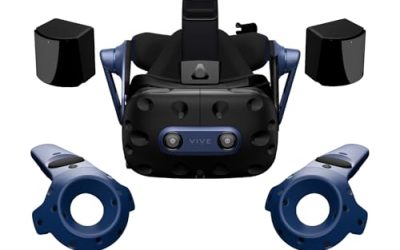
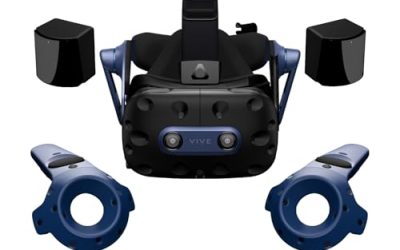
The Vive Pro 2 is the balanced seated pick, with a 120-degree view, built-in headphones, and stable tracking.
The HTC VIVE Pro 2 is a full PC VR system built around two LCD panels with a combined 4896 x 2448 resolution, a 120-degree field of view, and a 120 Hz refresh rate. It connects to a Windows PC over DisplayPort and USB, and it works with SteamVR. The full system in the listing includes the headset, two Base Station 2.0 units, and two wireless controllers, so the tracking setup is the familiar outside-in SteamVR arrangement with sub-millimetre tracking accuracy.
Comfort and fit get real attention here. The headset uses a balanced construction with an IPD adjustment dial, and it fits a wide range of head sizes and vision types, including glasses wearers. Built-in Hi-Res headphones provide 3D spatial sound without a separate headset, which keeps the cable run simpler on a desk.
Best for: PC VR users who want a wired DisplayPort connection, high resolution, and SteamVR tracking.
Keep in mind: this is a wired, base-station system, so it needs a clear play area, mounted or placed base stations, and a PC with a DisplayPort output.
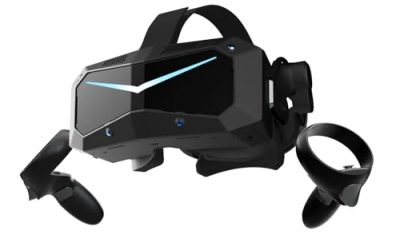
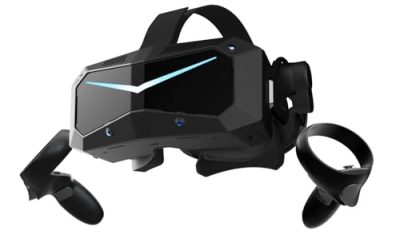
Pimax Crystal Super VR Headset
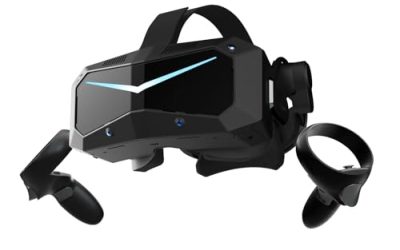
The Crystal Super is the widest seated pick, with a 140-degree view and the sharpest panels here.
The Pimax Crystal Super is a PC VR headset built for visual breadth. The full payment version in the listing pairs 3840 x 3840 pixels per eye with an ultrawide 140-degree field of view, QLED panels with Mini-LED local dimming, and built-in eye tracking with automatic IPD adjustment from 58 to 72 mm. A DisplayPort cable is included in the box, and the headset connects to a Windows PC over DisplayPort 1.4a with USB.
Eye tracking here does more than move a cursor. It supports foveated rendering in compatible software, so the area you are looking at can be rendered in full detail while the periphery is rendered more lightly. Lighthouse tracking is available as an option for users who already own base stations, and the headset works with SteamVR and OpenXR content.
Best for: simulation and high-end PC VR users who want the widest field of view in this group and built-in eye tracking.
Keep in mind: this is a demanding headset that asks for a strong GPU, and the ultrawide view and high resolution need a PC that can drive them.
PlayStation VR2 (PSVR2)
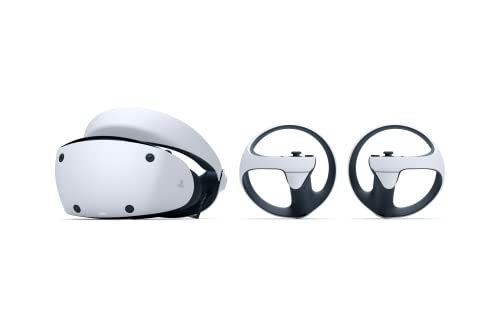
The PSVR2 is the console seated pick, with eye tracking and haptics that suit cockpit and narrative games.
The PlayStation VR2 pairs 2000 x 2040 pixels per eye with a 110-degree field of view and 4K HDR visuals. Its PlayStation VR2 Sense technology includes eye tracking, headset feedback, and 3D Audio, and the Sense controllers add haptic feedback, adaptive triggers, and finger touch detection. The headset connects to a PlayStation 5 console with a single cable.
For PC use, Sony provides a separate PlayStation VR2 PC Adapter, which connects the headset to a Windows PC for SteamVR, and that adapter uses a DisplayPort connection. Confirm the adapter is included in the listing you choose, because the standard headset box on its own is built around the console connection.
Best for: PlayStation 5 owners who want eye tracking and strong haptics, and PC users willing to add the separate PC Adapter.
Keep in mind: PC use needs the separate adapter, and eye-tracking features depend on software support in each title.
Comparison Table
| Product | Key features | Best for |
|---|---|---|
| Meta Quest 3 512GB | Standalone, 110-degree FOV, 2064 x 2208 per eye, up to 120 Hz | Wireless home VR and mixed reality |
| HTC VIVE Pro 2 Virtual Reality System | DisplayPort, 120-degree FOV, 4896 x 2448, 120 Hz, SteamVR | Wired PC VR with SteamVR tracking |
| Pimax Crystal Super VR Headset | DisplayPort, 140-degree FOV, 3840 x 3840 per eye, eye tracking | Wide-view simulation and eye tracking |
| PlayStation VR2 (PSVR2) | Eye tracking, 110-degree FOV, 2000 x 2040 per eye, PS5 and PC with adapter | PS5 play and PC VR with the separate adapter |
Frequently Asked Questions
How wide should the field of view be for seated VR?
A 110-degree view already feels open from a chair, and it suits media, desktop use, and casual games. A 120-degree or 140-degree view is better for simulation, because it lets you check side panels and mirrors with a glance rather than a head turn.
Is a standalone headset comfortable for long seated sessions?
Yes, for most people. A standalone headset is light and wireless, which helps from a chair, and the battery lasts around two hours per charge. Keep the charging cable nearby if you plan longer sessions, and take a short break between sessions.
Can I use a wired headset while seated without tangling the cable?
Yes. Run the cable behind the chair and let it rest on the floor, so it never crosses your lap or your arms. A cable hook or a simple clip on the chair back keeps it in place, and seated play barely moves the cable at all.
Does a wide field of view help with virtual desktop use?
Yes. A wide view lets you place several virtual screens around you and glance between them, which feels closer to a multi-monitor desk than a single narrow window. High resolution matters here too, because text needs sharp pixels to stay readable.
What chair works best for seated VR?
A stable, armless chair with a low back works best, because armrests and high backs can interfere with the controllers and with the headset cable. A swivel chair is useful in sims and social apps, because it lets you turn smoothly without standing.
Conclusion
For seated VR with a wide view, the Meta Quest 3 is the easiest choice, because it needs no PC and no cables, and its 110-degree view suits media, desktop use, and casual games from a chair. The Vive Pro 2 is the step up for PC owners, with a 120-degree view and stable tracking. The Pimax Crystal Super is the widest view of all, and the right choice for simulation from a chair. The PlayStation VR2 rounds out the group for console owners who want eye tracking in seated play. Pick the headset that matches your PC or console, then set your chair, set your position, and enjoy the view.
Disclosure: As an Amazon Associate, we may earn from qualifying purchases.
Related guides
More from Amazon
Programs that pair well with the guide above. Offers and eligibility are set by Amazon and may change.
Free shipping on eligible items, Prime Video and more. Eligible new members can start with a free trial.
Start a Prime free trialAd-free music streaming. Eligible new subscribers can start with a free trial.
Try Music Unlimited freeA Prime membership for ages 18-24 with a trial period. Eligibility is set by Amazon.
See Prime for Young AdultsAudiobooks and podcasts to listen to on the go. Eligible new members can start with a free trial.
Try Audible freeAs an Amazon Associate we earn from qualifying purchases.