Simulation is the most demanding use a VR headset can face. A flight simulator asks you to read small instruments at a distance, a racing simulator asks you to judge a corner at speed, and both punish a soft image or a narrow view. The best DisplayPort VR headsets for VR simulation answer with a wired connection that carries an uncompressed image from the graphics card, so the cockpit stays sharp and the horizon stays steady.
DisplayPort matters here because it removes the compression and the wireless variability that can blur fine detail. The headsets below all connect to a PC over DisplayPort, either directly or, in the case of the PlayStation VR2, through a separate PC Adapter that uses a DisplayPort connection. Each one is judged on the things sims care about: field of view, resolution, refresh rate, and tracking stability.
Our Top Picks

Top 3 picks at a glance
What to Look For in a Simulation VR Headset
Simulation rewards a different set of strengths than room-scale gaming. You sit still, you look around a cockpit, and you read instruments, so clarity at the centre and at the edges both count.
-
DisplayPort connection: a native DisplayPort cable carries an uncompressed signal from the GPU, which keeps instrument text readable and avoids compression artefacts.
-
Field of view: a wide view lets you check mirrors, side windows, and wing views without turning your whole head, which matters in both flight and racing sims.
-
Resolution per eye: high pixel counts keep distant runways, track markers, and dashboard labels legible. This is where simulation headsets earn their keep.
-
Refresh rate: a steady 90 Hz or 120 Hz keeps motion smooth when the scenery moves quickly, and it reduces the strain of long sessions.
-
Tracking stability: a seated sim needs tracking that never drifts. Base-station tracking and solid inside-out tracking both work, as long as the play space is set up correctly.
-
Eye tracking: in compatible sims, eye tracking supports foveated rendering, which concentrates detail where you are looking and eases the load on the GPU.
The Picks
Pimax Crystal Super VR Headset

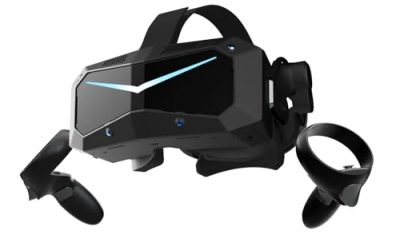
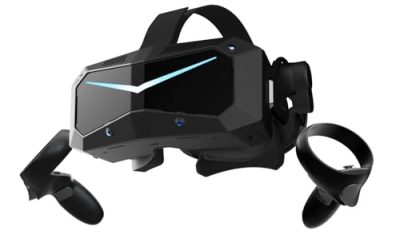
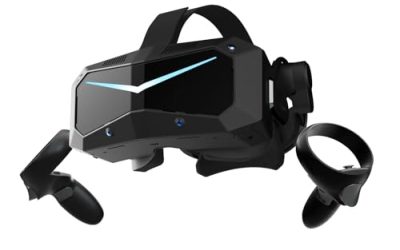
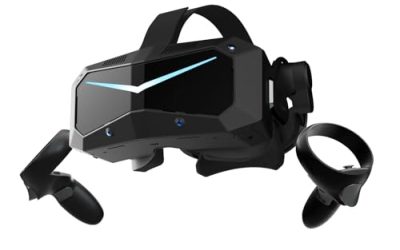
The Crystal Super is the simulation pick in this group, with the widest field of view and the highest per-eye resolution here.
The Pimax Crystal Super is a PC VR headset built for visual breadth. The full payment version in the listing pairs 3840 x 3840 pixels per eye with an ultrawide 140-degree field of view, QLED panels with Mini-LED local dimming, and built-in eye tracking with automatic IPD adjustment from 58 to 72 mm. A DisplayPort cable is included in the box, and the headset connects to a Windows PC over DisplayPort 1.4a with USB.
Eye tracking here does more than move a cursor. It supports foveated rendering in compatible software, so the area you are looking at can be rendered in full detail while the periphery is rendered more lightly. Lighthouse tracking is available as an option for users who already own base stations, and the headset works with SteamVR and OpenXR content.
Best for: simulation and high-end PC VR users who want the widest field of view in this group and built-in eye tracking.
Keep in mind: this is a demanding headset that asks for a strong GPU, and the ultrawide view and high resolution need a PC that can drive them.
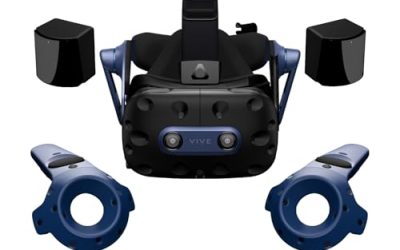
HTC VIVE Pro 2 Virtual Reality System
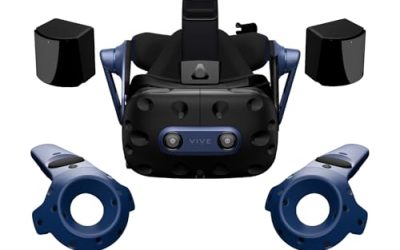
The Vive Pro 2 is the proven simulation workhorse, with base-station tracking and a 120 Hz refresh rate.
The HTC VIVE Pro 2 is a full PC VR system built around two LCD panels with a combined 4896 x 2448 resolution, a 120-degree field of view, and a 120 Hz refresh rate. It connects to a Windows PC over DisplayPort and USB, and it works with SteamVR. The full system in the listing includes the headset, two Base Station 2.0 units, and two wireless controllers, so the tracking setup is the familiar outside-in SteamVR arrangement with sub-millimetre tracking accuracy.
Comfort and fit get real attention here. The headset uses a balanced construction with an IPD adjustment dial, and it fits a wide range of head sizes and vision types, including glasses wearers. Built-in Hi-Res headphones provide 3D spatial sound without a separate headset, which keeps the cable run simpler on a desk.
Best for: PC VR users who want a wired DisplayPort connection, high resolution, and SteamVR tracking.
Keep in mind: this is a wired, base-station system, so it needs a clear play area, mounted or placed base stations, and a PC with a DisplayPort output.
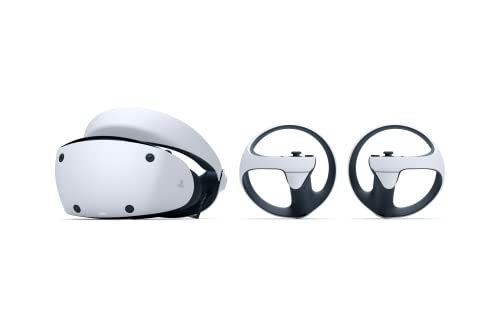
PlayStation VR2 (PSVR2)
The PSVR2 is the console-origin option that reaches PC simulation through the separate PC Adapter.
The PlayStation VR2 pairs 2000 x 2040 pixels per eye with a 110-degree field of view and 4K HDR visuals. Its PlayStation VR2 Sense technology includes eye tracking, headset feedback, and 3D Audio, and the Sense controllers add haptic feedback, adaptive triggers, and finger touch detection. The headset connects to a PlayStation 5 console with a single cable.
For PC use, Sony provides a separate PlayStation VR2 PC Adapter, which connects the headset to a Windows PC for SteamVR, and that adapter uses a DisplayPort connection. Confirm the adapter is included in the listing you choose, because the standard headset box on its own is built around the console connection.
Best for: PlayStation 5 owners who want eye tracking and strong haptics, and PC users willing to add the separate PC Adapter.
Keep in mind: PC use needs the separate adapter, and eye-tracking features depend on software support in each title.
Comparison Table
| Product | Key features | Best for |
|---|---|---|
| Pimax Crystal Super VR Headset | DisplayPort, 140-degree FOV, 3840 x 3840 per eye, eye tracking | Wide-view simulation and eye tracking |
| HTC VIVE Pro 2 Virtual Reality System | DisplayPort, 120-degree FOV, 4896 x 2448, 120 Hz, SteamVR | Wired PC VR with SteamVR tracking |
| PlayStation VR2 (PSVR2) | Eye tracking, 110-degree FOV, 2000 x 2040 per eye, PS5 and PC with adapter | PS5 play and PC VR with the separate adapter |
Frequently Asked Questions
Why does DisplayPort matter for VR simulation?
DisplayPort carries the video signal from the graphics card to the headset without the compression that wireless and USB-based links apply. In a simulator, that keeps fine detail readable: instrument text, distant track markers, and runway lights stay sharp instead of softening under compression.
How wide should the field of view be for a flight or racing sim?
A 120-degree view already covers the side windows and mirrors of most cockpits, and a 140-degree view adds the peripheral cues that help with spatial awareness. Wider is better here, because sims reward looking around rather than turning the whole body.
Do I need eye tracking for simulation?
No, but it helps in compatible titles. Eye tracking supports foveated rendering, which renders the area you are looking at in full detail and lightens the rest of the frame, so a demanding sim runs more smoothly on the same GPU. It is a useful extra rather than a requirement.
Can I use a racing wheel or flight stick with these headsets?
Yes. All three headsets work alongside standard USB peripherals, and most sims let you use a wheel, pedals, stick, and throttle while the headset handles the view. Set the seating position in the sim before you begin, and keep the controllers aside once you are seated.
Is a base station needed for seated simulation?
Not always. The Vive Pro 2 uses base stations, which give very stable seated tracking. The Crystal Super and the PSVR2 use inside-out tracking, which needs no external hardware. Either approach works for a seated sim, as long as the tracking cameras have a clear view of the room.
Conclusion
For simulation, the Pimax Crystal Super is the strongest choice in this group, because its 140-degree view and 3840 x 3840 pixels per eye keep a cockpit readable at a glance. The Vive Pro 2 is the steadier, more proven alternative, with base-station tracking and a 120 Hz refresh rate that suits long sessions. The PlayStation VR2 reaches PC sims through the separate PC Adapter and adds eye tracking at a lower entry point, as long as you accept the adapter as part of the setup. Whichever you choose, connect over DisplayPort, set your seated position carefully, and let the sim fill your view.
Disclosure: As an Amazon Associate, we may earn from qualifying purchases.
Related guides
More from Amazon
Programs that pair well with the guide above. Offers and eligibility are set by Amazon and may change.
Free shipping on eligible items, Prime Video and more. Eligible new members can start with a free trial.
Start a Prime free trialAd-free music streaming. Eligible new subscribers can start with a free trial.
Try Music Unlimited freeA Prime membership for ages 18-24 with a trial period. Eligibility is set by Amazon.
See Prime for Young AdultsAudiobooks and podcasts to listen to on the go. Eligible new members can start with a free trial.
Try Audible freeAs an Amazon Associate we earn from qualifying purchases.