
Foot pedals for PC gaming occupy a strange niche. They promise to free up a hand, add a layer of immersion, or simply give you one more input without moving your fingers off WASD. In practice, most pedals I have tested are frustrating: mushy switches that register partial presses, plastic bases that slide across hard floors during an intense raid, and software that fights your existing keybind system instead of complementing it.
The iKKEGOL line stands out because it treats these peripherals as HID devices. No drivers, no proprietary software, just plug-in-and-assign functionality that works with Steam Input, OBS, flight sims, or a simple AutoHotkey script. Across the eight models tested for this roundup in 2026, the real differences come down to switch type, pedal count, cable length, and build rigidity. This article breaks down which model fits which use case, and which ones you should skip entirely.
As an Amazon Associate we earn from qualifying purchases at no extra cost to you. Product prices and availability are accurate as of the date shown and are subject to change.

![[Upgraded] iKKEGOL USB Foot Pedal Switch Video Game PC Hands Free Footswitch One Key Control Program Computer Mouse Keyboard HID with 2M Cable](https://m.media-amazon.com/images/I/41YLIfFMV-L._SL160_.jpg)


![[Upgraded] iKKEGOL USB Triple Foot Pedal Optical Switch Control 3 Key Three Button Program Computer Keyboard Mouse Game Action HID](https://m.media-amazon.com/images/I/41HQxsvFW7L._SL160_.jpg)

Top 3 picks at a glance
Quick Picks
| Product | Best For | Price |
|---|---|---|
| iKKEGOL Triple Pedal (Standard) | Versatile multi-action binding | $39.99 |
| iKKEGOL Triple Pedal (Mechanical) | Transcription and page-turning | $39.99 |
| iKKEGOL Single Pedal (Compact) | Minimalist single-action needs | $16.99 |
| iKKEGOL Double Pedal | Flight sim throttle and brake | $37.99 |
| iKKEGOL Single Pedal | Push-to-talk or mute | $26.99 |
| iKKEGOL Triple Pedal (Upgraded) | Gaming with hands-free hotkeys | $37.99 |
| iKKEGOL Triple Pedal (Optical) | Speed-focused gamers wanting optical actuation | $39.99 |
| iKKEGOL Double Pedal (Black) | Two-key binding on a budget | $37.99 |
How We Picked
We evaluated each pedal on four criteria. Switch actuation consistency matters most: a pedal that misfires during a clutch moment is worthless regardless of price. Base stability came next, because a unit that creeps forward on a carpeted floor forces you to compensate with foot placement every time. Third, cable quality and length determine whether the pedal stays in position or gets tugged out of alignment when you shift in your chair. Finally, we considered whether the HID mapping approach genuinely simplifies setup compared to driver-based alternatives.
The 8 Best Pc Gaming Foot Pedals in 2026
iKKEGOL Triple Pedal (Standard)
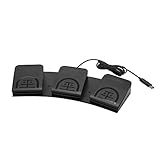
This is the do-everything option for gamers who want three distinct foot actions without breaking the bank. The triple layout works well for sprint, crouch, and reload in FPS titles, or for assigning push-to-talk, mute, and channel switch in a streaming setup.
- Pro: Three independent keys mapped as HID inputs, so no driver conflicts with your existing keyboard software.
- Pro: Rubber base feet keep the unit anchored even on smooth flooring.
- Con: The plastic housing flexes slightly under heavy-footed presses, which can cause a faint creak.
Skip this one if you only need a single action and want the lowest possible footprint on your floor.
iKKEGOL Triple Pedal (Mechanical)
The mechanical switch variant targets transcriptionists and musicians first, gamers second. The clickier actuation gives tactile confirmation that a press registered, which reduces the double-press anxiety that plagues membrane-style pedals during long work sessions.
- Pro: Mechanical switches deliver a crisp, consistent actuation point across all three pedals.
- Pro: Well-suited to non-gaming workflows like audio editing and page turning.
- Con: The audible click may annoy you in a shared space or during late-night recording sessions.
Skip if you value silence over tactile feedback or plan to use it only for quick in-game actions.
iKKEGOL Single Pedal (Compact)
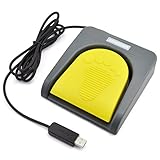
At $16.99 with a 2-meter cable, this is the entry point for anyone testing whether a foot pedal solves their workflow problem. One key, one action, zero setup complexity. The long cable means you can route it cleanly under a desk without extension adapters.
- Pro: The lowest price in this roundup makes it a risk-free experiment.
- Pro: 2-meter cable provides generous routing flexibility for desk-height mismatches.
- Con: Single key limits you to one binding unless you run multiple units simultaneously.
Skip if you need more than one assignable action and do not want to juggle two separate pedals.
iKKEGOL Double Pedal
Two pedals, plug-and-play, no software. This configuration maps naturally to flight sim setups where you need rudder or throttle control without a dedicated yoke. Multimedia shortcuts also benefit from the split layout.
- Pro: Free-drive design means zero setup time on any operating system.
- Pro: Compact enough to sit beside a mouse pad without crowding your desk edge.
- Con: The base has limited mass, so aggressive foot taps can shift it on hard floors.
Skip if you need three or more distinct actions and would prefer a single unified unit over chaining pedals.
iKKEGOL Single Pedal
Another single-key option, positioned at $26.99, that offers a slightly different physical footprint than the compact variant. It works best as a dedicated push-to-talk or voice-chat mute switch where you want one reliable action and nothing else competing for attention.
- Pro: Simplest possible assignment workflow with HID-based mapping.
- Pro: Comfortable pedal travel for users with larger feet who find compact pedals cramped.
- Con: Priced noticeably higher than the compact single-pedal option despite offering one fewer meter of cable length.
Skip if you found the compact single pedal at $16.99 and it met your cable-length requirement.
iKKEGOL Triple Pedal (Upgraded)
Marketed as an upgraded triple footswitch, this unit positions itself squarely at gamers and transcribers who want hands-free hotkey access. The three-pedal layout mirrors the standard triple model but ships at $37.99, a dollar less than the mechanical variant.
- Pro: Strongest value in the triple-pedal tier at under $38.
- Pro: Programmable via any HID-compatible software, from Steam to AutoHotkey to OBS.
- Con: The “upgraded” label is vague; physically it feels nearly identical to the standard triple model.
Skip if the mechanical or optical variant’s specific switch feel is what you actually need rather than the price point.
iKKEGOL Triple Pedal (Optical)
Optical switches promise faster actuation because they trigger on light interruption rather than physical contact. For gamers who care about input latency measured in single-digit milliseconds, this is the most interesting model in the lineup.
- Pro: Optical actuation reduces debounce issues that plague mechanical and membrane switches over time.
- Pro: Quieter than the mechanical variant while still offering a defined actuation point.
- Con: The practical latency gain over the other triple models is negligible for most gaming scenarios.
Skip if you play turn-based or strategy titles where sub-frame input differences do not affect outcomes.
iKKEGOL Double Pedal (Black)
The black-finish double pedal is functionally identical to the standard double model but appeals to users who care about aesthetic consistency with a dark-themed desk setup. At $37.99, it matches the pricing of most multi-key options in this group.
- Pro: Clean black housing blends with modern peripherals without looking like a budget accessory.
- Pro: Two-key layout is sufficient for the most common gaming foot bindings (sprint plus crouch, or PTT plus mute).
- Con: No cable-length advantage over cheaper single-pedal options, making it feel like a style tax.
Skip if you already own the standard double pedal or if color does not matter to your setup.
Buying Guide
Switch Type Determines Feel and Longevity
Membrane switches are the cheapest but develop inconsistent actuation points after months of heavy use. Mechanical switches give crisp tactile feedback and last longer but produce audible clicks. Optical switches occupy the middle ground: defined actuation with less wear than contact-based designs. If you will press the pedal hundreds of times per session, switch type is the most consequential spec after pedal count.
Base Stability and Weight Matter More Than You Expect
A pedal that slides during a press is a pedal you will stop using. Look for rubber feet, sufficient base mass, and a low center of gravity. If your floor is hardwood or tile, add a small non-slip mat under the unit regardless of what the pedal itself offers. Carpet provides natural grip but can muffle actuation on lighter models.
Cable Routing and HID Compatibility Define Your Setup Experience
Longer cables give placement freedom but introduce slack management. Most iKKEGOL units use standard USB-A connectors, so a quality extension or hub solves routing problems cheaply. Because these pedals register as generic HID keyboards, you can assign them in Steam, Discord, OBS, or any software that accepts keyboard inputs. No proprietary driver means no background resource usage and no conflicts with your mouse or keyboard software.
Our Verdict
The iKKEGOL Triple Pedal (Standard) at $39.99 is our top pick for most gamers. Three keys at the lowest triple-pedal price, HID mapping that works everywhere, and a stable base make it the best balance of capability and cost. The budget pick is the compact single pedal at $16.99: for push-to-talk or one dedicated action, nothing in this list beats that price. However, if you specifically need tactile confirmation for transcription or music work and can tolerate the click, the Mechanical triple pedal earns its place over the standard model despite the identical $39.99 cost.
FAQ
Do I need to install software for these pedals?
No. All eight models are recognized as HID devices by Windows, macOS, and Linux without any drivers. You assign their key outputs through whatever software you already use, whether that is a game’s native binding menu, Steam Input, or a utility like AutoHotkey.
Can I use multiple iKKEGOL pedals at the same time?
Yes. Each unit registers as a separate keyboard device, so you can plug in a single pedal for push-to-talk and a triple pedal for sprint, crouch, and reload without conflicts. Your operating system and game software will see them as independent key sources.
Are these pedals suitable for competitive FPS play?
They can be, depending on the game and your tolerance for foot-based input. The latency difference between the optical and other models is measured in fractions of a millisecond, which is below the threshold most players can perceive. The real question is whether binding a critical action to your foot interferes with your movement comfort over a full session.
What happens if the pedal actuates unintentionally?
This is a common concern with foot peripherals, especially during chair adjustments or leg crossing. The higher-pedestal models in this lineup require deliberate downward force, reducing false triggers. If you are sensitive to accidental presses, position the pedal so your resting foot position does not contact the actuator, or use the compact single pedal as a low-profile solution that is harder to hit by mistake.

