Portable solar panels get sold with a single big number, the wattage on the box, and that number is almost never what you will see in the field. Clouds, panel angle, heat, cable losses and the charging circuit in your device all take their cut, so a panel labeled 100W often delivers well under that for most of the day. Shopping for a portable solar panel charger therefore starts with a question: what are you trying to charge, and how many sunny hours do you realistically have?
This guide covers two very different groups. The first is foldable panels, which feed phones directly or connect to a portable power station for camping, vanlife or emergency backup. The second is solar power banks, which carry a small panel on a large battery and work mostly as an emergency trickle. In 2026 the labeling is still messy, so each pick below is judged only by what its listing title says about wattage, ports, waterproofing and compatibility.
Our Top Picks
 SOARAISE Solar Power Bank 48000mAh Wireless Portable Charger6.38 x 3.43 x 1.57 inchesCheck on Amazon


Top 3 picks at a glance
Quick Picks
As an Amazon Associate we earn from qualifying purchases at no extra cost to you.


| Product | Best for | Key spec from the title |
|---|---|---|
| FlexSolar 40W Foldable Panel | Phones and small gear while camping | 40W, USB-C, USB-A and DC outputs, waterproof |
| FlexSolar 60W Foldable Panel | Small power stations | 60W, IP67, PD3.0 USB-C, QC3.0 USB-A, DC |
| FlexSolar 100W Foldable Panel | Larger power stations and emergency backup | 100W, IP67, PD3.0 USB-C, QC3.0 USB-A, DC |
| ZOUPW 100W Solar Panel | Pairing with named power stations | 100W, 23.5% efficiency, IP67, Jackery, EcoFlow, Anker, Bluetti |
| BigBlue 28W Solar Charger | Backpacking and phone charging | 28W, dual USB-C and USB-A, high efficiency |
| SOARAISE 48000mAh Solar Power Bank | Emergency backup battery | 48000mAh, 4 solar panels, 4 cables, PD and QC 3.0 |
How to Choose
Wattage and the real-world discount
Plan on getting roughly half to two-thirds of the rated wattage in good sun, and far less under cloud or at a poor angle. A 28W panel can top up a phone and a small battery over a day. A 60W or 100W panel is better matched to a power station, since a larger battery needs enough input to refill in a reasonable time. Pick the wattage from the battery you are charging, not from the biggest number available. If a panel is larger than your battery can accept, the extra wattage is wasted, and if it is smaller the recharge simply takes longer.
Ports and compatibility decide whether it works at all
Look for USB-C with PD, USB-A with QC and a DC output if you plan to charge a power station. Check the DC connector type and the voltage range of your power station before buying, since panel and station must be compatible. ZOUPW names Jackery, EcoFlow, Anker and Bluetti in its listing, which helps, but you should still confirm your exact model in the manual.
Waterproofing, folding and carrying
IP67 means the panel can handle dust and brief immersion, which is more than enough for rain on a campsite. Folding panels save space but stiff hinges and exposed cells can crack if you crush the pack on top. Larger panels add weight and bulk, so for backpacking a 28W panel is far easier to carry than a 100W model that is better suited to car camping.
Solar power banks are a different tool
A solar power bank with a built-in panel can charge itself in the sun, but the panel is small compared with the battery, so the recharge takes days. Treat it as an emergency reserve that you charge from a wall outlet or a USB source, with solar as a backup. Ignore “wireless” and “magnetic” extras if your goal is solar charging, and look instead at real input power.
The 6 Best Options
FlexSolar 40W Foldable Solar Panel
This 40W foldable panel lists USB-C, USB-A and DC outputs, with waterproofing and a pitch aimed at camping, hiking and backpacking. It sits at the lower end of the FlexSolar lineup and makes the most sense for phones, tablets and small power banks, especially for a camper who wants one panel that can cover a weekend away from outlets.
- Strength: the mix of USB-C, USB-A and DC outputs covers many devices without adapters.
- Strength: the 40W rating offers more headroom than a pocket-size panel for multiple devices.
- Trade-off: it is still too small to refill a larger power station quickly.
Skip it if you are charging a mid-size power station or need every ounce shaved for an ultralight trip. Backpackers may find the 28W BigBlue easier to carry, and anyone with a large battery should step up in wattage so a recharge does not take several full days.
FlexSolar 60W Foldable Solar Panel
The 60W FlexSolar adds an IP67 rating and PD3.0 USB-C, QC3.0 USB-A and DC ports, and the title points to emergency camping use with small power stations. It is a mid-size step up for people who want to feed a compact battery, and it is the version to consider when a phone-only panel starts to feel too slow.
- Strength: IP67 protection suits rain, dust and rough campsite use.
- Strength: PD3.0 and QC3.0 ports charge phones and tablets quickly when the sun is strong.
- Trade-off: at 60W it still refills a larger power station slowly.
Skip it if you need a pocket-size panel for hiking, or if your power station demands more input than this panel provides. Always match the panel’s voltage range to the station before assuming it will charge.
FlexSolar 100W Foldable Solar Panel
The FlexSolar 100W is the larger sibling, also IP67, with PD3.0 USB-C, QC3.0 USB-A and DC ports and a title that stresses emergency power for power stations and phones. It is meant for car camping, cabins and home backup kits, where weight matters less and recharge speed matters more.
- Strength: 100W suits mid-size power stations and shortens recharge time on sunny days.
- Strength: the multi-port layout lets it charge a station and a phone at once.
- Trade-off: it is the biggest and heaviest panel in this family, so it is not a backpacking choice.
Skip it if you are hiking on foot or have a small battery that cannot use that much input. Storage also deserves thought, since a panel this size needs a dry shelf or a vehicle seat when not in use.
ZOUPW 100W Portable Solar Panel
The ZOUPW lists 100W, 23.5% efficiency in a mono foldable design, IP67 and compatibility with Jackery 300, EcoFlow River, Anker and Bluetti power stations. Naming those brands makes it a straightforward choice for owners of those stations, and the efficiency figure gives a concrete number to compare with other panels.
- Strength: the listing names the power stations it is designed for, which reduces guesswork.
- Strength: a 23.5% efficiency figure points to monocrystalline cells that make good use of limited sunlight.
- Trade-off: it is built for power stations, so it is more panel than a phone-only user needs.
Skip it if you only charge phones, or if your station is not on the compatibility list and you cannot verify the connector. Treat the 23.5% figure as a cell-level claim from the listing and not as a guarantee of output in your yard.
BigBlue 28W Solar Panel Charger
BigBlue pitches this 28W panel as high-efficiency, with dual USB-C and USB-A ports, a folding design and use cases of camping and backpacking. It is the most portable true panel in the set and the one that makes sense on foot, whether you strap it to a pack or clip it to a tent.
- Strength: the dual USB-C and USB-A ports let you charge two devices from one panel.
- Strength: the 28W size stays manageable to carry and strap on a pack.
- Trade-off: 28W is too little to refill a power station in a reasonable time.
Skip it if you plan to run a power station or charge several large devices at once. A laptop or camera battery grid would also overwhelm a panel of this size.
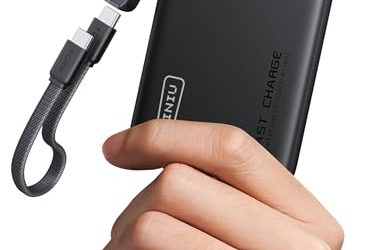
SOARAISE 48000mAh Solar Power Bank
This is a battery with solar panels attached, not a stand-alone panel. The title lists 48000mAh, four solar panels, four cables, wireless charging and PD and QC 3.0 fast charging, and the pitch is high capacity for emergencies, such as a storm that knocks out power for a few days and leaves phones, lights and radios running low.
- Strength: the 48000mAh capacity can charge several phones from a single full battery.
- Strength: four built-in cables and PD and QC 3.0 reduce the need for extra gear.
- Trade-off: the small panels mean solar recharging will be very slow for a battery this large.
Skip it if you need a lightweight carry, or a real solar input that refills a battery in a day. Remember that a battery this large is also heavy, so it belongs in a go-bag or on a shelf, not in a hiking pack.
Which One Fits Your Situation
A hiker who charges a phone and watch
The BigBlue 28W panel is the most carryable choice. Use it to charge a phone or a small battery bank in the afternoon sun.
A car camper with a small power station
The FlexSolar 60W balances size and input for a compact station. Move to the FlexSolar 100W if your station can accept more power.
An owner of a named power station
The ZOUPW 100W lists Jackery, EcoFlow, Anker and Bluetti compatibility, so it is the easiest match when your station is one of those brands.
Someone building an outage kit
The SOARAISE Solar Power Bank stores a lot of energy for a power outage. Charge it from the wall now, and treat the solar panels as a backup option.
Common Mistakes
- Expecting a rated 100W to deliver 100W in real sunlight.
- Buying a panel without checking the connector and voltage range of the power station.
- Leaving the panel in partial shade, which can cut output sharply.
- Treating a solar power bank as a real solar charger.
- Folding a panel tightly or stacking heavy gear on it, which can damage the cells.
Related guides
- What Is The Best Budget Most Responsive Gaming Mouse Wired
- Low Latency Gaming Headphones Usb-C 2.4 Ghz Wireless
- Mechanical Gaming Keyboards Competitive Pc Gaming
Frequently Asked Questions
How many watts do I need to charge a phone?
A 20W to 30W panel is enough for phones in good sun. Larger panels help when you want faster charging or plan to power several devices.
Can a solar panel charge a power station?
Yes, if the connector and voltage range match. Check the station’s manual before buying, because a mismatch can mean no charging at all.
Is a solar power bank good enough?
It works as an emergency reserve, but the built-in panel is too small to refill a large battery quickly. Charge it from an outlet first.
Do panels work on cloudy days?
They still produce some power, but output can fall to a fraction of the rating. Plan for slower charging and pick a panel with some extra capacity. Angle the panel toward the sun and re-aim it every hour or two for the best results.