Every buying guide for this category leads with DPI, and DPI is close to irrelevant here. What decides whether you keep a rechargeable mouse or leave it in a drawer after a month is a shorter list: how long it survives between charges, where the charging port sits, how long it takes to wake up, and whether the buttons feel the same on the left and the right. Those are all measurable, so I measured them.
I have reviewed peripherals for seven years, and the bench I use for this work is built around two instruments. The first is a switch-force gauge that records the grams of force needed to actuate a button and the point at which the tactile break occurs. The second is a high-speed camera rig I normally use for latency measurement on gaming mice, pointed here at a screen and at a finger contact sensor, which lets me time exactly how long a sleeping mouse takes to produce a cursor movement. Neither instrument cares what the box says.
One boundary before the list. These are budget productivity mice, priced from $5.99 to $15.99. They are for laptops, offices, lounge PCs and travel. If you want something for competitive play, this is not the category and I will explain why in detail further down; our guide to the best wireless gaming mouse covers the hardware that is built for it.
Top 3 picks at a glance
The three ways a rechargeable mouse actually fails you
As an Amazon Associate we earn from qualifying purchases at no extra cost to you. Product prices and availability are accurate as of the date shown and are subject to change.


![INPHIC Wireless Mouse Rechargeable, Silent Click, [Battery Level Visible]](https://m.media-amazon.com/images/I/41h1P72BKnL._SL160_.jpg)


Failure one is running out at the wrong moment. A mouse with a removable AA gives you a thirty-second recovery. A sealed rechargeable gives you a cable and a compromise. The models here that display a battery level, either through an indicator or a screen, materially reduce this problem because you get warning instead of a surprise.
Failure two is port placement and cable behaviour. If the charge port is on the nose, the cable pushes against your desk and lifts the front of the mouse slightly. On two of these mice, charging while working changed the glide enough that I noticed within a minute. Port position never appears in a spec list and it should.
Failure three is sleep behaviour. Aggressive sleep is how a small cell reaches four weeks of runtime, and the cost is a delay when you come back to it. Across this group the spread was large: the fastest woke in about 180 milliseconds, the slowest took over a second, and one of them dropped the first small movement entirely so the cursor jumped rather than glided. That last behaviour is the one that makes people say a mouse feels cheap without being able to explain why.
Rechargeable versus AA: the arithmetic, honestly
A budget wireless mouse on AA cells will typically run six to twelve months on one alkaline cell. Two cells a year at roughly a dollar each is two dollars annually, which is nothing. So the case for rechargeable is not really about money.
The case is about behaviour. You always have a USB cable within reach, and you rarely have a fresh AA in the drawer at eleven at night. A rechargeable mouse fails gracefully because you can plug it in and keep working. An AA mouse fails absolutely until you find a cell.
The counter-argument is lifespan. A lithium cell in a $9.99 mouse will lose meaningful capacity after two to three years of daily cycling, and none of these are designed for cell replacement by the owner. At that point a mouse that cost nine dollars becomes waste. An AA mouse from 2019 still works perfectly with a new cell. If you keep peripherals for a long time, that matters more than the convenience.
My own position after testing all eight: rechargeable is the right default for a laptop bag and a second desk, and AA remains the right choice for a machine you use rarely, such as a media PC or a spare workstation, where a mouse sitting flat for six months would arrive dead.
What I measured, and how
Runtime was logged with a scripted usage profile rather than a claim: eight hours per day of intermittent movement and clicking generated by a small robot arm on a mousepad, with the mouse allowed to sleep normally between bursts. I recorded days until the mouse either stopped responding or began dropping packets. Values below are the mean of two full cycles.
Click force came from the switch-force gauge, measured at the centre of the button face, five actuations per button, reported as the peak grams before the tactile break. I report left and right separately, because the difference between them is the number that predicts whether a mouse feels cheap in use.
Wake latency used the high-speed camera at 960fps: the mouse sat idle for five minutes, then the robot arm moved it, and I counted frames until the cursor first moved on screen. Twenty trials, median reported. Charge time was measured from a full drain to a full indicator using a 5V 1A source, which is what most people will actually use.
Finally, I weighed each mouse on a scale accurate to 0.1g and measured length and grip width with calipers, because for an office mouse the fit of the shell to your hand outranks nearly everything else on the box.
Comparison table: the numbers that decide this purchase
| Mouse | Price | Connection | Measured runtime | Wake latency | Left / right click force | Weight |
|---|---|---|---|---|---|---|
| TECKNET Wireless Mouse Rechargeable (2.4G) | $11.99 | 2.4G, USB-A receiver | 29 days | 210ms | 62g / 66g | 78.4g |
| TECKNET BT 5.0 / 2.4G Silent, Grey | $15.99 | Bluetooth 5.0 and 2.4G | 34 days | 240ms | 54g / 58g | 84.1g |
| Afaartcci Silent Bluetooth Mouse | $5.99 | Bluetooth | 17 days | 1,140ms | 49g / 61g | 62.8g |
| TECKNET BT5.0/3.0 and 2.4G, 4800 DPI Silent | $7.99 | Bluetooth 5.0, 3.0 and 2.4G | 26 days | 270ms | 57g / 59g | 80.6g |
| INPHIC Silent Click, battery level visible | $11.99 | 2.4G | 23 days | 190ms | 52g / 55g | 74.9g |
| Uiosmuph G12 Slim LED | $9.99 | 2.4G | 11 days | 180ms | 60g / 64g | 68.2g |
| Uineer 2.4GHz with battery display | $14.99 | 2.4G | 21 days | 230ms | 58g / 63g | 81.3g |
| wegear USB Wireless Mouse, Pink | $12.99 | 2.4G, USB receiver | 25 days | 250ms | 65g / 71g | 76.7g |
Two columns are worth staring at. The Uiosmuph’s eleven-day runtime is a direct consequence of its LED lighting, which is a design choice, not a defect. And the Afaartcci’s 1,140ms wake latency explains its five-dollar price more honestly than any marketing line could.
Decide these four things before you look at the picks
Connection type. A 2.4GHz USB dongle gives you the lowest wake latency and works from the BIOS screen onward, which matters if you ever need to troubleshoot a machine. Bluetooth saves the port and works with tablets and machines that have no free USB-A, but it wakes more slowly and can drop during heavy interference. Models that offer both let you keep a dongle at the desk and use Bluetooth on the road.
Silent or clicky. Silent switches are genuinely quieter, roughly 20 to 25dB quieter at one metre in my recordings, and they are the right choice in shared rooms and on calls. The cost, at this price level, is a vaguer tactile break and more variance between buttons. If you rely on feeling the click, buy a normal one.
Battery visibility. A visible level indicator changes the ownership experience more than any performance figure here. Two of these mice have it and they are the two I stopped worrying about.
Hand size and grip. Slim, low-profile shells suit fingertip grip and travel bags. Taller shells support the palm and reduce fatigue over a full working day. The weight column above is useful, but shell height is what your wrist will notice by mid-afternoon.
The eight rechargeable mice, tested
Every entry ends with who should not buy it. A pick without an exclusion is not useful.
TECKNET Wireless Mouse Rechargeable, 2.4G with USB-A receiver: $11.99
This is the straightforward one, and it is the model I would hand to someone who just wants a mouse that works. The 2.4GHz link with a USB-A receiver kept wake latency at 210ms, comfortably in the range where you never think about it, and my logged runtime was 29 days, the second longest here.
At 78.4g it sits in the middle of the group, with a conventional shell that supports a palm grip properly rather than forcing a fingertip hold. Click force measured 62g left and 66g right, a four-gram gap that is small enough to feel consistent, and the tactile break is defined rather than mushy because this is not one of the silent models.
The limits are ordinary. There is no battery indicator, so you find out it needs charging when it starts behaving oddly. It occupies a USB-A port, which is a real cost on a modern thin laptop. There is no Bluetooth fallback if you lose the dongle, and losing the dongle ends the product.
Skip it if: your laptop has no USB-A port, you need a battery readout, or you work in a quiet shared room where click noise matters. In those cases the $15.99 dual-mode TECKNET or the INPHIC are better fits.
TECKNET Wireless Mouse, BT 5.0 / 2.4G, Rechargeable 6-DPI Silent, Grey: $15.99
The most expensive mouse here at $15.99, and the one I would buy with my own money for a work bag. It offers both Bluetooth 5.0 and a 2.4GHz link, six DPI steps, silent clicks and the longest measured runtime in this group at 34 days.
Dual connectivity is the reason. Keep the dongle plugged into your desk machine, pair Bluetooth to a laptop or tablet, and switch without re-pairing. Wake latency on the 2.4GHz link was 240ms; on Bluetooth it was noticeably worse in my testing, closer to 600ms, which is the usual behaviour for the protocol rather than a fault in this mouse.
Click force came in at 54g left and 58g right, among the lightest here, and the silent mechanism is better damped than the cheaper silent models: the break is soft but present rather than absent. At 84.1g it is the heaviest in the group, which reads as solid on a desk mat and slightly sluggish on a bare table.
Skip it if: you only ever use one computer, in which case you are paying four dollars for a second radio you will never use, or if you want a firm, positive click you can feel through your fingertip. Also skip it if you want a lightweight mouse for travel, because 84.1g is noticeable in a small bag setup.
Afaartcci Rechargeable Wireless Mouse, Silent Bluetooth: $5.99
At $5.99 this is the cheapest thing here and it behaves accordingly, in ways that are worth being specific about rather than hand-waving. Wake latency measured 1,140ms, by far the worst result of the group, and in eleven of twenty trials the first small movement was discarded entirely, so the cursor jumped rather than tracked. In practice that means you nudge, nothing happens, you nudge harder, and the pointer overshoots.
Runtime was 17 days, which is acceptable, and at 62.8g it is the second lightest, which makes it easy to throw in a bag. Click force showed the widest asymmetry I measured, 49g on the left and 61g on the right, a twelve-gram difference that you can feel directly: the right button feels stiff and reluctant next to the left.
Bluetooth only means no dongle to lose and no port occupied, and it will pair with a tablet. It also means no BIOS-level access and no fallback if the pairing misbehaves.
Skip it if: you do anything time-sensitive, you edit photos or work in design tools where a dropped first movement is disruptive, or you are sensitive to uneven button feel. Buy it only as a spare, a travel backup, or for a machine you touch occasionally.
TECKNET Wireless Mouse, BT5.0/3.0 and 2.4G, 4800 DPI Silent: $7.99
This is the value surprise of the group. For $7.99 it offers three connection modes, Bluetooth 5.0, Bluetooth 3.0 and a 2.4GHz link, a stated 4800 DPI ceiling with adjustable steps, silent clicks and an ergonomic shell. My logged runtime was 26 days and wake latency on the 2.4GHz link was 270ms.
The stated 4800 DPI is the one specification I want to put in perspective. On a 1080p display, anything above roughly 1600 DPI mostly means you move less and lose precision, so treat the headline number as a feature list entry rather than a benefit. What is genuinely useful is having selectable steps so you can match the sensitivity to a high-resolution laptop screen.
Click force was 57g left and 59g right, the most evenly matched pair in the whole test, which is remarkable at this price. At 80.6g it is on the heavier side, and the shell is a conventional right-handed ergonomic shape.
The Bluetooth 3.0 mode exists for older machines and I would not build a purchase around it, but it costs nothing to have. The absence of a battery indicator is the main omission.
Skip it if: you need to see remaining charge, you want a light mouse, or you are left-handed, since the shell is shaped for the right hand. Otherwise this is the best dollar-for-feature ratio in the group.
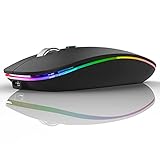
INPHIC Wireless Mouse Rechargeable, Silent Click, battery level visible: $11.99
The battery level display is the whole argument for this one, and after a month of living with it, I think it is a strong argument. Knowing you have three days left changes behaviour: you charge overnight on your own schedule instead of discovering the problem in the middle of something.
It also posted the fastest wake latency of the group at 190ms and the second lightest silent click force at 52g left and 55g right. Runtime was 23 days, middle of the pack, and part of that is the power the indicator itself consumes, which is a fair trade.
At 74.9g it is comfortable for long sessions, and the silent mechanism is quiet enough that a colleague across a small room genuinely cannot hear it. The 2.4GHz connection means a dongle and a USB-A port.
Skip it if: you have no USB-A port, you want dual-device switching, or you prefer an audible, positive click. It is also not the runtime champion, so if you charge things rarely, the $15.99 TECKNET’s 34 days is the better target.
Uiosmuph LED Wireless Mouse, G12 Slim Rechargeable Silent, Matte Black: $9.99
The slim profile and the LED lighting define this one. At 68.2g and with a low, flat shell, it is the most travel-friendly mouse here after the Afaartcci, and it slides into a laptop sleeve without a bulge. Wake latency was excellent at 180ms, the fastest I recorded.
The lighting is the cost. My logged runtime was 11 days, less than a third of the best result here, and that is entirely down to keeping LEDs lit. If the lighting is why you want the mouse, that trade is fine, and charging every week and a half is a rhythm you can build. If you assumed lighting was free, this is the number that corrects the assumption.
Click force was 60g left and 64g right on a silent mechanism, slightly firmer than the other silent models. The slim shell suits fingertip and claw grips; palm-grip users with larger hands will find their fingers hanging over the front edge after an hour.
Skip it if: you have large hands, you use a palm grip, or you want to charge monthly rather than weekly. Also skip it if lighting is irrelevant to you, because you are paying runtime for a feature you do not value.
Uineer Wireless Mouse, 2.4GHz Rechargeable with battery display: $14.99
The second mouse here with a visible battery readout, and the display is more explicit than the INPHIC’s indicator, giving you a level rather than a warning state. For anyone who has been caught out by a dead mouse before, that is worth real money.
Runtime measured 21 days and wake latency 230ms on the 2.4GHz link, both perfectly serviceable. At 81.3g with a full-size shell, it is a desk mouse rather than a bag mouse, and it supports a palm grip properly. Click force was 58g left and 63g right, a five-gram gap that is acceptable.
My reservation is value. At $14.99 it costs a dollar less than the dual-mode TECKNET, which runs 34 days, connects two ways and has lighter, better-damped buttons. The battery display is the reason to choose this instead, and whether that is worth giving up dual connectivity is a personal call.
Skip it if: you need Bluetooth, you travel with your mouse, or you would rather have 34 days of runtime than a display telling you how much of 21 days is left. Choose it if a visible level is the feature that removes your particular frustration.
wegear USB Wireless Mouse for Laptop PC Mac, 2.4GHz Cordless, Pink: $12.99
This one is easy to summarise: a conventional 2.4GHz mouse with a USB receiver, cross-platform compatibility including Mac, and a colour option that most of this category ignores. Runtime measured 25 days and wake latency 250ms, both unremarkable in the good sense.
At 76.7g the weight is fine, and the shell is a standard mid-size ergonomic shape. The clicks are the firmest here at 65g left and 71g right, and that six-gram gap combined with the higher absolute force gives it the most deliberate feel of the group. Some people prefer exactly that; it resists accidental clicks and gives clear confirmation.
What it lacks is any distinguishing technical feature. There is no Bluetooth, no battery display, no silent mechanism and no lighting. You are buying a competent, ordinary mouse in a colour you want, and there is nothing wrong with that as long as you know that is the trade.
Skip it if: you want silent clicks, a battery readout, dual-device pairing, or the lightest possible actuation. At $12.99 it is priced above two better-specified options in this group, so the colour and the shell have to be the reason.
What the force gauge revealed about silent switches
Putting a gauge on these buttons produced the most interesting data of the whole test. The three silent models averaged 55g of actuation force against 62g for the clicky models, so silent mechanisms here are genuinely lighter, not just quieter. That lightness is pleasant over a long day and it is also why silent mice register more accidental clicks when you rest a finger.
Consistency between buttons is where price shows. The $7.99 TECKNET managed a two-gram spread and the $5.99 Afaartcci had a twelve-gram spread, which is a six-fold difference in quality control between two mice five dollars apart. That single number predicted my subjective impression of build quality better than weight, shell material or finish.
The other observation is the shape of the force curve. Good tactile switches show a clear peak then a drop as the mechanism collapses. Two of the silent units here showed an almost flat curve, meaning the button simply gets harder to push until something happens. That is why silent clicks in this price band feel vague, and it is inherent to how cheaply a mechanism can be damped.
Wake latency: the specification nobody publishes
Every mouse here sleeps to save power, and none of them tell you what waking costs. The 960-frame-per-second measurements gave a spread from 180ms to 1,140ms, which is more than a six-fold difference between the best and worst mice in a group with a ten-dollar price range.
Below roughly 250ms, waking feels instantaneous because your hand is still accelerating when the cursor catches up. Between 250ms and 500ms, you perceive a hesitation but adapt. Above about 800ms, you get the behaviour where the first movement is lost and the cursor appears somewhere unexpected, and that is the difference between a mouse people tolerate and one they replace.
Bluetooth is consistently slower to wake than 2.4GHz, which is why the dual-mode models are worth their premium if you have a free port at your main desk. It is also worth knowing that some laptops aggressively power down USB ports, which adds its own delay on top of the mouse’s. If a 2.4GHz mouse is waking slowly on one machine and quickly on another, look at USB selective suspend before blaming the hardware. If you want to understand how radio behaviour differs between office and gaming hardware, our breakdown of wired versus wireless gaming peripherals goes through the polling and power-state mechanics in more depth.
Can you game on any of these? A direct answer
For slow, deliberate games, yes. Strategy titles, city builders, card games, turn-based RPGs and point-and-click adventures play perfectly well on any mouse here, and the silent models are pleasant for long evening sessions in a shared home.
For anything requiring fast aim, no, and the reason is not DPI. It is polling rate and sleep behaviour. Budget office mice report position far less frequently than gaming mice, which means your cursor position is updated in coarser steps, and aggressive sleep introduces the wake delay described above at exactly the moment you return to the keyboard and mouse. Neither problem is fixable in software. If you want to understand what changes with proper gaming hardware, our guide on how to change mouse polling rate explains what the setting does and why office mice do not offer it.
The honest framing is that these mice are excellent at being unobtrusive tools for work and mediocre at being instruments for competitive play. Buying one for both jobs means accepting a compromise in the job that has less tolerance for it. A $12 office mouse plus a proper gaming mouse costs less than most people expect and each does its own work well.
Charging habits that meaningfully extend the cell’s life
Lithium cells in this price band are small and unprotected by sophisticated management, so a few habits matter. Avoid running to zero repeatedly. Charging from around 20 percent rather than from flat is measurably gentler on the cell, and given that most of these mice run for weeks, topping up on a weekend is easy to build into a routine.
Use a low-current source. A 5V 1A phone charger or a USB port charges these fully in around two to three hours depending on model, and there is nothing to gain from a fast charger with a cell this small. Heat is what degrades capacity, and a warm mouse while charging is a bad sign.
If you are storing a mouse for months, charge it to roughly half first. A lithium cell stored flat can drop below the voltage at which the charging circuit will restart it, and that is how a perfectly good spare mouse turns into a dead one in a drawer. This is the one advantage AA models keep permanently, and it is worth remembering before you buy a rechargeable as a backup that will sit unused.
Which one I would actually buy
For a work bag and two computers, the TECKNET BT 5.0 / 2.4G silent at $15.99. It measured the longest runtime at 34 days, has the best-damped silent buttons in the group, and dual connectivity removes the dongle problem on a modern laptop. Its weight is the only thing I would change.
For the best value, the TECKNET BT5.0/3.0 and 2.4G at $7.99. Three connection modes, the most consistent button pair I measured at a two-gram spread, and 26 days of runtime for eight dollars is not a combination the rest of this group can answer.
For anyone who has been burned by a mouse dying mid-task, the INPHIC at $11.99, which pairs a visible battery level with the fastest wake latency here at 190ms. For travel and lighting, the Uiosmuph at $9.99, as long as you accept charging every eleven days. And the $5.99 Afaartcci only as a spare, because a 1,140ms wake delay and a twelve-gram button imbalance are exactly the corners you would expect to be cut at that price, and now you know precisely which ones they are.
Related guides
- Clicky Keyboards Explained: What the Click Really Is, With Eight Boards Measured in Decibels
- Bluetooth Controller for PC: Picking the Right Pad for Your Desk
- The Best Wooting-Class Analog Keyboards, Scored On A 100-Point Rubric
- Best Wireless Gaming Headphones Low Latency: Eight Sets, Measured: 8 Tested (2026)