
The best resin 3D printers for detailed models in 2026 are the Elegoo Saturn 4 Ultra for most hobbyists, the Anycubic Photon Mono M7 Pro for fast high-resolution printing, and the Elegoo Mars 5 Ultra for compact, lower-cost workspaces.
Resolution is only part of the decision. A printer with a very fine XY pixel size can still produce disappointing miniatures if its exposure settings, screen uniformity, Z-axis stability, resin profile, washing process, or support placement are poor. The table below compares the practical trade-offs that matter when printing gaming miniatures, display figures, terrain accessories, and small mechanical parts.
| Printer | Approx. XY resolution | Build volume | Best suited to | Typical market range |
|---|---|---|---|---|
| Elegoo Mars 5 Ultra | About 18 microns | Approximately 153 × 77 × 165 mm | Small figures, miniatures, and first resin printer | Usually $200–$300 |
| Elegoo Saturn 4 Ultra | About 19 × 24 microns, depending on model specification | Approximately 218 × 122 × 220 mm | Multiple miniatures and larger character models | Usually $400–$600 |
| Anycubic Photon Mono M7 Pro | About 14K-class detail, roughly 16.8 microns | Approximately 223 × 126 × 230 mm | High-detail production and faster batch printing | Usually $500–$700 |
| Phrozen Sonic Mighty Revo 14K | About 16.8 microns | Approximately 223 × 126 × 235 mm | Large batches and detailed display pieces | Usually $600–$800 |
Build dimensions and prices can vary by region, bundle, and revision. “14K” or “16K” describes the screen’s pixel count, not a guarantee that every feature on a model will be visibly sharper.
As an Amazon Associate we earn from qualifying purchases at no extra cost to you.
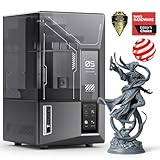

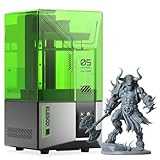

Top 3 picks at a glance
Best overall: Elegoo Saturn 4 Ultra
The Saturn 4 Ultra is the strongest all-round choice for detailed gaming models because it combines a large build area with fine resolution and a relatively beginner-friendly workflow. Its volume is large enough for several 28–32 mm miniatures in one job, a large bust, or a character model split into fewer pieces than would be necessary on a compact printer.
Its principal advantage is not merely the nominal pixel size. The larger platform lets you arrange a complete squad or several replacement parts together, reducing the number of print cycles and the amount of repeated setup. A printer that produces six miniatures in one run can be more useful than a slightly sharper machine that handles only two or three.
Choose it if your workspace can accommodate a larger enclosure and you expect to print regularly. For occasional single-miniature projects, its extra capacity may not justify the higher purchase price, resin consumption, and cleaning equipment.
Best for maximum detail and speed: Anycubic Photon Mono M7 Pro
The Photon Mono M7 Pro targets users who want high pixel density without moving to a much more expensive professional system. Its 14K-class monochrome screen is well suited to facial details, armor panel lines, texture on cloaks, and small mechanical components.
It is also a sensible choice for batch printing. High-speed resin and optimized exposure profiles can reduce cycle time, but speed depends on layer height, lift settings, resin viscosity, model geometry, and how aggressively the printer moves. A manufacturer’s maximum speed should not be treated as the normal setting for every resin.
The M7 Pro makes the most sense when you already understand support placement and can maintain a consistent resin profile. Beginners may spend more time correcting failed supports than they save through faster motion settings.
Best compact option: Elegoo Mars 5 Ultra
The Mars 5 Ultra is a good fit for a desk, small workshop, or first resin setup. Its smaller build volume is a limitation for large figures, but it remains generous for tabletop miniatures, busts printed in pieces, terrain details, and replacement components.
Compact printers also reduce the quantity of cleaning liquid needed for each session. The trade-off is throughput: a full army or a large collection of gaming accessories will require more batches. If you mostly print one to four highly detailed models at a time, the Mars 5 Ultra can deliver the relevant detail without paying for a larger machine.
When the Phrozen Sonic Mighty Revo 14K is worth considering
The Sonic Mighty Revo 14K is aimed at users who value a substantial build area, fine detail, and a more premium machine category. It is particularly attractive for display-scale models and repeated batch production where platform space has a direct effect on how many pieces can be printed per job.
Its higher purchase cost is easier to justify when the printer will run frequently. For occasional hobby use, the ongoing cost of resin, gloves, cleaning fluid, filters, and replacement release films matters more than a modest difference in advertised resolution.
Resolution: what you can actually see
XY resolution determines the approximate width of a pixel on the LCD mask. Layer height determines vertical detail. A printer may resolve extremely fine horizontal edges while still showing visible stair-stepping on a sloped surface if the layer height is too large.
- 50 microns: a practical starting point for terrain, larger figures, and fast prototypes.
- 35 microns: a good general-purpose setting for gaming miniatures.
- 20–25 microns: useful for faces, weapons, jewelry, and very fine surface features, but increases print time substantially.
- 15 microns: appropriate for exceptionally detailed pieces when the model and resin profile justify the extra time.
For example, reducing layer height from 50 to 25 microns roughly doubles the number of layers. A 100 mm-tall model needs about 2,000 layers at 50 microns, but about 4,000 at 25 microns. If each layer takes 3 seconds of exposure plus 5 seconds of lifting and settling, the estimated printing time rises from roughly 4.4 hours to 8.9 hours before accounting for transitions and delays. The finer setting improves vertical smoothness, but it does not automatically improve every small feature.
Odor control and workspace requirements
Resin printers need more than a cover placed on a desk. An enclosure can reduce the spread of odor, but it does not make uncured resin vapor harmless. Use ventilation that moves air outdoors where possible, keep resin containers closed, and avoid printing in bedrooms, food-preparation areas, or poorly ventilated living spaces.
Some printers include activated-carbon filtration or offer an optional exhaust accessory. These systems can reduce odor, but carbon filters are consumables and do not replace ventilation. Low-odor resin may be more comfortable, yet it still requires gloves, eye protection during handling, and proper disposal of contaminated wipes and liquid.
The printer is only one part of the setup. Plan space for a wash station, curing station, resin bottles, disposable towels, a silicone work mat, nitrile gloves, and a container for filtering used cleaning fluid.
Wash-and-cure workflow: the costs people underestimate
A dedicated wash-and-cure station is worth buying if you print more than occasionally. It makes the process more repeatable and reduces the chance of handling uncured parts under strong manual scrubbing.
- Remove the build plate carefully. Keep uncured resin on the plate and avoid scraping directly over an unprotected desk.
- Remove the model and supports. Removing supports before final curing is usually easier and reduces the risk of tearing delicate features.
- Wash the parts. Use resin-compatible cleaning fluid, commonly isopropyl alcohol or a manufacturer-approved alternative. Agitate the model enough to clear cavities and support marks.
- Rinse or perform a second clean wash. A dirty first bath can leave a sticky film. Two-stage washing extends the useful life of the cleaner in the final bath.
- Dry completely. Trapped solvent or water can produce a tacky surface or interfere with curing.
- Cure according to the resin profile. Start with the resin maker’s time rather than guessing. Thin parts often need less curing than thick parts, and excessive curing can make some resins brittle.
A rough consumables calculation helps compare printer sizes. If a 750 g bottle costs $25–$40 and a model plus supports uses 80 g, the raw resin cost is approximately $2.67–$4.27. Add perhaps $0.50–$2 for cleaning fluid, gloves, paper towels, filters, and failed-print allowance, and the practical cost may be closer to $3–$6 per model. Large bases and hollowed display pieces can consume far more resin unless drainage holes and wall thickness are planned correctly.
Decision matrix: which printer fits your situation?
| Your priority | Best direction | Why |
|---|---|---|
| Small desk and occasional miniatures | Elegoo Mars 5 Ultra | Lower entry cost, compact footprint, fine detail |
| Several tabletop models per batch | Elegoo Saturn 4 Ultra | More platform space without moving into specialist pricing |
| Fine detail plus high-throughput printing | Anycubic Photon Mono M7 Pro | High-resolution screen and speed-oriented features |
| Large display models and frequent production | Phrozen Sonic Mighty Revo 14K | Large detailed platform suited to repeated batches |
| Very limited ventilation | Do not buy until ventilation is solved | Filtration alone is not a substitute for safe workspace control |
Final buying advice
For most hobbyists, choose the Saturn 4 Ultra if you want room to grow, the Mars 5 Ultra if space and budget are tight, and the Photon Mono M7 Pro if speed and high-resolution production are central priorities. Budget for a wash-and-cure station, ventilation, protective equipment, replacement film, and cleaning supplies rather than spending the entire budget on the printer itself. The best resin 3D printers produce their finest results when the whole workflow—from support design to final cure—is treated as part of the machine.


